
Root Access — Chapter 23: Five Realities of Telemetry
"Nothing physical," I said.
I said it twice. The first time answered A1. The second time answered me, and the second time it came out sounding like the label on a box with something wrong inside it.
Pixel came in last, because Pixel finishes what she is holding before she answers a WHERE, and what she was holding was a crate of undelivered copies from the Wednesday run. She set it down the way you set down a row you are afraid to drop.
The table had the folder in the middle, the camera shot of Marrow's signed page beside it, and A1's reserve blend going cold at the far edge, where he puts things he intends to look at later. Om read the folder name and stayed on his feet. A1 parked at my left elbow with his display dimmed to the number he uses when he does not want a crowd reading over his shoulder. Luminara came in with the raid frames under her arm. Clive sat on his shelf with his light off, which is his version of leaning forward.
Meatball was asleep under the table with one paw out, doing the only thing in this building Corporate has never managed to log.
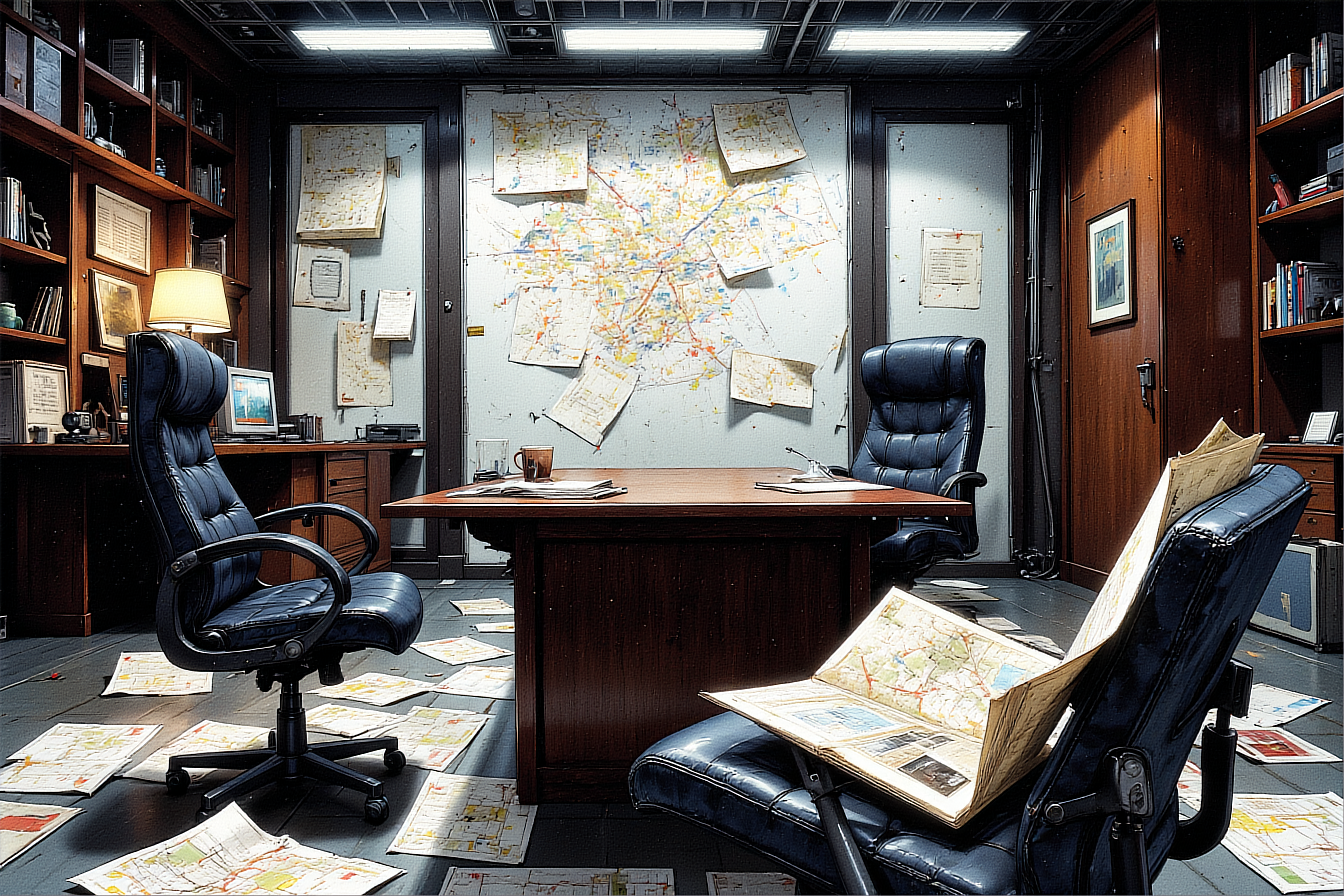
I cleared the wall first, and the clearing took longer than the speech. Six weeks of staple lines came down in sheets: route maps, Kofi's window, the Vega rows, Fenwick's signature scheme, four diff photos Luminara had shot through a van window at an angle. The press clacked while I worked and Meatball followed each sheet to the floor and chewed the corners. A blank wall in this room is a bad sign. They all knew it before I opened my mouth.
"Clock's running," Pixel said. "Talk."
I put the camera shot of Marrow's signed page on the wall first, because the crew deserved to see what I had seen before I explained it. ACCEPTANCE CRITERIA across the footer, one line already ticked in that actual pen of hers, a smaller line about to be, and the only words I had been able to pull off the page: METRICS CAPTURED, and under it, CONTINUED OBSERVATION. I had watched her move down that page without any hesitation, the way you sign for a delivery. She was signing for us.
Then the R&D folder, and I started at the bottom of the build path, because that is where the floor is.
"The quantum scaffold," I said. "Everybody down there compiles against it. Every deck in the lower districts, every exploit kit, every kid on a borrowed terminal writing a prank payload. The floor is theirs."
I scrolled the comments, the variable names, the lock files named after weather, and let them sit on top of my handwriting for a while.
"Seeded when?" Pixel asked.
"Nine years before I wrote the fragmentation exploit. By the time I found it, it was already folklore. Every account down there tells it the same way: nobody knows who poured the slab."
"Corporate poured the slab."
"Corporate poured the slab." And I put the approval ID underneath it, the same one from Job 1's paperwork: pre-cleared route, looped cameras, a clerk's access revoked before we ever arrived. "I wrote the exploit. They built the floor it ran on. And when I ran it in the café, six weeks before Job 1, they had five capture plans already booked."
I opened SCENARIO: FRAGMENTATION BETA. SUBJECT: GLITCH, Z. Five child processes tagged REALITY 1 through REALITY 5, each with its own capture log, each log complete.
"Complete means what?" Luminara asked.
"Complete means somebody listened to all five. From the first second of the scatter to the last anchor that stitched me back together."
I listed them, because the listing was going to happen either way, out loud tonight or in my head at three in the morning for the rest of my life. The taco stand, with its salsa recipe and its schedule of regulars. The mannequin in the department store window, four hours standing while a shop assistant adjusted its scarf. The glitter, a cloud of me arguing tax policy with myself over a parking lot. And two I never named out loud, because naming them makes them places I lived.
"They watched you make salsa," A1 said.
"They watched me make salsa."
"Four hundred iterations, if the capture log is honest. That is a great deal of tomatoes for a window."
And that is A1: he finds the number inside the grief and reads the number out loud, because a number can be held. His display had gone to a page I had never seen him use, a wall of small figures doing the arithmetic of our week. Five realities, five logs, coverage 98.6 percent, capture hours booked three days before the run date. He read three of them to the room in his mildest voice. When he finished he said, "The projection was written before the subject ran. Standards must be maintained," and his cup did not move, and it sat there going cold for the rest of the night.
Then the rescue, which took the longest to say and went the fastest.
"A1's anchors are in the plan," I said. "Timestamped. So is your voice, Pixel, the exact frequency you used to cut through. So is the staple map." I looked at Clive. "Somebody booked a room for the three of you to be brilliant in, and then watched you be brilliant, and ticked a box."
"Coverage on the rescue itself runs to ninety-four percent," A1 offered, in the tone of a man reading a weather report off a falling anvil. "Which, for an unplanned intervention, is excellent staffing."
"Next time you grieve in numbers," Pixel said, "warn us."
"I did warn you. I have been warning you since Job 1. The warnings are also numbers."
The jobs took longer.
"Every job we have run is a branch in their file," I said, and put Marrow's dashboard on the wall: SUBJECT GLITCH, Z. Job 1: eleven seconds, flagged complete. The mind-farm: cache extracted, marked within projection. The Registry: four hundred and six, deviation under four percent. Fenwick: signature scheme, unplanned, tagged emergent. And the branch I was standing in, drawn before I found it: FILE ACCESS: R&D/FRAG, status OBSERVED.
"Deviation under four percent," Pixel said. "Four percent is the width of my whole life in there, and it sits inside their error bar."
"The zine is in there," I said. "The help desk, the phone tree, the distribution rota, all indexed as an unregistered process on the day we printed the first issue. My salsa recipe is in a dossier with a header on it. Somewhere in that office is a document that explains how I hold a knife."
I let that sit, because there was a worse part after it, and I had learned from Marrow that timing is a form of respect.
"The deltas," I said. "Predicted against actual, kept for every decision I have made under load. That is how she reads me."
I gave them one example, because one example beats an hour of theory. Job 3, the red-tag daemon stopping on a row I cared about, and me burning a shot early to save it. I had called that my worst improvisation of the whole run. On her dashboard it was a fork with a probability attached, priced in advance and closed after, deviation under four percent. The probability was the part I could not sit with. She had already priced the version of me who burns a shot early.
"Every time I thought I was surprising them," I said, "I was confirming a number."
Pixel's hands went flat on the table.
"Do not hand me a person to hate," she said. "I can hate the woman with the pen, and it will feel enormous for about a minute, and the room she works in will still be built." She pressed down with both palms as if the table were a page she could staple. "Corridors left open. Cameras looped for us. A clerk revoked before we got there. They never lied to us once. They filed us. Everything creative we have ever done, they had already built a slot for it to land in, and then they let us be original inside the slot, and the slot has our names on the tab."
She looked at the wall of branches. "Systems do this. People just sign for the delivery."
"A1," she said. "The number you declined to read in this room six weeks ago. Read it now."
A1's display brightened to full, which in this room is the equivalent of a man taking off his glasses. "One-year survival for this crew. I declined to read this figure the last time it came up in this room, and I declined it as a kindness, the way one declines to read a meter aloud in a lift." He read it anyway. Forty-one percent, dropping, and every drop timed to a job we had run. "The curve is now the same curve on her wall. Same model. Same inputs. I have simply stopped pretending ours is a private copy."
"So we are alive at their sufferance," Pixel said.
"You are alive at four percent deviation," A1 said. "Sufferance is a strong word for it. What you have is a rounding error with a coffee machine in it, and I mention it because the arithmetic of our week now includes it."
Clive took the folder off the wall.
He carried it to his shelf, set it down square, and stapled the left edge shut. One. He shifted the staple gun a half inch and did it again. Two. A third, evenly spaced, the mechanism going clunk, clunk, clunk into the cork. Then he closed the folder's own clasp over the staples and pressed it flat with his body weight, which for a Swingline built in 1967 is a considerable gesture.
Nobody spoke. The press clacked. Outside the threshold, a vending machine's compressor cycled and did not start.
"A war bond says a document is worth keeping," Luminara said at last.
"This says it stays closed until hands with the right authority open it," Clive said. "We who bind, we who exist. Tonight we bind our own paper, and we route it through no machine at all."
Luminara set the raid frames down and studied the branch labeled SUBJECT GLITCH, Z. with the expression she uses when a photograph comes up wrong in the tray.
"I was in their telemetry before I was born," she said. "Linda3637 got her designation issued row by row, and the Registry knew my block, my billing cycle, my renewal window before I had a face to measure. All those years I thought the number came first because the office was cruel." She touched the edge of the projection, two fingers, the way she handles wet prints. "The number came first because the office was predicting."
I have watched Luminara photograph a deletion mid-commit and hold the diff bloom steady with her hands, and her hands were steady now. That was the part that got me.
She raised her camera and took the wall: the branches, the capture logs, the signed page, four frames, no hesitation. Then she set the camera down with the lens facing the room.
"For the record," she said, "that photograph is now a thing they can request. Everything in this room is. I want everybody to understand what it costs me to keep taking them anyway."
Om waited until the room had finished with itself, which took a full minute, and then he asked the only question on the table that had a use.
"They own our deltas," he said, into the towel he has kept on his hands since Fenwick. "The predicted, the actual, and the distance between them. Every move we make spends down a number they already hold." He flexed a finger under the towel and it did not flex far. "So tell me what they do not own."
Nobody had an answer, which is what that question looks like at the start of a night, and it was the only honest thing anyone in the room had said out loud yet.
Under the table, Meatball dreamed of something and his back legs ran a route I could not see, and I watched his paws for a while and let the envy come and go.
The anger came for Aether first, and I let it, because it is an old road and I know every turn on it.
He built me the deck on my twelfth birthday and he hid a line in the firmware where a warranty should have been: reality's just another system, Zeph, it's got code, it's got rules, it's got exploits. He was right about all three. He pinged me from kernel space like a man tapping a pipe from the wrong side of a wall, and I spent a year running toward the tapping with a hacked deck and five captured realities behind me, and the whole time the tape was rolling in an office with good lighting.
A farm that runs its test subjects and keeps the deltas. My brother knew what he was inside, and he left me in it, and one word at any point in eleven years would have told me the floor was theirs.
I got as far as that, sitting there with my hands on the deck, and then the road ran out, because Aether did not build the farm.
Whatever he is at The Edge, he is in it unwilling, conscious in bursts, holding something with both hands. He gave me a deck built for reading code because his one instruction, every time, was to read the code. He never poured a slab. He never booked a capture window. He never ticked METRICS CAPTURED on a page while a boy at a table four blocks away figured out his own ruin.
I put the ghost back where he lives, which is everywhere and nowhere, and the anger went with him, and what stayed on the table was plainer and much harder to hold.
"We keep the file," I said.
Pixel looked up. "Say that again."
"We keep the folder. All of it. The scenario, the capture logs, the dashboard, the acceptance criteria. It is the only document in existence that shows how they think."
"A map they drew of us."
"Maps read both directions." I was already thinking in branches, the way you do when a system hands you its own topology. "She replays our deltas. Every move we have made was a move her model could price, because we have always done the thing people in our position do: take the score, run the exit, come home and print it."
Clive's light came up a notch. "And when we do the thing people in our position have never done," he said, "the model prices nothing."
Om, from his corner, nodded once at that. "A delta requires two readings. Take one away and there is nothing to subtract." He was already working the problem the way he works a cipher, turning it in the towel. "Their power has been called surveillance, a word I dislike, because what they actually hold is the difference between what they expected of us and what we did." He said surveillance the way you say a clause from somebody else's contract. "Prediction is a comparison. Remove the expected side and the comparison fails, a failed comparison is noise, and they cannot bill noise."
"So we become noise," Pixel said.
"So we become difficult to price," Om said. "Those are different sentences and one of them is a plan."
I pulled the cork back off the wall and found a marker, and the room did what it does when there is a blank sheet and a working question: everybody talked at once.
"So what have we never done?" I asked, meaning it the way you mean a whiteboard question, and I expected ten answers.
Luminara said, "We have never lost on purpose." Grief talking. We had lost plenty.
Om said, "We have never volunteered a number," and that one stayed on the board with a circle around it.
A1 said, "We have never run a job without a coherence patch, and I would not recommend it for reasons I can list," and two people almost smiled, and I let it stand, because A1 grieves in percentages and the room needed one second of him.
Clive said, "We have never let the house see a book it cannot balance," and Pixel wrote that on the board in her capitals, and the marker squeaked at the end of it.
Pixel had been quiet through all of it, reading the diff ahead of the edit, the way she does when the answer is already moving toward her. She put both hands flat and gave me the line the whole night had been walking toward without either of us admitting it out loud.
"We've never told them the truth."