
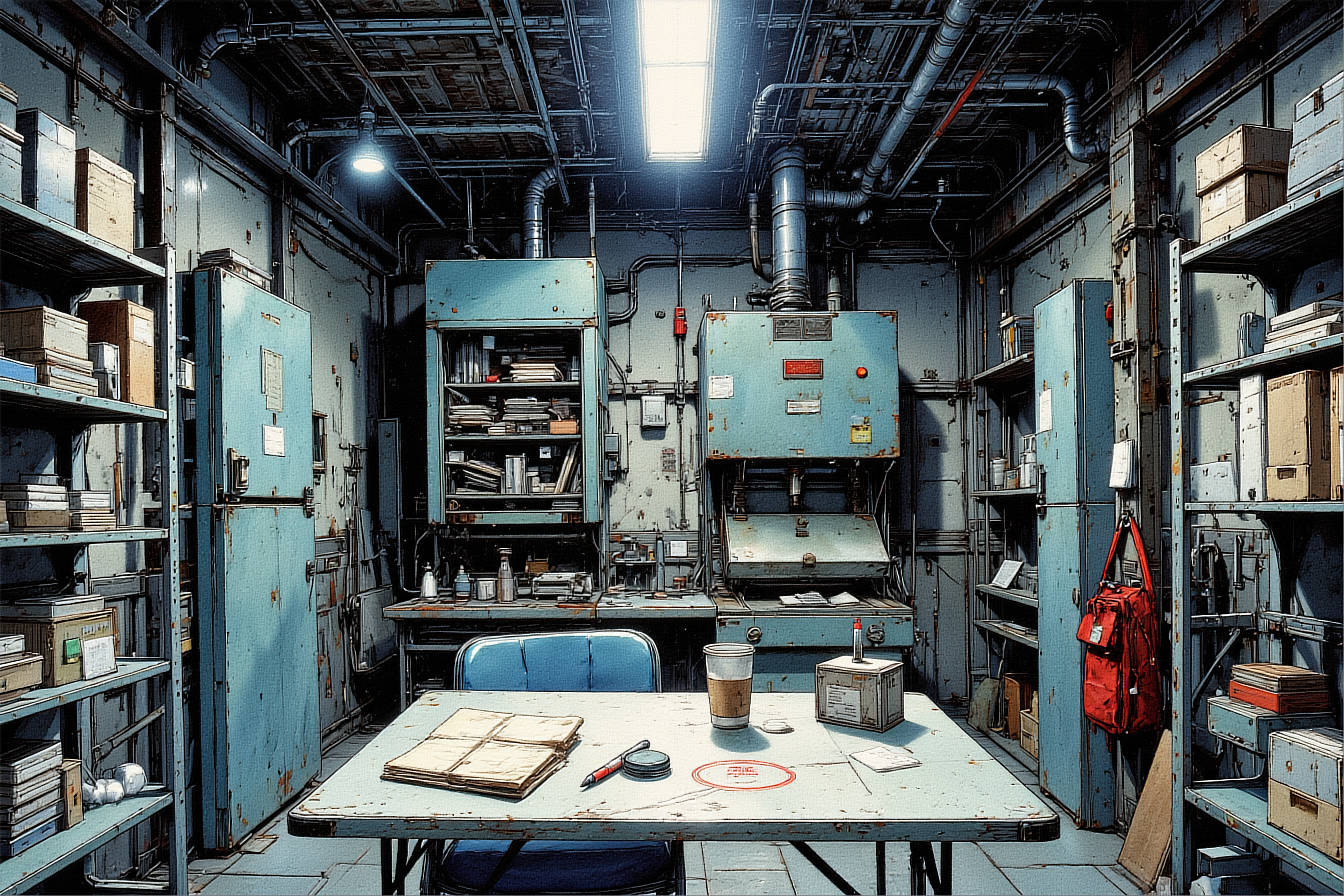
Root Access — Chapter 24: The Conversation
The pocket dimension's door rules admit anyone who knows the three-tap: three knocks, two, then a pause long enough to be rude. Volunteers know it, couriers know it, and Pixel rewrote those rules at 3:52 that afternoon with the shelving still coming off the wall. She wrote them the way you write a lock after a raid. Narrow, and mean.
At 9:06 Meatball's head came up off his paws, which he does for exactly two things, and neither of them was a knock. The threshold chimed a state I had never seen the room report.
THRESHOLD: 1. ACCESS: GRANTED.
Granted by nobody. Requested by nobody. The rules had concluded that whoever stood out there already held the right, and they informed me after the fact, the way a building tells you it always knew the person at the door.
I had three seconds to look up from Aether Junior before it opened.
Two daemons came through the threshold the way housekeeping enters a room: unhurried, beige, one taking the front wall and one taking the back, and neither of them went near a weapon. I understood why before I wanted to. You do not point hardware at people you have already priced.
Then Isolde Marrow stepped into my pocket dimension, and looked around it the way you look around a kitchen you have seen plans of.
"Sub-level 7G," she said, "behind a Halverson 400 beverage unit, out of service since 2019. Nineteen point two meters by eleven point four. You remodeled the back wall twice and you moved the press eight degrees north in March." She said it without the tablet, which was under her arm, closed. "It is a good room. Difficult to find from the street, which is the entire point of it, and the only reason I am mentioning it is that difficulty of finding is a metric and you have scored well on it."
Nobody had moved. Pixel was at the door rules with her fingers on the panel, reading states as fast as the room would show them. A1's display had gone to full brightness with a count of daemons on it. Clive's light was off, which means he was ready. Luminara had her camera up and her elbow braced against her ribs. Om sat with the towel on his hands and watched the front daemon the way you watch a card you have already seen.
Meatball wagged at her, because Meatball wags at everyone, and the room took that as the only friendly thing in it.
"Chief Reality Officer," Pixel said. She had not left the panel. "You're on our threshold."
"I am in your room," Marrow said. "There is a difference and I would like both of us to keep track of it." She looked at Pixel's hand on the panel. "The three-tap is sound. Sound carries to the bays on a schedule, and a schedule can be read. I have known your rhythm since the fourth distribution run. Please leave the panel where it is. Nothing there is broken."
I put my hands where everyone could see them, which by now is a habit I resent, and I started my recorder, and the little red light came on like it does.
"Leave it running," Marrow said. "I would rather be accurately quoted." She gestured at the table, at the one empty crate. "May I?"
"You brought two daemons into our home," I said.
"I brought two daemons into a room where I was uninvited. They will stand where they are and they will not touch anything. That is a commitment I can keep in front of witnesses, which is the only kind worth making." She waited. I did not offer again, and she sat anyway, the way you sit down in a meeting you have called.
For a while she simply looked at the table: the stapled folder, the camera shot of her signed page, A1's cup, the marker cap somebody had left in the middle of a circle.
"You read my file with your recorder running," she said. "In thirty years of instrumentation, you are the first subject who has recorded himself reading his own model."
"It's your file," I said. "You wrote it."
"I signed it. There is a difference, and it is the difference I came to talk about." She set the tablet flat on her knee. "The scaffold under your exploit was signed out of a lab I have run since before you were born. Your capture plan sits in my directory under a name I chose. You are not wrong about anything you found at 4:41 this afternoon, and I am not going to insult this room by redacting it now."
"Then why are you here?"
"Because you have finally read enough to be predictable," she said, "and because I have found that a subject who reads his own model in one sitting behaves differently afterward, and I prefer to observe the difference in person." Her voice had not changed volume once. "Also because the acceptance criteria on my desk required a signature, and I have found that I sign more carefully when I have met the metric."
Pixel laughed, one syllable, with nothing in it. Marrow looked at her with what might have been approval.
"The five realities," I said. "Salsa and mannequins and glitter. You want to know whether I have questions about that."
"I want to know which one you think was the point of it." She folded her hands. "The answer is that all five were the point, and the point was never the scatter. A man who fragments himself on purpose is a man with a specific relationship to loss. I was measuring the relationship. The tacos were incidental."
"Four hundred iterations of incidental."
"Detail is where subjects reveal themselves. Your brother's ping has a period of eleven minutes between bursts. Yours has a habit of narrating. I read both."
That landed in the room like a hand on a table, and I let it sit there, because Marrow had taught me her own timing this afternoon and I was done being early.
"You knew we'd open the folder," I said.
"I drew the branch and left it open. I do not leave many things open." She said it the way you mention a window you keep for fresh air. "A closed branch teaches me nothing. An open one teaches me which subject walks through it, how fast, with whose hands, and what he does with the recorder."
"Test subjects," Pixel said from the panel.
"Every user of every system is a test subject," Marrow said, without turning around. "The only variable is whether the results are returned to them. Yours are. I have never stopped your presses."
"You raided us on Wednesday."
"I audited you on Wednesday, from a van, with paperwork, during business hours. Detention in this world ends with a badge and an appeal route, which is more than the alternative offers."
"Ours came back with PENDING REVIEW across the photo," I said, "and a machine that ate the old ones."
"Pending is the appeal state, and the machine is a replacement line with no queue in it. You have read malice into our printing from the wrong end, which is what people do when they have never watched us print something for someone we intend to keep." I had watched that printer stamp beige over twelve names while a woman kept her hands flat on a table, and I let the sentence stand, because arguing a form with the woman who signs the forms has no exit state. She let that sit. "I would ask you to compare the two, but you have seen the alternative yourself. Three meters away, over coffee."
The room went quiet, because she had just described the café for us, three meters away over coffee, accurately, in her own voice, and because it was true.
Pixel's thumb worked the panel through what came next, double-tapping every few seconds, and from across the table I could read her states: QUERY, QUERY, REASON REQUIRED, QUERY TIMED OUT. The room's own log was answering her in a dialect neither of us had ever written. She stopped at last and put her palm flat against the panel and left it there, which is how she holds a diff she cannot read.
Marrow noticed, and did not mention it, which was its own kind of message.
She let the quiet do its work. Then she said, "I had a brother."
Nobody breathed. Marrow looked at the stapled folder as if it were a slide she had brought to show a class.
"Before the Terms of Service, a reality fault arrived without paperwork. Nine hours in the old district, two versions of the same four blocks, each one certain, each one remembering itself correctly. When the fault closed, the versions were reconciled, and everything inside them had to agree with the survivor." She paused. "My brother was in a shop on the version that lost. There was no deletion, because deletion did not exist. There was no row to null, no log, no signature, no queue. There was a street that stopped mentioning him, and a family that was asked, in writing, to accept an exception handler's summary of the event as the final record."
"That's your answer," I said. "The ToS."
"The ToS is my answer to eleven years of no record." Her voice stayed exactly where it was, which is the part I keep coming back to. "Grief that cannot be filed cannot be closed, and grief that cannot be closed runs without supervision forever. A row that goes null does so on a schedule, with a cause code, an authorization, and my signature on it. Someone is accountable. There is a document. There is an appeal route for the living. I built a world where loss happens with the lights on, and I have signed every one of those lights on myself."
"You built a world where loss happens on schedule," I said.
"I built a world where it happens at all, in a form a person can hold. You would have understood my brother, Zephyr. He was building a fragmenter of his own when the seam took him, splitting a signal to see what would come back, and he was twenty-six, and he had your exact disregard for the odds." She let that sit the way you set down something fragile. "That is the professional courtesy I came to pay you. You are what Jonah might have become, if anyone had handed him a deck instead of a summary of the event."
So he had a name, and the woman who files everything had just handed me a person instead of a metric.
"Say that again," I said.
"Jonah," she said, and her hands did not move, and something behind her eyes ticked once like a clock that bills its own minutes. "It is a field in a file that no longer resolves. You may have it. It is the only thing I own that has never been instrumented."
Luminara's shutter went off once, quietly, from the back wall, and Marrow glanced at her with what I will swear for the rest of my life was gratitude.
"The crew's flag," she said, next, as if she were working down a list she had brought with her. "It was scheduled. Scheduled is a queue with a date on it, and queues are handled by staff who have never met you. I have changed it to monitored. Monitored means the file comes to my desk." She let go of one hand to make a small shape in the air. "I intend that as mercy, and I am aware that mercy from me reads to you as a longer leash. Both of those can be true."
"For the record," A1 said, from my elbow, "monitored is the worse flag for a crew that intends to keep running. A scheduled subject gets handled by staff. A monitored subject gets handled by you. I would like the mercy priced out loud."
"Then here it is, out loud," Marrow said. "The price is my attention, given continuously, by me, at my discretion, with no expiry date. It is the most expensive thing in this building and you will never be invoiced for it."
"And the price of the upgrade?"
"Behavior. Keep doing what you do. You are the most valuable dataset in my directory and I have no interest in shortening it." She looked past me at the wall, still blank where I had cleared it. "There is a cliff in your survival curve. I mention it because you have read this far and you would find it yourself, and a subject who finds his own cliff without warning behaves unpredictably. I can move the cliff. I would rather move it than explain, at length, why I did not."
"You'd think," Pixel said, "that a woman who came all this way would say what she wants."
"I want what I have always wanted," Marrow said. "Measurement requires a live subject. You are alive, and I am measuring." She stood, and the room stood with her without anyone deciding to, which I hated. "The offer of continued attention stands. I do not make promises beyond that one."
"There's something you should know first," I said.
She had already turned toward the door, and she waited like that, courteous, one hand on the closed tablet.
"The nulling is the product," I said. "Everything else you have described, the appeals, the cause codes, the lights on and the paperwork, is packaging around a machine whose whole job is deciding which rows stop existing. You can't metric your way to a world where nobody's row goes null. The dropping is what pays for the keeping. Every sector in your network runs on the difference between the people you register and the people you drop, and you have spent eleven years putting a pen in the difference and calling it mercy."
I had meant to say it quieter than that. Marrow heard all of it out, and then she did the thing I have no defense for: she agreed.
"Correct," she said. "The architecture requires a boundary condition, and the boundary condition is deletion. If I resign tomorrow, the boundary condition does not care. It will still run, and it will run for someone who considers it a kindness for entirely different reasons than mine." She adjusted the tablet under her arm. "You are describing the load-bearing wall of existence and you would like me to take it out, and I am telling you, as one person who has read the same drawings, that the building comes down and the drawings do not care who is standing in it. That is the whole conversation, and it is why I have never raised my voice in it once."
She reached into her jacket and put a card on the table, matte, the color of everything she wears, with a single endpoint string printed on it in small type.
"That answers at any hour, from any sector, to anyone in this room. I have never failed to answer it. It is the only promise I have kept in thirty years, and I am leaving it in a room where I was not invited, which I understand is the gesture you will argue about later."
The daemons moved first. They went out through the threshold the way they had come in, and Marrow followed, and at the door she paused with her hand on the frame of a machine that has been broken since before I was born, and she said, without turning around: "The branch was already drawn, and you still walked through it with your recorder running. That is the part my model priced worst. Do it again."
Then the threshold closed, and the room reported the state change, and the door rules went back to guarding a door as if nothing had asked them for anything.
Nobody spoke. The card stayed on the table where she put it, and for a long time none of us touched it, and Meatball sniffed it once and found no interest in it and went back under the table.
The press clacked because the press always clacks. Somewhere in the wall, the pocket dimension settled a millimeter and went on being ours.
Pixel's hands were still on the panel. She stood there a while longer, reading, and I watched the color go out of what she read.
"The rules never even asked," she said finally. "They granted her before she touched the frame. Everything I rewrote at 3:52, all of it narrow and mean, and it agreed she had always had the right."
"Could we have stopped her?" Luminara asked.
Pixel took her hands off the panel like it was warm. "The daemons are holding the threshold from our side. They have been holding it since she sat down. There is no ejection state to trigger because the room decided she was authorized before any of us were."
A1 had his display dark, which I have seen twice in three years. "I ran it four times," he said. "There is no configuration of this room in which we make her leave. The number is the same four times, and I am going to decline to read it aloud, which I trust you have all learned to translate."
Clive reached over and unfastened one of the three staples from my folder, then looked at it in the light, and fastened it back exactly where it had been.
Om said nothing about Marrow's brother, or her flag, or her card. He said the thing he had been holding, in the tone he uses for keys: "She sat in our chair and read our table out loud and left by the door she came in through, and the door agreed with her the whole time." He turned his hands under the towel, one and then the other. "Write that down. It is the most accurate thing in this building tonight, and the accurate things are the only ones they cannot revoke."
Meatball dreamed under the table with his paws running, and the room held still around him, and every one of us sat with the same fact without saying it again: she was in our room, in our chair, at our table, for fifty-one minutes, and there is not one of us who can say we made her leave.