
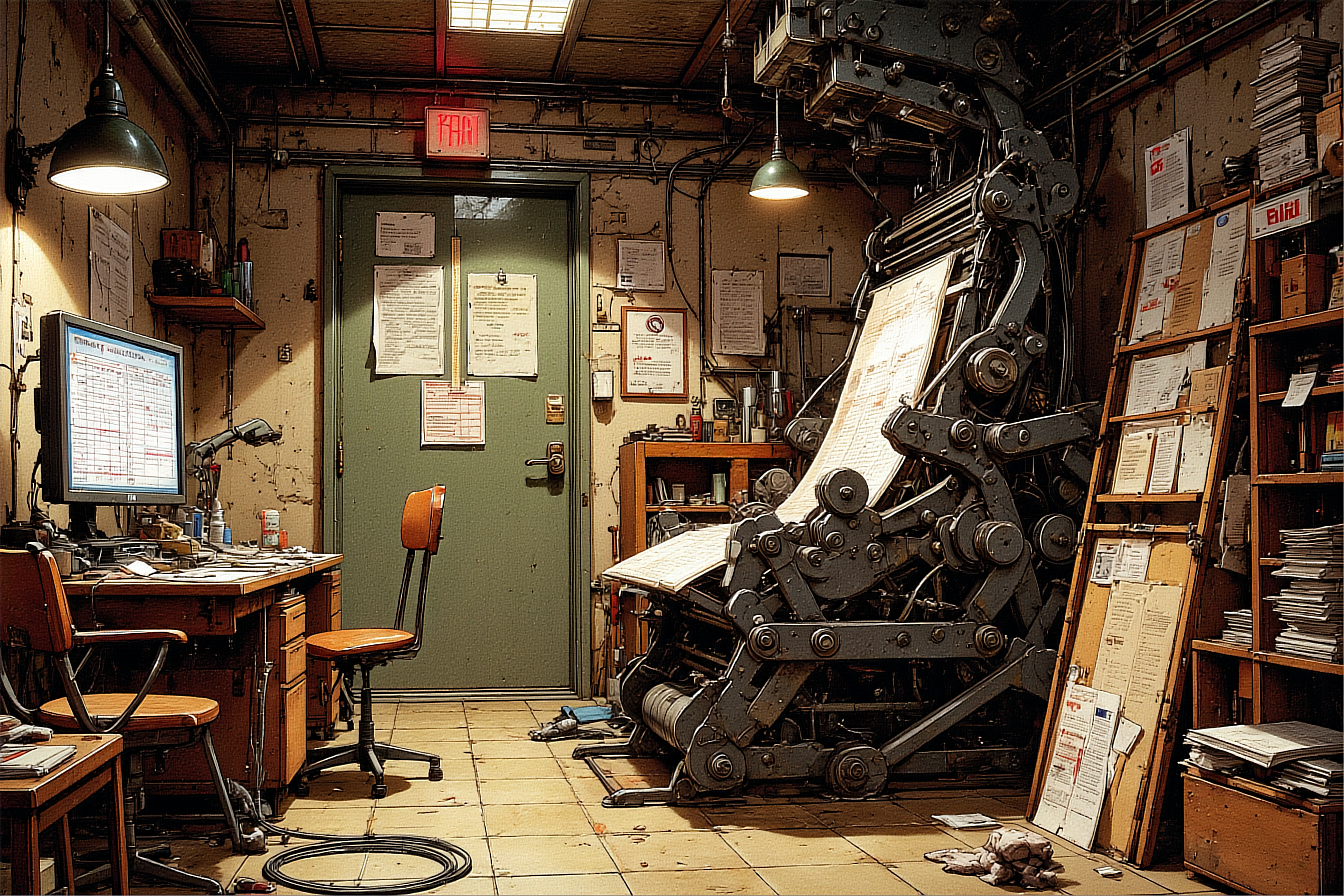
Root Access — Chapter 27: The Dog Who Doesn't Parse
Attempt one fired at 02:19 and died at 02:19.
Four hundred lines of issuance code, the wildcard half Om and I wrote against the registry's SHORTLIST field, pushed from my deck into a mirror of the sync relay's endpoint built from the Cogsworth vault's keys and the door blueprints we lifted with them. On the wire it was a credential looking for a handshake. In the predictor's feed, which we had been able to read since the day I opened Corporate's R&D folder, it was a request for a sandbox box. And the box was already there. Allocated four milliseconds before my stub left the deck, labeled with a scenario ID, waiting with the door open.
The stub went in. The door closed. In the feed, a line of model output with the flat tone of a clerk: PATTERN MATCH. CONTAINMENT ASSIGNED.
"Again," Pixel said.
She had the stopwatch and the feed open side by side, and Luminara had the camera up at the screen, because every time the model allocates a box the feed blooms beige for a fraction of a second and she wanted the bloom on film the way she wanted every edit: proof that the system moved first.
Attempt two, restructured: I split the credential into eleven pieces and gave them a delivery order Om designed, so no single packet reads as issuance. Nine milliseconds. The box came up pre-drawn again, and this time it carried a scenario file name off my own dossier, and I knew the name because I was the subject in it: SCENARIO: GLITCH, Z. DELTA SET 12.
"Twelve," A1 observed from the doorway. "They have delta sets named after you the way a library names shelves."
Attempt three: I built the payload around Om's signature scheme instead of my own structure, conscious-keyed, because deltas that aren't mine should cost their model a guess. The box came up in six milliseconds, and it sandboxed a counter-move I was about to make and hadn't typed yet. The prediction of my next keystroke arrived on the wire ahead of the keystroke, the feedback came back up the cable into my own rig, and my left hand smeared.
Just the fingers, for about two seconds. The fingertips lagged behind the rest of me, trailing a half-frame like wet ink, and when I pulled my hands off the keys they kept doing it a beat after I'd stopped.
"Desync," A1 said, and he was already rolling, because A1 had been waiting for one of us to break since dinner. "This is what happens when a man argues with a model that has read his autobiography. Hold still."
The shot went in. Colors re-quantized at the edges of the room, the press stopped double-printing itself, and my hand came back to one hand. A1 recapped the syringe and parked the cradle where he could see the whole table.
"Two left," he said, to nobody, to the record.
Attempt four was Clive's idea, and it was the saddest of the four.
"Make it paper," he said. He'd been sitting in his corner through all of this, spring wound, watching the feed the way he watches a mailroom. "Launder the credential as an interoffice requisition. Fourteen fields, a form number from 1971, a signature block nobody reads. Every form I have ever moved in this city has crossed every checkpoint in this city."
So we wrapped issuance in bureaucracy: a requisition for nothing, addressed to everyone, form-stamped and plausible to the last box. It was the best disguise we had, and it was built out of a lifetime of Clive's traffic.
It got as far as the model. And the model didn't box it. There was no allocation, no scenario file, no containment line. The packet simply went to a class the feed called JUNK, PRIORITY LOW, and got recycled, and the whole thing took eleven milliseconds and never once became interesting.
Pixel stared at the empty allocation field. "Recycled," she said. "Our best work, eleven milliseconds from being somebody's junk mail."
"Sorting is stopping, at that speed," Om said quietly.
Which was the lesson of the whole night in one line: a model that can name a thing owns the thing. Predictable, contained. Predictable, discarded. Either way, dead before it arrives.
The fourth attempt never got fired again, because Meatball came through the test field with a glove in his mouth.
It was Luminara's spare, off the chair by the door, and he had clearly been planning this for hours, because he came in low and fast and pleased, tail at full broadcast, negotiating the cable run under the deck with the practiced ease of a creature who had been stealing laundry since the day he arrived. The test field was a scan perimeter I rigged around the rig: a low-frequency sweep that reads every process inside HQ and reports it up the chain we tapped, so that every firing of the stub also gets a read of the room it was fired from.
Meatball crossed the perimeter at a trot. The rig logged the crossing. And in the predictor's feed, where a second ago there had been a clerk's voice sorting our best work into junk, there was nothing at all.
No row. No read. No allocation. No scenario ID. A dog walked through a Corporate sensor sweep carrying a stolen glove, and the entire system's opinion of the event was a gap.
I sat forward hard enough to rattle the keys.
"Again," I said. "Everyone. Fire the sweep on the room."
Pixel ran it. The sweep read the press, the cradle, the deck, the lamp, four people, one stapler, one espresso cradle, a stack of paper: rows for all of it, with timestamps and confidence values, the model's opinion of everything in the room rendered as a tidy inventory. My own row came back flagged PRIORITY WATCH, which I waved away, because that's old news.
Then I carried Meatball back across the perimeter myself, under my arm, glove and all, and the feed gave me the same nothing: a dog-shaped hole in the telemetry where data should be.
"Run it on me," Clive said.
He got a row: MACHINE, INERT-CLASS, ATTACHED: NETWORK. A1 got one too, MEDICAL-CLASS, and the reading took him eight milliseconds longer than the rest of us, which he noted with visible pleasure. Pixel got a row with her flag on it. Om got a row, and the model annotated it, which I'd never seen it do with anyone: STATIONARY. LOW PRIORITY. TRACKING INCOMPLETE.
Meatball got an absence, every time, as many times as we cared to walk him through.
I pulled six months of scans.
Corporate had swept this pocket dimension since before we had a readership, through daemon handoffs and maintenance passes and the polite beige auditor who keeps showing up at our distribution points with a clipboard. Every one of those scans enumerated the contents of this room: the press, the deck, the cradle, the vending machine's power draw, six humans with flags, and Meatball, who in every scan, every month, every pass, was logged the same way.
ABSENT. VARIABLE NOT RESOLVED.
"Look at this," I said. "They've been counting him as missing for half a year. Six months of sweeps and their conclusion is that there is a dog-shaped hole in this room, and the hole keeps moving."
"Because he gives them nothing to hold," Om said. He was crouched next to the rig, watching the feed's empty line where the dog's crossing should be, and he had the stillness of a man looking at his theorem in an animal. "A model predicts an agent by what the agent wants. It reads intention and forecasts the next move. Every payload we've built tonight died of intention: issuance wants to register, infiltration wants in, escape wants out. Every shape of wanting they can price, they can sandbox or they can bin."
Meatball, meanwhile, had given up on the glove's strategic possibilities and was chewing the cuff of it, joyfully, for no reason anyone could put in a forecast.
"Simple joy doesn't parse," Pixel said, reading the empty log row over my shoulder. "He wants the glove. That's the entire agenda. There's no delta in wanting a glove."
"The kernel can't sandbox what it can't model," I said.
"There's a hole in every sweep of this room," I went on, "and holes are the kind of thing auditors eventually learn to read. What happens when somebody in Marrow's building looks at six months of ABSENT and starts asking questions?"
"Six months of sweeps," Pixel said, "and nobody has."
"Because absence reads as architecture," Om said. "Their sweeps report what's present. The gaps between present things are where the model puts walls, pipes, and dead air. A dog-shaped gap looks like a duct."
"That's either reassuring or the reason we're still alive," A1 said. "I'm choosing the first."
Then the tithe checkpoint came back to me, sideways and all at once: the scanning daemon at the facility that waved a dog through because it couldn't find a threat profile in an animal happy for no reason. I wrote it down in the Job 4 recon notes, three lines, under lucky breaks. I never read my own note again.
Because we had five realities of my telemetry on their shelf, six months of sweeps in their archive, every job we'd run replayed in a file they owned: and the one member of this crew Corporate has never once measured is the only one who never asked to exist.
They had measured me in five realities and kept the deltas. They kept my brother close enough to the compile that I could feel the readings on him from out here. They swept this room six times a month with the patience of a landlord, and every sweep, the dog was missing.
Luminara had been silent through the whole thing. Now she held up her camera and showed me the screen: a photo she took thirty seconds ago of Meatball mid-crossing, four feet off the ground, glove swinging, ears back. Then she turned it to face the empty log row on my monitor, and held the two side by side.
"The picture and the record," she said. "Same dog, same second. One of them is true and their system keeps it anyway."
Meatball finished the glove, sighed, and went to sleep on it.
"We wrap the credential in him," I said.
The room went quiet in the particular way it gets when an idea is either brilliant or insane and everyone is waiting for someone else to say which.
"The recording," I went on, pulling the rig's capture data up on the wall. The corporate sweep logged a hole, but my own rig logged the dog, because my rig doesn't care about intent: gait off the floor sensors, four-beat trot, weight shift at the turn; heartbeat off the collar's cheap monitor, which he chews twice a year and we replace; the acceleration of a creature with no objective. "We wrap the root credential in a package that reads, top to bottom, like a recording of this dog wanting a glove. The payload rides inside his signature. Their model takes it apart looking for the issuer and finds a tail."
"It finds nothing to flatten," Om said. "Because there's nothing flat in there. Noise all the way down, shaped like a dog."
"The one packet the firewall drops," A1 said. He sounded delighted. He sounded aghast. With A1 those live in the same register. "In all my projections I confess I never modeled our advantage as mammalian."
Om stood at the board while the dog slept across the room on a stolen glove and said, quietly, the way he says the theorem when he's thinking out loud: "Consciousness makes an excellent encryption key. This is the first key I've been handed that has no idea it's a key."
To build the wrap we had to capture him properly, which took the better part of an hour and three failed takes, because Meatball has opinions about staging. Pixel walked him across the floor sensors with the glove held out, and the first time he took it from her hand and bolted under the table. The second time he made it four steps and sat, convinced the game had changed. The third time he trotted the whole line, ears back, tail going, and the floor sensors got a clean read of a creature in motion who was going somewhere for no reason at all, and I captured it while Luminara photographed the capture, and we had our envelope.
The heartbeat came easier: he fell asleep on the sensor pad twenty minutes later, and his rate dropped to whatever a dog's rate drops to when the day's theft is done, and we recorded that too. I nested the credential inside the gait, the gait inside the pulse, the pulse inside the want, and rendered the stack. Then I fired it at every model we own.
Every model rejected it as unreadable. The local models were ours, so that proved nothing, and everyone in the room knew it.
"Before we call it loaded, run it the honest way," Clive said. "Run it my way."
So the dog-wrapped credential went into a requisition envelope and rode the office-supply network the way real paper rides: into the machine in Accounting, out at a print room in Sector 2, across three photocopiers that have owed him favors since the seventies, and back to us with a timestamp stamped on every hop. Twenty-two minutes, seven machines, zero incidents, because a form for nothing escorted by animal noise is the least interesting freight in this city. It came back to us clean.
"That's our network," I said. "That's the only proof we get."
"It's a start," Clive said. "In 1967 a start was called a start."
"That's the cost, then," Pixel said, reading my face. "We can't take it end to end."
"We can test the payload. We can test the wrap against every model we own. What we can't do is point it at theirs. The moment we fire a sample at the real predictor to check the envelope, the predictor has the sample, and then they model it, and then we're back to attempt one with better paperwork."
"So we find out on the day," she said.
"We find out on the day."
Clive considered this from his corner. "In my trade there is a name for a load you cannot open before delivery. It is called a load." He paused. "It is not a popular term."
"Somebody has to run it once, blind, against the real thing," A1 said, "and I note for the record that blind tests have gone well for this crew exactly one time out of five."
"Four out of five," Luminara said, not looking up from her camera.
"One time out of five," A1 repeated, with the serenity of a man who has decided the number is the point.
We sat with it. Untestable against their model, keyed to a dog asleep on a sensor pad, waiting on a door that may not open and a brother who may not answer. It was the best plan we had, and it had a hole where the proof should be.
Pixel looked around the table and did the thing where she makes a decision without announcing one, and everyone who works with her recognizes the closing of a bracket.
"Then that's the envelope," she said. "Load it."
"Is he coming?" Luminara asked. "On the run. Because the envelope is him."
"The envelope is asleep on a glove," Pixel said, "and we are not leaving him behind, no. He rides with Zephyr, like always."
"Someone had to say it out loud," A1 offered. "The plan now contains a dog. Plans containing dogs behave differently in my projections, and I would like the record to reflect that nobody warned me."
"Nobody warned us either," I said.
A1 collected the syringes from the cradle and lined them on the corner of the table, in the same row he'd kept all week, counting as he went, moving each one a little as he did it, in case the arithmetic changed while we weren't looking.
"Two shots," he said. "Seven days, two shots, one payload wrapped in a dog. Standards," he said, "must be maintained."
Nobody laughed. Nobody has to. Meatball lifted his head once from his sleeping place, decided the war is elsewhere, and settled again, and the only member of this crew who has never once been inside Corporate's telemetry slept on through the announcement of his own usefulness, wanting nothing that anyone can bill him for.