
Root Access — Chapter 26: Fork Everyone
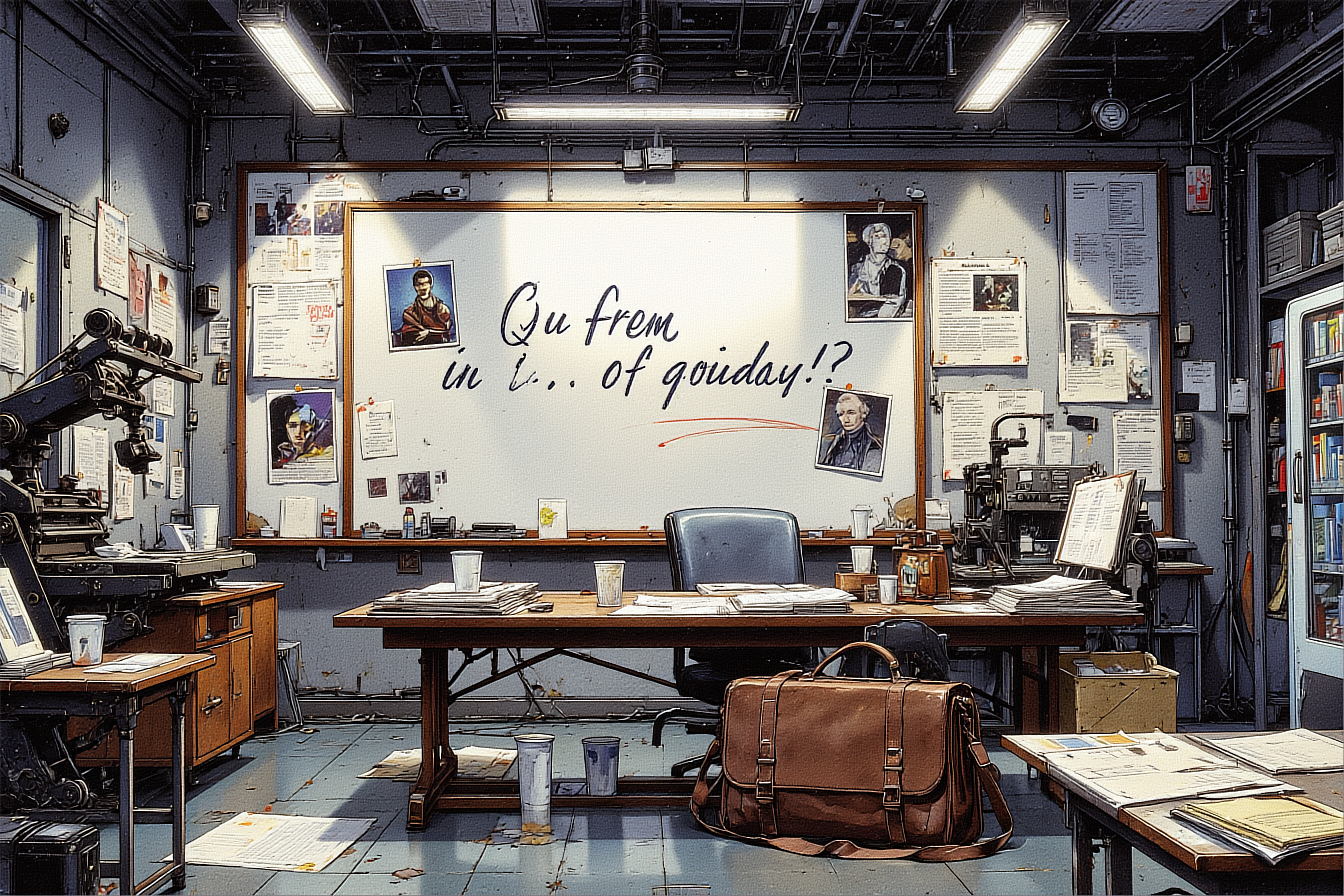
I put the question on the board in black marker at 01:10, because after seven hours of moving paper the question deserves a board: WHAT CAN WE DO TO AN OS?
The room was in its pre-run state, which is a state only this crew has: Luminara's photographs pinned in a grid beside the release note with its one dead-center staple, the press ticking through the last of a run nobody ordered, Meatball asleep above the power supply, five cold cups, and the smell of Clive's courier satchel. Everybody came back to the press room at some point in the last hour without agreeing to, because this is where the wall is.
The answers to the question came back in order of how long they'd been wrong.
Clive went first, because Clive had been in his casing since 1967 and went first out of habit. "Route around it. There are stashes under this city that predate the Terms of Service. We put the rows on paper and we go somewhere the registry doesn't render."
"Name somewhere the registry doesn't render," Pixel said.
"The Edge," Clive said, and nobody laughed, which was how we all found out at the same time that he meant it as a joke.
A1 had one ready. "Reduce exposure. Every model I own says quiet crews outlive loud ones by a factor of four."
"Three million subscribers," Pixel said, "have exactly one loud thing left, and it's this room. Go on. Be quiet."
Luminara lifted her camera an inch off the table and set it down again. "Publish the note. The drivers list, the acceptance criterion, the whole release schedule. Make them read their own words back in the street."
"We published your credentials front page," I said, "and the thank-you note came with a timestamp."
Om was quiet for a while, butter tea going cold in his hands. Then: "Last month I told you an operating system that owns the truth can only be embarrassed. I've sat with that all night and I want to revise it. Embarrassment assumes an audience, and they have one. It's us." He looked up. "Ask it the other way around. What does the Purge actually do when it fires?"
Pixel capped her marker and tossed it to me. "You wrote the question. Draw the answer."
So I drew, and this was the part where the room stopped arguing and started leaning in, which in this crew counts as applause.
"The Purge is a query with a death penalty attached," I said. "At 03:00 it walks the registry and asks one question: which processes are running without a current registration token. Every name it gets back, it soft-deletes. Single pass. The whole weapon is that question." I underlined the board twice. "Delete is authorized per name. Take away the names and there's nothing to authorize."
Pixel saw it before I finished drawing it. "You register everyone."
"Everyone. Every unregistered process on the network, in one pass, at the same time, before the query fires. The unregistered stop being a category the moment the category fills up." I wrote FORK on the board, because it sounds like what it is. "Root is a permission the system hands out. Permissions get copied. So the move is a fork. Mass credential-issuance: push a root credential to every consciousness on the network, registered and unregistered alike, and let them all hold the same privilege the OS uses to delete them."
"The registry floods," Om said, sitting forward. "Registration stops being scarce, and scarcity is the entire enforcement model."
"Every reader of the zine becomes a citizen before the timestamp," Pixel said slowly, "and the Purge executes against a full ledger."
"Against a ledger with no empty rows left in it," A1 corrected, with the particular relish he keeps for statistics that are also war plans. "The uninstaller's scope query returns the empty set, the acceptance criterion fails its own check in public, and the Simplification ships without its prerequisite. Standards," he added, "would genuinely have to be maintained."
Clive had been rolling one staple back and forth under his casing while he thought, and he stopped it with a click. "Every hand on the same root. Fifty years in my trade and that's what we call a night when every lock in town stands open."
"Then it's a night when every lock in town stands open," Pixel said. "Keep going."
"And after?" Luminara asked. She had her camera up, photographing the board as I drew. "After the broadcast, what does a world look like where everyone holds it?"
"After, no row goes null without asking a person first," Om said. "After that, whatever people do with keys is theirs to do."
"Whatever they do," Luminara said, and took the picture, "it'll be theirs."
That was the play. Hackers save everybody. This was an issuance to every name Corporate never paid for, our three million readers with the crew riding in the same batch. It was the first idea we'd had all night that gets bigger the more you look at it.
"Now the fun part," Pixel said. "How."
Om and I took the whiteboard, and for the next two hours the crew watched us argue in marker.
"Every channel from here down is theirs," I started. "Registry's theirs, backbone's theirs, HR's theirs. The zine's inbox just got a clerk fired for proving it. Push a credential through anything above ground and it gets filtered, flagged, or folded into somebody's dashboard before it reaches the second subscriber."
"Then we use a channel they can't block," Om said. "A channel so structurally necessary that cutting it takes the OS down with it."
"The sync."
He nodded, and drew the diagram himself, because this is his cathedral: the master clock in Cogsworth reaching down quarterly to The Edge, the handshake where Corporate's own time shakes hands with kernel time. During the handshake the kernel re-signs the registry's authority chain. For the duration of that ceremony, credentials carrying a kernel signature propagate straight down, no registry mediation, no audit queue, no middle manager in Prime Material deciding which names deserve issuance. That's how rows get born in the first place. The sync is the pipe everything else is a copy of.
"Block it," Om said, "and the registry has to explain to reality why it stopped issuing names."
"So the payload rides the sync." I tapped the board. "One port, through the kernel, opened during the window we lifted out of the Cogsworth time-vault."
"Can we forge the signature?" Pixel asked. "That's the part I don't like. Nothing below the kernel can sign as the kernel."
"We don't have to forge anything," I said. "Everything crossing the pipe while the sync is shaking gets signed by the kernel itself, because the handshake is the signature. The blessing comes from the ceremony. We stand in the line where it's handed out and let it hit us."
Om added a box to his diagram and labeled it ISSUANCE, WILDCARD RECIPIENT. "The routine the registry runs at every sync is simple. It takes a list of names issued from above and stamps them." He crossed out the list and wrote one word: everyone. "During the window, what we put in the pipe is issued from above too, because for six minutes we are above. Everyone registered at once, in Corporate's own hand, on Corporate's own paper, and registration becomes a word instead of a wall."
I tried it on the deck while he talked, because theory is how you get killed and a stub is how you live: I pulled the registry's own issuance routine, swapped the recipient list for the wildcard, and ran it against the zine's test ledger. The routine rejected it on the first pass. Corporate wrote a mode for one name, a mode for a thousand, and a mode for a scheduled batch, and every mode assumes the list arrives signed from above, which is the entire reason the list exists. The field where the names go was annotated SHORTLIST, ALWAYS. In the whole life of that function it had never once been pointed at everybody.
"Then we write the half it's missing," Om said, "and the sync signs that for us anyway."
"Nine days when we stole the schedule," Pixel said. She was at the wall now, next to Luminara's photograph of the release note, doing arithmetic with her finger in the air. "The quarterly sync fires at 01:40. The purge fires at 03:00. Same morning."
"Eighty minutes," I said.
"Eighty minutes," she agreed, "minus however long a port stays open, minus however long a broadcast takes to reach millions of names. Miss it and the next sync is a quarter away, and the timestamp isn't."
She let that sit. Somewhere outside, the vending machine rattled its one loose panel at nothing.
"The window we stole from the vault, the keys that unlock the relay door, a payload in the queue, and eighty minutes," I said. "We walk into the chrome downtown, we cross to the sync relay, we put the payload through the seam at The Edge, and everybody who ever had a row go null gets handed the same keys Corporate signs with. The Purge fires, gets an empty list back, and exits."
Clive had been still through the entire briefing, which from a stapler is a standing ovation. He rolled once across the table and stopped at the edge of the board. "And the seam," he said. "Open it from out here, do you think?"
The room looked at me, because I'm the one who reads kernel space for a living.
"The port is held from both sides," I said. "Corporate seals it from outside, same as they seal everything. From inside..." I put the marker down. "From inside it has to be held open, held through the whole six minutes of the ceremony, against every routine that wants it shut. Inside is where the kernel keeps its unwilling staff. Inside is where my brother is."
Nobody rushed to fill that.
"The door opens inward," I went on, "which means somebody on the other side has to be holding it when we arrive, and conscious when we signal. There's exactly one path that runs from out here into kernel space and comes back: the callback path we traced off the erasure daemon in Job 1. That's how his ping reached us through eleven seconds of stolen cache. The line runs both ways."
"And if he's in one of his gaps when it lands?" Om asked. "He's conscious in bursts."
"Then we plan around the bursts," Pixel said, before I could. She said it evenly, and she didn't look at me while she said it, which was the version of her that had already priced this in.
I pulled the callback route out of the Job 1 files anyway, because hoping is not a channel. Three pings, the handshake we used to read eleven seconds of stolen daemon cache, aimed at the only endpoint that had ever answered from The Edge. The deck ran them. One second. Five. The packet counter walked OPEN, then WAITING, then nothing, in the patient way kernel space has of saying nothing at all.
"Nothing," I said.
"Nothing yet," Om said. "He's either in a gap or he's holding something shut. From out here those two look identical."
"One byte," I said. "Give me one byte and I'll know the line is alive."
The screen stayed dark, and I closed the file, and the shape of the problem sat on the table where everyone could see it: we were planning a job around a person we couldn't currently reach, to open a door we couldn't currently see, inside eighty minutes we hadn't earned yet.
"Route gets its own night," Pixel said. "Tonight we decide whether the job exists at all. A1, what does it cost?"
"Corporate's predictor models," I said, while A1 was still opening his kit, "have five realities of my telemetry. They know how I think at a level I don't. Every job we've run is a replay of a file they own. So whatever we build, they generate it first, sandbox it, and wait for it to arrive in a box they've already drawn."
"The payload can't be modeled," Om said.
"The payload can't be modeled," I agreed. "Anything I design has my fingerprints in the structure. Anything Pixel strategizes has hers. They replay our deltas for breakfast. Wrap it in us and we might as well walk it over and hand it across the desk." I capped the marker for real this time. "I don't have this one yet. It's the hole in the plan, and I'd rather say it out loud tonight than discover it at the relay."
"Better tonight than at the relay," A1 agreed. "I have drafted several speeches on that theme."
Pixel sat down on the edge of the press platform and rubbed her eyes with the heels of her hands, and when she took them away her left hand lagged about a quarter second behind the rest of her, then caught up. She looked at it. Looked at A1.
"My projections call that desync," A1 said, already rolling. "Seven hours of sleep is a myth we invented, and grief is a load-bearing one." He had the syringe out and the sleeve up before anyone else moved. "You have been on that handset for fourteen hours. Hold still. This is going to reduce my inventory."
The shot went in. Reality tightened around Pixel the way it always does, colors re-quantizing at the edges, and her hand stopped lagging. A1 recapped the syringe with enormous care and then arranged the remaining vials on the corner of the table in a row, counting as he went, moving each one a little as he did it.
"Three," he said. He waited a beat. "Three. There are seven days, three shots, one port, one dog, and one unanswered card on the table, and I'd like the record to show that I have seen worse odds in better weather."
"You haven't," Luminara said.
"No," A1 agreed. "I have not."
Then the tally went around the table the way it always does before a run, what each of us was carrying, and when it reached me I surprised myself by saying it out loud, the number I'd had in my pocket since the Cogsworth time-vault.
"Four days," I said. "Off the end. Permanently. The vault billed me four days and I've known since we walked out, and I didn't tell you how many because saying it makes it sit down at the table."
A1 opened his mouth, and Pixel put two fingers on the table, once.
"Don't price him," she said. "File him." To me, level: "Four days. Filed. Add it to what this costs. Add all of it. That's what the bill looks like and we're paying it anyway."
Om poured fresh tea and said nothing, and Luminara wrote the number on the back of a contact sheet with a grease pencil, which is how things get remembered in this crew.
Nobody called it a vote, because calling it a vote would make it a thing that can be lost by one.
Pixel went around the table with her chin on her hand, the way she does a distribution list. A1 gave a probability out loud, a number so low that in his delivery it functions as an endorsement, and followed it with the only compliment he gives plans: "The failure modes are legible. I can work with legible." Luminara loaded a fresh roll of film and didn't look up from the spools, which from her is a signature. Om set a sixth cup where Aether's name would sit if we wrote names on cups, and that was his answer.
Zephyr Glitch, twenty-one, orange mohawk, one cyberdeck held together with quantum tape and spite, voted yes by picking the marker back up and writing the three unsolved problems in a column: ENVELOPE, DOOR, TIMING. Under ENVELOPE, nothing. Under DOOR, a name. Under TIMING, 01:40.
Clive rolled to the center of the table and let his spring drop once. Thump. The sound a Swingline makes when a decision gets stapled into the world.
Nobody looked at Marrow's card. It was sitting out in the open, endpoint up, for a day now, and every one of us had had a hand near it at some point tonight. The door that card opens does not lead to The Edge. It leads to a woman who instruments people, and her offer would come with a serial number on it.
"Seven days," Pixel said. "We load the payload, we find our envelope, we cross the downtown, and we get one eighty-minute window to hand root to everybody who breathes. Questions."
"I have eleven," Clive said.
"Save them for the route. Lights in six hours, and I want the payload stubbed out before then."
She killed the overheads and the room dropped to the green of the press's power strip and the glow of my deck. I stayed at the board. Under the column for ENVELOPE, I wrote nothing, because writing nothing is the honest notation for a hole. Under DOOR, my brother's name in small letters, the way you write something you intend to go and get.
Seven days, and a door with a brother behind it.