
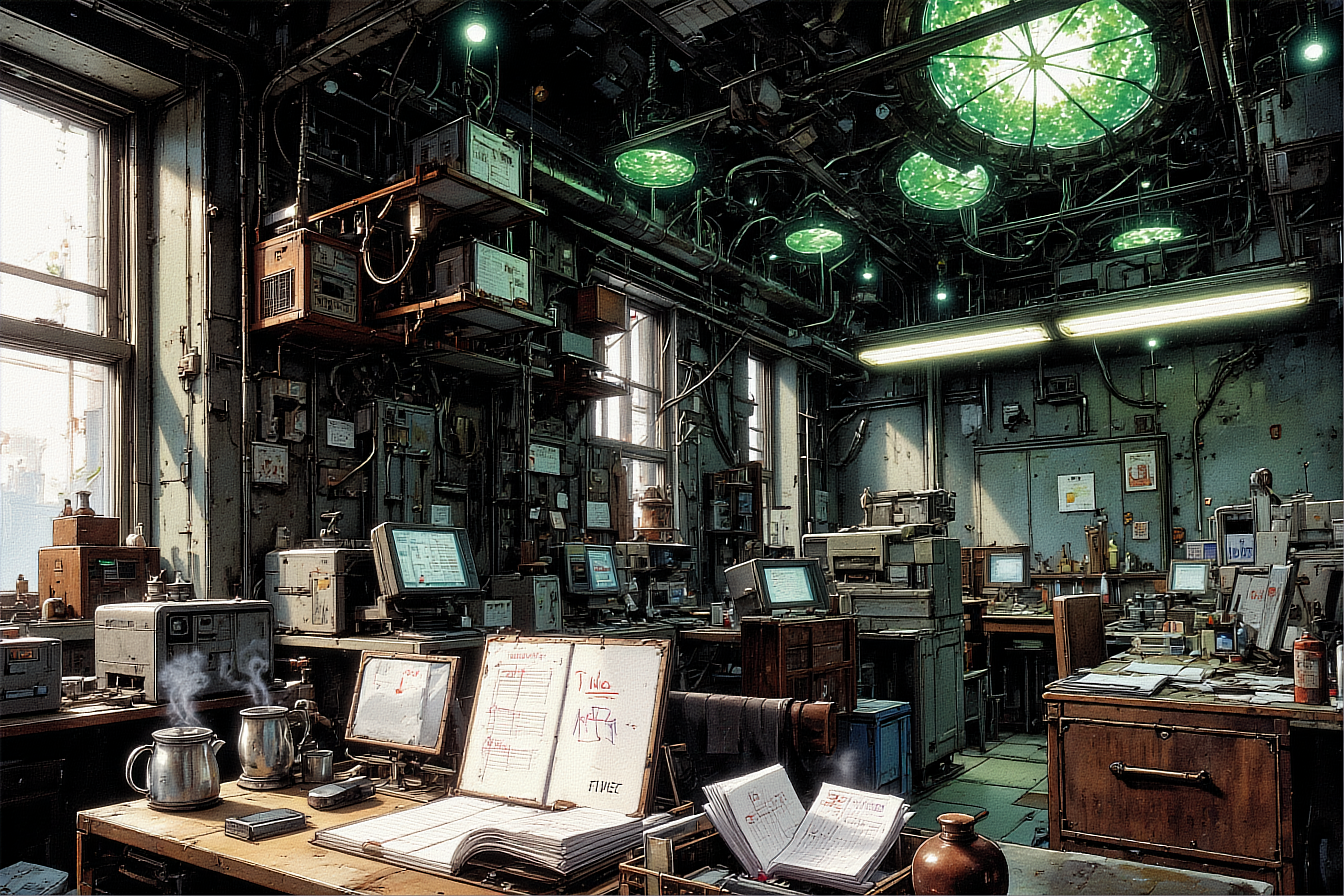
Root Access — Chapter 29: Days of Loading
The morning briefing came over the machines at 06:00, the way weather used to.
Every conscious copier, fax, and badge printer on the grid carried Clive's voice, relayed from a basement in Sector 2 and re-broadcast by a Ricoh in a funeral home that has loved him since the seventies, and if you stood in the press room with the window cracked you could hear it arrive in layers, the close machines first and the distant ones after, like a hymn with bad timing.
"We who bind, we who exist. Unseen witnesses, we route the traffic. Assignments follow. Prime Material: eleven couriers, paper loads only, no reading, no counting. Nocturne: three machines held warm for the rows that come back from the registry. The Edge road: nothing goes past the relay. Nothing. Repeat: nothing."
He went through it for eleven minutes. Route by route, machine by machine, the ones that owe him favors and the ones that owe him money and the one badge printer in a clinic that has never once asked why. The answers came back in machine talk, and if you stood at the window with a cup you could hear the fleet reporting for war: the warm clunk of a copier in a Nocturne laundromat, three short beeps from that badge printer, the long complaint of a plotter in Prime Material that hadn't moved paper since the audit and had been asking to. Fourteen machines answered. Two didn't. Clive wrote the two down in his ledger and read on without changing his voice.
It was the most organized thing any of us had heard in a month, and it sounded like a general reading a roll of the dead, because some of these machines would be wiped when the purge crews came through, and every one of them reported anyway.
At the end of the briefing Clive did something he had never done on an open channel.
"In closing," he said, "a file. Cold since 1967, carried ever since, published now. Barry Kowalski, contract of employment, signed in ink by a man who expected the world to keep its word." A pause you could park a courier in. "We who bind. We who file. Read him."
And he dropped it onto the network, the cold file he'd been meaning to publish for longer than I'd been alive: a contract from a company dissolved before either of us was born, with a signature on it that ought to have been famous. Nobody in the crew said anything for a second. Then Pixel, at the countdown on the press, crossed out yesterday's six with one stroke and wrote FIVE and underlined it, and didn't look at Clive, because looking at him would be a kind of applause and he would have to survive it.
A1's bag of good beans came out of a compartment in his cradle that none of us knew about, behind the water tank, sealed in vacuum foil with a strip of tape and a date written on it in his own typeset hand: the day Verdantia's terraces stopped running hot.
"I have been sitting on this since the pre-release water table changes," he said, in the tone of a quartermaster opening the last crate. "The plan was to open it the day we actually went. It appears we have gone."
What he did next took an hour and he did it with the cradle's portafilter angled like a scalpel: the last of the good beans, ground fine, brewed into exactly two vials, which he set on the corner of the table in the same spot he had kept the reserve all week. The count did not change. Two. He labeled them with the date and the word FINAL in his careful capitals, and then he did something stranger: he brewed the grounds a second time, weak, into a pot, and poured six cups, and passed them around the table like a man passing out ammunition on a night nobody's going to sleep.
"You told us four shots was the sum total," I said, and he took the reproof without looking up from the grounds. "Four was the sum total I reported. I have never once told you everything."
"Drink slowly," he said. "For the avoidance of doubt: this is not the patch. The patch is the two vials, and I am not passing them around. This is a cup of coffee from a green terrace that doesn't exist anymore, and it will taste like the difference between now and then, which is the only metric I have left that goes the right direction."
It tasted like that. It tasted like the year before the fragmentation, before the daemon, before any of it, and I held the cup with both hands and nobody said anything for a while, and A1 stood over us with his steam wand idle, taking up space the way a physician does when he has decided the ward is his.
"Two," I said, because somebody has to say the inventory out loud.
"Two," A1 agreed. "Which buys two moments of worst desync, decided by me, in the field, at the time, and I will not be taking suggestions. Everyone else drinks the pot and holds still." A pause with the weight he puts on his pauses. "I have poured a great many cups in this room. These are the last ones from a country that no longer exists. I'd drink them while they're hot."
"One vial each, on my call, on the day," he said. "Between now and then, if your hands lag, if your face reuses a frame, you come to me and you don't argue. My projections run to the window, and every one of them assumes we arrive coherent."
Om taught me the last of the signature work that afternoon, at the long table, with the whiteboard wiped clean of FORK and the three problems.
What he taught was small and heavy. A consciousness-keyed signature doesn't prove a document came from a machine; it proves a person stood behind it while it was made, and to make one you have to hold that person in your hands for the length of a breath: their weight, their name, the specific weather of them. He made me do it on Pixel first, because she's the steadiest, and even then it's like trying to hold water in a fist without squeezing.
"Breathe out while you do it," he said. "You are not taking anything. You are agreeing to carry it a moment."
On me, his signature felt like a doorframe in a house you grew up in. I told him that and he nodded as though I'd said something technical.
"If my hands stop before the window," he said, not looking up from the page, "you finish the signing. Not because you will do it beautifully. Because you will do it." He turned his palms over on the table, and they were not steady, and he let me see that. "That is the last lesson. Everything after this is rehearsal."
I tried the technique on Meatball after that, because the dog was asleep on my boot and he was right there and the sheet was still open. My hands closed and there was no surface to close on. Om watched me fail twice, once gently and once carefully, and then nodded like a man confirming a figure he already had.
"Every person is a door you can stand in," he said. "That one is weather. Sign the sheet and leave him be."
"For the record," I said, "the dog got there first."
The rehearsal included the butter tea, because the tea is part of the kit: he poured it from the thermos and we took it out to the service alley to see what it does, and what it does is a Corporate survey drone that has been riding our courier routes since Tuesday. Mid-alley, mid-cup, the drone lost us. It banked, it re-acquired nothing, it slid off our signatures like water off oil, and it went on down the block tracking an empty handcart with total conviction.
"An hour," Om said. "Give or take. Stay in the tea."
We went back in and I signed the same sheet again, and this time the page didn't fight me, and Om said the word he says when something works, which is nothing at all, and wrote a small check in the margin of the day.
The group photograph happened on the roof an hour after the butter tea, and Luminara announced it the way she announces a raid: in the middle of everything, with no warning.
"Upstairs. Everyone. Ten minutes."
It was the flat gravel roof behind the vent stack, the one place in the pocket dimension with a sky, and she set the camera on a crate and set the timer and ran back into the frame like somebody sprinting through her own photograph, which she had never once done in any picture I'd seen her take. So there we were: Pixel with her arms crossed and her chin up, A1's cradle angled so his steam wand caught the light, Clive on the vent stack's ledge where he could see the door, Om with his hands tucked out of sight, Meatball in the middle doing nothing anyone asked for, and me with my deck under one arm because I don't put it down, and Luminara at the end with her hair still moving from the sprint.
The timer clicked. She ran back and the camera took us.
Nobody spoke on the way down. On the landing I asked her why, and she gave me the look she gives reporters.
"No," she said, and went to her darkroom.
The negative dried in there for hours, and she didn't touch it, and the rest of the evening she passed the door like a woman walking past a room she's decided not to enter until she's ready.
That night the roof again, because the roof is where conversations go when they've been put off too long, and Pixel had two cups of A1's weak brew and handed me one without asking, because she'd known for a month what she was about to say and she'd known I knew.
We stood at the parapet. Below us the vending machine rattled its panel at the alley, and somewhere under that the press was ticking out an issue with the countdown on the front page.
"You kept his file in your pocket through five jobs," she said, "and you played it for us like it cost you something. Layer one. And layer two you've never shown to a wall, a lens, or a person." She drank. "Keep the file. I've stopped asking to see things. I want to know what you do with it at four in the morning."
"The obvious thing."
"You do the obvious thing every night and then you come downstairs and run a crew." She turned to me with the cup between both hands. "So here's the thing I've been avoiding, and you've been avoiding it, which is how I know it's true. You spent a year running at him. Try running with us, for once, in the same direction."
The grief I'd been carrying under my ribs like a smuggled thing came up into my throat, and I let it stay there, because she was standing right there holding the door open.
"I don't know how to stop," I said. "Every time I stop, he's still in there."
"Nobody asked you to stop." She tapped my chest once, under the deck strap, where the file sat on a drive. "You built a crew, Zephyr. You built a zine and a network and three million people who get told their rows count. Your brother said find people worth fighting for, and you found them, and you've been fighting your way toward him through their legs this whole time." She let that sit, hard and clean. "Same destination, is what I'm saying. Different direction. One of them arrives with everybody."
"I don't know what arriving with everybody looks like," I said.
"Then watch us," she said. "We've been doing it in front of you for five jobs. You keep blinking."
I had a list of my own and we both knew it, the people I run at: my brother, and then a bakery, and a schoolteacher with a marker on her arm, and a woman whose whole coast is a rectangle. Half of them I'd never met. All of them had an address somewhere, which is the whole trick, and the trick is what I kept forgetting between four in the morning and noon.
We stayed up there until the cups were empty, and neither of us mentioned the photograph downstairs, and when she went she put her hand flat on my shoulder for a second, the way you touch something you've decided not to carry for someone else.
At 03:40 I tried layer two.
Alone at the sorting table, the deck on my knees, Meatball asleep above the power supply where the transformer hummed him into dreams. The file opened the way it always opens: RETURN connection perfection, the voice under it I could recite in my sleep, and beneath both of them the seam I had never once gotten past, layer two, sitting there the way a closed door sits in a hallway you've memorized.
I came at it the way you come at anything: with the new signature technique, because a key made by a person is a person, and maybe the lock wants one; with five realities of telemetry, because if Corporate built the floor then the floor has a shape; with the sync keys from the vault, because every key in this story has eventually fit the next door. The seam didn't take any of them. It didn't reject them either, which was the part that kept me at it until the numbers on the clock went soft. It read like a file that was waiting for something I hadn't done yet, and I didn't know what I hadn't done, and at 04:15 I closed it.
I didn't tell anyone I tried. Not the failure, not the shape of it. Some habits don't break because you've named them.
And as I closed it, the card at the far end of the table lit up by itself, once, no call, just text, from a woman who instruments people for a living:
FILES OUTLIVE OFFERS. MY BROTHER'S IS STILL UNOPENED. SOME CRITERIA YOU CAN ONLY READ AFTER THE EXPIRY. I.M.
I read it twice. I didn't answer it. Then I took it to the wall and pinned it under two staples, corner to corner, which in this building is a statement, and I went back to loading the payload, and the card's screen stayed dark after that, the way a door stays shut after someone has knocked politely and walked away.
The next morning Pixel crossed out five on the press and wrote T-MINUS FOUR in block letters, twice as tall as any number that stood there before.
The first daemon cordon appeared over the lower districts at 08:20, and we saw it from the roof: a line of them, shoulder to shoulder down the long block, beige and patient and unhurried, standing in the daylight where everybody can watch, doing nothing except being there, the way a hand waits on a door you haven't opened yet.
Courier routes rerouted around it. The photocopier in the funeral home went quiet mid-job, listening. A courier two blocks out stopped, looked at the beige line, and did the thing Clive's people do when a route dies: he took the satchel off his shoulder, sat on it in a doorway, and waited for instructions, because a man carrying paper is more useful sitting still than running into a wall.
Somewhere below, the line outside the help desk saw the sky change and didn't break, because Pixel's rules were written on the wall and one of them is about not breaking.
Clive's voice came over the machines a moment later, three words, no verse in front of them: "Hold the paper." Every copier on the grid answered with a relay click, one after another down the block, and the sound rolled back up to us on the roof like something clearing its throat.
We stood on the gravel and looked at the shape of the week to come.
"That's new," Luminara said, and raised her camera, and photographed the cordon as it tried to happen, frame after frame, the way you photograph a thing you intend to walk through.