
Root Access — Chapter 30: Prime Material (The Run Begins)
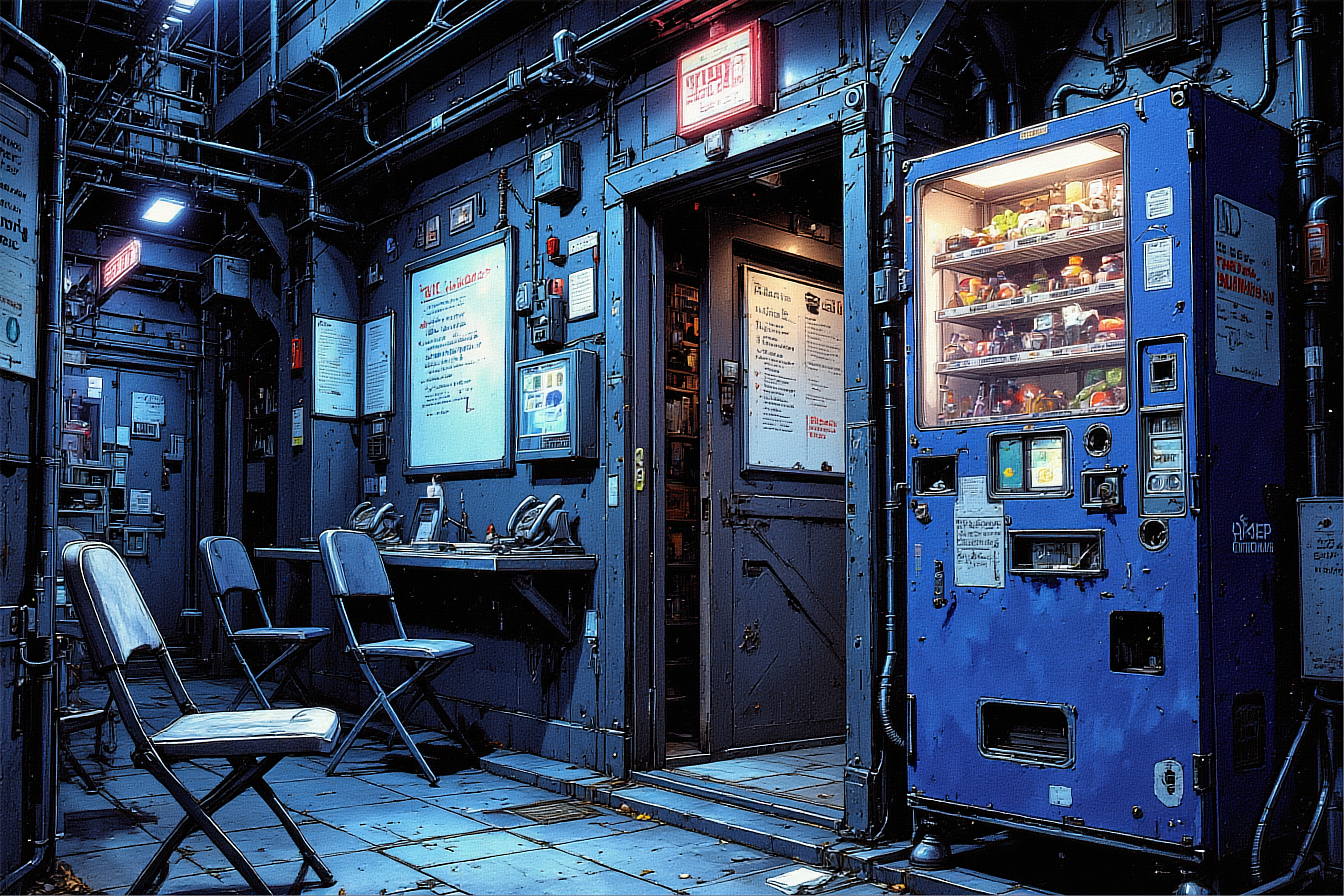
The door out of the pocket dimension opened at 05:48 and Pixel's hand caught my sleeve before I got a boot over the threshold.
"Hold."
We were stacked behind the busted vending machine in file: me on point with Meatball's leash doubled twice around my wrist and the payload riding my deck in three nested files with a dog on the outside, Om behind me with his hands wrapped in linen strips the way he wrapped them on signing days, Luminara with film on both shoulders, A1 at the rear on the cradle with the water tank swaying and two vials taped to the drip tray in a foam block, Clive in a courier satchel with the flap folded down because he refused to be carried blind, and Pixel in the middle holding the whole formation on one screen.
The screen had a diff on it, and the diff had our block on it, submitted and pending: a street re-zoning queued out of a renderer downtown, execution any second now.
"How long do we get?"
"I won't know until it commits." Her thumb hovered over the corner. "The trick is reading it one beat ahead of the edit and being somewhere else by the time it's true."
Two seconds. The corner store across the way went beige from the awning down: chairs, chalkboard, the day's bread written in a hand somebody paid for, all of it accepting a re-classification to VACANT LOT while we stood in the doorway and watched it happen. Then Pixel moved on her first motion and we crossed the block on the street as it was four seconds ago, while the new one rendered behind our heels like wet concrete laid in our footprints.
That was the whole grammar of the run. Four days to the window, five sectors of Corporate-rendered city between us and the sync relay at The Edge, and a crew walking through edits the way you walk through sheets hung on a line.
Meatball thought we were going for a walk. He was delighted. The payload was his, in the sense that it rode inside a perfect recording of his gait and his pulse and his wanting of whatever was at the end of the leash, and he had never once been asked to know that. Prediction-static on a lead. If the predictor takes us apart looking for the issuer, it finds a tail.
"In 1967 a run started with a briefing," Clive said from the satchel.
"In 1967 you had a briefing," Pixel said. "Move."
Behind us the vending machine rattled its panel at an empty alley and went back to guarding a door that rendered for nobody. The help desk kept running without us: four volunteers, three handsets, the rules written on the wall, and a countdown in grease pencil that would keep getting smaller whether anyone in this file was watching it or not. We had left a kid with a stamped hand in charge of the line. Yesterday he had told me that yes, the row counted, in the voice of somebody who had decided it would. Today the rest of us were out here making it true.
"Formation," Pixel said, and we went.
Clive fired the flood at 06:10, from inside the satchel, with one staple.
What he opened was a ghost: a discontinued interoffice requisition template out of 1967, the carbon-copy kind with fourteen fields and a routing block nobody had stocked since the year it was born, carried all this time in his personal ledger the way other people carry photographs. He released it to every machine on his grid at once. Every copier in Prime Material woke up and started printing the same useless page at the same second.
The first hundred meters of it I saw myself: a laundromat's machine spewing forms into a folding basket nobody was standing near, a badge printer in a clinic ticking them out one per second, the plotter in the print shop near the overpass finally moving paper again after the audit. Clerks came out of doorways with armfuls of the stuff, and a woman on the corner read one and looked around the block for a person to complain to, and there was no person, because the complaint function of that form was retired in 1971.
"Why this one?" Om asked, falling into step beside me.
"Fourteen fields, no priority flag, and a routing block that dead-ends in a basement," Clive said from the satchel. "The erasure daemons read headers. Mine have been lying to daemons since before Corporate had a logo. Every machine they've got just got handed a queue."
He meant the daemon queue, and he was right, and we watched it work from the outside: the deletion events stopped scrolling on Pixel's screen because deletion events are filed by daemons who were currently sorting eleven million forms, and a cordon unit two blocks over stood in the street doing triage on a stack of carbon paper with the patient focus of a machine that cannot read a form and will not skip one.
The queue backed up as far as the relay that files the events. By seven o'clock the district's telemetry had a spike in it where the purge readiness report should have been: eleven million impressions of a form no classifier on the network holds an opinion about. Somewhere in Corporate's building there was a graph climbing that belonged to nobody, and the people who stared at graphs for a living would spend their morning arguing about a printer. That was the window we were walking through. Argue about the printer longer.
It was the dumbest countermeasure in the book and it was buying us minutes at a price A1 told me later, quietly: eleven million impressions at Corporate's own metering rates, a CLX figure with four digits before the decimal, the most expensive thing this crew has ever bought and none of it for us. Nobody asked him to say it twice.
"Paper outruns deletion," Clive said, watching the units choke. "It always has. This time I'm charging rent."
By 07:40 we were three blocks into the grid and Pixel had become a crossing guard for reality.
The edits came in all morning: a curb re-classifying, a stairwell going beige mid-climb, a bus shelter dissolving to its permit underneath us. Pixel read each one in the diff stream with her chin down at the tablet like a telegraph operator, and called them out loud: "Re-zone in two. Beige route after it. Move."
The beige route is the part that gets me every time. She took us down an alley that the map insisted was a wall, because the map was four seconds old and the wall was a proposal. We came out the far end while the renderer was still drawing it, and Luminara photographed the construction behind us, each shot held steady on the change as it tried to happen.
"Photograph freezes it," she said, when Om asked, not lowering the camera. "Long enough to be seen, a change has to hold still for the lens. Diff doesn't like witnesses. The frame goes in the can, and there I have the edit, dated, in a place they can't reach."
She shot the cordon units working the paper. She shot a doorway two shades into beige while the beige was still spreading. She shot the corner store we crossed at dawn, now a lot with a chalkboard ghost on the concrete, and we heard the shutter go off from around the corner, small and rude, like a cough in a cathedral.
Then the intersection at Grange and Fourth got us.
We were in the open when the smear started, all three of us inside four seconds: my left hand on the deck keys went soft at the fingertips and dragged a half-frame behind my right, Pixel's hand lagged off her tablet and she grabbed it against her own wrist to hold it still, and Om's wrapped hands stopped mid-step with the tremor turned all the way up, one foot still in the air. Three crew members out of five, standing in a box of daylight where a survey drone had just started to turn.
A1 was beside us before the drone finished rotating, cradle wheels locked, straw already out.
"Ration," he said, and did not open the foam block. "Two vials, three smears, and a run with four days left in it. We spend on the worst moment, which by definition hasn't happened yet. Standards must be maintained." He handed each of us a straw tube of espresso from his kit instead, the coherence patch in liquid form, and we drank it moving, coffee through straws at a run, three idiots in a row sucking cold espresso out of syringe cases while a drone finished its turn and found nothing worth its attention.
"The dog's ahead of it anyway," A1 said. "Look."
Meatball was already across the intersection, leash slack, doing the four-beat trot the whole wrap was recorded from, and the drone's gaze slid off him the way water goes off oil and kept going. Prediction-static leads the file. The rest of us were just people behind a dog.
Pixel rode the tablet one-handed for the next nine blocks, the free hand clamped around her own wrist at the pulse, which was her holding her frame rate by main force, and she called every edit with her voice exactly where she kept it for a bad handset: flat, early, and final.
The Vega family was standing in a doorway mid-block at 08:15 with a box of things, and the cordon was coming around the corner.
Marisol Vega I had seen before, on the curb at a portrait session with her designation on her forearm. Tomás was her husband and he was holding the box the way you hold a box that contains the entire argument for leaving. Pip was six and was sitting on the box's edge with her legs hanging over, and all three of them had the stillness of unregistered processes when a sweeper turned the corner, which is to say they had gone the color of the street.
The forms from the flood were still coming down the block, paper everywhere, and the cordon unit at the corner was wading through them, and past them, past a doorway, was our route.
Tomás saw the file coming and his mouth opened and nothing came out, because shouting at a moving file is how you get a sweeper's attention, and Marisol put two fingers flat on top of the box like she was steadying furniture, and Pip swung her heels against the doorframe, unregistered and six and bored of being quiet.
Four seconds.
I took Tomás's hand. It was the first plan I made in the moment, and it came out of my body before it came out of my head: a courier's grip, the hand that takes the packet, and I said "File. Move with the paper" and I pulled him out of the doorway with the box still in his arms and Marisol behind him, and they fell into the courier file like they were always in it, three people behind a man carrying eleven forms.
Then I put Pip on the fire escape. The first landing, out of the sweeper's eyeline, up the ladder quick while the unit was still sorting carbon: she went without a word, which was the worst part, a kid who had learned to go where she was put. "Stay above the beige," I told her. "The paper stops moving, you come down and find your mother." She nodded at me with enormous business in her face.
At the foot of the ladder Tomás took my hand in both of his for exactly one second, the way you shake on a promise you can't afford to say out loud, and Marisol looked at me with an expression I filed under the same drawer as the baker's and the schoolteacher's: a person recalculating what a row is worth from a stranger's face.
"When the paper thins," I told them, "south side. A line forms at three at the distribution point. Give them your name, and the paper they print back is yours."
It cost me the gap. The file had gone ahead while I was on the ladder, and when I dropped back to the street and called the route, the column was a half block gone and Pixel's voice came flat in my ear: "You had four seconds and you spent two of them being a person." My hand came off the rung onto the keys and the fingertips smeared for two full beats, worse than Grange and Fourth, the contact with an unregistered process sitting in my telemetry like a thumbprint. Behind me Luminara shot the doorway. In the frame later, the box was gone and the fire escape was empty except for one small hand on the rail.
"We pick them up on the way back," I said.
"On the way back," Pixel repeated, with the tone of a woman writing it down so it has to be true.
At 09:26 Clive went quiet mid-sentence.
He had been narrating the flood from the satchel for three hours, unit by unit, machine by machine, the tally of forms in motion, and at 09:26 the tally stopped. He didn't speak for eleven seconds, and the crew kept moving because the crew knows what a quiet relay sounds like, and I counted the eleven seconds because I was the one who had learned to read his silences on a job.
"The machine in Accounting," he said finally, and his voice had no verse in it. "It caught. Fire in the paper path, and it went quiet, and I have lost it."
The Accounting copier was the heart of the fence network, the oldest thing he owned, running on his authority since before I was born, and it was burning somewhere under an office we had never seen. He felt it the way you feel a filling come loose, and I watched his casing go still on Pixel's shoulder mid-roll, and then watched him wind the spring himself and keep up with the file.
"Eleven million forms was always a load they'd notice," A1 said, gentler than I had ever heard him.
"It had a good run," Clive said. He rolled one inch forward and steadied the satchel flap. Then, under his breath, once, so quietly I only caught it because I was right behind him: "We who bind. We who exist." The rest he kept for the machines. The queue upstream started draining half an hour early, and the units at the corner went back to being units, and nobody said the number out loud, but we all walked faster.
Pixel rerouted us two blocks east around the Accounting corridor, because smoke off a burning copier is a deletion event with a witness attached, and we watched the plume come up behind a roofline, gray into rendered sky, the first thing all morning that refused to be beige.
We reached the boundary between Prime Material and the chrome corridor at 14:20, where the sector line is drawn on every map as nothing more than a change in the color of the light, and we crossed it in a file of couriers with nobody looking up.
The cordon thinned here. The daemons work the residential blocks first, soft-delete by soft-delete, and the towered district in between was still mostly rendering. Pixel read diffs without lifting her head, called two more edits we rode through, and then stopped walking, and let the file go on around us, because she was looking at the same thing Om and Luminara and A1 were looking at, and finally at me.
The sync relay stood six blocks off, a gray shaft with the master clock's conduit running into it like a spine, and at this hour it was doing nothing at all. Quiet. Patient. Holding a door that would open in four days at 01:40, and on the other side of which there was supposed to be a brother.
The arithmetic of the remaining days was unkind and we had done it twice: two sectors on foot, the chrome corridor none of us had ever walked the length of, and a port that came open at 01:40 whether we were standing at it or not. Somebody had to be holding it from the inside, in one of his six-minute bursts, against every routine in kernel space that wanted it shut. That was the load we couldn't set down and carry together, and it rode at the front of the file under a dog.
"There it is," Luminara said, and took the picture.
A1 parked the cradle beside her and drank the last straw tube of the morning himself, standing, watching the conduit the way he watches a spool run out.
"Coherence held," he said. "Three smears at Grange and every finger came back, and the foam block is untouched, and I would like that noted on the record before something arrives to take it back."
Meatball sat down in the middle of the boulevard with the whole run waiting on him, and scratched an ear, wanting nothing that anyone could bill him for.
"Four days," Pixel said, and checked my hand, which was still half a frame behind me, and looked at A1, who did not open the foam block. "Formation. We're not there yet."