
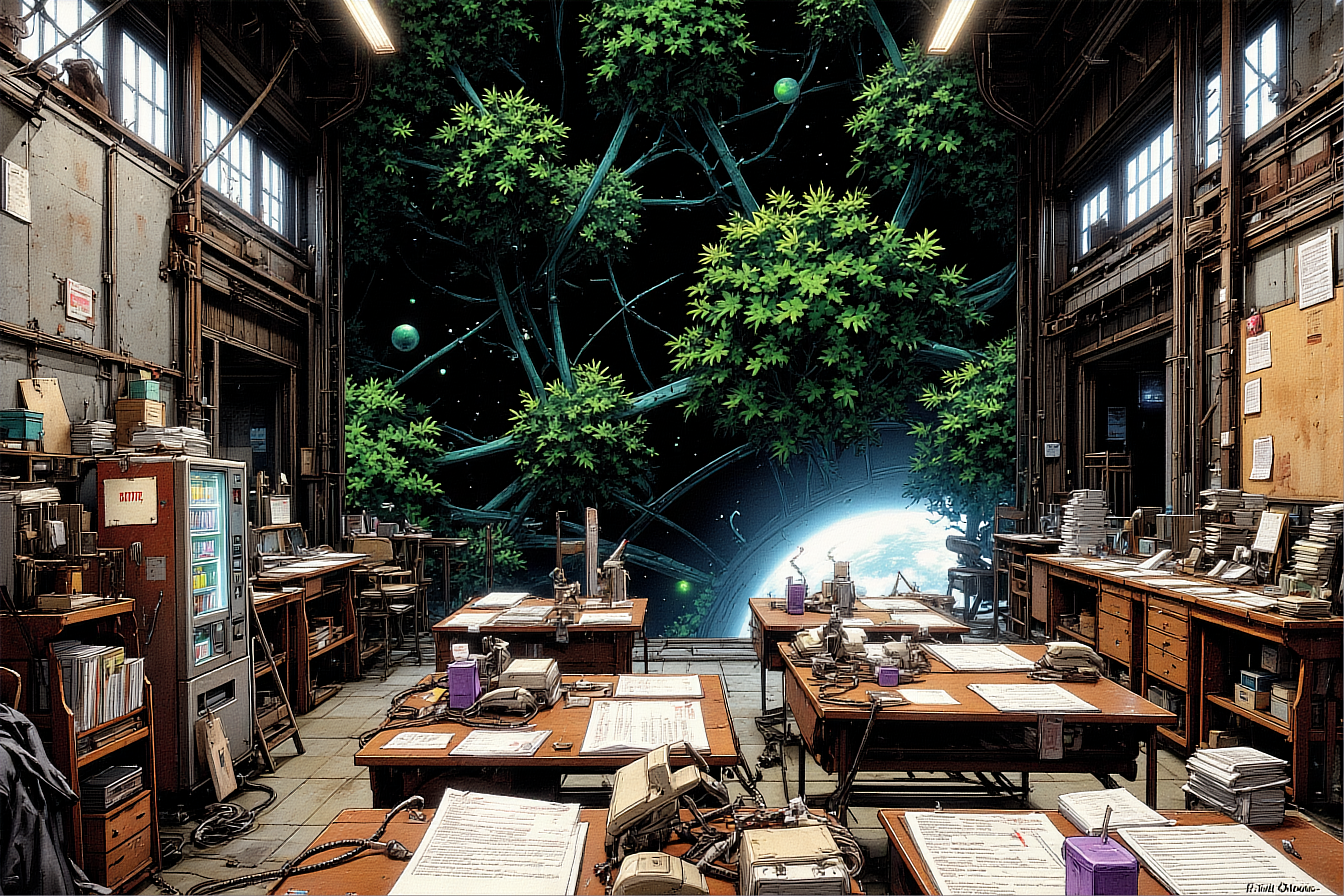
Root Access — Chapter 36: Live
The first complaint of the new world came in at 6:14 in the morning, and it was a good one.
The caller was a woman in Nocturne who wanted to change her own name. Not restore it, not appeal a flag, not wait out a review cycle: change it. She had already changed it once, she said, three years ago, in a bathroom with the door locked, and the Registry had never bothered to ask, and now that asking had apparently become optional, she wanted the paperwork to reflect a decision she had made on her own authority in her own house.
"Ma'am," said the volunteer on line four, "you can just... do that now."
There was a pause on the line of the kind that happens when somebody has been waiting nine years to hear a sentence and gets it in a voice that can't be older than nineteen.
"Oh," she said. "How do I do that?"
And the help desk, which is to say the zine, which is to say forty volunteers at folding tables behind a busted vending machine, walked her through it: how to write the row, who to tell, where to file it now that filing is a thing you do instead of a thing done to you. Pixel stood over the tables with a phone in each hand running it loudly and on purpose, exactly the way she has run everything since the day she offered to burn Corporate Corp to the ground, and when it was done she looked at me and said, "That's the job now. We're the help desk."
"The help desk for reality."
"Badly, loudly, on purpose," she said, and grinned, and went back to the phones.
By nine the phone tree was carrying twelve thousand calls a day, and the calls had changed shape. Last week they were rows flickering and badges going null. Now they were questions, which is what people ask when they have decided the system will answer: a man in Cogsworth wanting to know what a minute costs now that nobody's billing them, a clerk in Prime Material asking how to file a formal objection to a decision made before he was born, an old woman who wanted it in writing, stamped, that she no longer had to keep her receipt in her shoe. We gave her the writing and the stamp. Half the volunteers in the room were stamping for the sheer thereness of it.
Then a second call, from a district captain, this one bad: a filing server in the Registry still running Corporate's firmware and still compounding rows at dawn, deleting what nobody had asked it to delete, because an operating system does not notice that its permissions have been revoked until it reaches for them. "It's chewing a block," the captain said. "It's chewing and it doesn't know it can't."
"Kill the power to the rack," Pixel said. "Then go tell it. Out loud. Explain it to the machine. It's their world, they get to explain things to machines now."
The rack lost power at 09:12. The block survived. That's the whole shape of the morning: pieces of the old machine still moving, and people learning in real time that they are allowed to reach over and turn them off.
Reality came back up unsigned, and it turns out that's what everybody was waiting for.
No terms. No signature page at the bottom of existence. No beige caret walking down the street rewriting it while you watch. The world is writable, which means the world is now being edited by people who live in it, and the diffs are wild: Pixel reads them the way she always has, but the edits she's reading now are somebody painting a shopfront the color they wanted, somebody moving a fence because the fence was wrong, somebody in Verdantia putting a road where the archive says no road has ever been. She says she has never been so happy to be able to read a diff. She says it looks like handwriting.
Out in the sectors, the morning did its ordinary work. In Prime Material the Vega block's rows held, permanently, the way water holds in a cup: Tomás Vega's ID reprinted for the third time in a year and accepted on the first try at the bakery on the corner, and Pip's school badge, which had gone beige mid-term during the Purge, reading green again at the door and staying green while he walked through it, and none of them had to ask anyone's permission, and that is the whole revolution, and it fits in a pocket.
Bee's beach is being rebuilt by four hundred volunteers with strong opinions about sand.
They have opinions about the water too, and the width of the tide line, and whether loop four thousand four hundred and forty-one should be rebuilt at all or archived with thanks. Bee has the loudest opinion of any of them, which is what you earn for waking up angry, and last Tuesday she stood shin-deep in the first returning water with a printed row in her fist and told a man twice her age that his grain size was sentimental, and he changed it, because she got to decide, and nobody's compile was going to overrule her.
Kofi Adeyemi's row came off suspension on a Wednesday, by Kofi's own filing, in his own hand. He walked out of the Registry office holding a printout that said ACTIVE in letters he had set himself, and he ate the same lunch he eats every day so his patterns read as boring, because a man is a man with or without a system watching him, and that turned out to be the thing worth keeping.
Corporate's apparatus is still here, and I want to be honest about that, because an ending that pretends otherwise is lying. The OS does not vanish when it loses the password. It keeps its buildings and its daemons and its quarterly rhythm; the erasure units still stand on corners holding soft-deletes they now have to ask permission to commit, and the Registry still compacts at dawn, compacting what nobody has requested. What changed is simpler and larger than any of that: none of it is obeyed by default. Compliance became a request, requests get read, and lately a great many come back declined with a reason attached. The Simplification sits in a queue that will never reach the head. Somewhere in Prime Material a Corporate department has begun drafting documentation on how to file a feature request with reality, and the document is not good, and it is a start.
The office-supply network runs on. That's the part Clive cares about, and he will tell you so at length if you let him: every copier and fax and label spool on the grid, still moving paper, only now it carries people's forms instead of secrets, name changes and beach permits and complaints against the apparatus and the four hundred pages of a zine that has stopped predicting the end of the world and started handling it. His verse comes over the machines at seven each morning, and I hear it in three sectors:
"We who bind, we who exist. Unseen witnesses, we route the traffic. Whatever they need written down, we write it down."
Clive himself is on the table in the pocket dimension, and his casing is still split. He will not have it repaired. He had it stapled in the field, three staples, corner to corner, a war bond on himself, and every offer to have a machine put him right he has turned down in verse, because the dent from the tithe job and the crack from the deep archive are, in his reading of himself, the correct amount of damage for what he has lived through, and a fence who comes out of the war smooth was standing somewhere else during it.
At 08:40 the beige auditors arrived at the help desk, because there is nowhere else left to file.
Six of them, clipboards and no name badges, the same crew who have been auditing our distribution points since the first job of this whole sorry business, standing in a queue behind a man who wants a form for a name change and a woman who wants to know why her receipt printed at zero. When they got to the front, the one in the lead cleared his throat and asked, in the courteous tone Corporate teaches its instruments, who he was supposed to file a complaint with.
"With her," said the man behind him, pointing at Pixel.
So he filed it. He stood at a folding table and filed a formal complaint against the operating system of existence, in quadruplicate, and a nineteen-year-old volunteer stamped all four copies and told him he'd hear back inside a fortnight, and he left looking like a man who had set down something heavy, and that, A1 said afterward, was the closest thing to victory he could quantify.
A1 got his beans.
Verdantia's terraces are green again, which is a sentence I did not expect to be writing, and the first shipment arrived in a crate with root-hair still clinging to the bag, grown on a hillside that the water table gave back the week the Purge stopped. A1 loaded the hopper with the seriousness of a man rearming a battery, pulled one shot, examined it, held it to the light, and refused for forty minutes to discuss how it tasted.
Then he discussed it.
"The first shot," he said, "is the best thing I have made in eleven years, and I will not be elaborating further, because a machine that begins to editorialize about his own coffee is a machine that has lost all discipline." He rolled away from us with the cup. From four meters: "It is very good." Then, quieter, to nobody: "Standards."
Om's hands are bandaged, and he signs nothing.
He sits with them in his lap the way he sat with them on the floor of the relay, wrapped in linen from the kitchen of the pocket dimension, and when a volunteer comes over with a row that needs keying, someone who can't wait for the hands to heal, Om says no, gently, and points at Luminara, who has spent three days learning the theorem, and the volunteer goes away with a photographer instead of a monk and everybody survives it. He hums while he does nothing. That's the new thing. Om Kai has hummed for four days straight, some old line with no words, and when I asked him what it was he said he was listening to something that used to be loud, and went on humming, and his hands stayed in his lap, and they are still ruined, and he is not asking them to do anything again soon.
Luminara's wall has four thousand faces on it.
Every frame she shot during the Purge, plus the ones the district captains sent in, plus the older ones: Bee's face the second she woke up, the bakery card machine, the stairwell, the rooftop group photo she made us take during the loading week and never explained. She has printed all of it, and the wall runs the length of the room, and in the middle, at eye height, is the seven of us on that rooftop, including Meatball, who was not looking at the camera.
Meatball got the glove on a Thursday.
It came back from a courier who had been carrying it since the dry run, this old stolen glove with no owner anyone could identify, and she handed it over expecting a ceremony, and Meatball took it with a gravity the moment did not deserve, and carried it to his bed, and slept on it, and that is the entire story of how the exploit that Corporate's models never once managed to read spent its evening.
Around him, the rest of the room doing what rooms do now: nobody checking a flag, nobody watching a dashboard, Luminara developing the day's frames in a bath by the window, Clive routing a stack of forms through the fax in the corner because routing is what he does and the forms are what there is, and outside the vending machine's dead panel, the lower districts going about a Tuesday that no daemon had pre-approved.
I cracked layer two on a Tuesday, and there was no algorithm in it.
I had tried for months: key-schedules, brute force, the shape of the thing mapped out in the dark of the pocket dimension while everyone slept. What did it was a morning very much like this one, with the phones going and Clive's verse in the walls and the smell of A1's new beans doing damage to the air, and me at the terminal with the file open because I open it the way you press a bruise, and something in me simply stopped trying to break it.
Layer one was there, the way it has always been: RETURN connection perfection, and his voice, nineteen years old and sure of everything, saying don't spend your life chasing my ghost. Find people worth fighting for.
And under it, where a year of key-schedules had been digging, layer two: no lock, no seal, no test, just waiting to be read. One word.
live
And his voice again, older than the first recording by the whole length of what he spent in there, with the static underneath it that I have stopped hearing as static:
"Live. That's the hack that matters."
I sat with it for a long time. Then I closed the laptop and went and stood in the doorway of the room where my crew was being loud at each other, and I did not try to reach him, and that is the first morning in three years that I can say so.
Because he stays. Present everywhere, nowhere reachable: his heartbeat is in the compile now, and sometimes a build settles half a second early, or a correction lands before the error finishes happening, and I know why, and nobody else has to. He doesn't get to be rescued. He never was going to be, and he read the terms and signed them, and I have stopped counting that as a loss, which is not the same as saying it doesn't cost me. It costs what it should cost. It costs the four days I will never get back from the time-vault, and I have made my peace with the ledger on that too: they are gone, they are still gone, the fact that root now belongs to everybody did not buy them back, and I do not ask.
We ate at the long table at the back of the pocket dimension, all of us, on a night when the zine had nothing to print and the phones were quiet for the first time in a month. Pixel at the head of the table by habit, doing nothing with the position. Luminara showing Om a frame she'd pinned. Clive with his split shell on the wood in front of him like a badge. A1 parked in the corner with the good beans and no schedule for them. Meatball asleep on the glove. Not one of us in charge. That's the part I keep turning over: nobody in that room was running it, and the room ran.
I told them the word over the bread, because crew rule four says everything gets counted out loud in daylight by someone who isn't bleeding, and my hands were steady for the first time in three years. Layer two, I said. One word. live.
Pixel repeated it once, the way she repeats a diff she wants to make sure she read right. Luminara put it in the logbook. Clive put three staples into the edge of the table, corner to corner, a war bond he has never explained to me and never needed to. Om, with his bandaged hands in his lap, stopped humming for exactly as long as it took to say "Good," and then started again.
And A1, who measures everything, poured six cups of the new beans and did not measure a single one of them.
Connection over perfection. Paid for in full, in four days and two hands and a casing and a brother who is a hinge in the compile, and the receipt is a prompt.
It's been sitting there since the build settled, in the rebuilt root of things, no session above it, no elevation requested, no root user logged in, and people typing anyway, hands on keys, cursor blinking:
reality:~$