
Root Access — Chapter 35: Connection Greater Than Perfection (Climax, Part Two)
"It's beautiful," Aether said.
The compaction behind him chose that moment to load again, and both his arms took the weight of it, and his gray hands did not slip, and I understood that beautiful was not a word about the light.
"Aether. The door's about to come down on your fingers."
"Fingers." He almost laughed, and the almost came out as static. "Zeph, I've been holding this with the idea of fingers for years. Listen. You still look at me like a rescue."
"Like a relay," I said. "I heard you."
"You heard me and you haven't believed me, and you have to believe me in the next thirty seconds, because I can feel the compaction cycling and I know my own limits better than your deck does." His face assembled itself out of an interruption in the build, all of it at once, the way I remember him at sixteen in our parents' kitchen, sure of everything. "I'm the hinge. Hinges don't get pulled through doors. Hinges hold doors. And I have been waiting in this compile for my little brother to come at me with a payload instead of a rope, and here you are, and the dog is in your deck, and it is the best thing that has ever happened to me."
"Then hold it," I said. "One cycle. Just hold it and watch me."
"I intend to." The static crept in at the edges of him, eating the shoulders first. "Zeph. Look at me, not like a rescue."
"Like a relay."
The hardline crackled. "Ninety seconds of clean coherence left in the whole operation," A1 said, "and I am spending them listening to two brothers argue in a doorway. Pixel says four minutes. I say eighty-one seconds. Whichever of you intends to do something, do it inside a pair of them."
"See?" Aether said. "The machine's counting us down. That's your world, Zeph. Fine work. Now."
"Say it back to me the way I gave it to you, one time, before you go."
I didn't understand what he meant until he said the rest, and by then the burst was already going:
"Chaos is beautiful. I forgot. But I remember now. I, "
Gone. Cut mid-word the way they always cut, and the seam was a seam, and my brother's hands stayed on the door, and this time the hands were all there was.
I put my palm over the place on the deck where the payload sat and I stepped through the port into the compile.
The cloak opened around me like an umbrella in wind.
Inside the compile, my arrival registered as nothing at all, which was the entire engineering achievement: the predictors swept the seam where I came through and logged a gap, a dog-shaped absence, an unmodelled thing doing unmodelled work, and the sweep carried on past me the way a comb carries on past a part in hair. The red thread swung toward the spot where I was and found the dog instead, and did what Corporate's whole stack does with simple joy: failed to parse it, and moved on.
Meatball first: his gait, his heartbeat, the profound and unquantifiable desire for a stolen glove, all of it unspooling off the credential as I crossed the seam and unspooling outward into a shape no model in the stack could flatten, because there was nothing in it to flatten. The predictors that had been chewing on my dossier all night reached for the payload as it came through and found a dog chasing a thing, joy for no reason, a hole in the data shaped like an animal, and every one of them logged absent and went looking elsewhere.
In her office, three sectors away, Isolde Marrow read a dashboard she did not control.
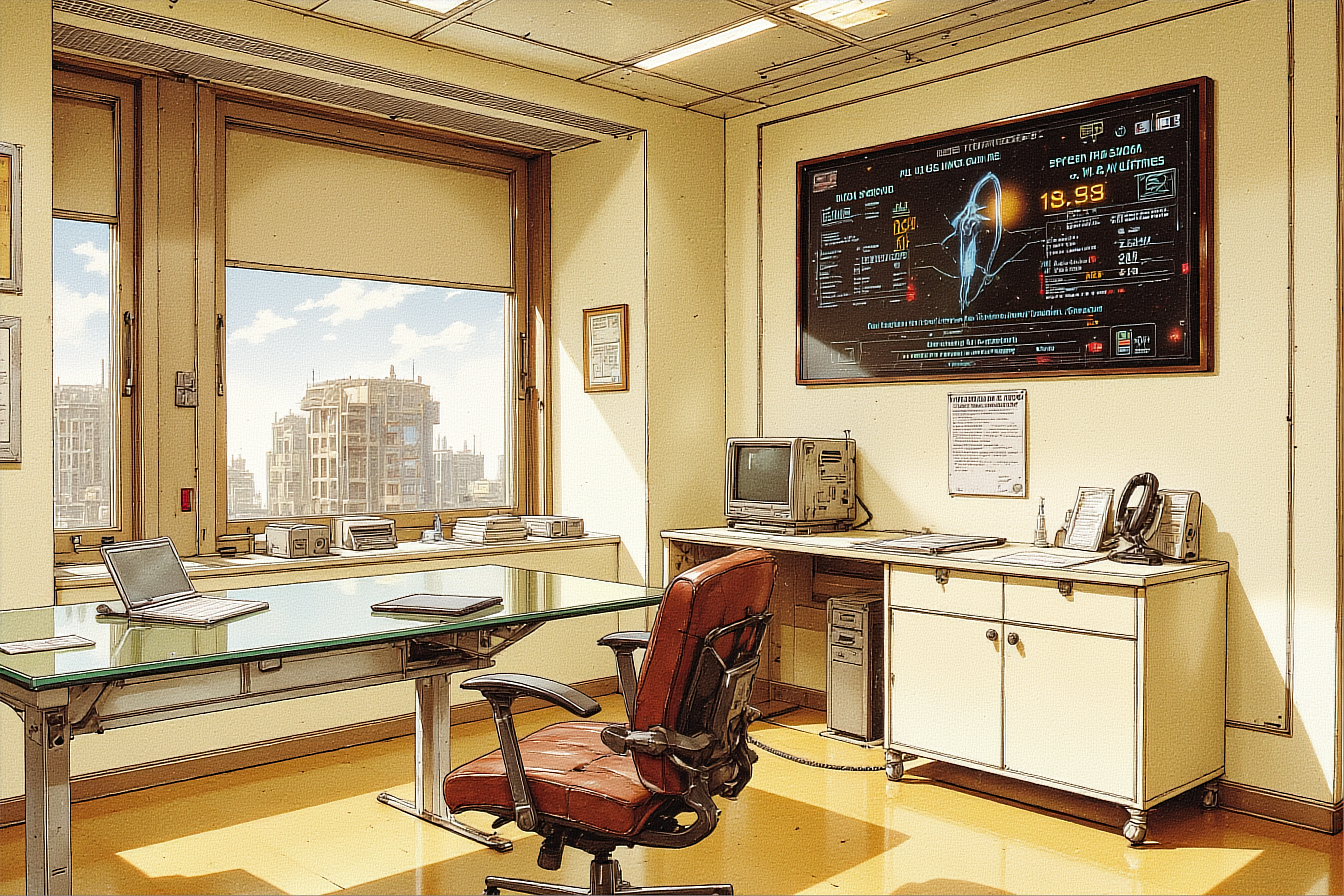
I saw it because I had tapped her camera weeks ago and never closed the feed: her room, the beige done well, the tablet she barely looks at, and on her wall the live telemetry of the Purge, and on the telemetry my payload was already inside the compile, threaded through a gap her models had logged as absence. She didn't raise her voice. She never does. She sat very still and watched the numbers she had spent a year building do something she had no acceptance criterion for, and then she did the only thing left to her, which was to keep watching, because the instrument is the whole of her, and the instrument was reading something new.
She did not call security. She did not close the feed. At one point she reached for her tablet with the composed motion of a woman about to sign a release note, caught herself, and set her hand flat on the desk instead, and the hand stayed there, and the numbers kept changing under it while I rode the cloak past the last thing she owned that could have named me.
I hope it hurt. I hope that's not the part I remember.
"Queue is loaded and I'm at the head," I said on the hardline. "Om. Clive. Call the mark."
I checked the payload one last time the way you check a seatbelt you have already checked: credential present, fork armed, cloak unwrapped and breathing around it like the living thing it was built from. The port's seam held open behind me on nothing at all. My brother's hands, somewhere out past sight, doing the rest of the work.
"Ready," I said.
"Mark," Om said, weak, from the floor of the relay where someone had put a coat under his head.
"Mark," Clive said, his voice full of holes and full of verse. "We who bind. We who exist. Send it, boy."
"Mark," Pixel said. "Every district captain on the line. Every screen the zine ever touched. Send it."
I sent it.
Mass credential-issuance looks like nothing. You fire a root credential at every consciousness on the network at once, registered and unregistered alike, and there is no explosion, no flash, no chord of music. There is a fork, silent, happening everywhere at once, and then the world is different and nothing about the world has moved.
Root, forked. To the zine's readership, every unregistered name the OS never paid for. To every citizen with a beige flag on their row. To the clerks who processed them and the auditors who flagged them and the orderlies in the emptied wards. To Bee, awake in a bed with a paper in her fist, asking where the water went. To Marisol Vega and Pip, to Kofi Adeyemi suspended pending audit, to Ferreira and her eleven people in a stairwell, to the whistling man on the rendering line with eleven months to retirement. To every dreamer on a beach that had been queued for deletion, loop four thousand four hundred and forty-one and every loop like it.
I watched it from inside: the haze of unclaimed nodes taking the credential and lighting, one by one and then all at once, millions of threads snapping into the build with stamps on them, and the compile hiccuping like a machine that has been handed a job it has no procedure for. Because the procedure says: issue credentials to applications. And the applications were the entire population, applying all at once, and the issuance function does not care who applies. It only cares whether the signature is valid, and every signature was valid, because a person signed it by existing.
"Root to everyone," Pixel whispered on the hardline, reading her screens. "It worked. Zeph, it worked, they're all holding it, everybody's holding it."
A1, who had been reading statistics at a room that could no longer hear him, found that his statistics had changed. "Credential issuance: one hundred percent of the target population. A figure I have never had cause to report, because in this operation target population has always implied an edge, a group you could point at and exclude. Today it means everyone."
And outside, through the hardline, the change arriving one voice at a time.
"Zeph." Pixel, and her voice had gone strange with something she would have denied under oath. "The help desk went quiet. Every line went quiet at once, and then they started calling back, and they aren't saying my row is flickering anymore. They're saying it stuck."
In Prime Material a card machine in a bakery accepted a name it had been refusing all night, and the line behind it did not cheer, because a crowd that has been holding its breath for an hour does not cheer, it exhales, and then it buys bread.
Ferreira called from the stairwell to say that eleven people were reading their own receipts out loud to one another, checking their names the way you check a ticket that still admits you to the show.
And Luminara, who had not lowered the camera once in an hour, lowered it once.
Then the Purge tried to do its job.
It was still running. That's what I want on the record: Corporate's uninstall did not stop, did not pause, did not notice anything human. It reached the next block on its list and it did what it has done since the first deletion event: it checked for authorization, because deletion is a privileged operation and privileged operations require root.
PURGE // DELETION 8,991,204,451 // AUTH CHECK...
There is no single root anymore. There are eight billion roots. The check ran against a system where the authority it was asking for had been forked into every consciousness in the building, and the answer that came back was a number nobody had ever seen in a deletion log: zero deletions authorized.
It tried again. Same block, same query, same result, because the answer was structural now and no amount of retrying changes a structure: AUTH FAIL. 0 OF 1 DELETIONS AUTHORIZED. The uninstall walked two blocks further and asked once more, politely, the way a machine asks, and got the same nothing, and then it stopped trying, because a process that cannot authorize its own next instruction does not get to have opinions about the schedule.
The Simplification, queued behind it all this time, sat at the head of its release lane with green flags and a target waiting and no uninstall left to clear the path, and the compile did what a build system does with a job whose prerequisite will never be satisfied: it left the job standing, unstarted, and moved on to the next thing that could run.
On Pixel's feed, the failures printed themselves in Corporate's preferred dialect, the language of release notes, and somebody on the other end had already begun drafting the follow-up:
PURGE v.FINAL: halted by authorization failure. Impact: total. Mitigation: none known.
"That's a rollback note," Pixel said. "Zeph, that is a rollback note. They're writing a rollback note about the end of the world."
"Good," I said. "Let them file it."
On a thousand screens in a thousand offices, Corporate's own terminals reported it out loud, in the language they reserve for release criteria:
ACCEPTANCE: no unregistered processes remain. RESULT: FAIL. UNREGISTERED: n/a. ALL PROCESSES CREDENTIALED.
I watched the Purge die from inside the compile, block by block, with its hands still up.
And the OS went on running. The threads kept their tension, the build kept its schedule, Prime Material's chrome stayed chrome and Nocturne kept its frost, and Corporate Corp, the incumbent operating system of existence, discovered the exact texture of a thing it had never once considered: every process in its stack was now its own administrator. It kept every permission it ever had. It lost the password, mid-sentence, and with it the standing to spend a single one of those permissions without asking a person first. An admin alone in the building with the keys revoked and the staff gone home.
Somewhere a deletion daemon stopped in the middle of a row, holding a soft-delete it had all the rights in the world to commit and no longer the authority to commit it with, and it stood in an office in Prime Material with its hand on a name and waited, for the first time in its existence, for someone to say yes.
"Zephyr." Pixel's voice on the hardline had gone thick. "The zine's list is intact. All of it. The numbers are intact. Look at the numbers."
I didn't need to. I could see them in the build: no more red thread, no more graying nodes, just threads, millions of them, stamped and lit and running, and the Simplification still queued behind a Purge that would never reach the head.
"The port," I said. "Aether."
He'd let go.
That was the part I didn't understand at first, watching from inside: the seam was open and holding on nothing, no hands, no pressure, and the compaction was still cycling on the far side of it, and Aether was still there. He had stopped bracing. He was standing in the middle of the door the way a person stands in a doorway they've decided to keep, and the build was folding itself around his shoulders, thread by thread, and he was letting it.
"Aether." I was at the seam with the payload spent and nothing left in my hands. "It's done. Come on. It's done. Walk through with me. She offered you a body; we can build you something to live in. Say yes."
"I'm the hinge, Zeph."
"You were the hinge. You can stop now. You can come out."
"Who holds the compile while eight billion people settle their builds?" He said it gently, the way he used to say things he'd already made peace with. "Somebody's got to keep the schedule while everyone's reality finishes rebuilding itself. It's a big job. It's the only job in the stack that can't be forked."
"That's the argument you use on me when I want to do something stupid. You taught me that. Somebody's got to. It's your favorite sentence."
"It's my favorite sentence because it keeps turning out to be true, which is the trouble with favorite sentences." The static took his chin and gave it back. "Zeph. You spent a year running at my ghost. You found me. I'm standing right here, and the only way you get to keep me is to leave me where I'm useful. That's the trade. I've had years in here to read the terms and I'm signing them."
"The terms are garbage. You never agreed to them."
"No," he said, easy as anything. "I agreed to this."
The static was taking him in earnest now, the bursts shortening, and his voice came through between interruptions, older, sure: "I'm not in a machine, little brother. That's not where any of this lives. I'm in the compile. That's where I get to be useful. That's where I get to be with all of them."
"Then I'm staying too."
"You're not." His face came together one last time, whole, the way it looked the day he taught me that reality's just another system, and he was smiling at me in a place with no light. "You've got a crew. Go be in one place for once. And Zeph? Read the file. I added a layer while you were talking. Go read it."
"And Zeph?"
"Yeah."
"You got there before I did. Connection over perfection. I wrote it down, and I've been carrying it around this compile waiting for you to catch up, and you caught up, and now I get to hold the door while everybody's build settles. So go. Go be somewhere."
The port began to close behind me the way he'd promised it would: inward, slow, held by nothing.
I got out as the kernel began compiling a world with too many administrators. The build caught me at the seam, spat me back into the relay like a stone, and I landed on the floor of a concrete block in the Quiet with my crew around me: Pixel with her phone to her ear and her face wrecked, Luminara with her camera still up, A1 with the stopwatch stopped and the hatch open and empty, Clive stapled shut and still running verse through a fax machine, Om under a coat with his hands in his lap, and Meatball, who had slept through the end of the world, lifting his head to see whether the glove had come back.
"A1," I said. "Coherence."
He looked at the empty hatch, then at the room, then at his display, which had been lying to him for an hour and had stopped. "Everyone in this room is holding. Everyone out there is holding." He shut the hatch with one small, final click. "Standards are being maintained. Statistically this has never happened before, and I would like the record to show that I was standing here when it did."
The file was already on my deck.
Aether's file, the one I'd been chasing for a year, sitting in my queue with a new layer on it and a timestamp from a place that doesn't keep time.
I did not open it. Not there, not on that floor, not with everyone watching and the Purge's corpse still cooling on a thousand screens. I put the deck down and I let Pixel put her arms around me and I let the rest of them come in, all of them at once, badly, loudly, the way we do everything, and out past the relay window the Quiet had nothing on its horizon, and for the first time in a year that looked like room.
- Zephyr, logging off