
Static Between Stars — Chapter 02: Three Dead People and a Dog
The bridge to the aft hold is ninety-one meters of converted courier corridor, and she has walked it with a clipboard often enough that her feet count the seams on their own: eleven expansion joints, a scab of old weld where some prior owner took a rock at speed, and one deck plate short of the aft bulkhead that rings a note higher than all the others. At 0230 she was walking it with A1's coffee in her left hand and the Ostrell log in her right, because that is what a night aboard a press ship actually is: corridor, mostly, and the clipboard, and the hour you walk it again because the numbers have not moved.
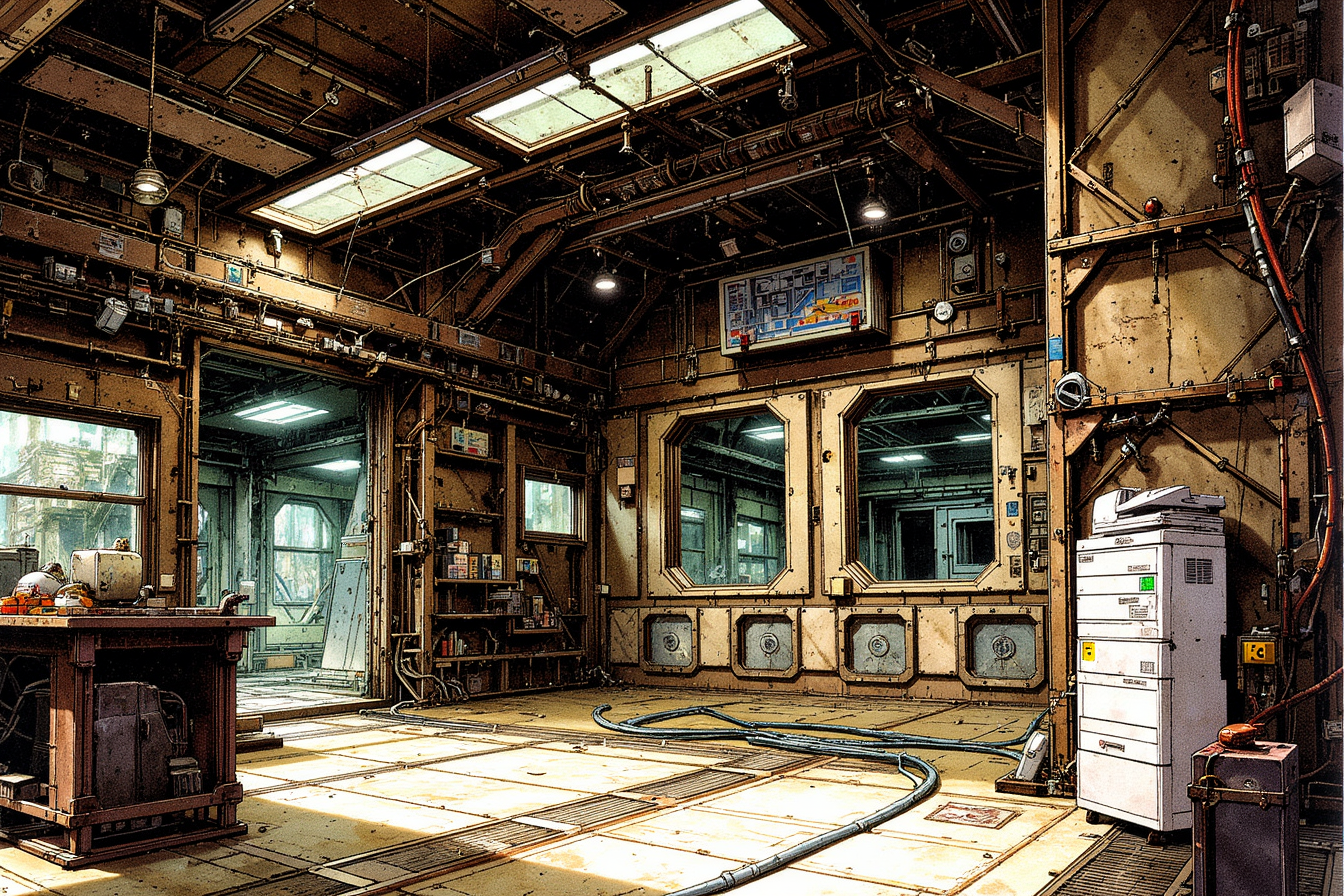
The hold still carries the bones of a cargo bay. Crane rails run the full length of the overhead. Tie-down rings sit in their grid in the deck, three years untouched, and what fills them now is half press, half paper: rack after rack of duplication hardware bolted to shock frames, a carrier amplifier with its face panels missing, cable looms roped along the overhead like rigging on a boat that never learned to stop, and the master files in steel drawers against the port wall. They had spent three years filling it.
Against the starboard frame, welded to the deck plates with a bead so ugly it could only be hers, sits the photocopier. Her serial number is ground off, her feed tray jams about once a week, and she has put more subversive truth into more hands than every licensed broadcaster in the Ostrell system combined. That is the whole architecture of their lives: one converted courier with her cargo bay gutted for equipment, one amplifier, one copier with attitude.
She found A1 at the bridge console, because A1 is either at the console or in the galley pretending he is in the galley. His espresso machine is the only appliance aboard with its own power conditioning, and the size of the cup he pours is a readout she has learned to read the way other captains read an altimeter.
Small cup. Bad numbers, and a name attached to them.
"Interdiction probability over the next six hours: nine percent," he said, before she asked. His hologram stood at the chart table with his hands folded behind his back, butler over a tactical engine like a rug over a floor. "Ostrell's coordinates are still warm, and warm coordinates draw curiosity. Eleven percent if we transmit again before dawn."
"I filed four hundred words at 0440."
"Which is precisely why the number improved." He set the coaster square. "Sit, Captain. The greenish one is turning in its dark and you have been standing up for eleven hours."
She took the coffee instead. "Crew status."
"Officer Glitch is at the comms board with his deck on his knees, running a listening queue he has not shown you. Photographer Usha is in the hold with her lenses in the order she trusts them, which as always is not the order they are numbered. Chaplain Om is in the galley, counting. And the dog has achieved the comms panel again."
"Where the luck lives," she said.
"Where the luck sleeps," A1 said, "which is a related but distinct claim."
On the board, exactly as advertised, Meatball lay in the exact center of the comms panel, a Rottweiler of unclassifiable classification, forty-one kilograms of black and tan pressed flat across the soft keys so that any signal reaching them from outside would have to route around him. He had been a stray on a freighter dock, unpriced by the Registry, unclassifiable by targeting software, and statistically the best thing that had ever happened to this crew. She has never been able to prove the luck part. She files it anyway.
Zephyr did not look up. He was twenty-one, mohawk gone to bristle, cyberdeck taped at the corner where the hinge had given out, and his fingers moved across it the way a pianist's do when the piece is easy and the mind is somewhere else entirely.
"Anything on the band?" she asked.
"Freighters still loading on the quayside. Nine of them. Somebody down there is yelling at a crane operator in a language the courtesy packet does not have a word for." He said it flat, and his fingers never stopped. "Also your carrier light is green, Pixel, if you were wondering whether anybody is out there listening to us be honest."
"Nobody's listening."
"That's not the same as nobody hearing," he said, and then, because the bridge is where Zephyr says the true things he will later pretend were jokes: "Log it. File it. It's what we do. Three dead people and a dog, keeping the row even."
Three dead people and a dog.
The Registry believes, in the specific way it believes things, that Piper Chen died in a variance incident on a Tuesday: the day the break room tore, the day reality went out of true across four systems, the day a ship's manifest and a ship's crew stopped agreeing with each other and the paperwork resolved the disagreement by killing them. Piper Chen's row was struck. Zephyr Glitch's row was struck. Luminara Usha's row was struck first and came back under a designation instead of a name, Linda3637, which is a number the Registry still files in a field called person. Om Kai's monastery answered for him. A1 has never had a row at all, which he regards as the only clean fact about his existence.
Clive's row reads property, lost. He considers this the most accurate thing the Registry has ever written.
"You're brooding in the doorway again," Clive said. He was up on the port console with his staples-arm out, driving a fastener through the corner of an old survey chart, one of nine he has pinned to that bulkhead over the years, the ink faded to the color of weak tea. "A captain in a doorway is a woman deciding whether to walk. Walk, kid. The dead don't need you to stand still on their behalf."
"You logged the strike?"
"I logged the strike." Tap. The staple went home. "Nineteen minutes after the packet arrived, I logged the population field, the closing note, and the exact wording of endeavours, plural. Evidence is the only trade I have left, and I intend to die inside it." He adjusted the chart's lower corner, the one with the route inked out into coordinates the modern maps leave empty, the line that goes to where the Petrel did not come back from. Barry Kowalski's name is not on the chart. It does not have to be. "You want the odds, ask the machine. You want the truth, ask who filed it."
"A1 gives odds."
"A1 gives espresso," Clive said. "The odds are in the cup."
The galley is four meters of it, and Om Kai occupies it the way weather occupies a valley.
He had the kettle at temperature and his tea steeping in the glass pot he keeps for nights like this, and on the table between his hands lay the count: a paper ledger, because Om does not trust a file that can be struck, filled in his careful block numerals. The dead of Ostrell he had not started, because the dead of Ostrell were not dead yet, and Om has never once entered a name early to spare himself the writing later. Above that line, older, he kept the totals he had carried off the mountain with him when the Deeproot Cloister was delisted and its records seized, one copy of one ledger that no archive in the galaxy will admit exists.
"Sit," he said, without looking up. It is the word he uses most and means least as an instruction; he knows she will not sit.
"How many," she said, "are you at."
"Two hundred years of the Conglomerate's arithmetic, in a hand I keep, and I do not round." He kept his hand flat on the closed cover. "The older columns stay shut tonight. Plus the ones since. Plus tonight, which is not yet a number, because a delisting kills in categories and the categories arrive on schedule."
"On schedule," she said. "That's the part I keep filing. Nobody improvised anything on Ostrell."
"No," Om said. "That is exactly what I am counting for. A crime with a doorbell is not less of a crime. It is a crime that expects to be thanked." He poured, and the smell of it, black and bitter and honest, took the whole small galley. "You will want to know whether we should have jammed the packet again."
"I already know what I decided."
"Then I will tell you only the thing you did not decide," Om said, "which is that somewhere down there, a child is going to sleep tonight on the last night of a grid, and nobody has told that child what the word retired means. Carry that, Captain. Do not answer it. Carry it."
Luminara came down the ladder with her long lens capped and swinging at her hip, and stood in the galley doorway a moment the way people stand in doorways on a ship at night, listening for the shape of the conversation before entering it. She had been on the viewport for an hour with the glass, photographing nothing, which is a decision she makes deliberately and then logs.
"The quayside is still lit," she said. "I have eleven frames of a crane that will be an empty sky by morning, and I am not taking a twelfth." She sat on the bench and put the lens on the table like a man setting down a drink. "I was erased, so I know what it looks like from the inside. It looks like the last shift finishing on time. It looks like people being good at their jobs on the worst night of their lives."
"That's the war, then," she said. "A last shift finishing on time."
"That's the war so far," Om agreed, and wrote nothing down, which for Om is the same as writing it down.
The toll-lane inspector found them at 0312, which is the hour the universe reserves for men with clipboards.
Zephyr took the hail with one hand, Meatball's ribs against his wrist. "Courtesy sweep, Lane Nine Toll Authority, inbound," he said, reading the header before the voice finished introducing itself. "They want the transponder lit."
"It's dark," she said.
"It's been dark since we arrived, which they know, which is why they're calling it a courtesy." He grinned without any humor in it. "Courtesy is a boarding with the paperwork pre-filled. Want me to feed them the manifest?"
"Feed them the manifest."
The cover identity unrolled on his screen: Bright Ordinal, independent courier, registered out of the Fenwick rows, crew of four, cargo listed as agricultural filtration membranes, forty tons, bound for the quayside at Ostrell with a delivery window that no longer existed because the quayside was in the middle of being retired. A clever cover invites a second look, and a boring cover leaves a form nowhere to stick, so they had chosen boring on every field.
"Courtesy sweep returning," A1 said. "They are running a passive bio-count alongside the ident. Their system will note any discrepancy between declared crew and found crew."
"Found crew," Zephyr said. "We have four."
"We have," A1 said, "a discrepancy."
The scanner had found Meatball. Not as a dog: the ship's register classified him under miscellaneous, non-revenue, which is what you file when the alternative is explaining a stray to a toll authority. The inspector's software had matched the mass on the comms panel against a manifest field and found nothing to file it under, the same way every targeting computer in three systems had found nothing to file him under, and a machine confronted with a value its form cannot hold has exactly one administrative option.
"Inconclusive," the inspector said over the channel, in the voice of a man reading a screen he did not enjoy. "Bright Ordinal. Your bio-return shows an unclassified mass on the bridge. Confirm the nature of the mass."
Zephyr looked at her. She looked at A1. Somewhere behind them, in the quiet that a bridge makes when it is deciding who is going to say it, Clive's staple went through the bulkhead with a sound like a period.
"Confirmed," she said. "Ship's dog."
"The form has no field for a dog, ma'am."
"Then put us down as inconclusive and keep the lane moving, Inspector."
A pause long enough to file. Somewhere in Toll Nine, a man weighed a dark transponder against a mass his software would have to explain to a supervisor, and chose the lane. "Bright Ordinal, your receipt is on the civil band. Declare the membranes on arrival." The carrier dropped, and Zephyr let out a breath like a man setting down a crate.
"He picked inconclusive," he said. "Over a dark transponder. Because of the dog."
"Because inconclusive costs him nothing and boarding costs him a report," Clive said. "The universe is a badly written detective novel, kid, and the butler always files. Sometimes you win by making him file something dull."
Meatball, who had just been cited as a jurisdictional argument, opened one eye, considered the victory, and closed it again.
She filed the ship's dispatch at 0340, in the chair, headset on, Zephyr's carrier light green in the corner of her eye. Short, because the night was not finished yet.
Dispatch, 0340, from a bridge the Registry says does not exist:
This is Pixel Paradox, aboard Bright Ordinal, which is our name when someone asks, and a lie when someone checks. Tonight's cargo: none. Tonight's cover: forty tons of filtration membranes we do not have, a crew of four we do not have, and a dog the toll authority's forms cannot hold. We are officially deceased. I am writing this from a chair my own row says is empty, and the row for Piper Chen reads retired, and the row for the world beneath us reads retired, and the only field either of them ever filled correctly was the date.
We are three dead people and a dog, and we keep the row. Every name the machines strike, we write down in a format they cannot delete. That is the whole war so far, and if it sounds small, remember that the Conglomerate's entire genius is making four hundred and six thousand people fit inside a sentence.
If you are out there with a transponder dark and a manifest you are not proud of: keep it dark. Keep moving.
, Pixel Paradox, signing off
The headset came off. The bridge went back to breathing: the hum of the amplifier warming, Meatball's snore a half-step off the metronome of the cooling fans, Ostrell turning below with its kitchen lights out.
It was 0455 when the dead-drop resolved. The packet that had lit the console while she was still speaking had been sitting sealed in the corner of the board since 0440, no sender, no route, a contract addressed to nobody in particular that had found them anyway, and Zephyr had been working its cipher in the margins of the watch the way he works everything: sideways, patient, with his tongue between his teeth.
"Opens clean," he said. "Pixel. It opens clean and I don't like that."
He threw it to the main screen, because a captain should see a contract the way the whole crew sees it: unrolled across the glass in the Conglomerate's own billing font, patient as an auditor with all the time in the billing quarter. Transfer of custody. A crate consolidated at a depot called the Tenth, out past the toll-lanes where the maps start apologizing. Destination filed as reprocessing. And the commodity line, in the flat gray text the Registry uses for things it has decided are inventory:
Registry entries, unregistered.
Under it, the quantity.
Three thousand.
Under the quantity, the custody clause: crated, sealed, and scheduled for reprocessing at the opening of the depot's next cycle, which A1 calculated aloud as nineteen hours and eleven minutes, and did not comment on the size of the cup he was already pouring.
"They're boxing names," Zephyr said. He had stood up without meaning to, the deck still in one hand. "Three thousand rows with birthdays attached, and somebody wants them moved before the repressor wakes up. That's not contraband, Pixel. That's a grave with a shipping label."
"And the payer," A1 said. He had the signature field isolated on the console, a single line of cipher turning slowly where a company seal should have been. It did not resolve to any registered entity. It did not resolve to any registry, any lane authority, any mint, any court. Every payer in the Conglomerate's long and immaculate book of payers ends in a number somebody can call.
This one ended in a stranger's name.
"Who signs a job like this?" Luminara asked from the doorway. She had come up from the hold with a lens still capped in her hand, drawn by the light of the screen. "No sender, no route, no seal. What kind of payer doesn't want to be paid back?"
"The kind who wants the crate gone," Clive said, "and wants the receipt to be the only proof he ever asked."
The bridge let the screen hold the quiet for a moment, which is what this crew does when a decision has arrived ahead of the plan for it.
A1 watched the signature field go around its slow circle twice. "The cipher will keep, Captain. The cycle will not. Somewhere past the toll-lanes a crate is counting down to a morning, and every hour spent admiring the question comes off the answer."
She looked at the contract on the glass: transfer of custody, destination filed as reprocessing, and a name at the foot of it that belonged to nobody who could be asked anything. Three thousand rows with birthdays attached, priced as unregistered entries in a font that never hurries. It was the oldest kind of bad job in the quadrant, and they were the only hull that would read the whole manifest before signing it.
"Zeph," she said. "Take the job."
He turned around on his stool. "Take it?"
"The oldest trick this crew knows," she said, "and it's still our best one."
On the comms panel Meatball lifted his head over the quantity, the way he lifts it when the bridge has gone quiet for the wrong reason, and put his chin down on the soft keys, so that from that moment on any signal reaching them from outside would have to go around him.