
Static Between Stars — Chapter 03: The Contract We Took to Steal
A contract that finds you in the dark leaves mud on its boots, and his job was to find the footprints.
He gave the dead-drop the better part of an hour before he touched its route, because that is how long it takes a sealed packet to stop shedding and start being evidence. Then he put the deck on his knees, ran the header backwards through Aether Junior's oldest filters, the ones taped at the hinge, and took the thing apart on the comms board while the rest of the ship slept off a night that had already taken a world. No sender. No toll-lane entry. But it had to cross something to get here, and everything crosses something.
What it crossed was a maintenance carrier on Lane Nine, a fat unlit buoy repeater the toll authority leases to third parties for courtesy broadcasts. The packet had ridden that repeater's return path for two hundred and eleven seconds, piggybacking on somebody else's handshake, and folded itself into their band on the tail of it. Clean. Polite. The signature of a shop that does this professionally.
Tucked inside the contract's routing shell, in a compartment the billing font does not advertise, was a live feed.
That was the part he did not show anybody for ten minutes. A live feed means the payer wants this job watched. You do not hand a stranger a window unless you intend to see what he does at the glass.
"Play it again," Pixel said. She had come up behind him with the coffee A1 makes when he is worried about him specifically, which is the same coffee he makes when he is worried about everyone, only his arrives faster. "The depot side. From the custody beacon."
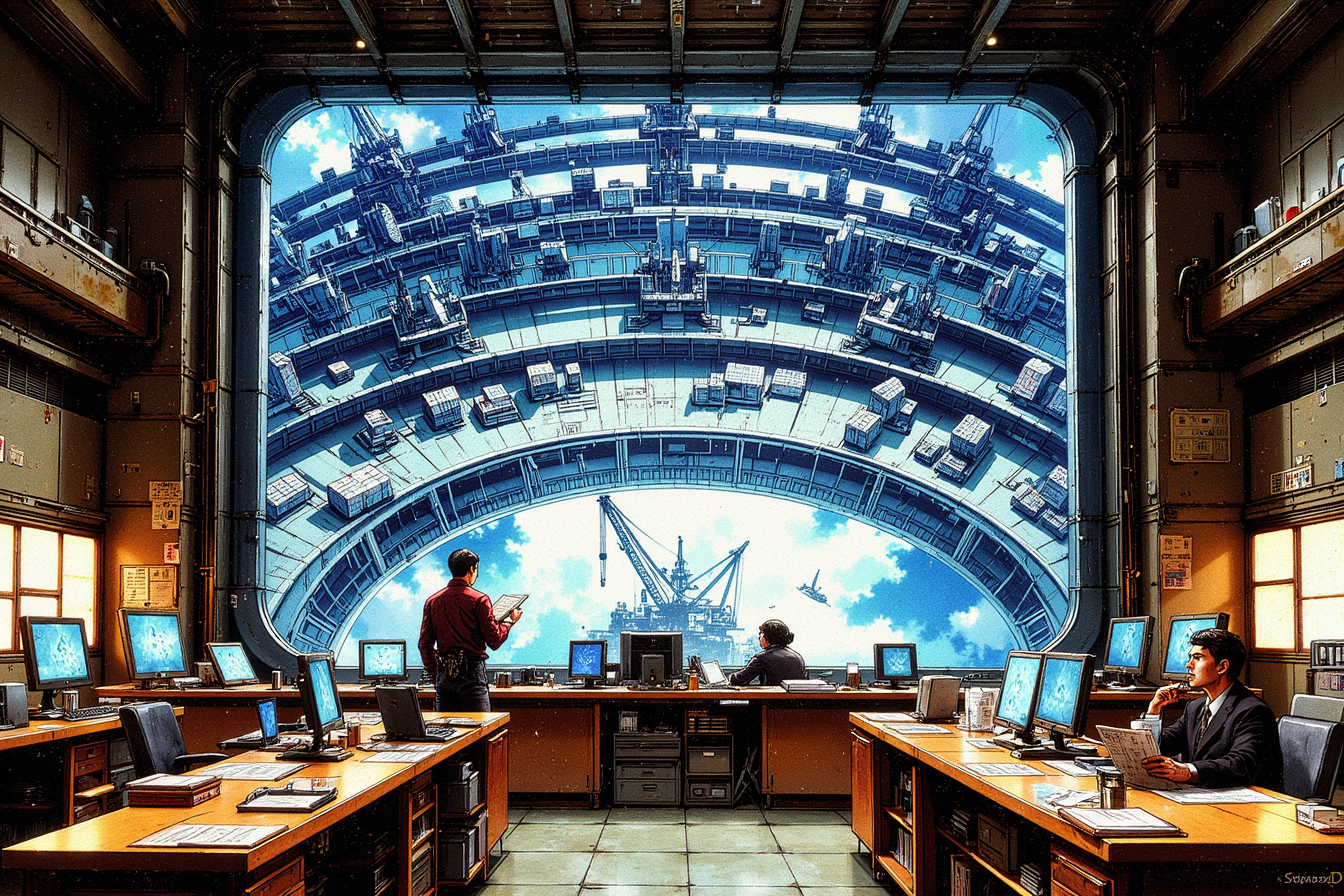
He played it. The comms room's main screen filled with the Tenth Depot: a transfer station out past the toll-lanes where the maps start apologizing, three rings of docking cranes around a core the color of wet concrete, and the depot's own traffic running on a civil band so relaxed it was practically furniture. Freighters came in with crates and left lighter. The crates did not leave.
"The Tenth is a consolidation point," he said, riding the feed's timestamps. "Everything the harvest fleets pull off a struck world that isn't worth the fuel to keep moves through here first. Registry books, school rolls, the birth index for a whole row, all of it boxed as reprocessing assets and held until a cycle opens." He let the depot's audio run: a customs second calling a clamp number, a clerk confirming a custody seal, a voice reading a quantity in a bored register. "Three thousand entries consolidated into one crate, bay nine, cycle opens in eighteen hours and change."
"And our crate," Pixel said, "is being moved because somebody upstairs wants it gone before the cycle opens."
"Or somebody upstairs wants it gone before somebody else finds it." He tapped the payer's cipher where it sat unresolvable in the corner of the screen. "No seal. No lane authority backing it. Whoever signed this has clearance to book a reprocessing transfer and does not want their name anywhere near a receipt. That's not a normal crime, Pixel. Normal crimes get a company."
"It's a stranger's signature," she said, and said it again quietly, the way she does when she is putting a fact into the file she keeps behind her eyes. "Then we take it."
Halfway through the feed, a cycle closed while he watched. Ring two's cranes came awake in sequence, four freighters backed out of their berths with courtesy receipts spooling in their wake, and bay nine's crate went nowhere. The clerk on the audio read seal numbers for eleven minutes without breaking, because seal numbers are nothing to break over, and then a second voice asked the question the whole feed had been staged around: manifest basis. And the first voice answered, still bored, still filing: struck row, registry entries, unregistered, custody transferred to reprocessing, cycle queued.
He has heard crews talk about a haul. He had never before listened to the paperwork that erases a row get read out by a man with his lunch cooling somewhere behind him.
What the payer had built that feed to show was the receipt. The goods were incidental, and the clerk was incidental, and the eleven minutes of seal numbers were the whole point: proof that a person can move three thousand lives through a transfer station without ever meeting one of them.
Pixel watched the cycle receipt scroll past and then reached over and shut the feed off herself, which is what she does when a thing has finished telling her what it is.
"File the receipt," she said. "The one he just read. Somewhere down the line somebody is going to ask what a cycle at the Tenth looks like, and I want our copy to be the exact one."
They planned it in the comms room because the bridge has windows and the comms room has steel, and nobody wants to look at the thing they are about to do.
A1 came first, of course, with a tray: cups for Pixel, for Om, for Luminara, and the small one for himself, which he set down without a word because everyone in the room had already seen the number the night had been carrying. His route math went up on the secondary screen as a lattice of possible lanes, eleven of them, drawn in the thin green Registry font so that even A1's murder plots look like bookkeeping.
"Eleven vectors to the Tenth Depot," he said. "Nine run through toll-lanes where our cover identity would be scanned twice. Two run out along the dead channels past the freight ring. I recommend the dead channels. I recommend them strongly enough that I have already begun calculating them."
"How strongly?" Pixel asked.
"The strength with which a small ship recommends anything, Captain. We are forty tons of courier against a station with its own point-defense."
Clive had pulled up the depot's structural record, and his staples-arm traced the crane rings on the screen with a metal point that has stamped a thousand hulls. "Station's old," he said. "Pre-standardization bone, half of it. Look at the clamp patterns on ring two: mechanical overrides, manual release wells, the kind of hardware you install before the accountants arrive. The Tenth was built to move freight, not to keep secrets, and hardware that old has one opinion about locked doors." Tap, against the screen, on bay nine. "I can get us in and I can hold a door, and I do neither politely."
"You'll have a customs second with a scanner on every ramp," Luminara said. She had her camera on the table, one of the older bodies, the one she shoots when the story is bigger than the frame. "So the answer to the scanner is documentation. I go aboard as press covering a custody transfer. The Conglomerate loves a witness with a letterhead; it's the only kind of witness they've ever trusted, because a photographer files a caption and a caption is a form."
"You're erased," he said. "Your row reads Linda3637. If their gate runs a name check..."
"Then I don't give them a name," she said. "I give them a commission, out of the Ostrell regional bureau, and a request for facility access that is so boring their clerk will approve it to make me go away." She smiled with about half of her face. "I have been a number in their system. I know exactly how much attention a number gets."
Om Kai had not spoken. He sat with his tea going cold in his hands, watching the depot traffic the way he watches everything, counting something the others were pretending was arithmetic. When he did speak, it was to the screen.
"A crate with three thousand names in it," he said. "We take the contract to steal the cargo, and the cargo is people's birthdays and next-of-kin and the schools their children go to. If we drop that crate off a ramp because a plan got tight, we have not saved them. We have only unfiled them a second time." He looked at each of them, and stopped on Zephyr, which is his habit when he has noticed something nobody else has said out loud. "So the plan has to be honest before it is clever. All three thousand, or we decline. Nobody takes a count."
"Nobody takes a count," Pixel agreed. "That's the first line. Anybody want a second?"
"The second," Om said, "is that we do not become the payer. No cipher with no name behind it on this ship. When we sign our acceptance, we sign it as ourselves, in the open, so that everyone who later asks who did this gets an answer."
"That's a hell of a signature to staple to a felony," Clive said, and sounded, in his flat case-number voice, like a man reading back his favorite paragraph of scripture.
Pixel stood. "A1, work the dead channels until the numbers beg. Clive, the depot's hardware, everything manual, everything old. Luminara, write yourself a commission so dull it hurts. Om, you keep the plan honest and you keep the count; if it starts going clever, say so and we stop." She turned to him. "Zephyr. You built the intercept. You take the acceptance. We answer in the Conglomerate's own billing font, under our cover identity, courteous as anything, and we promise them delivery of the crate they want moved."
"And under the table?"
"Under the table," she said, "you and I both know what we're actually doing. We are taking the contract to steal the cargo." She said it the way she says everything she has decided, without a flourish, like a headline already set in type. "Everybody get to work."
What they did not say, and what he did not tell them, was how close the acceptance came to costing him the hour he needed.
Because the filing is the trap. You cannot steal a Conglomerate crate with a dark transponder and a wish; you take custody the way the machine expects custody to be taken, with signatures and lane entries and a transfer acknowledgment that routes back to a payer who is watching. So he built it: Bright Ordinal, independent courier, forty tons of filtration membranes on an unrelated outbound leg that just happened to be rerouted through the Tenth's freight ring, available for a sub-charter, one crate, custody intact. He matched their billing font down to the kerning, because a document that looks even slightly human invites a second look, and second looks are how crews like theirs get their rows finished off.
The acceptance went out at 0540 on the dead channel, routed through two repeaters and a buoy the toll authority had not gotten around to replacing since before he was born. Then came the four minutes you never get back, watching your own forged paperwork stand in front of a machine that holds a checklist, and then a query, because a system that likes a lie will often ask it a follow-up.
The cipher wanted the carrier crew complement confirmed against the sub-charter.
He had already typed four crew when A1 answered it off the bridge, having read the query the same second he did. A1's voice arrived up the ladder as level as a floor: four crew, one vessel, manifests attached, sub-charter Bright Ordinal, awaiting custody window. The cipher accepted four without discussion. Somewhere out past the toll-lanes, a payer who insists on being a stranger now believes in a ship with four crew aboard and a hold full of membranes, and he believes it because they told him the one number his own form knew how to hold.
"He didn't ask for biometrics," he said.
"He did not ask for biometrics," A1 agreed, "because asking would have required a name to ask them under. The signature goes both ways, Officer Glitch. That is the weakness in a payer who insists on remaining a stranger."
Then the acknowledgment, unresolvable cipher, one line in the billing font: custody accepted, sub-charter acknowledged, deliver crate intact to designated hulk. Which A1 reported without inflection, noting that the payer's signature had accepted their cover without comment, which is the most expensive kind of praise a machine can give.
"Custody window opens at the depot's next cycle," he said. "Transit to the freight ring is four hours on the dead channels. That leaves a margin I would describe as honest and a probability I am going to keep in the small cup."
"Say the probability," Pixel said.
"Captain."
"Say it where everyone can hear it."
"Thirty-one percent that we leave the Tenth with the crate and our names attached to nothing," A1 said, and poured, and the little cup clicked on its coaster like a period. "Which, for a ship the Registry believes is scrap, is a handsome quotation."
Pixel did not smile at that, though her mouth considered it, and she looked down at the little cup the way she looks at a headline she has already decided to run.
It bought them the room, and rooms on this ship get bought cheap. Clive went below with a toolbox to modify the loading ramp for a crate he had never seen, muttering the depot's clamp specs the way other men sing hymns. Luminara went to the hold to write her commission letterhead, and he heard her typewriter, manual, the one she uses so the keystrokes cannot be logged. Om sat down with the custody manifest and began, in his careful numerals, to write three thousand lines he was determined not to round. He heard the galley kettle go over and did not go for it; caffeine had quit being a decision somewhere around the second hour of the intercept, and the deck wanted his hands more than his blood wanted another cup.
And the deck went on running, because the intercept was not finished. He pulled the depot's traffic forward hour by hour and watched the crate move through the paperwork: bay nine to seal to cycle queue, three clerks and one customs second, every one of them courteous, every one of them filing. That is the thing about the Tenth. Nobody there is doing anything wrong. The wrongness is in the ledger they are keeping so well.
He had the audio up at low volume, the depot's channel murmuring its clamp numbers, when the second signal came through the floor of the band, underneath everything, on a frequency no toll authority lists.
Aether's ping.
He checks it the way you check a wound you cannot stop touching, and he has stopped apologizing for it.
It arrives as a pulse with no carrier, timestamped, addressed to no one, emitted from coordinates the charts insist are empty: a month struck from every calendar three years ago, the lost month, the Fairweather the maps gave back. His brother is inside it. His brother chose to stay inside it, which is a sentence he can write and cannot yet say out loud to anyone on this ship, so instead he runs the spectrum between jobs, and he lets it run through Aether Junior's taped hinges like water through a leak he has decided to live with.
The ping does not say much. That is the part that gets him. It is not a distress call; distress calls are rude, they repeat, they interrupt. This is a heartbeat with a header. Fairweather 14. Alive, wherever alive is. Ask again later.
He played it once while the acceptance was still warm, for luck, the way you touch a gauge. Twice while he matched the billing font. Three and four times while A1's lattice resolved and the depot's voice read its clamp numbers over his brother's silence. Five, six, seven while Luminara's typewriter clacked in the hold and Clive's fasteners went home and Pixel wrote her notes in that reporter's hand, and the ship went on doing its work around him, three dead people and a dog becoming, for one night, a crew of thieves with a conscience problem.
Eight came in while the transit order was being finalized: dead channels plotted, jump prep staged, drives spooling to temperature in the engine room where A1 had already begun running the pre-jump checklist with the patience of a machine that knows he will be the last one awake.
Nine he saved for the dark, which is where he is now. The comms room with the screens down to embers, Meatball gone below to sleep on something more central than a soft key, the whole ship quiet in the way she gets when a plan has been accepted by every mind aboard and there is nothing left but the doing. Contract accepted, in the Conglomerate's own font, courteous as anything. Jump prepped, eleven vectors down to two, and the Tenth Depot waiting out in the dark to be robbed by a press ship with a photocopier and a conscience.
Nobody was left awake to say any of this to, and there was nothing left in the night to do except the thing he has done after every job since his brother's row went blank. So he put the headset on and let the signal come up through the floor of the band, from inside erased coordinates, on a frequency the Registry swears is transmitting nothing.
Fairweather 14. Timestamped. No carrier. Alive, wherever alive is.
Ask again later.
He heard Fairweather 14 for the ninth time, alone in the dark with the board down to embers, and it did not answer either.