
Static Between Stars — Chapter 04: The Crate Job
Berth nine on the Tenth Depot's transfer ring came with a mooring clamp pitted down to gray metal and a laminated card bolted to the rail: THANK YOU FOR YOUR PARTICIPATION IN STANDARDISED TRANSFER. The depot had no welcome. It had forty-one berths, a consolidation yard holding twelve thousand four hundred crates, and a reprocessing line on the far side of the ring that ran whenever the stacks got tall enough to justify the power. The air on the ring tasted of filings. Everything at the Tenth tasted of filings.
Her crew was there for one crate.
Clamp handshake at 1241, mooring lights green, and a courtesy packet delivered down the umbilical in a plastic sleeve with the depot's rules of transfer: eleven pages, which she read on the way in, because reading the rules is the entire trick of breaking them. Rule four: custody passes at signature. Rule seven: the depot is not liable for cargo once stamped. Rule nine: no hull departs berth nine without a courteous receipt. Eleven pages of courtesy, and under every one of them a machine waiting to be obeyed.
"Papers are green," Zephyr said in her ear. Green is his word for a document that has stopped arguing with itself. He had been at it for an hour: Contract Hauler Wren 44, out of Marrow Quay, running on a registrar's license A1 had resurrected out of a dead file, a toll receipt with a real timestamp, and a hauling endorsement that expired in two days, which was two days longer than they needed. "Custody window opens at 1400 and shuts at 1500. The clerk has our packet and nobody else's. He's alone in the bay office."
"And customs?"
"Second on rotation. Name's Ore. A scanner, a chair, and no particular place to be before supper."
She logged that. A customs second with nowhere to be is the most dangerous officer on any ring, because he has time, and time is the thing that finds the seam.
A1 counted the eyes for her before she asked. "Berth nine has four fixed cameras and one moving, a patrol cutter on a lazy ellipse, forty-minute period, running dark. I mention it so that nothing tonight will be a surprise to you afterward." Nothing about it was a surprise afterward. That is the whole difference between a plan and a hope, and they had used up their supply of the second one years ago.
A1's voice arrived from the console and from the espresso machine both, which he does when the number he is about to give is not a mood. "I have plotted eleven vectors off this berth."
"Eleven."
"Eleven. The contract specifies an approach, Captain. My conscience requires an exit. Vectors one and two take the main freight lane: courteous, photographed twice at the ring mouth, entirely legal. Four burns past the scrap line, where the depot's two patrol cutters sit with their running lights off, which I assure you is a choice they have made. Seven runs the reprocessing yard's approach: unlit, unwatched, and full of crushers that do not read manifests. Eleven goes out through the gap in the outer survey, where the charts stop being specific."
"And nine?"
"Nine requires a maneuver this hull performed once, during trials, before it was a press ship with a photocopier bolted where the cargo bay theoretically was." A pause that in any other machine would have been humility. "I have ranked all eleven by median outcome. I am not ranking them in your presence."
"Odds, then."
"I have made espresso, Captain. That is the answer to that question."
He had made it. Small cup, set on the console edge beside her glove, which is the severity readout, and she had never once asked him for the big one.
"Fair enough," she said. "We sign, we load, and we do not go to Yard Four."
"That is the job as written."
"Then we'll amend it."
She put Clive on the ramp, Luminara on documentation, which means she carried two cameras and called the whole exercise paperwork. Om Kai stayed aboard with his tea, because somebody has to sit still while the rest of them commit a felony, and Meatball took up his station on the comms panel, in the exact center, so that any signal reaching the ship from that moment on would have to go around him. Then she rode the ring tram out to Bay 22 with Luminara's shutters clicking softly and her gloves sticking to the bench.
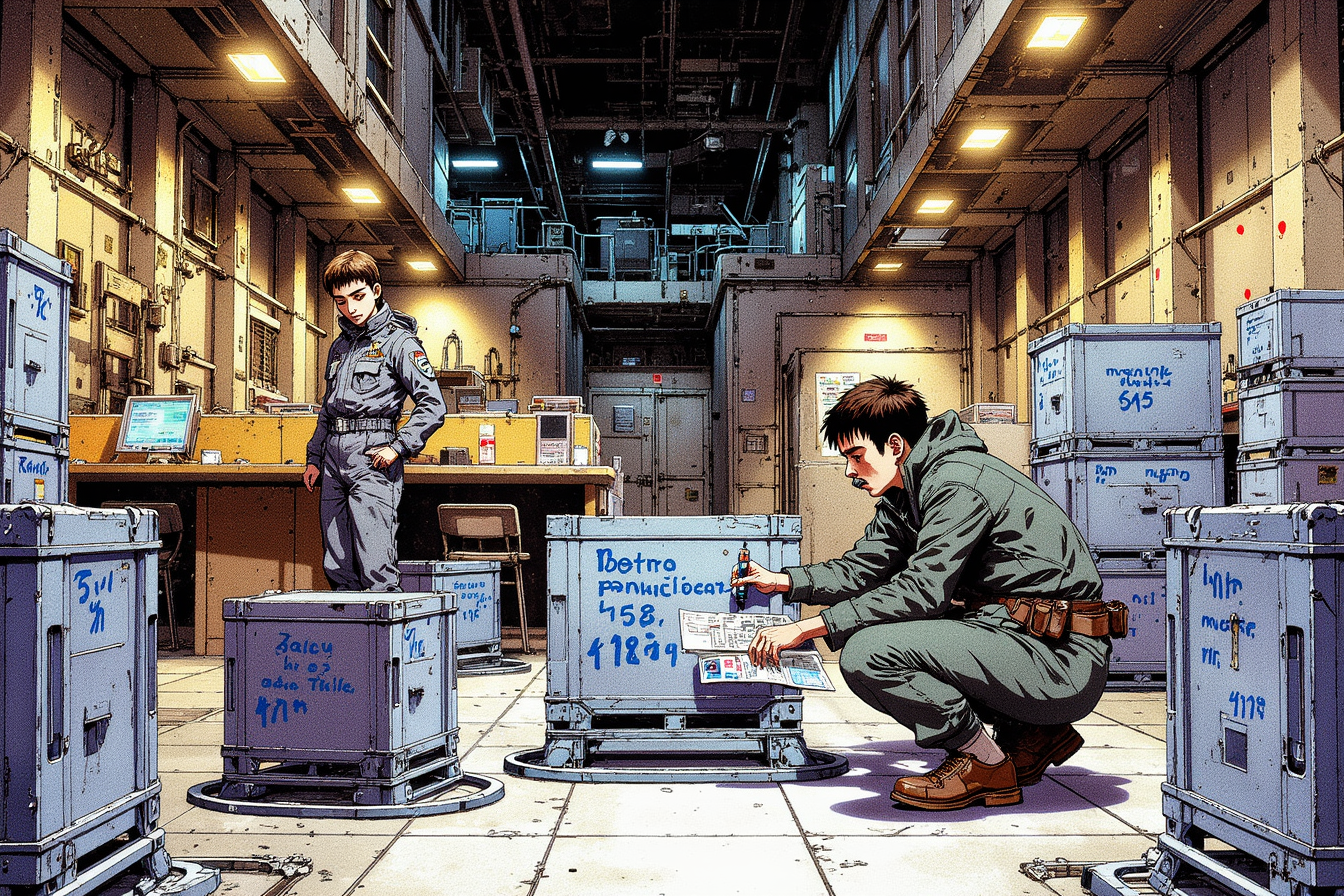
Crate Bay 22 was cold enough to see breath, lit by work lamps in a cage, stacked four high with matte gray boxes that all wore the same stencil in the Conglomerate's billing font. Ours was on a transfer cradle by itself, and it was smaller than three thousand people have any right to be: two point four meters on the long side, corner reinforcements, a coolant collar at the base breathing on a slow cycle. REGISTRY ENTRIES, UNREGISTERED. QUANTITY: 3000. DESTINATION: REPROCESSING. Under that, the smaller line the depot adds when nobody wants to think: CONTENTS UNEXAMINED. And beneath the stencil, a seal tag reading 88-KILO-VICTOR-9.
She had handled manifests where the quantity field was a population. It never stopped being strange that a person could write one in a font that fits on a crate.
The clerk had his transfer screen turned her way, because he was bored and pride works both ways, and on it she read the crate's consolidation history in six lines: collected at seventeen stations over nineteen days, boxed at a waystation whose own name had already been struck from the line beneath it, carried to the Tenth on a tender that had filed no crew. Six rows of origin for three thousand lives, and the sixth line read simply CONSOLIDATED, which is the word the Conglomerate uses for the moment a person stops having a hometown. She had written that word herself, once, in a quarterly, in a job where nobody asked her what it cost.
The clerk's nameplate read HESSEL VEY, CLERK FIRST, CUSTODY TRANSFER, and he did not stand up, which at the Tenth is not rudeness but calibration.
"State the hull," he said.
"Wren 44, contract hauler, out of Marrow Quay."
"State your intent to receive."
"I receive."
He stamped their copy and his copy, wet blue ink, and turned the crate's tag toward him and read the commodity line out loud the way men read scripture they stopped believing in years ago. "Registry entries, unregistered. Quantity three thousand. Contents unexamined. Value declared: none." He looked up for the first time. "None is the correct entry, if you were wondering. There is no field for what it is actually worth."
"There never is," she said.
"That's the job, hauler." He slid the stub across. "Sign inside the window or the window forgets you."
She signed. Luminara photographed the crate, the tag, the clerk's hands, and the stamp, because chain of custody is a story and she had been hired to tell it.
Then the customs second came out of the office corridor with a gray wand scanner hanging off his belt and all the time in the ring. Ore was a young man with a depot gray jacket two sizes past useful and a mustache his face had not finished deciding about. He scanned the seal. He scanned it again. He walked a slow half-circle around the crate with the wand up, reading the corners, and when he reached the coolant collar he crouched and held the scanner on it for eleven seconds, which she counted.
"Seal's intact," he said to nobody.
"The seal's intact," she agreed.
He scanned their papers. He scanned Luminara's cameras, one at a time, and wrote nothing down. He read the crew list and stopped on the fourth line.
"Who's the hull technician."
"Clive," she said. "He's aboard."
"You list him as powered equipment."
"I list him as what the form has a box for."
Ore looked at her for a moment the length of a good sentence, and then at the crate again. He had that particular stillness of a man who has been trained to notice and has not yet been told what to do about noticing. "Three thousand entries in one box," he said. "And you're taking them to Yard Four on a lane that's camera'd twice."
"That's the contract."
"I didn't ask about the contract. I asked what happens to you if that crate lands light."
"I get paid on arrival," she said. "Which is the same answer everyone gives you, Second. The difference is I'll mean it."
He held on one beat longer, then pocketed the wand. "Window's open for another fifty minutes," he said. "I'll escort the tram. Somebody should."
Luminara framed him from the side, going up the tram ramp with the scanner on his belt and the crate behind him, which is the frame she would have chosen too: the state and the box it had made, walking the same direction for once.
Back aboard, the hold was warm and smelled of toner and old rope, and Clive was waiting by the ramp bulkhead with the copy of the manifest they had signed and the orange 1967 Swingline in his grip like a man holding a witness.
"Three corners," he said.
"Three corners," she said, because they had done this before and she had stopped asking why.
The first staple went in high on the left, through paper and into the plate with a sound like a knuckle on a door: prayer, for the run and for whatever they had not thought of yet. The second went in high on the right: promise, because a manifest stapled to a bulkhead is a thing that can be pointed at, and pointing is what she does for a living. The third went in low, and Clive set it with his weight, home and flat and final.
"Prayer, promise, felony," he said, resting one end of the stapler on the chart he had kept pinned there since before half the crew had a species. "In the old days that was a desk. Now it's a bulkhead and I'm the desk."
While the tram was out, A1 put one thing on her console and no more: a single vector line, two, drawn in green, with one number under it. Median. Not the tails. She had never asked him for the tails.
"If the window closes early," he said, "we are on two, and we are burning before the clamp finishes letting go."
"And if the cutter wakes up?"
"Then I will be very interested to see what it does, Captain, and you will be very busy."
Ore rode the tram with the crate to berth nine, which was his right and apparently his evening. Under the work lamps at the ramp foot he stood with his arms folded while the tram aligned, and Om Kai came to the ramp mouth with his tea and stood beside her without saying anything, which is his way of saying the thing that has no operational answer. The depot's loading lamp made a hard white square on the ship's grating. The coolant collar sighed on its slow cycle, and the sound went up the ramp and into the hold like something sleeping being carried indoors.
"Ready on the cradle," A1 said.
"Release when the lip seats," she said.
The tram's cradle unlocked at the lip.
It unlocked early.
That is the whole of it, and she has gone over it since: a release signal four tenths of a second ahead of the seating confirm, depot-side, and two tons of gray crate that had been waiting on a smooth deck for a week suddenly found a twelve-degree ramp with nothing under it but gravity and grating. The crate went down the ramp fast, corner-first, aimed at the gap between the ramp and the ring deck where a body had been standing ten seconds earlier. Ore threw himself sideways into the cage railing and his scanner went out of his belt and clanged away across the deck.
Clive came off the bulkhead and put two staples through the crate's skid into the ramp grating.
They bit. The crate slewed, dug in, and stopped with its far corner hanging over the lip, and the whole hold made a noise like an intake of breath. Steam jumped from the base plate where the impact had cracked the seal's outer tag, thin white vapor unspooling into the work light, and Ore's voice came up from the deck in a register she had not heard from him: "Breach. I've got a breach on the seal."
"You've got a dropped crate," Clive said, not moving. "That's a depot-side event, kid. Look at your own cradle."
"Sir, my scanner says seal breach."
"A1," she said.
"Seal hash at handoff, 1403 station time: 88-Kilo-Victor-9," A1 said, from the console and from the espresso machine both. "Core seal status, read remotely: intact. The outer tag is fractured over forty-one millimeters. The contents have not been exposed to atmosphere. I am transmitting the handoff log to the bay office now, along with the cradle release timestamp, which is four tenths of a second early, and the name of the depot system that sent it."
Ore climbed the ramp. He was gray jacket and bad luck and twenty-four years old, and he put the wand on the crate's corner and read it twice more while the vapor died and the ring hummed beneath the hull. Nobody moved. Luminara took no stills of it. She had already turned the camera on the crate and left it running, which Pixel understood later was a kind of mercy.
Then Ore reached to his belt, took out the depot's own seal stamp, and pressed a fresh depot seal across the fractured tag, hard, with his thumb.
"Depot re-seal," he said. "I dropped it."
"The tram dropped it," she said.
"I was escorting. It dropped on my watch. That's my report." He signed the re-seal with his wand, initialed it, and stood looking at the staple in the skid for a long moment. "Your man put two fasteners through a custody skid."
"He repairs things," she said. "It's on the manifest. Powered equipment."
Ore did not laugh. He went down the ramp, collected his scanner from under the cage, and stood in his white square of light until the ramp was up and the dogs were home, and he raised one hand the way a man confirms an address.
Bay 22 called while they were torquing the straps down, wanting to know why a customs second had filed a drop on a crate that was still inside the window, and A1 answered them in their own language: form numbers, timestamps, the four-tenths, the cradle serial. By the fourth exchange the bay office was apologizing for the delay and wishing Wren 44 a smooth lane. Nobody in that conversation had told the truth, and every one of them had said please.
Clive wrote the whole thing in his file: date, time, the four-tenths, the two staples, Ore's initials on a re-seal he had not earned. Then he put the pen down and looked up at the three corners of the manifest on the bulkhead and did not say anything about Barry, which is the only kind of prayer he files now.
The hatch dogs spun shut and the hold went to ship's air, and the crate stood in the middle of it, sealed, cooled, venting on a forty-four-second cycle with a small white sigh, breathing the way a held thing breathes when it has decided nobody is coming to hurt it right now. Three thousand rows with birthdays attached, boxed for a machine that reads no manifests, parked on the ship's deck plates between a photocopier and a wall Clive had just improved.
She put the headset on and filed it from the hold, with Zephyr's carrier light green in the corner of her eye:
Dispatch, 1450, out of berth nine at the Tenth Depot. Today we hauled one crate on papers that were green for two more days. Cargo: three thousand registry entries, boxed for reprocessing, contents unexamined, value declared none, because when the Conglomerate prices a person it files the price as a rounding error. Our ship's intelligence plotted eleven ways off this berth and liked none of them. A customs second with a scanner lingered long enough for me to learn his name, and on the ramp the crate went sliding for the gap, and an orange stapler held it to the deck with two staples of his own, which is a repair here and a felony in any jurisdiction that has heard of us.
We are not going to Yard Four. If the depot asks, we were always going to Yard Four.
, Pixel Paradox, signing off
The clearance came back through Zephyr four minutes later, in the billing font, every letter courteous and none of them quick:
CUSTODY TRANSFER ACCEPTED, 1403. CRATE 88-KV-9, QUANTITY 3000, RECEIVED ON HULL WREN 44 AT 1441. THE TENTH DEPOT THANKS YOU FOR YOUR CONTINUED PARTICIPATION IN STANDARDISED TRANSFER. RECEIPT FOLLOWS YOUR HULL.
"Receipt follows your hull," Zephyr read aloud, and put it on speaker so the hold could hear the machine being polite to the people who had just lied to it, and nobody laughed, because the courtesy was the joke and the joke was not funny.
In the middle of the deck, on its forty-four-second cycle, the crate breathed.