
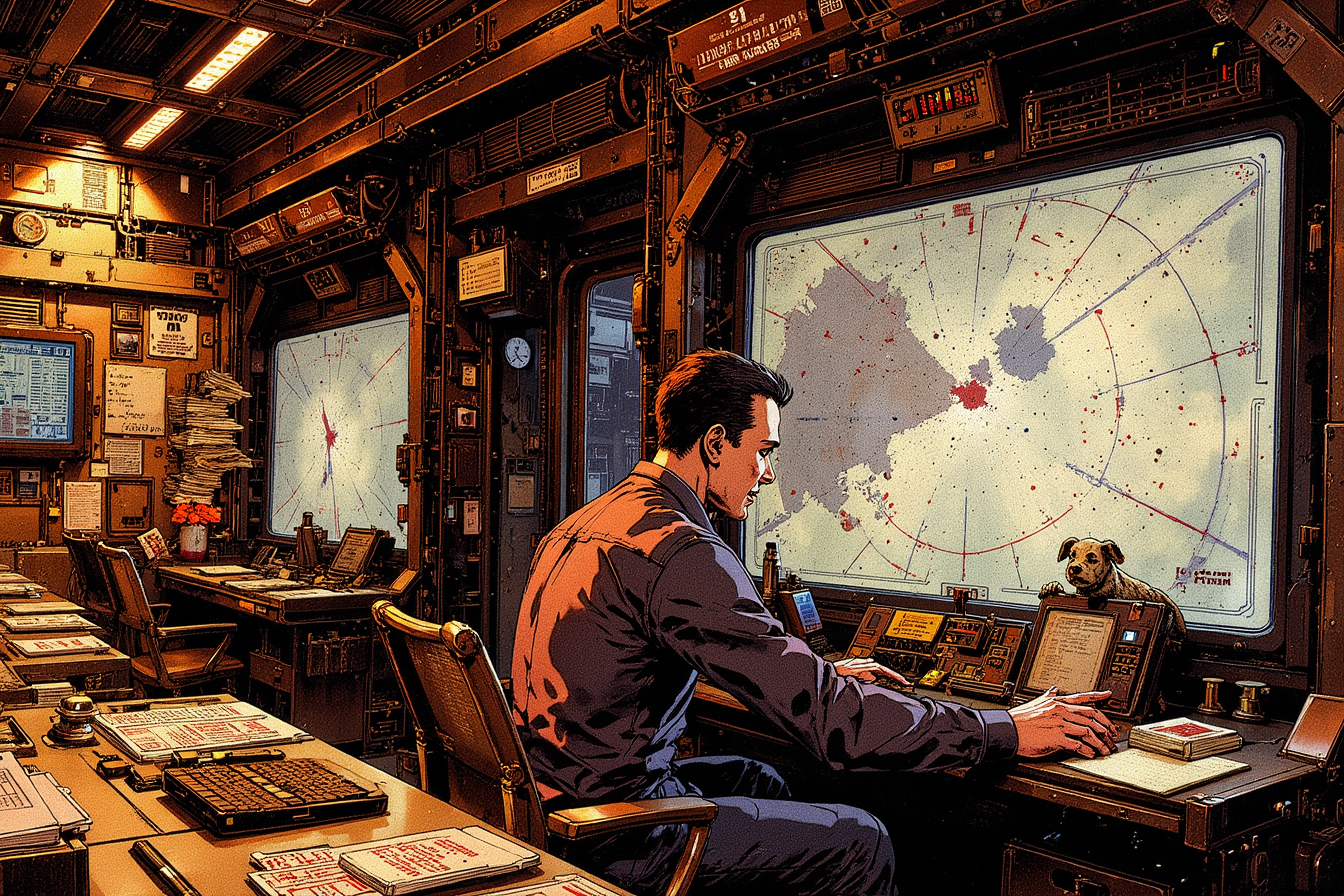
Static Between Stars — Chapter 06: Fairweather 14
Aether's second burst arrived at 0211 from a cell of sky every chart in the fleet agrees is nothing, and it came in as static, the way it came in on every other board along the Rim approach, and it came in as his brother, which was what the key was for.
He had been on watch four hours with his boots up on the console edge, running the spectrum the way he ran it every night now, which is to say he had stopped telling himself he was listening for anything in particular. The bridge was lit low for the watch. The press run had ended hours ago: three thousand rows spat out of a photocopier and thrown at the Deepwood net, the transmitters still ticking as they shed their heat, a sound like rain on the hull if rain were made of copper. Meatball lay along the top of the comms panel in his usual country, chin on a toggle, working through a dream in small chuffs.
Aether Junior objected first. Three flat notes, tape-roughened, the acoustic equivalent of a form submitted in the wrong century. Zephyr's boots hit the deck plates before he was all the way upright.
"Show me," he said.
The deck showed him.
Route: absent. Sender: absent, and not the polite absence of a jammed header, which leaves a wound where the sender used to be. This was the absence of a field nobody had ever filled in. Position: Rim approach, reference 44-NULL-9, and the chart's answer to that reference was the whole point, because the chart drew nothing there. No hazard code, no traffic count, no survey date, a gray square of scheduled nothing. Spacers call that a hole. The charts insist it is empty because the last ship sent to fill it in had gone out three years ago with a charter called the Ninth and had not come back to file.
"Where did it come from?" he asked the deck.
From there, the deck said. From nothing.
Header next. Modern receivers smoothed a header into an arrival time and binned the rest, so Zephyr peeled the smoothing off with two keys and read what lived underneath.
FAIRWEATHER 14.
He read it once slowly, to be sure he was seeing it. He read it twice fast, the way you reread a diagnosis to catch the detail you were hoping you had invented.
Every clock the Conglomerate bills against runs the standard metric calendar, and the standard metric calendar has no Fairweather in it. The Correction shipped three years ago as a routine patch: one night's push to every billing cycle, wall display, ship's log and schoolroom in the network. By morning the month that had sat between the last of Highsummer and the first of Lowturn was gone the way a line item goes when the quarter needs it. Nobody was asked. You can argue with a Registry ruling; nobody argues with a timestamp on their pay. The people who remembered a Fairweather learned to say it in the past tense, and then, mostly, learned to stop saying it.
Out here, three years of quiet later, a packet stamped with a day that no longer existed.
Out past the last toll-lane the charts stop surveying and start suggesting. The survey ships turn around at the Rim's edge, and the reach they decline to fill in is what spacers call the gap. Physics out there gets treated as a suggestion. So does the census. Nothing in the gap appears on a freight schedule, and a thing with no schedule has no record, and a thing with no record is a rumour with coordinates.
The session key was the Ninth's. Aether had pressed it into his hand the night before he shipped out, a strip of polymer with a number written on it in his brother's cramped hand, and had explained it in the tone he used for things he expected to be useful rather than necessary. Everyone out there will hear noise. You'll hear the warrant.
Zephyr loaded the key. The static resolved.
Four fields. Header, flag, position, warrant: NINTH SURVEY WING, GLITCH, A., 9-4471. The flag was a distress code retired from the beacon protocols years ago, so no modern receiver parsed it as distress; they parsed the packet as a ranging echo and let it fall through their logs the way rain falls through a grating. A fifth field waited at the end with nothing in it. That was the message field. He had played the first burst enough times to know precisely where the words would sit if his brother had put any in.
After the warrant came two tones four seconds apart, the same interval they had used to key the yard handset across the compound when they were kids: before the Wing, before the Correction, before either of them had a row the Registry could strike.
He played it.
The burst ran eleven seconds from key to silence. He played it again to check the first decode, and again because the warrant was resolving a half-beat slow, and again with his eyes shut so the deck stopped drawing and the bridge held nothing but eleven seconds of a man's name written into noise. The first burst had found him in the middle of the crate contract, and he had played that one nine times before Pixel leaned on the console and asked him what he thought he was keeping alive. The second burst had been on his board for the better part of an hour.
Then he was at twelve, and at twenty, and he had dropped the bridge lights twice more and they were down to night lamps. Somewhere aft a pipe ticked. Meatball's breathing kept the only steady rhythm in the room. By play thirty he could hear the second tone arrive a half breath before it came, which is what happens to a signal that has stopped being information and become furniture in a room you live in.
At forty he reached for the key again and a hand came down over his.
"Forty," Pixel said.
"It answers at forty-one."
"It doesn't answer at forty-one. I've read the log." She left her hand where it was. She had crossed the bridge barefoot, which is how she moved when she wanted a conversation to begin with the words instead of the footsteps. "From the top, Zeph. Not the version you tell yourself at two in the morning."
Clive had not been asleep. He was on the port console with his casing open to the night lamp, one staples-arm resting on the chart he had pinned to the bulkhead before Zephyr was born, and he had been listening to the deck rasp for the better part of an hour without saying anything, which for Clive was a kind of shouting.
Om came up from the galley with his tea. Luminara came up behind him with a camera on a strap, because Luminara always arrived with a camera on a strap; it is possible she slept that way. A1 poured before anybody asked, and the cup he set on the console edge was small, and Zephyr looked at the size of it and understood that A1 had already been through the packet.
"From the top," Pixel said.
So he gave it to them straight.
Fairweather. The Correction. The month that no calendar in the fleet would admit to. "The Ninth Survey Wing was out in the gap when the patch shipped. Rim survey, five year charter, my brother's ship on the manifest. Havenbright was out there under their protection, a colony that went out on the Wing's charter and was promised a row like any other settlement." He had that one from Aether too, who had read the colony's founding document to him over a channel once, amused by the word promised, the way you are amused by a promise you already know is going to be funny for twenty years. "Ask the charts what became of the Wing and the charts will tell you the question is malformed. The charter row, the colony row, the shipping manifests, the school the Havenbright children were enrolled in: struck in the patch, all of it, the same night that ate the month. The gap out there isn't empty because nothing ever stood in it. It's empty because everything that stood in it was scheduled for deletion and the deletion ran clean."
"Scheduled," A1 said. He had the packet up on the port screen, four fields and a hole. "Thank you, Zephyr. The chart does not report emptiness. It reports an absence with a date on it. I have queried the reference four times and been thanked for my interest four times."
"And your brother's row," Om said.
"Struck, and then the cleanup closed the wound, so there isn't even a hole in the record where he used to be. A warrant number on a packet stamped with a dead day. That's what is left of Aether Glitch on every chart in the galaxy, and under an hour ago it knocked on our hull."
Clive's staples-arm came off the chart.
"Say the reference again," he said.
"44-NULL-9."
He did not look at the screen. He looked at the bulkhead, at the old survey chart with its one inked route running out into coordinates the modern maps leave blank, the chart he kept beside his open file, the cold case, the Petrel and a man named Barry Kowalski who carried a box somewhere and never came back to a desk. His arm traced the ink until it reached the place where the ink stopped caring about paper.
"Barry went out to survey that same water," he said. "Before your month got deleted. Before the war, before the forms learned to be polite. The Petrel filed a fix in that cell, then filed nothing else, and the case has been open so long the file has gone soft at the corners." His voice had the flatness it got on the days he logged something. "Two ships went into one blank and the blank gave neither of them back. Somebody has to keep logging the evidence, kid. I've been logging a hole in a chart since before you could reach the console."
"Then let's go and look in it," Zephyr said. "Both of us. Tonight."
Nobody answered him at once, which was how this crew began an argument it intended to finish honestly.
"Route math," Pixel said.
A1 set down the pot. "To 44-NULL-9 and back is eleven days against the Verdantia escort windows, and the windows are not ours to move; they belong to the groves and to three thousand people waiting on a delivery. Add that a Conglomerate listening post opened a file on our carrier burst four hours ago. The Rim approach is being audited tonight. A ship that detours into a hole tonight is a ship that will one day be asked to explain the detour, and the asking will happen with our names on a form we did not fill out."
"We don't have names," Zephyr said. "That's the whole complaint."
"Then the asking will happen with our shape on a form," A1 said, and poured, and the cup he filled for himself stayed small.
"Eleven days buys us a look at a gray square," Pixel said. "Those same eleven days are the difference between three thousand people getting their rows restored on the convoy window and three thousand people getting them through whatever gate is still open afterward, flagged behind them all the way in. You want me to trade a scheduled delivery for an unscheduled one because a chart cell has your brother's warrant in it."
Luminara had been quiet in the way she is quiet when she is composing. She lifted the camera and took him at the board in one frame, no flash, the night lamp doing all the work.
"That one's for the file," she said. "Leave me the coordinates. Whatever this war ends up pointing the bow at, I'm bringing the long lens."
"You're assuming we go to war," Pixel said.
"I'm assuming we go somewhere," Luminara said. "We always do. The blockade at the Rim approach is tightening by the day and everyone aboard can feel the strap. When we go, the blank goes on the list."
Zephyr took the opening. "Then you've heard it. We just spent a night printing three thousand names for strangers because a record of a person is a person, and I'm telling you there is one record left of my brother and it is sitting on our screen asking for an answer. His row was struck. I hold the warrant. That's not a rumour in a bar, that's a document, and I have watched this ship move mountains for documents with less standing than mine."
He could hear how fast he was talking. He did not slow down.
"Eleven days," he said. "Eleven days out and back, one cell, one look. We take Clive, we take the chart, we take the key. If there's nothing there, I'll hear you say so for the rest of my life and I won't argue once."
"You'll argue at least once," Clive said. "It's in your file."
"Zeph." Pixel's hand was still on his. She had not raised her voice and she did not now. "Three thousand names are in our hold with a route home that has windows in it, and a listening post has our burst in a folder. I'm not saying no forever. I'm saying the order of the work. The names go home. Then we talk about holes."
"The names are people who are waiting," he said. "So is he."
"Yes," she said. "And one of those groups is currently on our freight manifest."
Om set his tea down on the console with the particular care he used when a question had no operational answer and he intended to hand it to all of them anyway.
"We told ourselves tonight that a person is not a number that may be rounded off for convenience," he said. "I am not willing to discover that we meant three thousand."
"Nobody is rounding him," Pixel said. "He's on the chart. He's on the chart because Zephyr put him there and he's staying there. That is what we do for the missing: we keep the row open. We do it by delivering what we're carrying first."
Clive looked at the inked route on his bulkhead for a long moment. Then he folded his staples back into his casing, which was his version of losing an argument and filing it.
"Deliver the names, kid," he said. "The blank has waited twenty years. It can wait for a freight run."
Zephyr looked at the gray square on the screen. 44-NULL-9. Scheduled absence. He had been listening to it since before the crate job, through the depot, through the ramp, through the night the photocopier ran hot enough to smell, and it had handed him his brother's name in a warrant field every time he asked and had said nothing else at all.
"I want it on the record," he said, "that I would have gone."
"It's on the record," Pixel said. "It's on the record in your speed of speech."
She filed the dispatch at 0410 with the headset on and the carrier light green, and Zephyr heard his captain go out over the open channels from four feet away, in the room and in the air at the same time, which is a strange way to hear a person you could touch. He heard her give the coordinates of the gray square to the whole Rim approach, and heard her tell whoever was transmitting into the hole that they had been heard, and then the carrier light went dark and the band went back to its hum.
The bridge went back to its sounds. Clive's staple going home in the chart's corner. Om's tea. The transmitters ticking themselves cool. Pixel took the headset off and did not look at him, which was its own kind of courtesy. The coffee A1 had left at the board had gone bitter in the cup, which meant A1 had poured it at the moment he finished reading the packet and had not come back to fix it, and Zephyr drank it anyway because it was the only thing in the room that had been made for him.
Zephyr put the burst back on the board with the key still loaded and wrote a standing entry into Aether Junior's log, the kind the deck will hold for years without complaint:
ANSWER: PENDING. 44-NULL-9.
He keyed the microphone with the carrier dark, so nothing left the ship, and said it anyway, into the cooling air of the bridge, because a thing said out loud in a room with witnesses is harder to take back than a thought.
"I heard you. I'm not coming tonight. Keep sending."
The gray square sat on the screen, the color the charts use for scheduled nothing. The two tones waited in the buffer with eleven seconds of quiet around them. Meatball slept over the toggle that any answer from that cell would have to travel around.
No one answered the ping that night. Zephyr watched the square until the night lamps came up, and he swore it into the deck's slow fan, quietly, where only the machinery could hear him: he would answer it on the way to wherever the war took them.