
Static Between Stars — Chapter 07: Advisory Blockade
The Conglomerate had taken the guns out of the frame and put in a form, and Luminara spent the cargo morning photographing the form.
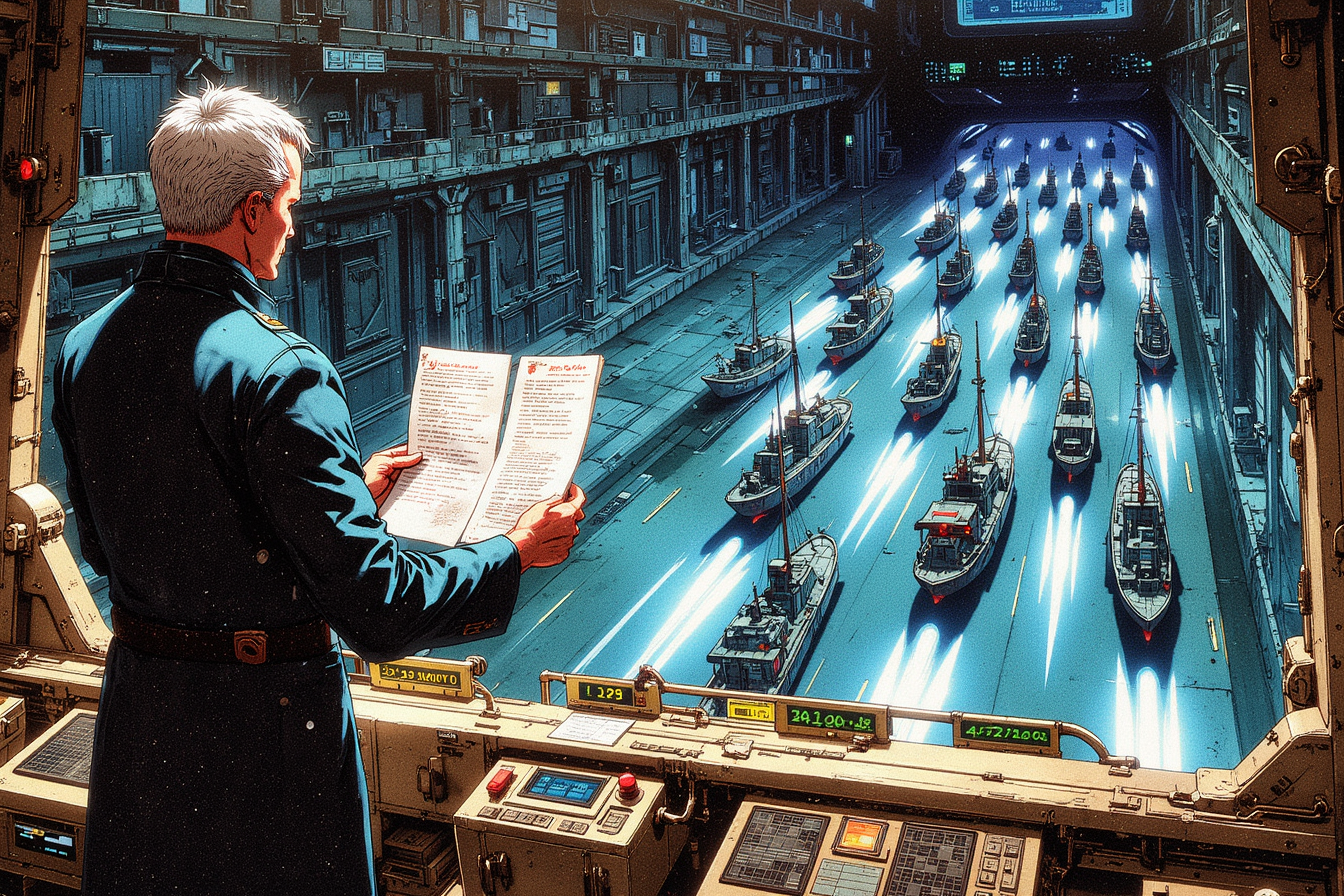
Bollard Nine is a wheel with six spokes at the first fork of the Rim road, and from the outer gallery you could see the whole approach in one wide shot: lane lights, anchor buoys, and the ships. Eleven hulls held when she came up at 0740. There were thirteen by 0800, and none of them had moved, and the ones that arrived did not so much arrive as get added to a queue that had been growing in place since the night before. Freighters. A tanker. Two small coasters with the wrong papers for this road, sitting in the lanes with running lights burning and drives cold, the way ships sit when they have been told to wait and cannot find anybody who told them so.
She worked fast and she worked wide. Thirteen hulls against the station's white cargo light made a composition that argued for itself: no smoke, no motion, and every one of them spending fuel to hold position.
The notice came by tender. A small Conglomerate tender with a courier's pennant ran the line and put a printed sheet into the hand of each master at the rail, and Luminara noticed the paper before she read it, because she notices paper. A printed sheet has no header to trace. It also has a tender's log behind it, so the paper was mostly theater: the sort of document handed over so that a person can crumple it in a fist without the crumple being recorded anywhere the crumpler will ever find it.
She photographed a sheet going into a glove, and the thumbprint the glove left in the ink.
The sheet said: The Conglomerate thanks you for your continued participation in standardised trade. Your assigned lane has been re-charted for your safety and convenience. Please remain at your berth until your new routing is published. Estimated publication: pending audit.
Pending audit. She took that line at two exposures, because a blockade with an estimate is a blockade that means to be liked, and because the estimate was the only deadline anybody out here was going to get all week.
She found a master at the rail who was willing to talk, with the particular willingness of a person who has been waiting since dawn and has nobody left to bill. The Greylag's master was a woman in a dock coat with the ship's name stitched on the pocket, and in one hand she held a printed slot issued at 0600 granting her outbound passage at 0715, and in the other the tender's sheet that had come at 0715. She held the two of them side by side for the camera.
"Seed stock," she said. "Six varieties of grain, and every one of them has a viability window, and a window is a window." No heat in it, the way there is no heat left in a number you have already said to four other people. "I filed the slot. I got the sheet. Now I'm told the lane was never certified and I should be patient."
"What happens when the window closes?"
"Then I sit here and I thank them," the master said, "like everybody else." She looked down the line of hulls burning fuel to stay still. "You can't lodge a complaint against a chart. I checked. There's a box for cargo disputes and a box for lane disputes and a box for conduct of crew. There is no box for a road that has been decided not to have been there."
Luminara photographed her face in the pause after that, which was the face she had come up for: a woman discovering in daylight that she had already answered her own question.
She shot the station's big traffic board twice from the same bolt in the floor plate: 0159 last night, and again at 0800 with the cargo lights on.
At 0159 the board showed the Rim approach as she had learned it over a week of shooting it: three outbound lanes, a spur out to the Rim road, right of way by slot. The gallery had been empty. She was up because sleep was not happening, and at 0201 the board behind her went white for a second and a half, which she counted, and came back with a different set of lanes on it. No announcement, no chime, nobody on the board's platform. A maintenance cart trundled along the base with two techs in it who did not look up, because the work had been pushed from somewhere that does not send memos and their job was to confirm that it had landed.
At 0800, same bolt, same frame: two lanes, no spur, a column of berths in advisory status. The outbound lanes had not failed and had not gone dark. They had been relabeled, re-charted, pending audit, and the station's own history, when she asked to see it, returned one plan for both hours.
She took the card down to the traffic office. The clerk was young, with a courtesy badge and the particular calm of a man who had been briefed that morning.
"Ma'am, the board is displaying current routing."
"At 0159 this morning it displayed three lanes outbound."
"Those were advisory drafts. They were never certified." He called up the board's history on his own screen and turned it for her, and the history came back identical for both hours: the plan of record, he said, had always read this way. "Drafts go out to stakeholders for comment, ma'am. They don't always match what gets published. You may be remembering the draft."
"I photographed it," Luminara said.
"Yes, ma'am. Photographs of drafts."
Over the office speaker a voice thanked the stakeholders of Bollard Nine for their continued patience and reminded them that all previously published routings were superseded by the current plan of record. It was the third such reminder before noon. The clerk glanced up at the speaker with something that had been standing in for pride all morning, and Luminara photographed the speaker where it sat in the ceiling tile: small, white, issuing supersessions.
She looked at him. He had the badge and the briefing and the calm, and he was twenty-two or so, and he was going to be fine. She took his picture as well, behind his own console with the relabeled lanes glowing above his head, and she told him she would caption it accurately, and he thanked her, because thanking was what everyone on Bollard Nine had been reduced to doing.
Down on the gallery's public notice board a tech was hanging the morning's sheets, and the method was to lay each new sheet over the old one and smooth it flat, so that the board showed the current plan and the corners of the plans beneath it, like sediment. Luminara lifted a corner with one finger. Underneath was last week's routing, dated, official. Under that, the week before. Each one had been superseded by the sheet above it without ever having been withdrawn, and no notice anywhere on the board said so. She photographed the corner held up between her fingers: two plans at once, both true, one buried.
Then the Greylag tried to leave, and she was already at the rail with the long lens.
The gallery speaker took the controller's voice in the flat, kind register the Conglomerate trains into its traffic staff: "Freighter Greylag, Bollard control. Your outbound lane has been re-charted. Please resume your berth and await your new routing. The Conglomerate appreciates your patience and your continued participation in standardised trade."
No weapons showed. The point-defense nests along the station's rim sat under their covers as they had all week, and the Registry destroyer was not even in the frame yet. The Greylag's drive lit for four seconds, a pilot's reflex, the kind of gesture made for the log, and then the light went out and the freighter settled back into the queue with everybody else. You cannot fly a lane that has been removed from the chart. Your insurer will not honor it, your registry will not stamp it, and your owner will not pay for a hole in somebody else's plan.
Nobody fired anything. Nobody had to.
She put the Fair Deal in the frame next: a fat little hauler with her name painted on the bow in a hand that had once been optimistic, sitting in the queue with her transponder cycling on the hour like a man clearing his throat in a waiting room. The name got one quiet laugh out of her, which she did not repeat, because there were thirteen hulls behind it and every one of them was somebody's entire plan.
She went on working the faces with the long lens.
A tanker's second at her rail with a coffee going cold between both hands, watching the board instead of the ships. A pilot in a coaster's cockpit with his forehead against the glass. A child three decks up at a viewport, palm flat to it, and the print her hand left on the transparisteel: a photograph of a photograph, the smudge of a person insisting on the surface. A man reading his notice a fourth time with his lips moving, hunting the estimate, because the estimate was the only part of it anyone had been given to hold. A woman who folded her notice into a square the size of a stamp and put it in her breast pocket like a ticket, and the ticket would not take her anywhere, and she put it there anyway.
That was the face she had been after all week. The face of someone who has been told to wait by a thing too large to argue with, and who has quietly declined to agree to it.
Her own row had been struck without a notice, which was the difference between the way they did a world and the way they had done her. Ostrell got a courtesy packet and a shipping season to make an ending of. She got a designation, Linda3637, spoken flatly by a clerk who was already reading the next file, and some months later the designation was retired as well, and there was nothing at all on the register where she had been. Linda3637 is what they call a person they have finished pricing. Eleven months of it, and she answered to it, because answering is a survival skill and she had every intention of surviving.
Everything she had ever filed under her name went with the row. The archives did not take her photographs down one at a time. They removed the index that made them hers, and a photograph with no photographer attached to it is a picture of weather.
So she rebuilt them.
The flat case lives in the aft hold of The Ephergent, under two other cases and a spare strap. Forty-one prints, and every one of them is a reconstruction.
They come off the ship's copier, the same machine that printed three thousand names in a single night, on the half-speed setting with the paper she trades for out of the commissary. Toner does not ask what it is reproducing. She has learned that machine's moods the way she learned a darkroom's: the drum that runs warm and softens her edges, the lid that never sits flat and lays a shadow down the left margin of every frame. She leaves the shadow. A print with an honest flaw in it is easier to trust than a print claiming to be the original.
Her first published frame, a dockyard morning with gulls in it, rebuilt in a stairwell in Farseight because the dockyard had been re-charted into a parking terrace. The face of a woman she had loved, rebuilt against the gray wall of her berth over three sittings, because the street where that face used to turn toward her ran under a toll-lane now. The sky is wrong in some of them. She has stopped repairing the sky. The wrong sky is the shape of the hole where the record used to be, and a hole you can see is a hole you can point at.
She was Linda3637 for eleven months. Then she was Luminara Usha again, in her own head first, which is the one address in the galaxy the Registry has never managed to audit.
Since then she has photographed everyone else who refuses to stay deleted. The people on this gallery are not political and most of them have never heard of her, and every one of them, by standing at a rail and declining to be re-routed into good humor, has refused to become tonnage. Her camera is what she answers their refusal with: "I see you, and here is the exposure."
She was back aboard at 1120 with two cards full, and the ship had gone quiet in the specific way it went quiet before a decision. Pixel in the bridge chair with the Verdantia route on her screen and the escort windows stacked up the side of it. Clive at the port console. Zephyr with Aether Junior in his lap, doing something that was not work. Om in the doorway with his tea. A1's machine ticking as it reached temperature.
Three thousand names in the hold, and the outbound lane that was supposed to carry them home had been, since the middle of the night, a draft that was never certified.
"That's the whole blockade, then," Pixel said, without looking up from the screen. "They've retired the guns. A revised chart and a very good manner will hold thirteen ships in place without spending a round."
"Every blockade I ever logged had a signature on it," Clive said from the port console. "This one has a footer."
Om stood it in the doorway a while longer, watching the queue on the gallery feed, thirteen hulls burning fuel to hold a position nobody would admit to assigning them. "A road that can be withdrawn overnight," he said, "is a road being kept for somebody else."
The hail reached them at 1126 on the civil band, and Luminara had the camera up before the second sentence was finished.
"Unregistered hull at Bollard Nine, berth fourteen. Transmit your Registry transponder for advisory verification. You have sixty seconds. This verification is advisory."
The Registry destroyer Redress had come in off the Rim road while she was changing cards, and now sat at the entrance with her bay lights on and her hull number in block type under the bow, gray on gray, close enough that Luminara could count the panel seams. She framed it: bow in the left third, the rest of the glass left empty for the silence.
"A1," Pixel said. "Time."
"Forty-one seconds, Captain." A1's voice had the evenness it took on after the small cup had been poured. "The transponder is dark. It will remain dark on your order."
"I haven't given an order."
"I have logged that absence of an order as an order, ma'am."
Zephyr's hands sat flat on the console, and in one of them he was holding the key strip from the deck, which he had been holding since the night before, and Luminara photographed that hand as well, because a person who holds a thing that tightly is telling you where they intend to go when this is over.
The Redress asked again, courteously, for a transponder, and added that advisory verification supported the Conglomerate's ongoing commitment to safe and standardised navigation.
"Twenty seconds," A1 said.
She shot the destroyer through the glass against the station's white light so that the hull fell to a silhouette, because a silhouette was exactly what was being asked for: the Registry had requested a description and would be given one whether or not anybody answered.
"The Redress has begun an active resolution scan," A1 said. "She is painting our hull now, ma'am. Our silence is being recorded as a point of data, and she is taking our picture."
Luminara kept her own lens on the gray flank through the glass. Two ships in the same light, each one building a description of the other, and only one of them intending to publish.
"Five seconds."
Nobody touched the transponder. Pixel sat with both hands on the arms of her chair, which was the whole of the order and the whole of the crew: nobody touched anything.
Silence ran out to the bottom of the sixty seconds. The destroyer held them in its light four seconds longer, then came about in a slow, economical arc, unhurried in the way a thing is unhurried when it already has what it came for, and went back to walking the line of stopped ships.
The bridge came back to life in the crew's individual ways rather than all at once. Clive logged a row. Om set his cup down in the exact center of its saucer, which he did only when he needed something to do with his hands. Zephyr put the key strip back in his pocket, which was his version of saying what he thought. Pixel sat looking at the plan of record with their outbound lane missing from it, then at the queue on the gallery feed, then at the destroyer's icon walking the line of stopped hulls.
"One ship," she said, "and no shots, and we're all more frightened than we were before."
Luminara had no frame for that. She wrote it on the back of the card's sleeve instead, in the small hand she used when a caption had to wait for the picture to be developed.
She photographed the turn in two frames: one tight on the bow swinging away, one wide with the queue of freighters behind it, so that the record would show the destroyer and the ships in a single exposure. Every hull the Registry stops gets described. Class estimated from the silhouette, drive signature from the thermal, behavior code from what the ship does when it is politely asked to identify itself. Ours would read: unregistered, hail declined, transponder dark, class approximated, conduct uncooperative. A description, and a description is how a war begins to know you. It draws you before it comes for you.
Zephyr was looking down at his deck, where a coordinate sat on a screen that had no description at all, and Luminara thought that somewhere behind the Redress an unidentified hull had just acquired a silhouette, a drive signature and a file number, and that the file would be read by people who had never seen her face.
They had not answered, and the destroyer turned, and the war now had a description of them.