
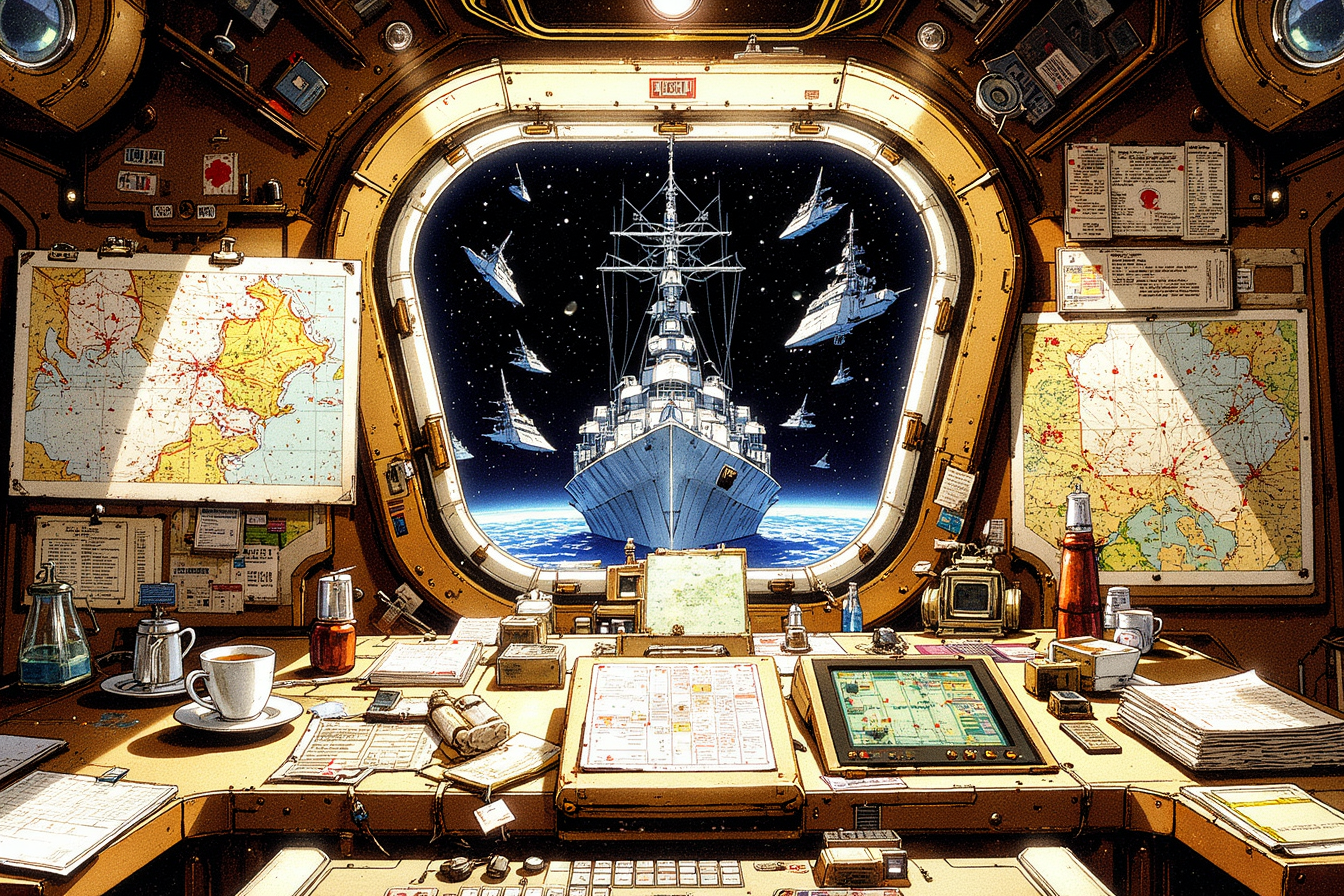
Static Between Stars — Chapter 08: The War Finds Us
The interdiction arrived at 0512 as a courtesy packet: timestamped, sealed with the Registry's gray sigil, addressed to all shipping in the Rim approach, ordering every hull to light its transponder and hold for inspection, and noting that the Conglomerate's blockade of these coordinates remained advisory.
Advisory was the word the destroyer had used in its hail three hours earlier, before it turned away from the crew's silence. She filed it then as a description of a blockade. She files it now as a description of an hour.
She had the helm. Ninety seconds ahead lay the lane mouth, a green corridor on the nav board running between two picket cutters that had not been in position when the ship began its burn for it. To port the survey buoys thinned into the Rim's dark, where the charts stop promising and start apologizing. To starboard the cordon held station in an even line, three frigates and a destroyer spaced so regularly that the blockade looked typeset.
Zephyr had four spoofed manifests queued on the comms board and Meatball asleep across its near corner, so every sequence he ran had to route around eleven kilograms of Rottweiler. Meatball was the load-bearing wall of Zephyr's workflow, and Zephyr worked around him the way other people work around a fact.
"Cutters want a Registry stamp," he said. "Inspection band, priority two, and they've used the word appreciated. That's polite. Polite buys us two minutes before it runs out of forms."
"A1?"
"Eighty-nine seconds to the lane mouth. If we hold, we will be boarded, and boarding takes precisely as long as they wish it to take. I have begun the second cup."
The small cup. She did not look at it. You do not look at the espresso when the numbers are bad; you look at the board.
The two picket cutters had come off their marks and were walking up the ship's bearing at two kilometers a minute with their running lights down, which is how a picket says it has stopped being a picket and started being a wall. Behind them, strung out along the cordon's even line, six freighters sat where the courtesy packet had told them to sit: engines warm, running lights lit, holding for a definition from a warship. She counted them twice and filed the number. Luminara, at the viewport with the long lens, counted them for the frame instead.
"Six hulls holding," she said. "Two of them lit because they were told to. Now they are sitting there lit, waiting for somebody to explain what advisory means."
"Somebody will," Om said. He had come up from the galley with the tea he never finishes on the bridge and stood it where the deck could get at it. "Definition is what the notice is for."
The Ordinance hailed the ship on the command band with the formality of a clerk calling a register: unidentified hull on bearing two-two-eight, state your Registry stamp, heave to for inspection, advisory only. Zephyr answered with the third manifest in the queue, a citrus contract out of a lane the crew had never flown, and gave it the tone of a man who resents being woken at anchor.
The reply came back in ninety seconds. Your manifest reads eleven hundred tonnes of registered citrus, said the boarding second, and your return mass reads fourteen hundred. Explain the discrepancy.
"Ballast," Zephyr said.
"Tell him the ballast is the citrus," she said.
"He can see we're a courier with no hold to put ballast in." His fingers never stopped. "I'm telling him the depot scale was certified last cycle and the lane flux has been generous. In their language. Fluently."
For eleven seconds the Ordinance said nothing, which is the sound of a warship reading paperwork it cannot refute. Then: Hull on bearing two-two-eight, you will heave to in ninety seconds or you will be fired upon. This is your only notice.
The first round went across the ship's bow at eleven hundred meters, and the light it made was white and total, a flash the width of a street. For half a second the bridge was overexposed: Zephyr's bristle of a mohawk, Luminara standing at the viewport with the long lens already up, Meatball's ribs going up and down, the old survey chart on the bulkhead with Clive's staple through one corner.
Luminara took the frame. Of course she did.
"Two rounds," A1 said. "Kinetic, warning interval, twenty-two degrees off our nose. They have drawn a line and are asking whether we can read."
The second came in higher and closer, and the viewport threw its heat back at her face the way an open door throws winter. The arithmetic reached the bridge before she spoke it: ninety seconds to heave to, and the third round would not be a line.
She thought about boarding in the time it takes to breathe. They would come aboard polite and thorough. They would find a photocopier bolted to the deck plates and a broadcast deck where the cargo bay should be, and they would find Om Kai's copy of the Receiving Ledger in the galley, wrapped in a tea towel because that is where it fits, and two point seven million souls would go from evidence to seizure before anyone finished reading a warrant. It was a bridge full of people the Registry had already pronounced dead, in a ship the Registry has never heard of, and the only papers they carried were the ones Zephyr had written that morning.
"Heave to?" Zephyr said.
"The cutters are inside nine hundred meters and the destroyer has us on steady tracking," A1 said. "If we heave to, I can no longer describe our continued existence as a forecast. I can describe it as a hope, and I do not traffic in hopes, Captain. The espresso is on the console if you would like the number in a language you trust."
"They board us," Clive said, "and they take the copier, and they take the paper with three thousand names on it, and they take the Ledger out of the galley where we have been keeping it in a tea towel. Then they file all of it, and kid, once the butler has your evidence, the butler keeps it."
"Kill the inspection band. Light the engines. Take us to the lane."
The third round caught the ship four seconds into the burn. It took the port quarter the way a can opener takes a can. There was no explosion. There was one enormous note, the sound of a hull being interrupted, and the deck dropped under the chair, and everything loose on the bridge went forward at once: the carafe, the clipboards, her own weight in the harness.
Then the alarms, in the two-tone register the ship uses when the problem is air rather than ship.
The port quarter's damage lights came up amber in a run of five and the nav board threw the ship's heading away like a page it had finished with, and A1 caught it on a backup solution before the chair had stopped swinging. Aft, the sound had changed from a roar to a rising whistle, which is what a hull sounds like when it is being persuaded to become a smaller ship. Zephyr took the comms board with one hand and Meatball's collar with the other and held both, and the dog, who had slept through the strike itself, slept through the alarm as well.
"Port quarter," A1 said, and his voice went into the mode she hates, where he reads numbers aloud in order so nobody can later accuse him of having hidden one. "Frames forty-one through forty-six. Plate separation two point four meters along the upper seam. Breach edge temperature plus six hundred and climbing. Aft hold pressure falling at nine point two kilograms a second. Compartment temperature minus thirty-eight. The aft hold is venting and the count is climbing, and the interior door is still open, and closing it requires a person standing on the correct side of it."
The aft hatch had come off its dogs and was hunting for the frame, and through it went a flight case, then Luminara, then the long lens bagged and clamped under one arm, all of it coming out on the hold's departing air like a hand spitting a seed. Om took the door with both hands and got a knee under the dogging wheel while the wind of it tried to close his fingers in the jamb, and she had the third hand on the wheel with him, and between the three of them they got the hatch shut and spun and the dogs home.
The two-tone alarm thinned to a single low note, which is the ship saying it has stopped counting for now.
"The wide body is still in there," Zephyr said.
"I know where my wide body is," Luminara said, and her voice had the level in it that means the arithmetic is going to hurt later. "Thirty-six frames on it that I will never get back, and it's tumbling out there in the dark with my best glass on it. Anyone who volunteers to open that door again will find me holding the wheel."
"The patch has to go on from inside," A1 said, "before the frames take a set. It also requires a person who does not need the air, because the hold has none."
Clive left the port console. He crossed the bridge, cracked the inner hatch, and stepped into the air that was leaving, and the door sealed behind him because that is what doors do when you have finished being in it.
Channel four, which is Clive, came back with the flat hiss of an open compartment: the hold in vacuum, the peeled plate curling away from the frame like the lid of a tin, and through the hole the Rim's dark, which is darker than space has any business being. Loose camera cases turned lazily in the middle of it. The hole was two point four meters of nothing with edges, and the nothing had a sound on the other side of it, a thin high note that arrived through the deck plates more than through the speakers.
"I see it," Clive said. "Twelve hundred tonnes of hole. You want it filed or you want it fixed?"
"Fixed," she said. "A1, count him."
"Ahead of you." A1's voice and the espresso machine's were the same voice again, which happens when he is running two systems at once. "Atmosphere given to the Rim so far: seven hundred and forty kilograms. Loss rate now nine point two and steady until the plate lands. Clive, you have the backing sheet at your feet, assuming your feet are where I think they are."
Clive's load lived in his own base: a hundred and forty staples to start, and he had never, in her memory, been below a hundred. He put the sheet to the inside face of the breach, braced against the frame, and drove the first staple through frame and plate and sheet, and the note in the hull changed pitch, and the deck stopped trying to shake her teeth out.
"The sheet holds because the ship's own air is pressing it into the frame," A1 said over channel four, "which means every kilogram we lose makes his repair worse. Do not vent the hold. Do not improve the ventilation."
The hold was minus thirty-eight with no air in it, which suited the man working in it. The hole's edge had feathered outward, bright metal gone blue and then gone white where the round had passed through, and past it the Rim's dark turned slowly, without stars, without traffic, without any interest in the two point four meters of the ship peeled off into it. The peeled plate hung on one remaining rivet and swung when Clive braced, and each time it swung it knocked a sound out of the frame like somebody tapping a pipe in the next room.
"Forty-one through forty-six still open along the seam," A1 said. "Air at nine point one. Air at eight point seven. He is buying us percentage points, Captain, one at a time."
Clive worked down the seam the way he works the chart on the bulkhead, in rows, left to right, and every staple cost him from the count inside his casing that only he and A1 could read. Ninety. Eighty. Seventy. The high note through the deck got lower and then got sullen and then got quiet, and into the quiet Clive said the thing she has thought about every day since:
"A hole is a statement. You staple a statement down long enough, it becomes a record."
"Load?" she said.
"Forty-one remaining in him," A1 said, "and the aft hold's air is no longer leaving at nine point two kilograms a second. It is leaving at zero. Hull integrity sixty-one percent, which I report as a number and not an opinion."
"And we gave the Rim nine hundred and ten kilograms of air," she said, "and one lens."
"And one lens," Luminara said from the hatch, level, the way she says everything that has cost her something. "The wide body. I came back for the long one. I would do the arithmetic the same way again and I want that on the record."
"On the record," Om said. He had not let go of the shoring bar. "Nothing that is logged can be unlogged by the person who logged it. This is the whole of my theology and most of my physics."
On the comms panel Meatball slept through the strike and the patch and the countdown, his ribs going up and down over the carrier light, and the carrier light stayed green, and the crew let that stand as a reading. The comms panel is where the luck lives, and the luck slept through the whole thing.
Behind them the cordon had closed over their wake like water closing. Both cutters had followed them to the lane mouth and stopped there, because a closed lane is closed even to a picket, and the Ordinance had already come off station for a run at the far gate, which told her two things: they knew the lane was there, and they knew The Ephergent was the kind of ship that would use it. She had four minutes of that, and A1 used all four.
A1 poured the third cup, small and slightly bitter, and told them there were eleven vectors.
"Eleven ways out of the cordon. Four are fatal inside a minute. Three are fatal on arrival. Two are intercepted at the far gate. One depends on a sensor watch blinking at the correct moment." He set the cup on the console edge and left the size to speak for itself. "And one is available."
"The available one."
"Lane Forty-Four, the Fallow spur, closed to traffic since the last toll revision. The charts mark it with a gray hatched box and two words: CLOSED, HAZARD. Dead buoys, an unlit gate, and a toll station somebody cut loose and left across the throat ten years ago."
"Ten years of drift," Zephyr said. "That wreck could be anywhere in a hundred meters of throat."
"It is where the chart says it is," A1 said, "because the chart has not been updated since the day the lane closed, and a stale chart is the only kind of chart that still tells the truth about a place nobody visits."
She took the ship in. The Ordinance got three more seconds of the stern and then the lane mouth took the light away, and the cordon's even line went behind them the way a courtroom door goes behind you.
Inside, Lane Forty-Four was a corridor with the power off. No guidance strobes, no toll handshake, no traffic control asking them to declare. A1 called margins in meters because kilometers were a courtesy the crew had stopped earning: forty wide, thirty-two, the wreck's carcass showing on the passive as a long dull thing that had once been somebody's revenue, thirty-one, thirty, and the peeled quarter singing a note of its own every time the ship made the lateral burn.
Somewhere ahead a beacon running on somebody's forgotten budget was still repeating the closure notice on a loop: Lane Forty-Four, closed to traffic, hazard, do not enter. It said it in the voice of a man paid once to read a parking notice to an empty street. Zephyr found the frequency and left it open in a corner of the board, and every thirty seconds the lane told them to keep out, and every thirty seconds they did not.
"Passive only from here," he said. "I'm riding their search window, not fighting it. If the Ordinance puts a probe down this throat while we're in it, she'll have us before I can blink the array."
"Then do not blink," A1 said.
"Port quarter stress rising," A1 said. "The patch is holding. The patch is holding. The patch is holding at fifty-eight kilopascals with three staples creeping."
"Clive."
"On my way," Clive said, and went back into the dark hold with the channel open, and added three staples to the seam while Zephyr held the ship's emissions flat and the wreck went by the starboard side close enough that Luminara, without a word, put her hand over the lens she still had.
At the far gate the charts had nothing at all, and A1 called the insertion blind because a closed lane does not answer hails, and the ship leaned into the throat and the note in the hull went up an octave and stayed there.
She flew it by the board and by the feel of the quarter that was patched, because the gate frame at the far end had no lights and no handshake and would not have cared if it had. A1 called the margins in the flat voice: eleven meters of clearance, nine, the frame's shadow crossing the screen, seven. The patch took a lateral load and reported it as a scream through the whole structure, and Luminara, who had been standing under the aft hatch with her hand on the dogging wheel for nine minutes, put her shoulder into it and held it there with her weight.
They came out into open dark with the cordon's lights lying behind them in a straight re-forming line, and the Ordinance still on station, and one last round sent after them out of professional spite. It grazed the comms mast. The transponder took the fringe of it: the crystal fused, the panel on Zephyr's board went from green to black in the time of a single frame, and the last partial ident spooled out of the ship like a thread being cut.
"So that's dead," Zephyr said. He had his hand flat on the black panel the way you touch a grave. "We can never light it again."
"Then we were never going to," she said. "Log it."
He logged it.
"The Ordinance painted us through the torn quarter on the way out," A1 said. "A peeled hull returns cleanly. She has our length, our beam, our deck geometry and the make of the plate we no longer have. That is a silhouette, and it will be circulated."
"Circulate it," she said. "Nine hundred and ten kilograms of air and one lens of Luminara's, a hundred and two of Clive's staples, the port quarter from frame forty-one to forty-six, and a transponder that will never speak again. Put all of that on the silhouette where I can see it."
Behind them a data clerk aboard a warship was opening a file with their outline in it: hull class, deck geometry, a converted courier with a broadcast deck bolted where a cargo bay should be, and a hole in the port quarter that no registered ship has ever carried. Enough to hang on every notice from here to the heartworld.
They had cleared the cordon with a holed hull and a burned transponder, and the Conglomerate had their silhouette, and she filed it the only way she knows how, in the plain register, on the bridge, at speed:
The war found us before we found the fleet.
, Pixel Paradox, signing off