
Static Between Stars — Chapter 14: The Sorrowful Moon
The exposure never had to change. Luminara set her meter on the descent and did not touch it again for eleven hours: f/8, a fifteenth, the dial where she leaves it for funerals. On other worlds the light moves and the photographer chases it. On Nocturne Aeturnus the star had gone under the horizon before the plate was poured and had not come back, and the sky held one fixed hour of dusk from horizon to horizon, violet iron with no brightening anywhere along it.
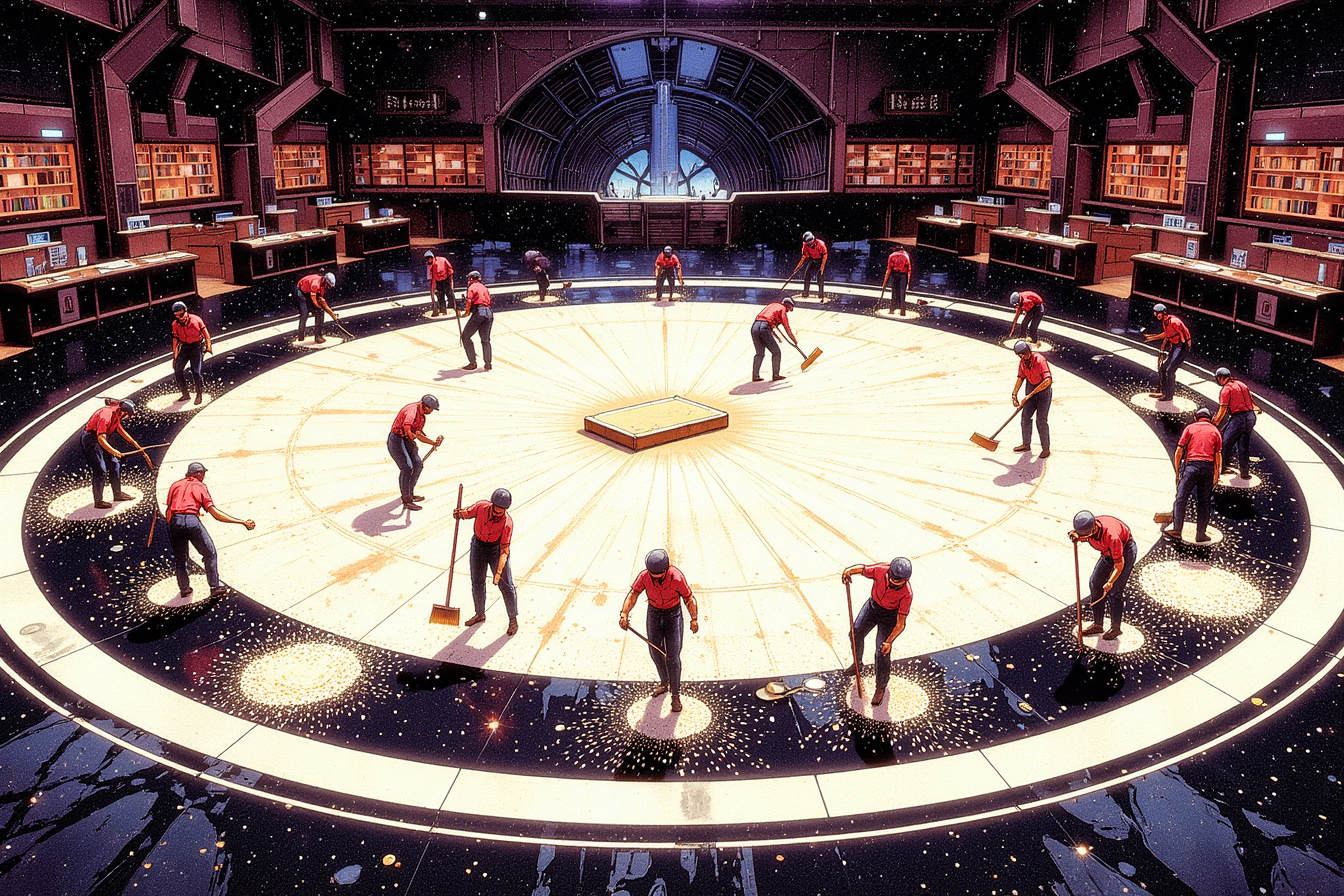
From the tender window the Sorrowful Moon lay on the black basalt like a coin somebody had dropped and declined to pick up: eleven kilometers of pale disc banded in seeded silica, white on white on white, the refinery block squatting at the north rim with its stacks lifting a heat shimmer that made the far edge swim. The surveyors had named the shape. The Conglomerate had kept the name. There had never been a moon over this world.
Maren Voss came up the aisle with the shift roster folded in one hand and looked at the plate the way a person looks at a kitchen.
"That is a plate," she said. "Eleven kilometers of it. The moon part is marketing."
"I was told extraction site."
"You were told the polite thing." She had a crew chief's voice, worn smooth at the edges from giving out the same numbers for twenty years, and her cuticles had gone shiny and hard, the hands of somebody who had swept since before anyone thought to attach a word like apprentice to her. "They call it the Moon because a moon hangs over you and gives nothing back. We built a better version, put it on the ground where we could sweep it, and then they named the ground after the thing it replaced."
The tender set down at the gate with a bump that Luminara felt in her teeth. Eleven minutes later she was standing outside with her camera bag on her shoulder and the wind pushing at her collar, and the first thing the wind did was prove that it had a grain to it. It came off the plates from the southwest, steady, carrying a fine powder that did not behave like dust. It settled on the back of her hand in flecks that caught the fixed light and threw it back as tiny hard sparks.
"Lift your arm," Maren said. "Palm up."
Luminara lifted it. After four seconds there were eleven flecks on her palm, and they did not melt.
"Sorrow-frost," Maren said. "That is the polite word for it, and it is the only one on the manifest. It comes down when the wind drops over the ridge. We catch it on seeded silica, we broom it, we weigh it, we send it north to the block. Everything else on this world is scenery."
The sweep was already going when they reached the plate edge. Nine crews worked the near rings at that hour, spaced out along the concentric bands so that from the gate each one looked like a small separate patience: wide brooms drawn in long even strokes, the crystal grating off the silica in sheets, crews stopping at the tray marks to funnel the sweepings into shallow metal pans that went to the scale on a cart.
The sound was what Luminara photographed first. She had expected something soft and got something like a chalkboard being swept, a dry organized scraping that carried across eleven kilometers of open disc with nothing to absorb it. Pell, who was seventeen and in her third season and whose broom was taller than she was, had a stroke she had clearly invented herself: pull, roll, set, a quarter turn of the wrists at the end that put the crystal into the pan without a single grain on the tray's lip.
"Again," Luminara said, and Pell did it again and watched the LCD with the wariness of somebody who has been shown a quota sheet.
"Does it go to them?" Pell asked. "The picture."
"It goes where I put it."
"Then put it somewhere good." Pell swept. "Nobody takes pictures of the plate. They photograph the product. Cartons, and the scale readout, and the serials when a shipment goes."
"You've seen the shipment photographs?"
"I've seen the ones they let the crew see." She said it without heat, the way people state weather, and went back to her quarter turn.
Maren walked Luminara down the second ring and gave her the numbers the way a person gives an address. Nine to a crew. Thirty-eight kilograms a shift, per crew, chalked on the board at the gate and re-chalked when the wind changed. Under quota and the crew's credit was docked gram for gram, and the dock came out of the crew, not the town, which Maren said was a distinction the paperwork was very careful about.
"And over?" Luminara asked.
"Nobody is over." Maren's mouth moved toward something that was not a smile. "The quota is what the town can bear in a shift. We have never once been handed more grief than the number."
Whose grief it was took Luminara an hour to see, and then she could not stop seeing it. The plates lay a kilometer from Keldan, the settlement strung along the basalt under the ridge, and the wind that came over the ridge came off the mourning ground first. Everyone on the crews could read the source. Wind from the third terrace and Anka Rell would touch the edge of her veil without looking up, because that was the Rells' row of houses and Anka had buried both of them there. Wind from the ridge road and the whole crew slowed by a stroke, because the ridge road meant a funeral walking out that morning.
"Every gram on this plate," Maren said, "was shed inside a kilometer of where we sleep. It is the closest thing the Conglomerate owns to a home industry. We grow it in our back yards and we bring it in by the sack."
"And you sell it."
"We are not permitted to call it selling. We are permitted to meet quota." She stopped walking and let the cart pass, a boy pushing pans of crystal toward the scale with his whole weight behind it. "Thirty-one years I have swept my neighbors off the ground and put them in a tray and signed for the weight. You want to know a funny thing, photographer? In thirty-one years nobody has ever asked me what it looks like."
The still house office was a prefabricated box with one window and a hot plate, and Maren opened a drawer in it and handed Luminara a paper fold containing four grams of the town's Tuesday.
"Straight out of Still Two," she said. "Don't drop it. That is somebody's week."
Luminara set her camera on the desk, screwed on the macro, and built a light out of a penlamp held at a low raking angle by a coffee mug. Under the lens the refined tear stopped being grit and became an object. It was the shape a drop holds between leaving an eye and landing, a curved lens with a seam down its center, and around that seam the refinery had grown its crystal the way a tree grows around a wire. Concentric rings ran outward from the core, fine as a fingerprint, and when she moved the penlamp the rings threw a narrow spectrum across the desk in a band no wider than a thread.
She shot twelve frames. On the ninth she stopped thinking about crystals and thought about eyes, because the core was still in there, curving the way it had curved when it left somebody, and everything the refinery had added was packaging.
"Frame count?" Maren asked from the doorway.
"Nine. Why?"
"Because Still Two runs eight hundred of those a day and you are the first person who has ever looked at one."
Outside, the gate board went from chalk-white to the green that meant a crew had hit its number, and Luminara was on the step with the camera up before the sound of it finished. Anka Rell, thirty-one years on the plate, had her broom mid-stroke when the board changed and stopped with it, both hands settling on the handle, and her face did the thing Luminara had come eleven hours to photograph. The jaw came loose. The eyes went to the board and stayed there, and for two full seconds Anka Rell was a woman who had finished something, and the finished thing had a shape that belonged to her alone, unguarded and briefly kind.
Then the wind shifted, fresh crystal came down over the tray line like glitter off a roof, the board re-chalked itself for the next shift, and Anka swept the new fall into the same pan without lowering her eyes.
Luminara crossed the ring with the camera still hanging off her hand. "Anka."
"Yes."
"When the number goes green, what does it feel like?"
Anka considered the question the way people consider a form they have signed before. "It feels like the end of the shift," she said. "What else should it feel like?" Then she went back to the tray line, and Luminara did not ask her a second time, because the answer was true and it was also not the whole truth, and the air between those two facts was exactly what the photograph was for.
Luminara lowered the camera and looked at the frame counter. Two frames taken. She had the face. It would be one of the two best photographs she made that year, and she was already aware that its caption would be a problem: what do you call the expression on a person's face when the number is met, when the number is a measurement of how much her town has lost.
"A met quota," she said, "is a report on the week."
Maren was beside her, watching the plate. "Yes."
"Thirty-eight kilograms of Keldan, delivered on schedule."
"That is what the manifest says." Maren folded the roster smaller, then smaller again, a piece of fidget that took ten seconds and had clearly been going on for years. "You want the part they do not put on the manifest. When the number goes green, the crew is glad. And the crew knows what the green means. And nobody on this plate has ever been able to hold those two things apart for longer than a breath."
Luminara had been Linda3637 long enough that she sometimes caught herself thinking in the designation, the way you catch yourself thinking in a currency you were glad to be rid of. The Registry did not simply strike a row. It went and got the images first, because a photograph is a memory with an address on it, and an erased person with photographs is only a person in hiding. Her archive had gone into custody with a courteous receipt. Forty-one frames from before had survived in a bag she had carried off a dock, and for a year she had gone back to the places in them with a camera and shot the same angle again and again until the new frame held what the old one had held before it was taken, so that she would have something to put a hand on when the memory slipped.
She had come back. That was the fact she built on. And now she photographed everyone else who refused to stay deleted, which had so far meant stopped freighters, restored gates, a courthouse full of names read in public.
Nobody had ever photographed these people. That was the fact she built next. The Conglomerate shot cartons and serials. Keldan had no portrait studio and no news feed and no habit of looking at itself, and the crews who spent their working lives converting their own sorrow into currency had never once been shown what they looked like doing it.
At the end of the second ring she turned around and planned a frame in the air with one hand: nine crews in a line with the brooms planted, the white rings of the plate running out behind them, the ridge above. She would shoot it at f/8 where nothing could hide, and she would make sure every one of them knew the shutter was going, because a portrait taken without notice is a different crime.
Maren watched her plan it. "Documentation again?"
"Documentation," Luminara said. "The most dangerous kind."
The still house was the loudest room Luminara had ever stood in. Still One ran down the center of it, a sixty-meter column wrapped in lagging and bolted through the floor, and it had not been cold in thirty-one years, four months, and whatever number of days A1 counted off in her ear as she came through the door. The hum was under her boots and up through the fillings of her teeth. Heat came off the lagging in visible sheets. Men and women worked the catwalks with ear protection and the unhurried movements of people who had long ago stopped hearing the thing that could kill them.
"Documentation pass," Maren told the floor supervisor, who looked at the pass, looked at the camera, and signed the register with a stylus worn down to a nub. The pass read plant safety documentation, one afternoon, camera access to the still hall. It was the truest document on the plate and also the cover for the only plan anybody had, which was the arrangement Luminara liked best.
Pixel's voice came in on the bead, small and dry. "A1 would like the manifold, the valve stack, the feed line, and the serial plate, in that order. He says the floor plates are meter stock, so leave the floor in the frame and he has his own scale."
"He can have them," Luminara said. "Tell him I am doing documentation."
"He knows. He says documentation is his favorite genre."
Om Kai had come with her and stood at the gallery rail below the column with his hands together, watching the crew on the catwalk with the expression he reserved for anything that ran on a schedule and had never been asked permission. "Where will you begin?" he asked.
"Where the plan is," she said. "I begin where the plan is, and then I take the picture that makes the plan unnecessary to explain."
She worked down the north catwalk and let the camera do the arithmetic. Frame 212: the manifold flange where the feed line from the plate came into the column, its eight bolts numbered in paint by a hand that had gone on numbering them for three decades, with the meter floor plates running beneath it so A1 could read the width of anything he liked. Frame 213: the valve stack and its manual wheel, painted safety yellow and worn to bare metal on the rim where hands had grabbed it. Frame 214: the feed line, its lagging stripped back for a survey that had never come, showing the crystal-packed interior glinting under her flash. Frame 215: the serial plate, SO-1, installed at commissioning, with the service dates engraved in a column that stopped four years ago because the crew that serviced the main still had been reassigned to quota work.
"Last four frames uploaded," she said into the bead. "You have your scale. Frame 215 has the cut dates."
"So it does," A1 said, and she heard the small cup set down on a console, which meant the numbers were bad for somebody and he had already begun rearranging them. "The main still is mapped, Luminara. I could cut it from a photograph. In fact I could not cut it from anything else."
Maren had caught up to Om at the gallery rail and stood with her back to the column, feeling its vibration through the plate. "Ask me what we do when it goes quiet, chaplain."
"When it goes quiet," Om said.
"Nobody on this plate has ever heard this hall quiet. Still One was commissioned when I was twelve and my mother was on the crew that poured the foundations under it. The hum has not missed an hour since. So when you ask me what comes after the documentation, I want you to know that the after is a place none of us have been."
Om looked up the length of the column to where it vanished into the roof vent. "Where I trained," he said, "we held that observation changes the thing observed. A measurement taken is a small closure as well as an opening. The monks argued about which one you were obliged to attend to."
"And which were you?"
"The one in front of me," he said. "Always the one in front of me. It is the least monastic answer I know and it has never once been wrong."
Maren folded her roster once more and did not reply, and the column went on humming between them at an hour of dusk that had not changed in a thousand years.
Then she climbed to the catwalk and stood at Luminara's shoulder with the roster folded down to a thick little square, which was her way of saying she had run out of paper to fold. "And when does documentation stop?"
"Documentarians?" Luminara lowered the camera and looked down the column at the hum that had not missed an hour in thirty-one years, at the crews who swept their neighbors into trays and never asked what it looked like, at the eight bolts she had numbered in a frame. "Documentarians stop when the picture is complete. We are very nearly complete."
At the gate, in the last of the unchanging light, she made the crews stand: the nine broom crews from the near rings and the six in off the far rings at the change of wind, the still-hands down from the block, the weigh-house and the gate, one hundred and forty-seven people in a line with the brooms planted, Maren at the end with her folded roster, the rings of the plate running out behind them to the refinery block and its shimmer. Pell blinked on the first frame, which Luminara had counted on, and she shot a second, and in the second nobody blinked because nobody was ready for a photograph to be a thing that was theirs.
She sent it from the gate tablet before she changed her mind about anything: to Maren, to the crew list, to every handset on the plate that the crews had ever been issued, forty-one devices, a copy to Keldan's switchboard, and one to The Ephergent for the file. On a plate where the Conglomerate had never spent a single frame on a worker, the Moon's crews had just been sent a photograph of themselves that nobody had ever seen.
Pell looked down at her own face for a long moment and then up at Luminara with an expression that had no name in any manifest.
"That is me," she said.
"That is you," Luminara said. "Frame two. You blinked on frame one, so this one is yours."