
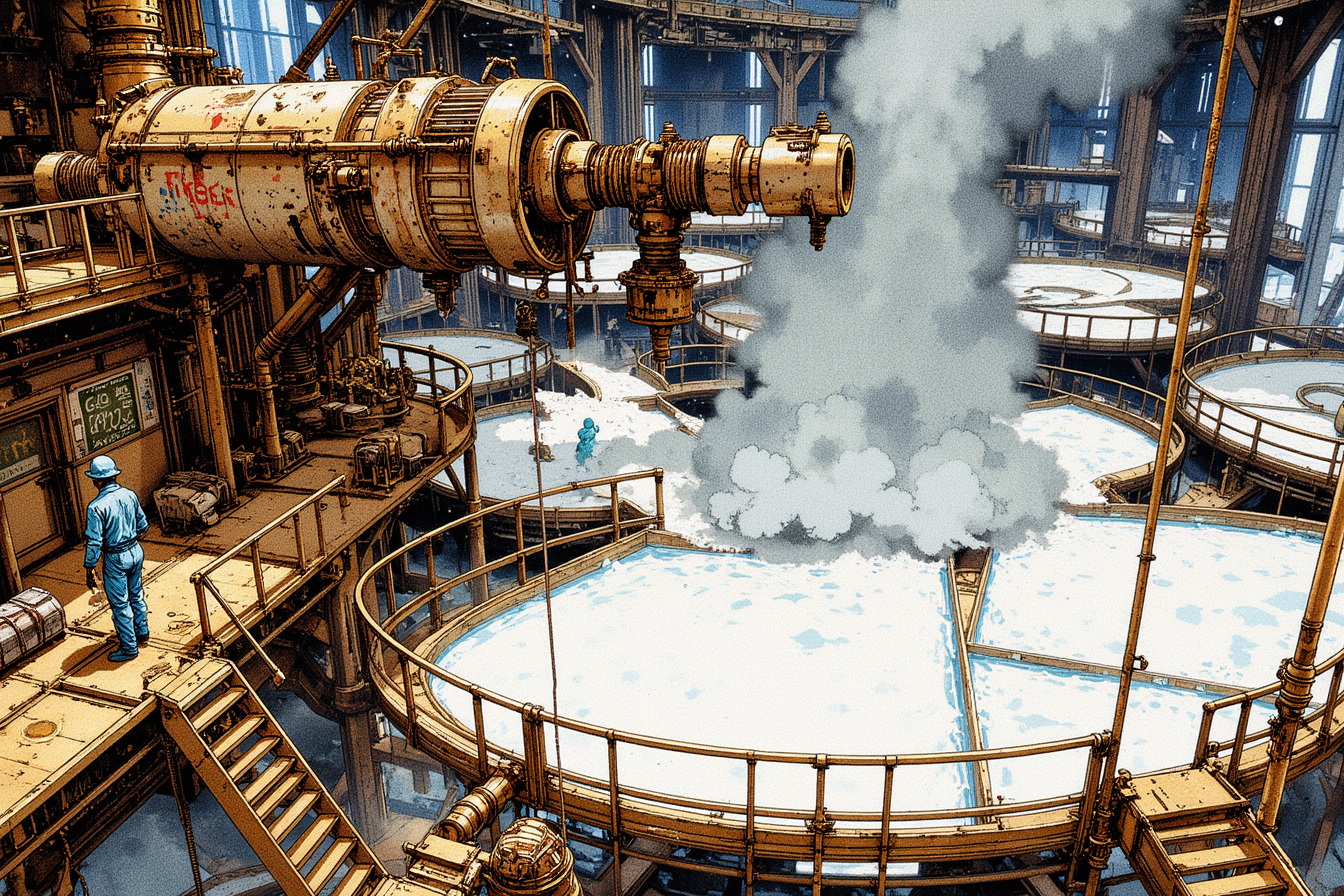
Static Between Stars — Chapter 15: Unmined Laughter
The main still had been running for thirty-one years, four months, and nine days when Pixel Paradox ordered it turned off.
She gave the order standing at the gate of the Sorrowful Moon with the plate's white rings running out on either side of her and the quota board still chalked with yesterday's green. Zephyr pushed the audit tender's schedule to her bead: fourteen hours out, a Conglomerate inspection barge out of the Keldan lane, four auditors and a manifest clerk, due to count every gram on the plate and file it under standardised production.
"Thirteen hours and fifty of those fourteen," A1 said, "is the part where nobody notices anything. We are in it now."
Maren Voss stood with her crews along the ring road, all fifteen broom crews called in at the change of wind, the still-hands and the weigh-house and the gate, one hundred and forty-seven people in work clothes with their tools in their hands, waiting for a captain on a planet to tell them to break the plant they had been born on the payroll of. Luminara was at Pixel's shoulder with the camera up. Om Kai was beside the gate post with his hands folded, and he did not say anything at all, which was how he said he was there.
"Sequenced?" Pixel asked.
"Satellites first," A1 said. "Still Two, Still Three, Still Four, run down in order so the plate's pressure bleeds off clean. Then the manifold feed, then Still One. At a walk it takes nine minutes. If it goes wrong it takes eleven seconds, and Anka Rell will be on the catwalk for both outcomes."
"I will be on the catwalk for both outcomes," Anka said. She had her ear protection around her neck and a paint-marked wrench in her fist, and she said it the way she had said everything for thirty-one years, as a correction to a form.
"Then we walk it," Pixel said. "Maren, your plant."
Still Two died without ceremony. One moment the north block was pouring eight hundred refined tears a day into cooling trays and the next the turbine note was walking down the scale, and the crews on the catwalk kept their hands off the rail because A1 had told them what a surprise does to a person twelve meters above a concrete floor. Still Three took forty seconds. Still Four took thirty-five, and when its relief valve sighed open, a fog of unrefined sorrow came out over the plate in a slow gray sheet and settled on the silica like weather.
"Lights on the tray line are out," Zephyr reported from the bridge. "Production board is blank. Their own system just filed the first line of its own obituary: output, zero."
"And the tender?"
"Still fourteen hours. They are not hurrying, Pixel. Nothing out here has hurried in thirty years."
The feed line to Still One was frame 214, the one with the lagging stripped and the packed crystal glinting in it. Anka put her wrench on the manifold flange and turned the first bolt, and the hum in Pixel's boots changed pitch, dropping under her arches the way a held breath drops. The feed line vented. A second sheet of gray came off the catwalk and went down the length of the plate on the wind, and Pixel watched it cross the ring road and reach the crews, and she felt it arrive: a pressure behind the eyes, a sudden knowledge of somebody specific who was not there, a graveside weather that had no respect for rank or shift.
Nobody on the ring road wiped their faces. There was no point; the fog kept coming.
"Manifold is clear," Anka called down from the catwalk. "Feed is open and draining. Main still, you have fuel."
Still One had never been off. That was the fact Pixel kept returning to while the still-hands worked the cut, the fact that would go in the dispatch. It had run through a war, through every audit, through the commissioning crews and their children and the children of those children taking brooms, through Keldan's funerals, eleven thousand four hundred days of continuous production, and the great turbine began its run-down at 4:41 in an afternoon that looked like every other afternoon on Nocturne Aeturnus.
The column went from a hum to a moan to a whisper to a sound like a spoon against a cup, and then it stopped, and the quiet came in so hard that Pixel heard her own pulse in her ears and a broom handle knocking against a tray two hundred meters away.
For nine seconds nobody moved. Somewhere inside the block a cooling pump finished its cycle and clicked off, and that was the last machine on the plate, and then there was only wind, and breathing, and the gray still coming down.
"Main still is off," A1 said, and his voice was the same as it had been all day, and it was also the only voice on a plate where a machine that had not stopped in thirty-one years had just stopped. "Cold start would take eleven hours and a work order signed by people who no longer exist. It will not be restarted."
Maren's voice went down the ring road, level, the same voice she used for grams. "Leave the trays. Leave the cart. Leave the sweep where it lies."
So the grief lay where it fell. The half-full pans sat on the cart by the tray line with their numbers still chalked on the lip. The fresh frost from the vent stayed on the silica in a gray band three hundred meters wide, unrefined, unswept, going nowhere, and in fourteen hours the audit tender would land on a plate covered in the one thing it had come to count and would have no form for it.
The crews walked off with their tools. Wide brooms over shoulders in the same posture, the scrapers and the hand scales and Maren's folded roster, the still-hands last with their wrenches, and Anka Rell at the end of the line with her ear protection still around her neck. They walked the ring road to the gate with their faces wet from a fog they had spent their lives sweeping into trays, and none of them looked back at the plate, because looking back at work you have quit is a habit the quota had never allowed them.
Pixel counted every one of them: one hundred and forty-seven.
Maren came back through the gate alone and stood beside her, looking at the gray band lying on the plate where the fog had settled and nobody had swept it.
"Wages stop when the roster stops," Pixel said, because that was the part of a strike that belonged in a ledger and she had promised herself she would say it out loud. "A hundred and forty-seven people just gave up a season of credit, and the town's ration tab runs through the same account."
"It does." Maren folded the roster down to its thick little square. "We brought food for four months. My mother started hiding it under the tender floorboards eleven years before she died, and nobody ever asked her why, because on this plate you do not ask a woman why she is storing grain." She said it flat, the way she gave grams. "She had been waiting for somebody to give us a reason to stop sweeping. It turns out the reason was seeing ourselves do it."
The barges lifted from the south apron in the fixed dusk, because there was no other kind. Three plate barges, Tare, Quill, and Vigil, running light with nothing in their holds for the first time in their working lives, and the crews' tender Keldan Roads riding above them with a hundred and forty-seven souls listed on her manifest.
A1 updated the board in the galley of The Ephergent, where most of the crew had gathered, because on this ship the news was wherever four of them could stand. Hulls, he said: fifteen before the lift, nineteen after. Souls: three hundred and twelve, four hundred and fifty-nine.
Rook Adeyemi came up on the net from the Woken's lead tug with her sleeves rolled and her voice careful. "Fleet says welcome. I should tell you the paymaster situation is unresolved and the food is whatever Zephyr has been hoarding."
"Then tell your paymaster," Maren said, "that ours was a chalkboard and we brought our own brooms." She signed the roster and slid it across the galley table, and Pixel signed it under a heading that did not exist in any Conglomerate form, which Maren had written out by hand in the space where the form would have had the form number: JOINING.
"Extraction bureau," Rook said, reading it over the net. "That's what you are now."
"That's what we always were," Maren said. "We just had the wrong extraction target."
Pell was down the corridor at a viewport with her broom still in her hand, which she had carried aboard the tender and up the ramp and would evidently not be putting down, and she watched the Sorrowful Moon fall away below the barges: eleven kilometers of white rings and a gray band across the middle of them where the fog had settled.
"It's still coming down," she said. "The grief. Nobody's sweeping it and it's still coming down."
"Yes," Luminara said, and raised the camera on the dark glass: a girl holding a broom in a corridor, a world under her chin going on grieving whether or not anyone had a form for it.
"Good," Pell said. "Let it pile up where they can see it."
The mint came out of a bread tin.
Maren set it on the galley table and unrolled the cloth inside it with both hands, the way other people unroll silverware: a chilled crucible no bigger than a bowl, its interior dusted with seeded silica swept from the plate's own rings; a hand press with a screw the size of a thumb; and two stamping dies, blank-faced, still bright from all their decades wrapped in oiled paper at the bottom of a tin that had ridden in three bread tins and two floorboards without the crew ever asking what was in it.
"Assay die from the plate office," she said. "My mother took it home the year Still One was commissioned and wrapped it in paper and never told a soul. She said if the Conglomerate ever counted the grief twice, somebody would want the other side of the scale."
Luminara had her camera on the table, because Luminara's camera was always on the table, and she did not raise it yet. "Does it work?"
"It presses," Maren said. "The rest of it, you are about to watch fail." She looked around the galley: Pixel, Zephyr, Om, Clive in his bracket by the chart, Luminara, Rook's second on the screen, and Meatball asleep on the end of the bench with one ear cocked at the bread tin. "The Conglomerate has six hundred refineries trying to schedule joy. You cannot. Grief will crystallize on a timetable because grief is patient and it arrives anyway. Joy waits to be wanted. So the crucible is chilled and seeded, and then you have to laugh, and nobody can tell you when."
"Then we laugh when it comes," Zephyr said.
"Laugh now," Maren said. "On three."
They laughed on three. It came out of the room like a drill sequence, flat and arrhythmic and slightly too loud, and the crucible stayed dark, and the galley was so quiet afterward that Meatball lifted his head to check whether somebody had died.
"Again," Maren said.
They tried again with worse results. Om Kai produced a sound of such formal goodwill that Luminara put her hand over her mouth, and A1, who had been watching through the galley's ceiling camera, announced that scheduled mirth was running at zero successes in twelve attempts and that he had known ship's intelligences who would have paid for that statistic.
"Counting it," Maren said, without looking up from the crucible. "Whoever is counting, stop. That is the whole of the science. The moment you are counting laughs, you are the Conglomerate."
So they stopped counting, and for a while nothing happened, and then Maren, with her thumbs on the press handle and her eyes on the dark silica, said, "Thirty-one years I have been weighed to the gram. And today I am a counterfeiter."
"You're a mint now, chief," Pell said from the doorway, where she had been standing with three other faces behind her for some time.
"I am a mint," Maren said.
And the laugh that came out of Pixel was ugly and graceless and entirely unplanned, half a cough, and she felt it leave her without permission, and at the same instant a hairline silver appeared on the crucible's black dust, spreading the way frost spreads on a window when somebody has breathed on it.
Nobody counted. Nobody moved. The silver went on spreading in fine threads, and Maren watched it with the stillness of a woman who had swept thirty-eight kilograms a shift for thirty-one years and was looking, for the first time, at the thing being made instead of the thing being gathered.
"There," she said. "That is unmined."
Two more laughs came in the next hour, both of them bad, both of them involuntary: Clive saying that he had been a stapler long enough to find this criminally reasonable, and Zephyr attempting an explanation of his own navigation errors that collapsed under its own weight at the second sentence. Each time the frost took another breath of silver. Maren gathered it with a spatula into the press, and the press took the three laughs, twenty-six grams of silver and seed dust together, and gave back six four-gram wafers stamped on both faces with a die that the Conglomerate's ledger had never once been told about, plus two grams of shavings that went back in the tin for the next time.
A1 ran the assay from the ship's lab connection and took his time about it, which meant he was being precise and not kind. Lattice: standard CLX columnar, exact match. Mass: 4.000 grams, nominal tolerance. Spectrum: clean, no inclusions, no plate contaminants. "It will pass any bench in the Rim," he said. "It will fail the only test the Conglomerate runs, which is the ledger. Their CLX exists because a book says where it has been."
"Merchants don't read their book," Zephyr said.
"No," A1 said. "They read the light."
Pixel took the headset Zephyr was already holding out and filed the dispatch from the galley chair, because the galley was where the news was. She kept the numbers exact and the adjectives out, the way she did everything.
Dispatch, from the galley of The Ephergent:
The main still on the Sorrowful Moon is off. It had been running for thirty-one years, four months, and nine days when the order came. Cold start now takes eleven hours and a work order signed by people who no longer exist.
The shutdown ran in sequence, satellites first down to Still One, nine minutes at a walk and no step of it wrong. If it had gone wrong, it would have taken eleven seconds.
Eleven thousand four hundred days of continuous production, filed this afternoon under output, zero. Their own system wrote the closing line itself.
One hundred and forty-seven still-hands, weighers, sweepers and gate walked off the ring road with their tools and signed onto our count: hulls nineteen, souls four hundred and fifty-nine. They signed under a heading no Conglomerate form has ever carried: JOINING.
The grief they spent their lives sweeping is still coming down: a gray band three hundred meters wide on the plate where it fell, unrefined, uncounted, going nowhere, and the audit tender lands in fourteen hours onto the one substance it has no form for.
Six four-gram wafers sit on this table, struck from laughter. They will pass any bench in the Rim and fail the only test the Conglomerate runs, which is the ledger. No book in the galaxy has an entry for them.
, Pixel Paradox, signing off
Zephyr spent the first two wafers at a relay pump in the Keldan lane that belonged to an independent dealer with a scanner he trusted more than his government. Six point two tonnes of propellant and forty cases of water went aboard the Bittern and the yard tug Kick, and the dealer's only question was whether the captain wanted a receipt. She did not, because a receipt is a ledger you carry yourself.
"Nine months," A1 said afterward, setting the small cup down on the console edge with the kind of care people use around a number they like. "At current burn, the fleet is funded for nine months on money the Conglomerate's books do not know exists. I would like to state for the record that I find this dishonourable, and that I have already begun doing the arithmetic twice."
The fleet was growing while he said it. Zephyr's board had answering transponders on it that had not been there a month before: hulls that had found them on the back of the Vannic Reach broadcast, and four that had come in today alone, a courier out of the Reach called the Sedge, two retired patrol skiffs with their Registry plates ground off, and a grain freighter whose master had heard the Vannic names read in public and had come two jump-lanes out of her way to ask if the rumors were true. Fifteen hulls before the Moon's barges lifted and nineteen after. Four hundred and fifty-nine souls. A photocopier with attitude and a mint in a bread tin.
Zephyr was still at the comms board when the drone came in, which was the only reason anyone heard it. Gray hull, Registry make, no weapons, running its transponder wide open on a channel The Ephergent had not lit in months, holding four thousand kilometers off the plate with its courier tube cold.
"It's not a hail," he said, and his hands went still on the board in the particular way of a comms officer reading a header he does not believe. "It's addressed to us. By name. The name the Registry struck."
"Open it," Pixel said.
It was not a contract and it was not a courtesy packet. It came on the Court's own gray, older than the Conglomerate's billing font, with a bench seal at the head of it and a docket number under the seal, and it had been routed through every toll-lane Zephyr could not account for and delivered to a ship that officially did not exist, which told her two things: somebody with authority had wanted it to arrive, and somebody with authority knew exactly where they were.
Zephyr read it aloud because reading things aloud was how he kept his hands steady. "Before the Galactic Registry Court, sitting in emergency session, docket nine-one, the Court requests the testimony of the crew of The Ephergent concerning the restoration of the Vannic Reach, the reading of the delisted names, and the custody of Registry records. The witness named in the docket is Luminara Usha, formerly designated Linda3637. The Court offers safe conduct under its own seal. Attendance is not required. The Court notes that you will come anyway."
Nobody in the galley said anything. On the bench, Meatball opened one eye, decided the packet was paperwork, and closed it again.
Magistrate Ilva Sorn's bench was asking for them by name. Fourteen hours out, the audit tender was running toward a count nobody would sweep, and ahead of both of them a courtroom in the heartworld had opened a docket with Luminara's designation typed into it, and the designation was there to be struck.
Pixel looked at the seal on the screen until the screen dimmed and then lit again.
"Well," she said. "They want testimony."