
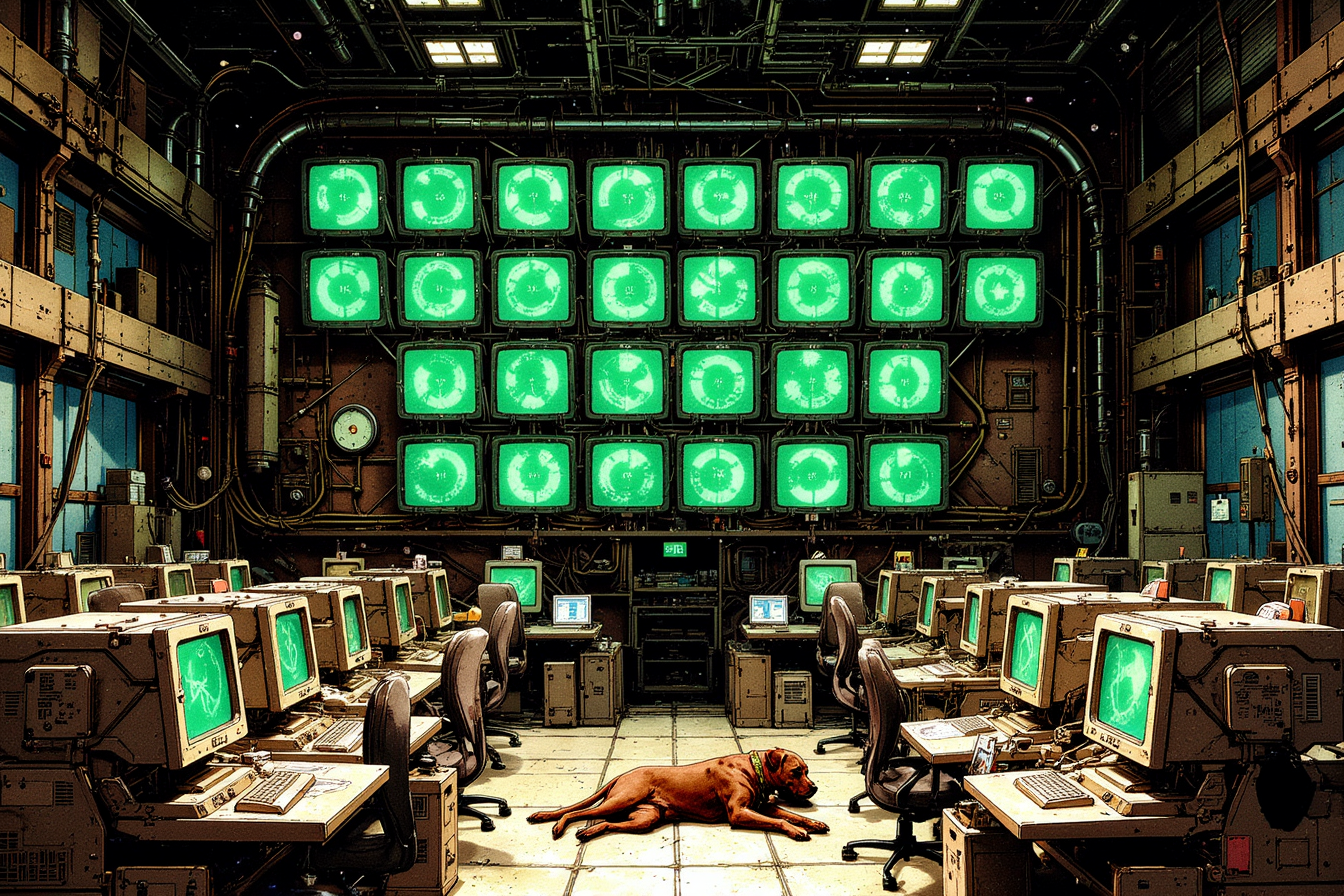
Static Between Stars — Chapter 27: The Great Inefficiency
At 0400, with the funeral still in the air, Zephyr put Aether Junior on the comms bench and began to build a flood.
He worked fast, which is his only speed: three screens up, the deck's casing open, a cup of coffee going cold behind his elbow because his hands were always quicker than his mouth. The plan started on the back of a mess chit, because anything that has to survive contact with this crew has to be written where somebody can find it later.
Five layers, he wrote, and under each one he wrote the thing he had learned from the last eight months of stealing signals from the Conglomerate.
Spine: the Deepwood net. Elder Sorrel's forest band, untappable, running under the leaf litter of Verdantia where an audit means digging up a world. Every other channel we have can be found by direction-finding. That one can only be reached by owning the ground.
Relays: every receiver that has ever heard us and repeated it. The Woken tugs. The Moon crews' handsets. Freighters with crews who pinned the Ledger in their mess halls. Gate clerks running pirate copies of our transcripts on equipment they bought themselves. A relay costs nothing and a jammer has to be aimed, and there is no aiming at a receiver that is only listening.
Carrier: Maren's mint. Counterfeit CLX struck from laughter the Conglomerate could not source, modulated underneath the signal as a carrier wave. Their whole law of supply is built on the fact that joy refuses to be mined on quota, and now somebody was going to put that refusal on the air where it belonged, humming under everything else like a heartbeat.
Payload: the transcripts. The Receiving Ledger with Ternhaven's line intact. The surrender offer we printed with the blank reply box. Luminara's testimony from the Registry Court. The Vannic names. Three thousand rows with birthdays attached, still the most dangerous document in the quadrant because you cannot argue with a school district.
Audience: the fifth layer, the one he had almost forgotten to write down. The people who hear it keep it, and a copy is cheaper than a censor, and that is the whole design. Nothing we send is meant to be unsent.
He pulled Maren's mint file next, because a carrier wave has to be something before it can be something underneath. The first laugh she ever struck for the war was in there: the galley, three months ago, eleven people trying to laugh on purpose so the die would take, all of them bad at it, and Om Kai laughing anyway, because laughing badly on purpose is still laughing. Zephyr had listened to that file more times than he would admit to anyone on this ship. It was four seconds long and it had no words in it, and it was the exact opposite of every courtesy packet the Conglomerate had ever sent. He modulated it into the carrier slot and watched the waveform settle into something that looked, on the spectrogram, like breathing.
The photocopier was the last layer, the physical one. Pixel's people ran paper copies for the receivers that still take paper, because a relay in a market stall does not decode a burst: it takes a page and pins it up, and a page pinned up in a market is a rumor with an address. The copier had started this whole war by being a copier, and tonight it was going to earn its keep again, one transcript at a time, while the flood carried everything else.
He was drawing arrows between the layers when Meatball sighed in his sleep, and Zephyr looked up and realized the dog had claimed the center of the comms panel again, which meant every relay he patched tonight would have to route around a Rottweiler.
"Route around him," A1 said from the console. He had come in so quietly that the only warning was the smell of coffee. "I have run that adjustment. It costs you four percent of the bandwidth and I recommend paying it."
"Because the luck lives there."
"Because the luck lives there," A1 agreed, "and because I have watched targeting computers fail to classify that animal four times, and I have stopped treating it as a coincidence."
The first thing Zephyr did after he finished the diagram was try to destroy it himself.
"Jam me," he said.
A1 set down the cup. "Specify."
"Source channel. Everything I've got. Full suppression, the way the Reckoning's people would do it if they were awake and annoyed." Zephyr loaded one line into the deck, the smallest payload he owned, a fragment he had carried since the day they printed the Ledger. "On my mark, kill the transmitter."
"Mark," said A1, and the source went dead in one point eight seconds with a clean hard silence that Zephyr felt in his teeth.
On the relay monitor, the line kept arriving.
It came in on a Woken tug's secondary band, then off a freighter's civil band, then out of a school receiver on a moon nobody in the Conglomerate's systems has bothered to price in nine years, then in a burst from a relay that had no business still being powered. Nineteen arrivals against one kill. The jammers had done exactly what jammers are for, and it made no difference at all, because by the time they pointed at the source the words had already gone out through the side door of every ear that had ever opened for us.
ACCEPTABLE LOSSES, said the screen, again and again, arriving.
Zephyr leaned back. "Anyone can jam a channel. Try jamming a rumor."
"I have now jammed it eleven times," A1 said. "It has arrived nineteen times. I note that you are pleased by arithmetic that includes my own competence as a casualty."
Then he ran the second test, because a rumor about a grave is only half the payload. He loaded four seconds of Maren's laughter into the carrier slot, sent it riding the same mesh, and A1 killed the source again. This time the classifier on the kill logged the dead transmission as unclassified commodity, no match, no tariff line, and Zephyr laughed at that for real: somewhere in the Conglomerate's own bookkeeping, a burst of laughing had failed to be anything they had a rule for.
"It has arrived twenty-six times," A1 said. "Nine of those arrivals are on receivers the Conglomerate has already written off as unprofitable, which means our signal is reaching equipment we are not supposed to be able to afford."
A voice came through the relay board, one of Rook's signal-hands, flat and brief: canary two, arrived, laughing, understood.
"They don't even decode it," Zephyr said. "They hear it and they know."
"Know what?"
"That it's ours."
Clive, on the port console with his case file open, put a staple through a page. "Log it," he said. "Two canary tests, sources killed at one point eight, payload survived both. Evidence that a war can be fought without a single shot, filed by a dog's radio operator."
"I'm a people's radio operator," Zephyr said.
"Kid," Clive said, "you're a rumor in a uniform."
They argued about it in the wardroom at the second watch, because the flood needed a schedule and the schedule needed permission, and this crew has never once let a plan go out without trying to break it first.
Zephyr put the diagram on the table. "Every channel at once. In a window, we open everything we have: the Deepwood spine, every relay that answers, the mint underneath it as carrier, the transcripts on top. Then we close and we wait, and when we open again we open somewhere else. A jammer can win a channel. It cannot win a minute where four hundred transmitters talk at once."
Luminara looked at the diagram the way she looks at a contact sheet. "If everything goes at once, nothing is a picture," she said. "I have watched an audience choose which photograph to keep, and they choose one. Give them forty images in the same hour and they keep none."
"Give them forty and they tell each other about the one they liked," Zephyr said. "That's the point. We are not broadcasting for custody anymore."
"No," she said. "We are not." Luminara studied the diagram a moment longer, then tapped it with one finger. "Then sequence inside the window. First image, then the words, then the names, all twelve minutes of it. A flood still has a current if you put it in a channel." She looked up. "I will cut the frames tonight."
Rook had her arms crossed. "A flood burns the relays that answer it. The moment a handset repeats us, it can be direction-found and it can be picked up the next morning. I have people hidden in six systems who have never been used, and this plan uses every one of them in one afternoon."
"It uses their radios," Zephyr said. "Not them."
"A radio with a mouth on it," Rook said, "is a person with a mouth on it."
"It doesn't have to be," Zephyr said. "The relays that answer repeat on a delay, and the delay is the disguise: by the time a direction-finder gets a fix, the transmission has already left the handset that sent it and moved two hundred kilometers. We built that in so the jammer aims at where the words were. Rook, I am not spending your people. I am spending radios they were never going to open again."
Rook looked at him a long moment. "If one of those handsets puts a person on a list," she said, "I will hold you to that."
"And you should," Pixel said.
Maren Voss, on the relay from the plate, had her counterfeit dies on the bench behind her where the light could catch them. "You want my laughter riding as your carrier. That is funding you're modulating. Every cycle my mint puts out is a cycle that pays for hull plating."
"It's a copy you're riding on. The mint doesn't spend it."
"Young man," she said, "everything spends."
"Then spend it with your mark on it," Zephyr said. "First second of every burst, the mint's strike, so the Conglomerate hunts the sound and finds whose laugh it is. Their law says laughter can't be sourced. We are going to source it, in public, on a schedule."
Hob Measham clicked his stopwatch twice and did not look up. "Hours," he said. "You want hours. The toll auditors run the lanes on the quarter, and anything you open inside an audit window gets logged against a bill of lading whether or not it belongs to anyone. Open your flood off the quarter. Three windows a day, twelve minutes each, and you will have me, because I will schedule the yards to be deaf at the same minutes, and a deaf yard is a stoppage nobody can bill."
Om Kai had been quiet in the doorway with his tea, in the posture that means he is waiting for the question that has no operational answer.
"The Conglomerate's entire strength," he said at last, "is that there is one version of things and it is theirs. A flood does not defeat that by being louder. It defeats it by being uncountable. So I will ask you the only question I have: what will people do with it once they have it?"
"Repeat it," Zephyr said.
"Then make sure the thing you are handing them is worth repeating," Om said. "Joy and history and testimony, in that order. A fleet that can only be described as noise loses the war it wins."
Clive tapped the transcript stack. "And keep the record fat," he said. "Rumors win mornings. Paper wins the years. Every window carries the ledger line and the offer, word for word, so that a year from now some clerk in a beige office says he never saw it, and there are four hundred relays that did."
"A1," Pixel said. "Coverage."
A1 laid three figures on the table and stopped there.
"Window one, at 0600 ship's time: four hundred and twelve open relays on the spine, with the payload repeating on eleven bands. Projected reach, sixty-one percent of receivers in the four systems inside nine minutes, and forty percent of Rim shipping inside a quarter of an hour."
"And after the first window?"
"Coverage compounds, because the receivers retransmit without being asked. By window three I project that jamming the payload in one system requires suppression of every civil band in it, which stops their own freight traffic, their own courtesy packets, and their own auditors from hearing each other."
"Window two," he went on, "is the Deepwood spine with every surface relay cold, so the payload travels under their feet. Window three, synchronised with Hob's stoppage, gives me a lane network that cannot report what it hears for eleven minutes. For eleven minutes, the Conglomerate's own toll-lanes are a rumor with nobody to tell on it."
The room went quiet in the way rooms go quiet when the numbers have started doing the talking.
"And the probability," Pixel said, "that it works."
A1 poured a small cup, set it on the table edge, and did not answer.
"A1."
"The coverage figures are the answer I have for this table, Captain." He folded his hands. "The other number is in a different cup, and I will serve it to you when serving it would do you some good."
"Which is a way of saying the odds are bad."
"It is a way of saying that odds are what you consult before you begin," A1 said, "and you have begun."
Zephyr did not want the other cup. He had spent three years wanting a number, ever since Fairweather 14 first came out of a gap in the chart, and he had learned that a number you get in advance is usually just a slower kind of despair. He wanted the schedule.
"Window one, 0600," he said. "Window two, 1400, Deepwood spine only with the relays cold until the payload lands. Window three, 2200, everything we have, coordinated with Hob's stoppage so the lanes go quiet while we shout." He wrote it on the chit and passed it down the table. "Then we sleep, and the next day we do it again from somewhere else, and the day after that from somewhere else, until their censor staff has to be awake in every system at every hour of the night."
"And then?" Luminara asked.
"Then they start shutting down receivers," Zephyr said. "And a Conglomerate that has begun confiscating the radios in its own shipping lanes has told every person in the quadrant what it is afraid of, and that is a payload we did not have to invent."
Pixel read the schedule twice, wrote The Great Inefficiency at the top of her own copy the way she had written it on the wardroom board, nodded once, and put her headset on. What went out was short, because Pixel does not waste a window: the 0600 window on every band, the Ledger line and the offer with the reply box and four hundred relays saying it in their own words, nothing sent that was meant to be unsent, and a fleet they could not outgun that they intended to outtalk. Zephyr heard it arrive on three monitors at once and went back to his chit.
At 0512 the deck cleared, because the crew of a press ship goes to sleep before a window the way sailors check the lines before weather.
Zephyr stayed.
He had the chit pinned above the board with the schedule on it, and under the schedule, in his own handwriting, the fifth layer he almost had not written down: audience. He thought about the school receiver on the unpriced moon. Somebody down there had kept the power on in a receiver that the Registry had no reason to notice, and last night that somebody had helped him win a fight against the flagship of the Conglomerate by repeating eleven words.
Meatball slept in the center of the panel. The luck lived there. Zephyr routed around him, gently, the way you route around anything you would rather not move, and opened the bottom of his listening queue.
Fairweather 14 had been sitting in that queue for three years, longer than the war, long enough that he knew its pulse the way other people know a lullaby. Coordinates in a gap the charts insist are empty. A month struck from every calendar. His brother, lucid in bursts, inside the grid, answering nothing.
He put the frequency on the open channel, where it would stay, and he keyed the mic before he could think about it, because thinking about it is the only way he never does it.
"Aether," he said. "It's Zephyr. We are going to flood the whole sky in under an hour, every channel, everything they ever told us we weren't allowed to say, and there is going to be so much noise in their grid that for one night nobody can hear a single clean order come out of anybody."
He checked the carrier. Green.
"I'm coming down that grid to get you. Whatever's left of it. So leave the frequency open, and when you hear the flood start, talk into it, because I am going to be listening on this band until you do."
The old ping answered the only way it ever answered: Fairweather 14, patient and faint, out of the coordinates the maps leave blank.
He let it run through the monitors the way he had run it four hundred times in rooms by himself, except that this time he had written it down beside a schedule: window one, 0600, everything. For three years that ping had been a question with no second half. Tonight it was a thing he could answer with a time.
Zephyr left the frequency open, turned down the lights against the 0600 window, and put his hand flat on the deck beside the dog, and waited for the sky to start talking.