
Static Between Stars — Chapter 28: Everyone Has Already Heard
The first flood window opened at 0600 over the Vannic Reach while Luminara was holding a photograph the Registry had spent nine years proving did not exist.
She felt The Ephergent take the window the way the copier takes paper: a small mechanical certainty rising through the deck plates into the soles of her boots. The broadcast deck smelled of hot toner and old paper. A1 had poured the large cup, which meant he had run the coverage math and liked it, and Zephyr had both hands flat on the comms board in the stance he takes when the board is about to argue with him.
"Window one is open," he said. "Vannic Reach, the Meridian gate, Hest lane, the undercity carriers, and eleven relay stacks that aren't on any manifest. Loud on three, two, one."
He counted the way he did everything, fast and a little short of breath, and then the ship started talking.
The payload went braided, which was A1's word after his night with the arithmetic of channels, and it was the right word. Joy went first because joy was the carrier: the counterfeit laughter struck at the Moon's mint from stock nobody had managed to put on quota, the badly sung galley laughs from the night the stills went quiet, folded now into a tone eleven systems wide that ran underneath everything else. History went under the joy: the line from the Receiving Ledger with its 2.7 million names attached, the court transcript in which a designation was struck and a name spoken back to the bench, the restored rows of the Vannic Reach, the registry book pages that came out of a barge hold with two names missing from the roster. Images went on top of both, because a number is a claim and a photograph is a witness.
Nine thousand of her frames sat in crates the copier had chewed at the corners: the harvest line, the plates at the Sorrowful Moon, the clockwork yards with every clock stopped at the agreed hour, the Woken on the day somebody handed them back their own afternoons. She had catalogued them in the order she trusts them rather than the order they are numbered, and now the order had stopped mattering, because custody was about to end.
Two frames she had taken out of the crate and then put back in, twice, because they were going out as well. Fes, shot on a dock the morning after the waking, grinning the way a person grins when somebody has just handed back an afternoon. Renna Sol in the Bittern's engine room, one glove off, mid-sentence about a coupling she did not trust. She had photographed both of them alive, and that was now the entire use of the pictures: a frame of a living person is an argument that the person lived. The Ledger supplied the dates. Her frames supplied the face.
In a darkroom a photograph has custody. One negative in a sleeve, three prints, and she could name the pocket each one went into, and if a print walked she knew which pocket was empty. That was the economy she had been trained in. Nine years ago the Registry struck her household's row along with her designation and took the archive with it, and the official position became that she had never held a camera. So she rebuilt the pictures from memory, frame by frame, because memory is one channel the Registry has never learned to tap.
The Deepwood net did the rest. Every receiver on the net is a transmitter by design, which Zephyr built in on purpose and mentions when he is pleased with himself, and each relay that takes a frame sends it onward with a thumbprint of where it has been. A copy of a copy of a copy. Back in their crate the negatives sat in their sleeves, no longer originals of anything, because the thing being copied was now the world's.
"Receipts," Zephyr said. "First batch, straight off the gate."
Pixel came up from the helm and put a hand on the back of Luminara's chair. "Show her the frames."
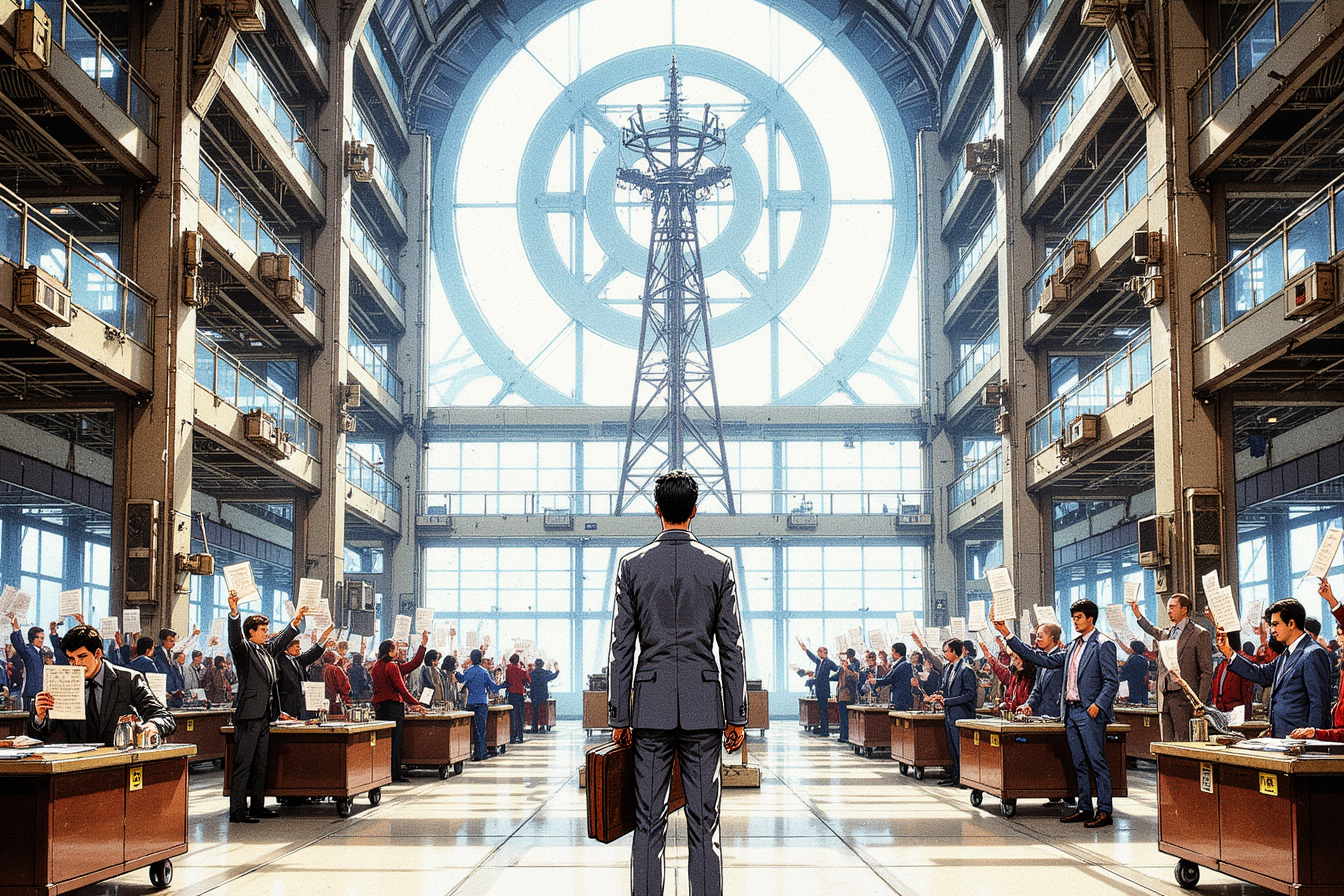
The Meridian gate ran six public cameras for its own security, and the flood had borrowed four of them. On Luminara's left screen the concourse lay in gray daylight under the Registry sigil, wide enough to land a shuttle in, crowded with arriving passengers and their baggage carts, and eleven meters of civil repeater mast standing quiet against the glass.
"The mast went dead at five," Zephyr said, riding the audio. "Not us. Their own repeater took a suspension order from the Office of Quiet Resolution and shut itself off out of good manners."
"Then who is carrying the gate?" A1 asked.
"Everybody."
On the screen a censor came through the west door with two clerks and a document case, a gray suit cut for a man who expects to be obeyed politely, and he stood in the middle of the concourse and opened the order. His voice came through the borrowed camera's speaker with the flatness of a man reading a form he has read before.
"By audit authority, this repeater is suspended pending review. You will deliver to my custody every printed sheet in this concourse. You will do it now, please."
Nobody moved the way he wanted. The baggage carts kept their routes. A Sub-Registrar in the gate booth, a thin man with a name plate that read VETCH, looked up from his console and then, because he was a clerk to his bones, answered.
"Sir, the repeater suspended itself an hour ago. We didn't have to touch it."
"Then you have done half my work for me. The sheets."
Vetch looked out at the concourse. Four hundred people, near enough, and Luminara could see the paper in their hands the way she would see it through a lens: folded, creased from pockets, held flat on the tops of bags. Pale stock. Her frames on the front.
"There were copies before I finished reading your order," Vetch said. "I counted."
"Count again."
"I'd rather not, sir."
The censor stepped around him and set one hand flat on the repeater's gray housing, the way a man checks that a machine is genuinely off, and found it cold.
"That is it?" he said. "That is the transmitter that carried a seditious document into this concourse?"
"It carried nothing, sir. It went quiet before the first sheet was printed. Whatever they are reading, they are reading it from somewhere else."
"Somewhere else," the censor repeated, and looked up through the glass at the mast, which stood there being an antenna about its own business.
A woman near the arrivals rail, dock clothes, a crate of tools at her feet, held up her sheet without any particular defiance in her face. She simply turned it so the censor could see the row printed across it, and read the top of it out loud, because reading out loud is what people do when they have been handed something true.
"Row nine seven two, Hest lane, restored in public, witnessed at this gate." She lowered the paper. "You can take the sheet, sir. I read it to my daughter on the approach and she's got it memorized, and she's six, and there's no form for that."
The censor looked at his order. Then he looked at the concourse, four hundred people holding the same pale paper, and Luminara watched him do the arithmetic that no clerk of the Conglomerate is ever trained to do: he was standing inside an audience. He folded the order along its own crease, put it back in the case, and left the way he had come, and the baggage carts resumed their routes around the space he had occupied.
Vetch watched him go and then did the clerkly thing, which was to write down what had happened in the language of forms: repeater suspended, no custody taken, audience in progress. He got the time of departure wrong by four minutes, and the sheet he filed with the Office of Quiet Resolution remains the Conglomerate's own record of the minute its censor stood in a crowd and could not find one thing in it to confiscate.
"He could have arrested the Sub-Registrar," Zephyr said.
"He could," Pixel said. "Then the story is a man reading a list of names. He'd have made it interesting."
"The jammer in his case would have helped," A1 said, "if the jammer were capable of jamming paper."
Under the Combats of Prime the shift market opened at the second whistle, and Luminara watched it come up on a borrowed handset feed, somebody's camera at a noodle stall, close enough that the lens fogged and cleared and fogged again.
A standardization second was working the row of stall radios with a puck jammer in his fist, moving stall to stall, and at each stall the radio died with a small click and the vendor went on selling. The market did not stop. The market had the flood stacked with the vegetables: pale sheets folded into produce crates, tucked under scales, handed across counters with the change. Somewhere above the undercity the carrier tone was audible as a hum in the pipework, the laugh from the Moon's mint, and two boys were trying to match it badly and failing with great confidence.
A woman buying ration noodles held her sheet up for the vendor to see while he made change. "It's got the whole line on it," she said. "Two point seven million, printed by name, and the amount they filed it under."
"Acceptable losses," the vendor said. He said it the way you say a price you have repeated too often. He wrapped her noodles and did not take the paper back.
The standardization second reached their stall. He was young, twenty perhaps, with a new issue of the citation book and a jammer that had killed four radios in a row, and he stood looking at the stack of sheets in the produce crate while the two boys failed at the laugh behind him.
"You'll surrender those," he said.
"Yes sir," the vendor said, and did not surrender them, and the second looked down at his citation book. Quantity, custody, date. He turned a page. He turned it back.
"There's no field for it," he said, mostly to himself.
"For what?" the vendor said.
"For what I'm looking at."
He closed the book and walked on down the row, killing radios, and at every stall the same stack sat in the open where a field for it did not exist.
The schoolyard at Fallowmark came through on an audio band with a parent's handset picture attached, blurry, low sun on a yard of gray pavers, children in rows for morning assembly.
Luminara knew the lesson before the teacher spoke it, because the lesson was the courtesy packet, the same wording the Conglomerate had used over Ostrell: six generations of service, the conclusion of participation, future endeavours in the plural. Standard curriculum. Approved history for a world whose row had never once been in danger. The teacher, a tall woman with a clipboard, was partway through it.
"The settlement concluded its participation in standardised trade, and the Conglomerate thanks the residents for their service," she read, and looked up over the rows. "Questions."
A girl in the fourth row with a satchel too big for her put her hand up and took a sheet out of it instead of waiting. It was the front page of the zine. Luminara knew the frame on it without seeing it clearly, knew the weight of the paper, knew the crease where the girl had folded it to fit the satchel.
"Is it true that you can be struck off?" the girl said. "Like a row. Whole school."
The teacher looked at the clipboard. "That's not in today's lesson, Vessa."
"I know."
"Then we'll take it at the end of the lesson."
"The end of the lesson is in twenty minutes and she says it's true," said a boy next to her, to the general committee of nine-year-olds, with the voice that settles things.
The headmistress came out of the door with a folded order in her hand and walked the rows collecting sheets, and the children handed them over the way children hand over anything an adult asks for, quickly, with the corners straight. She had a stack of thirty by the time she reached the fourth row. The girl Vessa surrendered hers without a word and stood with her hands at her sides, and Luminara watched the headmistress walk back to the door with the papers, thirty copies of a thing thirty children had already finished reading, and she thought: that is the whole war in one gray corridor, and nobody in it has broken a rule.
The teacher stayed at the door with her clipboard while the last sheets went over. When the headmistress was inside she looked down the row of thirty children standing with their hands at their sides, and she said, in the voice teachers use for the part of the day the timetable forgets: "Lesson continues at twenty past. Bring your own questions."
You can burn the sheet. You cannot take the sentence back out of a child's mouth, and the child will spend the rest of the lesson thinking about it, which is the part no censor has a form for.
At 0712 the relay out of Fallowmark returned a frame that made Luminara's hands go still on the crate she was closing.
A boy had taken his confiscated sheet back out of the bin, because children do, and he was holding it up against the low sun to look at the picture on it. The camera caught it from behind: the pale paper glowing, and printed on it, small, the frame she had shot nine years ago from a stairwell as the Registrar's tender lifted off her street with her household's strike order in its wake. The first photograph she had ever made. The archive went with the row the next morning, so that the official record of her life held no image of anything.
The boy could not have known any of that. He was looking at a vehicle in the air over a street. He turned the page over and his friend looked too, and then the friend took a picture of the page with his own handset, and somewhere in the next minute a copy of a copy of a copy existed on a device the Registry had never audited, in a yard the Registry had no jurisdiction over, on a world that would file its sheets for a lesson approved by the Registry.
That was the arithmetic Zephyr kept saying out loud and she had not been able to feel until now. A photograph can be deleted from a Registry archive. It cannot be deleted from a boy who has decided it is interesting.
At 0741 A1 set the small cup down.
"Order from the Conglomerate," he said. "Total jam, all bands, Rim approaches. Effective now."
The boards flattened. Zephyr's carrier lights went out in a line like windows going dark on a coast, and the audio from the gate and the market and the schoolyard cut to the thin hiss of a band with nothing on it. On the gate camera the concourse speakers died mid-sentence, and the gray daylight went on, and for nine seconds there was no broadcast anywhere across the Rim approaches.
In the concourse a woman looked up at the silent speaker mast, and then she looked down at the sheet in her hand, and she read it out loud, and four hundred people joined her because they had it too and there was nothing else to do with their mouths.
At ten seconds the yard clocks of Cogsworth, the plate bands of the Moon, and the Deepwood net, none of them inside the jam envelope, came back carrying the jam order itself, the full text of the order that had just silenced three systems, header and signature and time of issue. On the gate camera the order went around the square, read aloud from a thousand sheets by a hundred mouths, so that everyone who had just watched the bands die also learned in the same minute who had killed them and how hard they had tried.
Zephyr let out a breath he seemed to have been holding since five in the morning. "Well," he said. "They announced it."
"They had to," Pixel said. She was at the helm with her arms folded, watching the concourse read. "You can't order a jam quietly. A quiet order is a rumor, and you said it yourself: anyone can jam a channel."
"Try jamming a rumor," Zephyr said.
A1 poured. On Luminara's screens the frames kept arriving, and the ones coming in newest were photographs of other people's copies of her photographs, and she let them come, because there was no pocket left to put them in.
Zephyr was already laying out window two across his board, moving the lanes with the side of one hand. "Hest lane goes dark to them at eight. Second window is bigger than the first by a factor I am not going to say out loud while I am happy."
"Say it anyway," Pixel said.
"Fourteen," A1 said. "I am declining to sound pleased about it."
Pixel took the headset off the hook and put it on, and the deck went quiet the way the deck goes quiet, which is to say nobody stopped working. On Luminara's smallest speaker the window went out in her captain's voice, short the way she filed everything: nine thousand relays carrying, four of them the Conglomerate's own, the jam held nine seconds, and what the Conglomerate had lost that morning, precisely, was an audience that can be un-heard. Then the speaker went back to the frames, and Luminara let them come.