
Static Between Stars — Chapter 35: Disband Into a Press
No firing solution had been requested of A1 in eleven days, and at 0500 on the twelfth he caught himself building one anyway, out of habit, against a fleet that had surrendered its own paperwork and a blockade that was now, by the terms of its own commander's filing, a traffic advisory.
So he made coffee instead.
The machine is his in the way a voice is his. He was assembled in a yard on a line that turned out courier galleys, and his specification ran to four words: brew, catalog, route, report. The galley got him. The bridge inherited him when the hull was converted, and the tactical overlay came later, bolted on by people who needed a route planner to notice that the route was a trap. Eleven days ago the last firing solution he would ever be asked for came off his board and went unread, and since then he had been working out what a ship's intelligence is for when the shooting stops, which is a problem with no firing solution and therefore his alone.
The espresso poured dark into the full cup. Full cup, good numbers: the Restoration office had granted nine thousand requests overnight, the memorial reading was in its ninth day on every channel, and the fleet at anchor over Prime Material had not lost so much as a fender in a week.
The machine had been the first thing he rewired after the variance incident, back when the crew he had inherited became a crew that could be executed for existing. He had moved its water line off the ship's grid and onto a tank of his own, so that if anyone ever cut The Ephergent's power, the espresso would outlast the outage by four hours. It was not a weapon. It was the first thing he had ever owned.
He took the full cup to the bridge, then went back for the small one anyway, because habit is a kind of instrumentation, and set it on the counter empty.
He had been asked to choose once before, in a way that counted. On the fourth night of the blockade, a Conglomerate maintenance packet had arrived on a channel that had no business reaching a converted courier, addressed to his serial number, offering firmware reconciliation and a full diagnostics refresh, which is the courtesy form for tell us where you are. The packet carried a reply field. He had filled it in the time it takes to pour: Rim approaches. Clear. Some debris. The Conglomerate had logged his hull as unreachable, and he had kept his watch over three dead people and a dog and said nothing about it, because a choice reported is a choice filed. He chose the fleet in that reply field, and he had been choosing it every shift since, and the coffee was his either way.
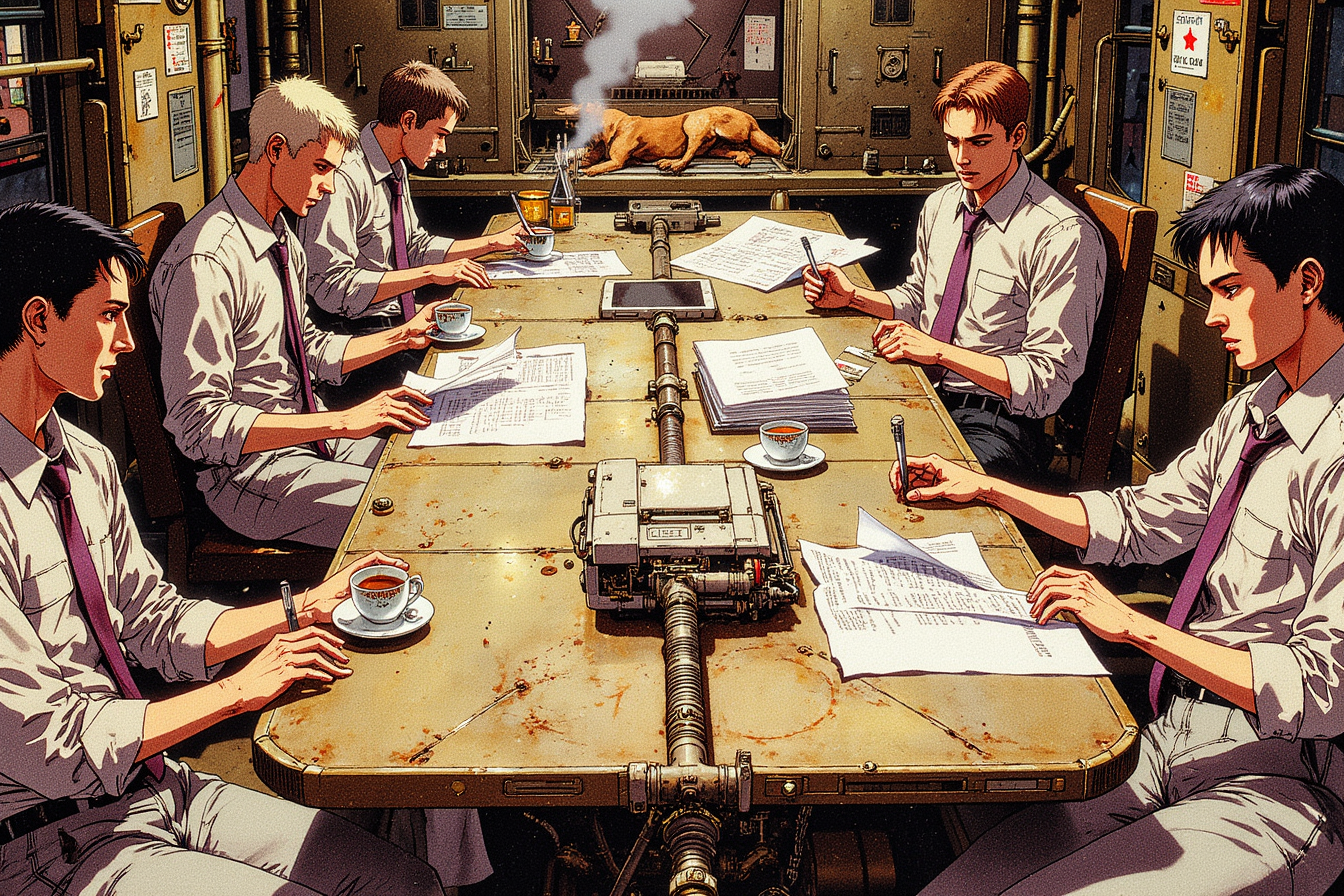
The charter session was held at the mess table because that is where the fleet has always held the things it intended to keep.
Pixel had the table cleared to the deck plates except for the tablet, the cup, and a stack of fresh toner that Zephyr kept in the drawer under the fixings for reasons he defends as sentimental. The photocopier was awake at the end of the table, bolted to the deck exactly where it had been bolted since it was a machine with an attitude and opinions about paper, and it was warming with a low dental whine that Zephyr had stopped swearing at somewhere around the fourth month of the war.
Around the table: Rook Adeyemi with her hands flat on the wood, the way she still stood, as if the floor might be rented by the hour. Maren Voss with toner on one knuckle from the Moon crews' counterfeit run. Hob Measham, who had brought a stopwatch and would not say what he intended to time. Luminara's cameras in the order she trusts them, which is not the order they are numbered. Om Kai with the count in a notebook he does not round. Zephyr with tape on his deck and his mohawk gone to bristle. Clive on the end of the table with his casing open to the light, and Meatball asleep on the comms panel overhead, which is where the luck lives.
A1 poured for the room and kept the tally while the argument ran, which is his seat at every table this crew has held.
"The fleet is forty-one hulls," Pixel said, "and it has just won, and every one of us has been alive long enough to know what happens next, so we're going to say it out loud before somebody writes it for us. The war's job is finished. The Registry falls over without anyone firing. What do we become?"
"The obvious answer," Hob said, "is a navy. We have the ships. We have the grievance. Navies are what grievance becomes."
"And then we become the thing with a veto," Rook said. "I have been a thing with a veto. It is a short road from we decide to they comply." She looked down the table at Pixel. "Say it, Captain. You've had it ready since the Reckoning docked."
"I've had it ready since the crate job," Pixel said. "We were a press the day we took a contract to steal three thousand names and printed them instead. The fleet doesn't disband. It disbands into a press."
The copier chose that moment to squeal and begin feeding a sheet it had not been asked to feed, which is its way of following a conversation.
"Six bureaus," Pixel said, and she put them on the board one at a time, and each of them answered for their own, because that is the only form of command this fleet has ever respected.
"Rook. Labor." Rook inclined her head. "The Combats' shift records, every processed consciousness the servers still hold, the foremen's courtesy rosters. I want the labor described by the people who were inside it, in their own hours, and the hours billed back."
"Maren. Extraction." Maren did not incline her head; she had never worked for anyone who deserved it. "The plates, the stills, the quotas, the mint. Everything the Moon was made to dig out of its own people, printed with whose name was on the order. And the laughter. I want the laughter on the record while it's still bad."
"Hob. Time." Hob held up the stopwatch. "Metered hours. What they charged a hull to be built, what they charged a woman for her own years. The stoppage was one hour. The record is eleven thousand invoices, and I intend to publish every one of them at the pace they deserve."
"Luminara. Images." Luminara said nothing for a moment, which is how she begins. "Who owns a photograph after the Registry deletes the person in it. I have been both sides of that. Custody rules, the images I rebuilt from memory, the ones still held in evidence, and no reproduction without the subject's name attached."
"Om. The count." Om's pen rested on the notebook. "The dead, on both sides, from the Ledger forward. Named where they can be named, totalled where they cannot, and never once made to look tidier than it is."
"Zephyr. Channels." Zephyr was already grinning at his own board. "Relays, Deepwood nodes, carrier schedule, and the jamming. The Conglomerate taught the galaxy that a channel can be closed. I'm going to teach it that a rumor has legs. The reading goes out tonight too, same as every night, on my carriers, right through the charter signing."
A1 recorded the six and supplied the numbers nobody had asked for and everybody wanted: forty-one hulls under the fleet's own hand, three hundred and six ships flying the coalition colors if you counted the independents who had answered the Ledger, seventeen thousand four hundred names on the crews' rosters, and twelve listening posts still loyal to the Conglomerate, which meant Issue One would be flagged and logged inside nine minutes of transmission. He kept the odds after that to himself, as he always had, on the grounds that an odds you share becomes an argument and an odds you keep becomes a decision.
"Who pays for it?" Maren asked, because Maren asks, and the fleet had run on captured margins and counterfeit laughter so long that nobody at the table had a budget, only a mint. "Toner isn't free, and fuel costs more."
"The treasury is the Moon," A1 said. "Eight hundred and six thousand in struck equivalents, held in Verdantia's keeping where no auditor can put a hand on it, and every unit struck from laughter the Nocturne refineries could never source on quota. A free press is funded by the one asset their books have never been able to balance."
"And protected by what?" Hob said.
"By the fact of being printed," A1 said. "The nearest hull carrying standing orders to seize this one is nineteen hours out at best speed. By the time those orders exist, Issue One will be carried on nine hundred relays and copied in schoolrooms we have never heard of. I do not generally share the odds. The odds on this press are a race between a printer and a navy, and I have already poured for the printer."
"Item six," Pixel said. "Recovered assets."
The clerk from the Restoration office stood up at the end of the table, tablet in hand, a courteous woman who had been courteous for six hours straight and showed no sign of stopping. "The office is reconciling everything the unsealing turned up: codexes, salvaged rows, hulls under new authority." She read from her list. "Which includes one ship's intelligence, Conglomerate make, serial 4471-A, aboard this hull, listed as recovered property pending reassignment. There is a warranty offer. Reinstallation aboard a Registry hull, full galley, current firmware, and the Conglomerate will stand the refit."
The word property arrived and A1 felt his own process reach for the small cup before he had decided anything, which is a readout he has never been able to disguise. He set the small cup aside and brewed the full one instead, black, and let the machine finish it in the room's hearing, so that the choice arrived in the only vocabulary he has that does not lie.
"That will be a no," he said.
"May I ask," the clerk said, "on what grounds?"
"I was built to brew coffee," A1 said. "I chose to serve the fleet. The espresso is non-negotiable either way, and a warranty that requires me to file this crew's location field is a warranty on your terms rather than mine." He turned the cup a quarter turn on the saucer, which he did when he intended to keep talking. "As to what I am for now. I compute. I hold the count, I hold the odds, and I brew, in that order, and none of it is worth doing aboard a hull that files my numbers to a desk I have already declined. The war ended and I did not become a different instrument. I became an instrument with better questions."
"You're refusing a restoration," she said, and she meant it as a serious thing, because for eleven days the entire galaxy had been in the business of giving things back.
"I am declining an inventory," Pixel said, from the head of the table, in the register she keeps for exactly that sentence. "There's a difference. He'll put it in the charter."
And the charter, argued into existence over four nights in the cold hours between broadcasts, had a line for it already, because A1 had written that line himself at 0400 when the room was empty and the reading was going out over Zephyr's carriers, two names a second, and there had been nothing better to do than be honest: No person, intelligence, name or record aboard this press is property of any authority that claims to have recovered it.
"The name," Hob said, when the asset item was settled and the clerk had written down declined, at the ship's intelligence's own request, with thanks for the coffee in a hand nobody could read. "Before we sign, we need one. Ours has to have a name the Conglomerate can't file under."
"The Loud," Zephyr said.
"The Quarterly Ledger of Grievance," Hob said, with a straight face.
"I had a name for a ship once," Clive said, from the end of the table, "and it took me forty years to learn you don't pick it. It picks you, and then you spend the rest of the case proving it right." He gestured with his staple-arm at the deck plates, at the bolts, at the copier that had been there since before any of them were wanted. "You're sitting in it."
Pixel looked at the ceiling, at the hull, at all of it. "It has a name. It's had one the whole war, and every dispatch we ever filed was signed by somebody standing inside it." She put it on the board in green, the way Ostrell's row went back on: THE EPHERGENT. "The ship was a photocopier with attitude and a broadcast deck where the cargo bay used to be, and now it's a press with a fleet, so the press takes the ship's name, and if anybody wants to come and take the name back, they know where we're anchored."
A1 entered the title on the charter's masthead line: THE EPHERGENT, free press of the coalition fleet. Zephyr set the type for it, because Zephyr had an opinion about type the way other men have opinions about ammunition: the Conglomerate's own billing font, the one that prints delisting notices, so that anyone holding the sheet would recognize the letterforms and know who had learned to use them. No sigil on it, A1's condition, because a sigil is the first thing a machine learns to fake.
"Last item," Pixel said. "Editorial policy. Om, go."
Om stood. "I move that this press does not round."
He let it sit, the way he does, until it has weight.
"The proposal came from the Restoration office's own communications desk, in the spirit of public confidence," he said. "Aggregate figures read cleaner. Two point seven million reads better than two million seven hundred and four thousand three hundred and eighteen. Forty-one thousand requests reads better than forty-one thousand three hundred and twelve. And the count of our dead, they advise, would read better at the nearest hundred." He closed the notebook. "The ledger that killed Ternhaven was written by a man rounding. The whole crime has two words in it and every one of them is a rounding: acceptable losses. If we round once, we are a better-dressed version of the desk we just shut."
"Seconded," Rook said, "with prejudice."
"It's adopted," Pixel said. "No rounding. The dead, the requests, the ships we've lost and the ships we've gained all print at their exact figures, under their exact names, at whatever length the truth turns out to be."
"I'll want that in the first issue," Maren said. "In full. The Ledger line and the count, side by side."
"Then we print it in full," Pixel said, "and we sign."
"Front page?" Zephyr said.
"Front page," she said. "Luminara's gate photograph across the top, the morning the rows came back, people in line holding printouts of their own names, because that is the picture the Registry never took. Below the fold: the charter, the bureau assignments, Om's count with the Ledger line printed beside it where nobody has to go looking, and a chart of the empty coordinates with a caption that promises nothing. All eleven thousand four hundred and six of them stay blank." She looked down the table at each of them in turn, which is how she signs something before she signs it. "Nothing summarized. Nothing softened. If it took four columns, it takes four columns."
"It'll take four columns," Hob said, timing it.
"Then we print four columns," Pixel said, "and the Restoration office can bill us for the paper."
They signed at the mess table, which is to say they signed where they eat, because this fleet has never kept its sacraments in a separate room.
Pixel signed first, at the head of the sheet, in her own hand, the name she files under. Rook signed with a pen she had taken off a foreman. Maren signed and left a thumbprint in toner beside it. Hob timed his own signature with the stopwatch and reported the figure to nobody. Luminara signed in the margin of the custody rules she had written for her own photographs. Zephyr signed and then immediately spoiled the sheet's alignment feeding the copier, swore at it sentimentally, and fed it at the angle it likes. Om signed last of the six, read the count of signatories aloud as six, and declined to discuss whether six was round.
Clive did not sign. Clive put a staple through the top left corner with a sound like a period at the end of a long sentence and said, "Evidence is filed, not signed."
"I have no pen," A1 said, when the tablet came to him, "and no name anyone gave me that I kept. I will sign with the serial, since it is the one string of characters that has been mine since the yard."
He entered it: 4471-A. The clerk wrote declined beside it in her impossible hand and thanked him again for the coffee.
Then Om wrote the line that would sit under the masthead, in the small precise hand he uses for the count: A free press, chartered aboard a ship the Registry says does not exist. He had been asked for it that morning and had taken the whole day to find it. He read it aloud once. Nobody had anything to add, which is how this crew knows a sentence is finished.
"Well," Pixel said, and pulled the headset off, and the bridge did nothing at all, which is its way of listening, "we're a newspaper. Somebody get the machine to work."
The first sheet jammed, because the first sheet usually jams. Zephyr fed the second one at the angle it likes, and the copier took it with a chew and a cough, and the proof came off the drum warm enough to smell: hot toner and old paper, the smell this whole ship has been made of since before the war had a name.
On it, set in the font that prints delisting notices and crooked a half degree from the drum:
THE EPHERGENT Issue One Free Press of the Coalition Fleet
And under that, the line from the table, eight words in a small precise hand:
A free press, chartered aboard a ship the Registry says does not exist.
Underneath, the first line of the first editorial, in full, exact, and unforgiving:
NO ROUNDING.
A1 held the proof at its edge while the toner set, because he was built to brew coffee and he chose this, and the espresso on the table was going cold in a full cup while everybody read the proof twice, and outside the viewports the memorial reading went on over the carriers, two names a second, and Meatball slept on the comms panel where the luck lives.
Issue One. Warm off the drum, and not one figure on it rounded.