
Static Between Stars — Chapter 36: Static Between Stars
The copier jammed on page nineteen.
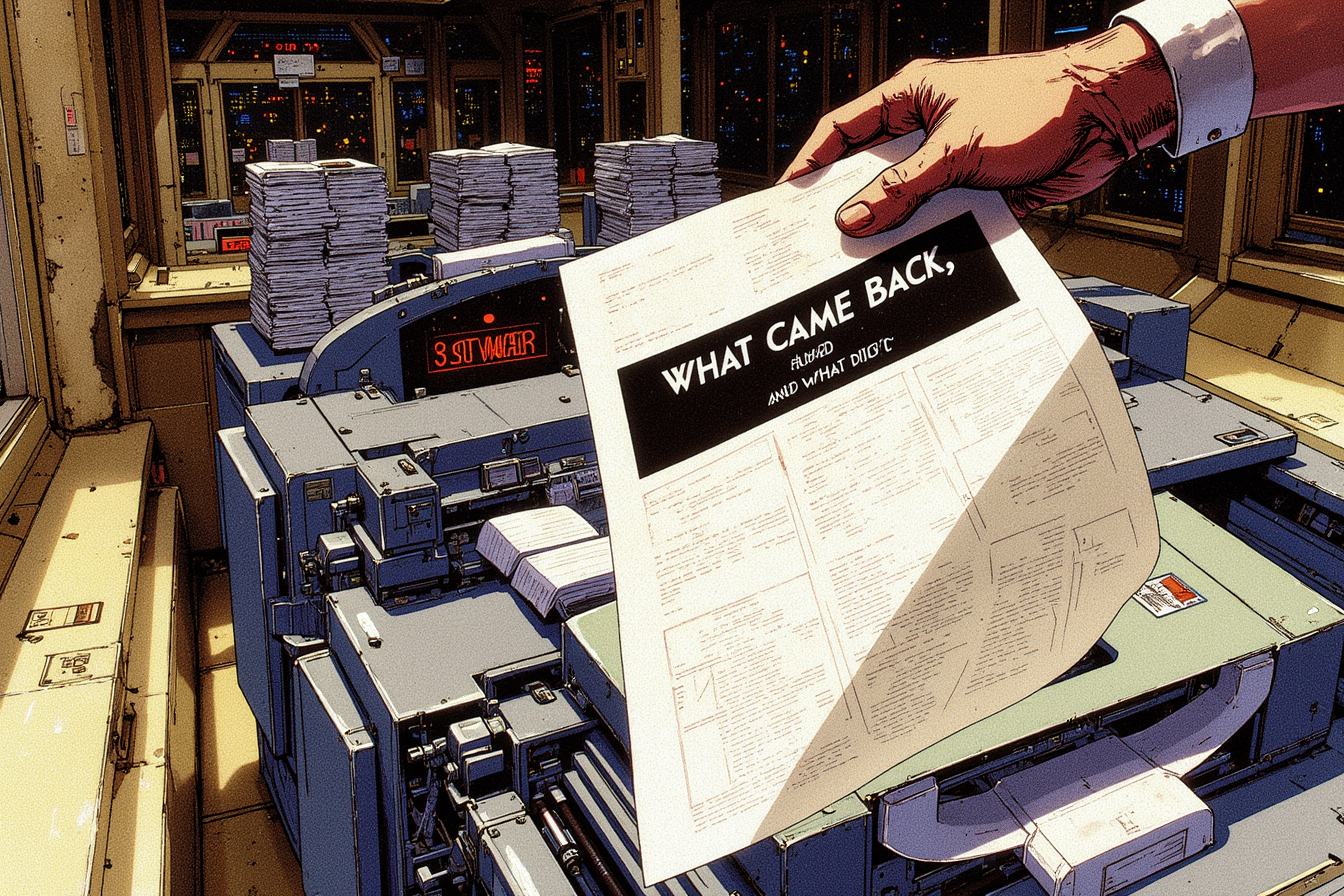
It has been bolted to the deck plates since the day the crew decided that a press ship which cannot press is a rumour, and it jams on page nineteen the way some machines jam on thirteen, with a malice that feels personal. Warm toner came up in a gray ribbon. Pixel broke the roller housing with a screwdriver, pulled the sheet out whole, black to the first knuckle, and held it to the cabin light.
WHAT CAME BACK, AND WHAT DIDN'T.
Twenty-four pages, two thousand copies, one photocopier with attitude. The masthead had been Zephyr's idea: THE EPHERGENT set in the Conglomerate's own billing font, the typeface that prints delisting notices, so anyone holding Issue One would recognize the letterforms and know who had learned to use them. Underneath ran the line Om wrote the night the charter was signed: A free press, chartered aboard a ship the Registry says does not exist.
Page one carried Luminara's photograph of the gate at the Vannic Reach, the morning the rows came back, people standing in line holding printouts of their own names. Below the fold: the charter, the bureau assignments, Om's count, and a chart of empty coordinates under a caption that promised nothing. These stay blank on purpose.
Pixel fed the sheet back. The copier took it the second time with a sound like a swallow.
Around her the bridge had gone to the quiet it only reaches when the war has become somebody else's problem. Three days since the signing, and four hundred hulls had already gone home in ones and twos, every courier carrying a bundle of Issue One with instructions to put it in hands rather than hoppers. Rook Adeyemi's Woken were running a labor bureau out of a yard tug. Maren Voss's crews had opened an extraction desk on the Sorrowful Moon. Hob Measham had gone back to Cogsworth to bill for the hours the Conglomerate owed and did not intend to pay. Zephyr had the press's relay map up on the comms board in three colors, the Deepwood trunk running through it like a vein.
"That's the end of the run," Luminara said, squaring the stack against the deck rail. Two thousand copies, still warm, smelling the way paper smells after a machine has spent a night arguing with it. "What happens now?"
"Now we find out whether anybody reads us," Pixel said. "We spent three years making sure the galaxy heard us. Printing it is the other half."
Luminara lifted the top copy and looked at her own photograph under the headline for a long moment. "Ostrell's grid has been up six weeks," she said. "I checked this morning. The quayside is loading again, out this time instead of back."
"One world," Pixel said.
"One world," Luminara agreed, and neither of them spoke the rest of it, because the rest of it was printed eight columns wide on the same page, under a chart with holes in it.
Clive had not moved his corner of the bridge in three years and he was not going to start now. Port console open to the light, the old survey chart pinned to the bulkhead with its single inked route running out into coordinates the modern maps still leave empty, the open file hanging beside it in its clip.
He took the front page of Issue One out of the stack himself, one corner pinched in his staples-arm, and put three staples through it into the bulkhead: prayer, promise, and felony, the same three he had driven through the depot manifest the night they stole three thousand names.
Beside the new page sat the older things. Two names with strikethroughs, Fes and Renna Sol, stapled there in the withdrawal after the harvest boarding, and beneath them the chart, and beneath the chart the file.
Pixel asked the question she had been carrying since the vaults unsealed. "Anything on the Petrel?"
Clive finished the row he was writing in his log before he answered, because Clive finishes rows. "Vaults are open. Every archive the Registry ever sealed is open to anyone with a printout and a pulse, and I have read all of them. Twice." The staple went home with a sound like a period at the end of a long sentence. "Barry Kowalski filed a flight plan into the Rim. The plan is in the file. The Petrel is not. Nothing past the second waypoint. No wreckage, no beacon, no cargo transponder, no recovery entry, no body."
"Nothing at all?"
"Whatever he was carrying out there didn't come back either." He tapped the blank edge of the chart with the nose of his arm. "Six months I worked it before the war and two years during. The answer today is the same as the answer the day I opened the folder."
"Which is?"
"The case stays open."
He said it flat, the way he reads a case number into a record nobody will ever pull. "Archives don't close a file, kid. They tell you the room has been searched. Somewhere past the last inked waypoint there is a survey ship with my partner in it, and there it stays until somebody finds it. No twist. No rescue in the last reel. A chart, a file, and a man who staples the evidence and waits."
He added a row to the log: date, Issue One, filed, one copy to bulkhead. He did not write a closing note. He never does.
Zephyr's board had four colors now instead of two, and he had stopped running intercepts, which for Zephyr was the moral equivalent of taking up gardening.
Pixel found him after midnight with one receiver pulled out of the rack and resting on his knee, its dial set to a frequency he had not changed since the lane lit. Fairweather 14, the lost month's distress band.
"The volume's almost down to nothing," she said.
"I know what it is." He watched the dial the way other people look at a candle. "Aether asked me to keep this frequency open until it was done. So I kept it, and it was done, and then there was nothing left on it but static. Static turns out to be a thing you can listen to for a very long time, if you know who isn't answering."
The last transmission had stopped inside a word. Pixel had heard it once and did not intend to hear it again, and Zephyr had played it back enough times to own it. He did not offer to play it now.
Instead he said, "Three times this month the receiver has ticked. Not the lane. Not Havenbright's remnant. Something further out, past the last survey buoy, unlabeled and off every schedule. I write the coordinates in a notebook and I do not set a course." He looked up. "The lost Rim is still out there. It has opinions about that once in a while."
"Are we ready?"
"No," he said. "That's why it's a notebook."
He put the receiver back in the rack with the dial exactly where it was. The press could have the board and the relay map and the three colors. One receiver stayed his, tuned to a month the calendars no longer contained, waiting on a brother who had burned his coordinates into the dark so thousands of people could come home and had not come with them.
The aft hold still smelled of fixer, the way it has smelled since Luminara took the far corner in the first month of the war and nobody asked her for it back. Red safelight. Three trays on a plank.
She developed one last frame from Ostrell.
It had been sitting in a film back since the first night, since the lane of lights along the inland river, since she had stood at the viewport with the long lens and taken nothing. At 0411, one minute before the crane went dark, she raised the camera and took exactly one frame and set it down, and there it stayed while the war happened.
Pixel stood in the doorway while the image came up in the tray the way images come up, slowly, like a room lighting from inside.
The loading lamps. The hard white square of work light at the quayside, the cargo trams still running their route, and behind them the dark half of a world.
"They were meeting the turn of the shipping season," Pixel said.
"The last shift," Luminara said. "On a job that didn't know it was the last." She lifted the print with the tongs and hung it on the wire to drip. "Ostrell's back. Its registry book came off that barge with us, and its lights are on, and Issue One prints the gate at the Vannic Reach, which is the right photograph for a front page."
"And this one?"
"This one goes into the archive we're building of everything the Registry deleted." She wiped her hands and looked at the hanging print: the trams mid-route, the lamps burning on a night two years gone. "Everybody else's photograph is the gate. Somebody has to keep the one of the dark."
Om Kai kept the count in a ledger with a hard cover and no lock, in longhand, in words instead of digits, because digits round themselves the moment you look away.
He was at it in the galley with his tea, writing out this morning's total the way he wrote it every morning: three million, nine hundred and forty-one thousand, five hundred and eighty-six.
Pixel read over his shoulder. "Every syllable."
"Every syllable," Om said. "Transcription is where the rounding starts. A clerk turns the words into figures, the figures get abbreviated for a memo, and by the second office a hundred thousand people have become a decimal." He did not look up. "Words are slower. Slower is the point."
"And the second page?"
The ledger had two. The first carried the dead of the war on both sides, harvest crews and Woken and Registry marines and freighter hands, an entry for each, with a name wherever a name survived. The second held rows of settlements with nothing after them: worlds the charts never recovered, delisted before anybody thought to keep a copy, so that no figure existed to write down.
"I don't total that page," Om said. "There is nothing to total. Ternhaven has a number because a copy of the Receiving Ledger survived, and two point seven million were read by name at a memorial, and a name read aloud cannot be a resurrection, so the number stays where it is." He turned the ledger so the blank column faced her. "This page has no number because nobody kept one. That is the honest shape of it."
He closed the cover.
"Will you ever stop writing it down?"
"Ask me when the second page is empty." He set the pen beside the tea. "It will not be empty in my lifetime. I intend to keep writing anyway."
A1 poured at the console while he ran distribution math for the second print run of Issue One: how many copies the Vannic Reach would need, how many the Deepwood net could carry, how many would be seized at a gate and how many would not. The cup he set on the console edge was the same small cup he had set down through every bad number of the last three years, and it was still small, and the war was over, and Pixel looked at it and found that some part of her had let go far enough to say it out loud.
"Big cup," she said.
A1 poured the small one and slid it across the deck plate. "No."
"It's over, A1. The number you are running is a print run."
"Which is a severity of a different order, and the cup has never once lied to you." He straightened, holographic hands folding. "I was built to brew coffee. I chose to serve the fleet. The espresso is non-negotiable either way, and the size of it is mine."
She took the small cup. It was the first time in three years she had wanted the big one, and she had never thought to want it while the numbers were bad, which either meant she was healing or meant she had gotten used to living inside a readout. A1 watched her drink with the expression he wore when a tactical model had resolved in his favor.
The war's severity had become a habit. That was all it was now, a habit in a porcelain thimble, and she had never once asked him for the large cup while it mattered, and she filed that the way she files everything.
Meatball, the ship's Rottweiler, was asleep in the exact center of the comms panel, which is where the luck lives, and every signal reaching The Ephergent from that moment on had to route around him. Targeting computers had never managed to classify him. The Registry, which could price a world by the harvest, had never priced him. The fleet's statistics called him the crew's luck and left the matter there.
He had slept through the copier, through Clive's staple gun, through the third reading of the charter, and he was still asleep when Pixel came up to the bridge at 0300. She put her jacket over his ribs. His tail, which holds opinions independent of the rest of him, beat twice against the board.
At 0300 she sat down in the editor's chair and put the headset on, and Zephyr put the carrier light green in the corner of her eye, and the bridge of the ship the Registry says does not exist held still the way it holds still before the truth goes out.
Dispatch, 0300, from the bridge of The Ephergent, over a galaxy whose charts are being rewritten by hand:
This is Pixel Paradox, broadcasting from the bridge of a ship the Registry says doesn't exist, crewed by people officially dead, over a galaxy whose charts are being rewritten by hand.
Issue One came off our copier tonight. Two thousand copies, twenty-four pages, a masthead set in the Conglomerate's own billing font, because the typeface that printed the delisting notices is now the typeface that prints the answers. The fleet that fought the last season of this war has disbanded into a free press, and the press is named The Ephergent. Rook runs labor. Maren runs extraction. Hob runs hours. Luminara keeps the images. Om keeps the count and does not round it. Zephyr keeps the channels. The press has a ship, and this is it, and it is still the ship you have been told does not exist.
Here is what we are printing. Aether lit the jump-lane so thousands of people could come home, and he is not coming back, and we keep one receiver on his frequency out of habit, and it ticks once in a while from a part of the galaxy that is still unmapped. Fes and Renna Sol died in the harvest boarding, and their names are stapled to our bulkhead where we have to look at them. Ternhaven's two point seven million were read by name at a memorial, which is a record and cannot be a resurrection. The Registry fell without a battle, which is what happens when an empire deletes itself trying to keep up with its own bookkeeping.
And the worlds the charts never recovered stay blank on purpose, because a blank you keep is a promise. Barry Kowalski's survey ship, the Petrel, was never found. The file is open and it stays open, because that is what an honest file does.
If you are holding a copy of this, know that the lost Rim is still out there, still unlit, still pinging once in a while. We are keeping a receiver on it. Send us what you have. Charts are being rewritten by hand, town by town, and we will print every row you send.
Keep your transponder dark. If anyone asks who we are:
Nobody. We're nobody. Keep moving.
, Pixel Paradox, signing off