

The Score — Chapter 4: Bad Coffee, Worse Horses
The Score — a novel of the planet Ephergent. Chapter 4 of 12.
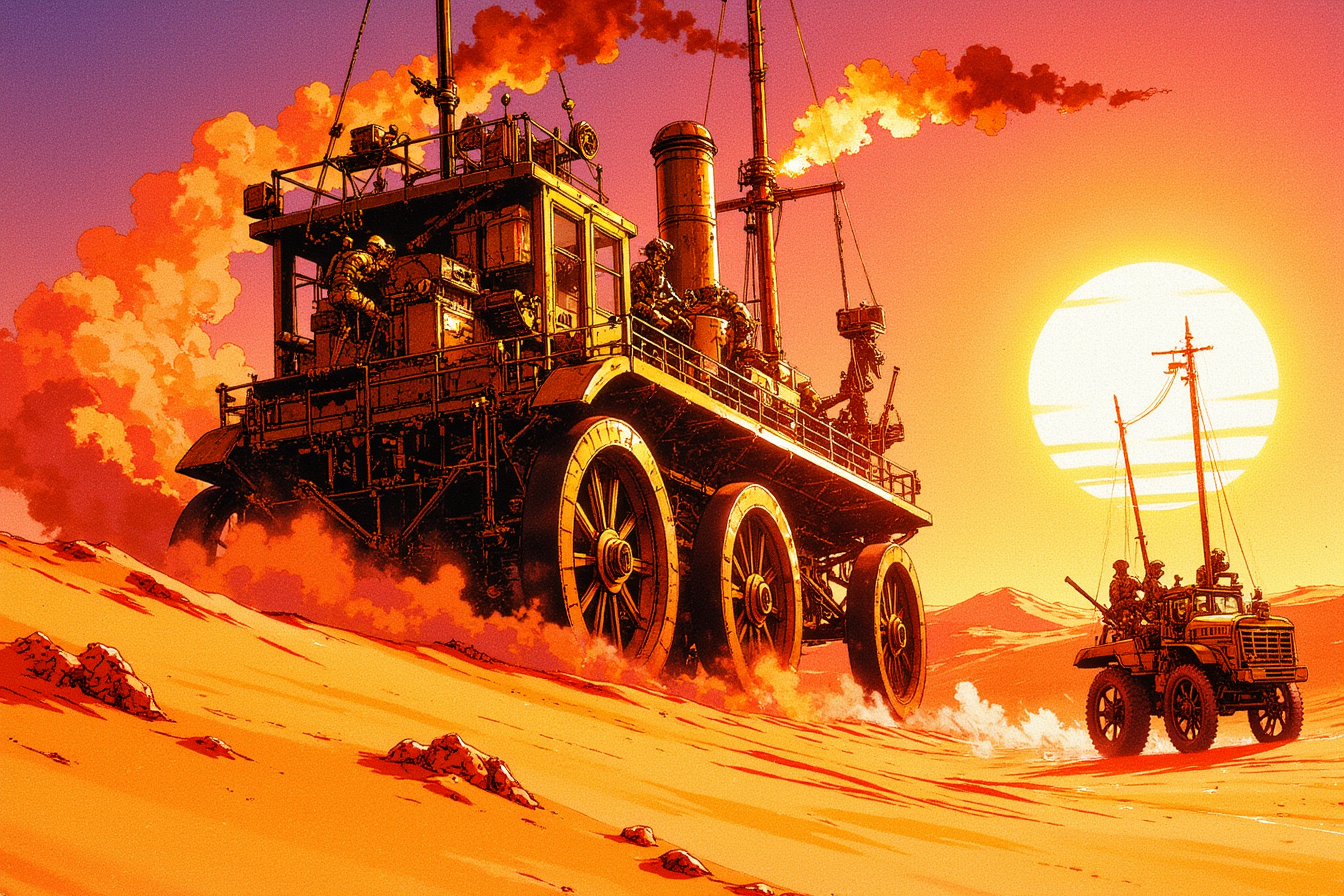
They came off the scree onto the flat at noon and the flat went on for thirty miles in every direction, flat as a page, and the only thing on it was a road. The road was packed sand the color of old coffee, and it ran east-west like a line someone had ruled across the world, and where it crossed their north line there was a station: four posts, a canvas awning gone the color of bone, a hand pump, and a sign nailed to the posts that said DELACROIX — COFFEE — WATER — NO SWINDLING.
"Swindling," Clive read, standing at the edge of the road with his cap pulled low. "That's a specific claim."
"That's a specific keeper," Chewy said. He was already walking toward the pump.
The coffee was bad. It was the kind of bad that had been engineered rather than allowed, the kind of bad that a person arrives at through effort and intent, and Chewy drank two cups of it standing under the awning because his mouth had been the color of the Gulchmarker dust for two days and the water in the can had gone warm and metallic. The keeper was a woman built like the pump, iron-gray braid down her back, hands that didn't stop moving even when she was standing still — wiping, coiling, folding, a permanent low industry.
"Name's Delacroix," she said, not asking. "You're the Chambers boy. You look like him. Not the missing one — the other one. The father."
"Uncle," Chewy said. "Hollis was my uncle."
"Hollis was a lot of things," she said, and went back to wiping a cup that was already clean.
The sandsteamer came from the east.
Chewy heard it before he saw it — a low grinding over the flat, like a barge being dragged over gravel — and then it was there, a long flat-bottomed sled under a canvas sail, two mules in the traces, moving along the road at the kind of speed that looked slow and then didn't. On the deck were three men and a stack of crates, and the man at the front had a surveyor's satchel that Chewy recognized because it was the same model Clive had, and the man was looking at them with the expression of someone who has been told to look at something and doesn't much care why.
"Vetch's office," Clive said. He had not moved from the pump. "North Prima Surveyor-General. Permit enforcement."
"We don't have a permit," Chewy said.
"No," Clive agreed. "We don't."
The sandsteamer slowed as it came abreast of the station, and the man with the satchel raised a hand — not a wave, a hold — and the mules stopped and the sled ground to a halt and the man stepped down onto the road with the ease of someone who has stepped down onto a lot of roads.
"Chambers," he said. He didn't say which one. He had a clipboard. "Chester Chambers, minor, traveling with a decommissioned survey automaton, north of Prima line without permit as of the eighteenth." He looked at Clive. "You're supposed to be in a crate."
"I was in a crate," Clive said.
"You were shipped to a storage yard in Prima."
"I got out."
The man wrote something on the clipboard. "That's going to be a form."
"We're not going back," Chewy said.
"You're a minor," the man said, and he said it the way other people say you're a trespasser or you're a forgery, a category rather than a person, and he was already turning back toward the sled because the form was the point, not the boy.
"Ma Delacroix," Chewy said, spinning toward the keeper. "Did Hollis come through here?"
She was already looking at him. "Every few months, for years," she said. "He'd sit where you're standing and drink my coffee and complain about it and then write me a letter when he got wherever he was going. Said I was his fixed point. Said the map needed one thing that didn't move."
Chewy's mouth was dry again despite the coffee. "Letters," he said. "You have them."
"I have them," she said. "I keep things. It's what a fixed point does."
The man with the clipboard was back on the sled and the mules were moving and the sandsteamer ground east, and Chewy watched it go because he wanted to make sure it was actually going and not circling, and by the time he turned around Ma Delacroix had gone inside the station and come back out with a metal box, the kind that doesn't rust, the kind that means someone intended to keep something for a long time on purpose.
She set it on the table under the awning and opened it.
There were eleven letters. They were in Hollis's hand — Chewy knew the hand the way you know a voice, the way the letters leaned slightly forward as if they were walking even when they were sitting, the cross on the t that went too far, the little spiral he put instead of a period when he was in a good mood. The envelopes were addressed to M. DELACROIX, WAYSIDE 40, NORTH LINE, and the postmarks were spread across four years.
"He wrote you for four years," Chewy said.
"He wrote me for six," she said. "Two of them never arrived. I keep those too, in my head. You can read them if you want. You can take them if you want. They're not mine; they were always going to whoever came looking."
Chewy picked up the first one. The paper had gone soft, the way paper goes when someone has handled it a lot before it was filed away, and he could feel where the folds were, three folds, the way you fold a letter to fit a small envelope, and he opened it carefully because it was not his letter and he knew that even though he was going to read it.
Delacroix — the coffee at Wayside 40 remains an abomination and I remain grateful for it. The line holds north from your pump for eleven days to the Verdanya edge. I have been up it twice and down it once and I am going up it again. There is a thing at the end of it that I have not written down yet because writing it down would make it a claim, and it is not a claim. It is an instrument. — H.
Chewy read it twice. He put it down and picked up the third one, then the seventh, and in the seventh there was a line he read four times because he was not sure he was reading it right the first three.
I told the boy the map is a promise someone made you. I am beginning to think I told him the wrong half.
He put the letter down and stood there with his hands on the table and the wind coming off the flat and the coffee going cold in the cups, and Ma Delacroix did not say anything, because she was a fixed point, and fixed points don't fill silence.
"The boy," Chewy said. "That's me."
"That's you," she said.
Clive had come to stand at the edge of the awning, looking east along the road where the sandsteamer had gone, and he had his hand up to the brim of his cap in the way he did when he was recalibrating, the brim going down and up and down again, a slow metronome of discomfort.
"We should keep moving," Clive said. "The road runs north at the next junction. We follow it to the Verdanya line."
"Not yet," Chewy said. He was looking at the box. There were letters in it he hadn't read and he was going to read all of them before they left, and he knew Ma Delacroix would let him, and he knew Clive wanted to be gone, and he did not care about either of those things in the order they were being presented.
He sat down at the table and read the letters.
They were not about him. That was the first thing, and it was the thing that took the longest to understand. Hollis wrote to Delacroix about the road and the weather and the coffee and the way the light came through the Verdanya canopy in the late afternoon like something being poured, and about a survey he had been running for the Prima office years ago that he had decided to stop running, and about a spire he had found that did not match its own map, and about a boy he had raised and the fact that the boy could read a contour map better than anyone in the Prima office and that this was going to be a problem for the boy one day, in a good way, in a way he was not sure the boy was going to forgive him for.
In the ninth letter there was a line about the journal. Chewy read it and then read it again and then held the paper flat against the table with both hands because his hands had started to do something he didn't want them to do.
Delacroix — I have started writing the book out again, the whole thing, in the margins this time, in the ink that needs the light. If anyone ever brings it to you, don't tell them what it is. Let them find out the way I did, which is slowly, and in order, and with the ground doing what it does. — H.
"He wrote it out again," Chewy said. "The journal. He wrote it out again in the margins."
"That's what he said," Delacroix said.
"In ink that needs the light."
"That's what he said."
Chewy put the letter down and took the journal out of the pack. It was heavier than it should have been — it had been heavy since Gulchmarker, since the map with the blank-looking numbers, since the boot on top of it — and he opened it to the margin where the gold word had been, his name, the address, and he held it up toward the flat white sky the way he had held it at the waystation, the way he had held it in the hole in the roof of the Gulchmarker house, angling it, hunting for the angle.
Nothing.
He turned it. He tilted it. He walked out from under the awning into the full flat noon light and held the page up and turned it slowly, degree by degree, the way Clive had taught him to read a shadow on a map to find the height of something, and nothing happened for a long time, long enough that Delacroix came to the edge of the awning and Clive stopped recalibrating his brim and stood still, and then the light did the thing it did, a slant, a particular slant off the flat sand road at that hour at that angle, and the margin of the page caught it, and under his name, below the address, a second line came out of the wood-colored ink the way the numbers had come out of the map, slowly, letter by letter, as if the ink were deciding.
keep up.
Two words. No spiral for a period, no lean forward, nothing to indicate whether it was a joke or an order or a prayer, just the two words sitting in the margin under his name in a hand he knew better than his own, and Chewy stood in the road holding the journal up to the light with the two words on it and the whole flat country silent around him except for the wind and the pump and the faint low grind of something very far east that might have been the sandsteamer or might have been the ground doing what it did.
He lowered the journal. He looked at it for a while. Then he put it back in the pack and put the box of letters on top of it, all eleven, because Ma Delacroix had said he could take them, and he was going to take them.
"Thank you," he said.
"Bring them back when you're done," she said. "Or don't. A fixed point doesn't check."
Clive was already at the road's edge, facing north, his cap squared, his hands at his sides, the posture of a man — of a thing — that has been standing at a north line for a very long time and intends to continue.
"The junction's four miles," he said. "We make it before dark or we make it after. Either way we're walking."
Chewy shouldered the pack. The journal was against his back with the box on top of it and the boot under that, and the boot fit the shape of the thing he'd been carrying, and now there was a new shape on top of it, two words, an address that had turned out to have a second line, and he stepped off the awning's shade onto the hot sand road and fell in beside Clive, and they walked north, and behind them the station and the pump and the keeper went small, and ahead the flat went on, and the road ruled across it ran north at the next junction the way Clive had said it would, because Clive's roads always ran where he said they did, and that was the one thing about him that Chewy had not yet found a reason to doubt.