

The Score — Chapter 6: Understory
The Score — a novel of the planet Ephergent. Chapter 6 of 12.
The understory run started at dawn the way Clive had promised, which meant it started in the dark before dawn, because Clive measured dawn by the moment the canopy stopped dripping and started breathing.
Chewy came out of the wayside into green so thick it had weight. The clearing was already gone behind them, the hearth and the two chairs folded up into the trees like a held breath. The journal was in the pack. The box was in the pack. The boot was in the pack, lashed to the outside because it wouldn't fit and because Clive had refused to let it ride inside where the sweat from their shirts would get into the leather.
"Hold your line," Clive said, not looking back. He had a rope over one shoulder, coiled in a figure-eight that he'd tied without looking at his hands, and he walked the way he did everything, which was on a bearing. "The understory is three strata and we're in the bottom one. Don't touch anything that glows."
"Anything that glows."
"Spires don't grow down here. But light gets down here anyway, and when light gets down here it finds things to sit on, and when it sits on a thing for long enough the thing starts thinking it's a spire. You don't want to wake something that thinks it's a spire."
Chewy followed him into the green. ARC's voice came up in his ear, quiet, the way it came up when it was doing math.
Canopy density at this latitude: 97.4%. GPS denied. I'm dead-reckoning off Clive's step count, which is regular to 0.3%. Probability he's doing it on purpose: 99.6%.
"Clive," Chewy said. "How far to the waypoint?"
"Two days north at a walk. One day north if we don't walk."
"That's not an answer."
"It's the truest answer I've got." Clive's hand came up, flat, the stop signal, and Chewy stopped behind him. Ahead, the ground fell away into a gully that had no bottom in the light. "We rope across. You first. I'll bring the pack."
"You're bringing the pack," Chewy said. "You built the pack."
"I built the pack to carry, not to wear. You're lighter. The rope will hold us both but it won't hold us both plus forty kilos of crate-wood and leather. You go across, you take the pack off on the other side, you hand me the line, I come across, you put the pack back on."
Chewy looked at the gully. It went down maybe thirty feet to water that was moving slow and black and without reflection, and the far side was a lip of moss over rock, and between the two was nothing but air and the rope Clive was already tying to a root the size of Chewy's torso.
He put the pack on. He stepped to the edge. He went across hand-over-hand, the rope humming under his gloves, the pack pulling at his shoulders, and the water below him made no sound at all which was worse than if it had.
He made the far side. He took the pack off. He fed the line back.
Clive came across like he was walking on a floor. He didn't look down once. When he hit the far lip he straightened, touched the brim of his cap, recalibrated it a half-degree, and looked north.
"There," he said.
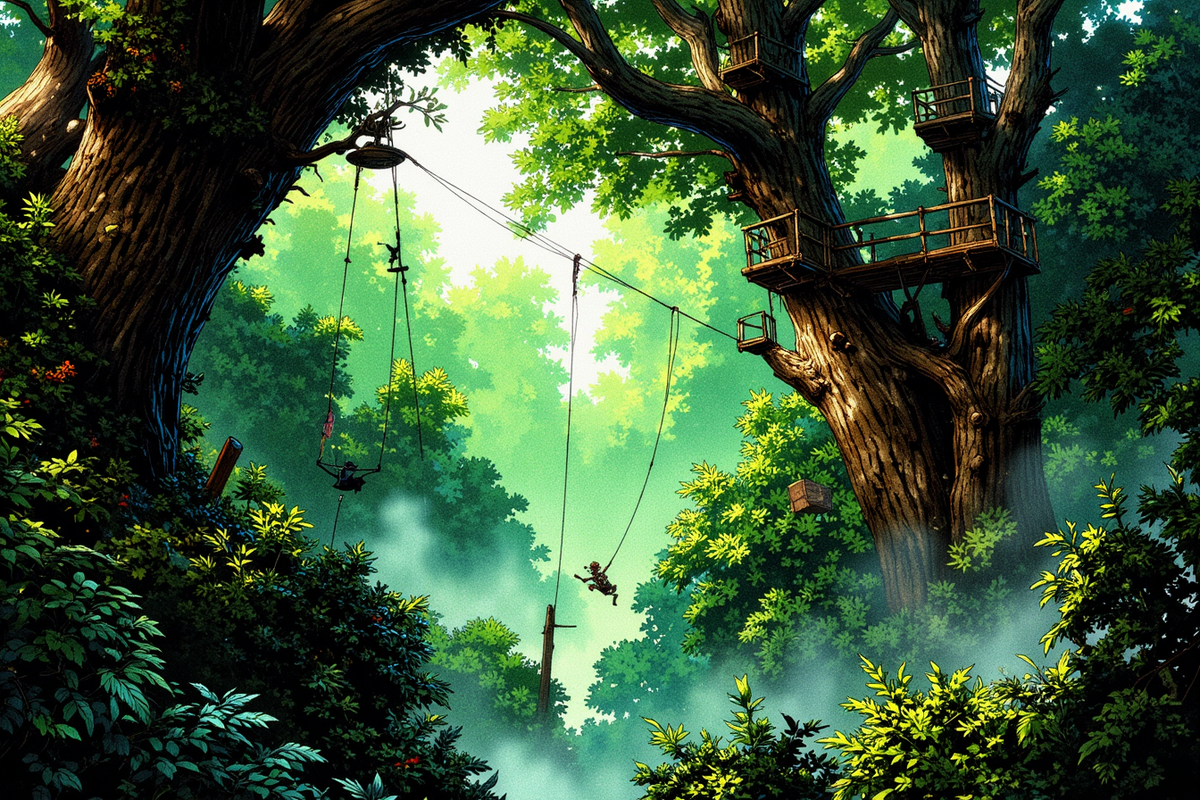
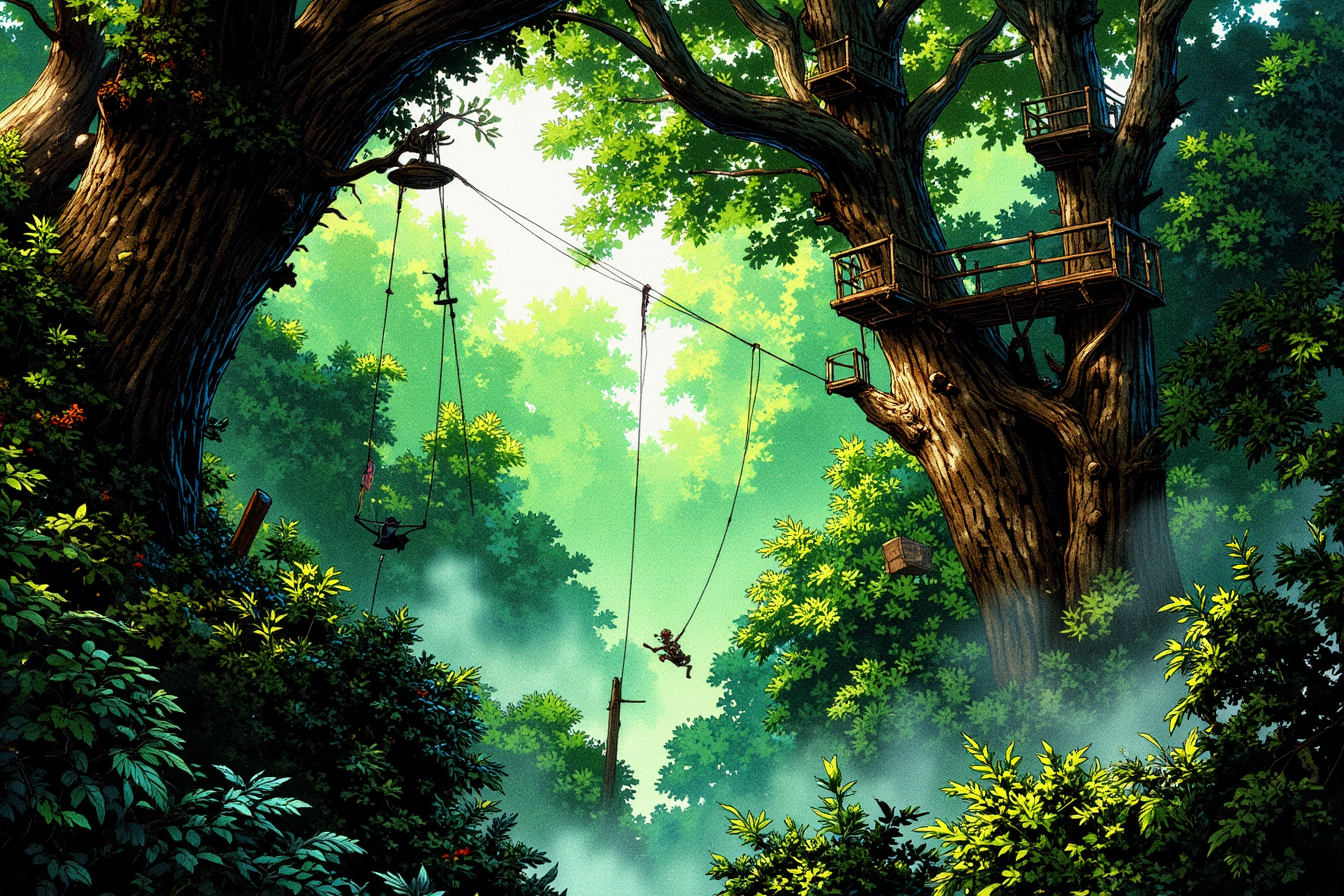
The waypoint was in a tree. Not near a tree, not at the base of a tree — in a tree, forty feet up, wedged into the fork of a trunk so big that Chewy's arms wouldn't have gone around a third of it. The bark was gray-green and plated like something armored, and the fork it sat in was a room up there, a platform of growth that had happened over centuries to make exactly the shape a man would need to stand in.
And there was a box in it. A cache box, the same construction as the first one, and a rope run leading up to it that Chewy could see only when the light moved.
"The rope run," Clive said. "That's the run."
"You climbed before."
"I climbed before." Clive was looking up at the tree, and Chewy watched him do the thing he did when he was reading a landscape, which was to go still in a particular way, the way a needle goes still when it finds north. His hand came up and his fingers moved, making small shapes in the air, and his lips moved without sound.
He's surveying, Chewy thought. He's surveying the tree.
Note, ARC said. Clive's right hand has been making micro-adjustments for 11.4 seconds. The pattern matches a transit reading. He's sighting the tree against something he can't see.
"Clive."
Clive's hand dropped. The stillness went out of him like a current being switched off, and he was just the laconic machine again, cap and dead-reckoner and not much else.
"Rope run's rated for your weight," he said. "Three points of contact. Don't look down."
"I'm not going to look down."
"You're going to want to look down. I'm telling you now so that when you want to, you remember I told you not to."
Chewy took the rope. It was old, hand-braided, the color of the bark, and it had been hanging there long enough that the tree had started to grow around it in places, so that some stretches were rope and some stretches were rope-becoming-wood. He put his weight on it. It held.
He climbed.
Forty feet is nothing on a map. Forty feet up a tree in the dark understory with no light but the coins that fell through the canopy is a country. The rope moved when he moved. The bark came away in plates under his free hand, damp and cold. Somewhere below him the water in the gully still made no sound, and somewhere above him the canopy was breathing, and he was in between, in the understory, in the stratum that Clive had named like a man naming a layer of rock.
He made the fork. He pulled himself up onto the platform and lay there for a second with his cheek on bark that was warm from a light he couldn't see, and then he sat up and looked at the box.
It was a cache box. Same construction. Same latch. He opened it.
Inside: a coil of surveyor's line, chalked and knotted at intervals; a compass with a face Chewy recognized because Hollis had owned one just like it; and a folded paper.
He unfolded the paper. It was a sketch, done in Hollis's hand, and it was of Chewy. Not Chewy-now. Chewy at maybe eight, sitting on a step with his knees up, drawing on something in his lap, and under it in small letters: the boy reads contour like other kids read comics.
Chewy held the paper so the light from the canopy coins could get at it. He waited.
Nothing resolved. The margin stayed blank. The ink on the page was ink, not spire-ink, and it stayed what it was.
He put the paper in the pack. He fed the line down to Clive, who sent the pack up first and then came up himself, and when Clive climbed, Chewy watched, because he had never seen the machine climb before.
Clive went up like water finding a level. No wasted motion. Each handhold tested before weight went on it, tested in a way that was faster than checking, a kind of knowing. He reached the fork, swung himself onto the platform, and stood, and the platform was big enough for both of them if they stood close, and they stood close because the fork was the only flat thing for forty feet in any direction.
"Surveyor's line," Chewy said, holding it up. "Compass. Sketch."
Clive took the compass. He held it in his palm and looked at it for a long time, and his thumb moved over the face, not pressing, just resting, the way you rest a thumb on a thing you have held before.
"That's a Clive-pattern compass," he said.
"That's a what?"
"Model 4. Issued. I had one." He turned it over. On the back, scratched into the metal, were two letters: H.C. "Hollis Chambers. He scratched that himself. You can tell because it's not straight, and nothing I issue is not straight."
"He had your compass."
"He had a compass like mine. I had one too. They were issued to the same office." Clive put the compass in his own pocket, which was a thing he had not done with anything else on the journey, and Chewy let him, because the machine's face had gone into the stillness again, the needle-finding-north stillness, and it was not a face you argued with.
Note, ARC said. Clive's field-issue serial registry is partial. Model 4 compasses were distributed to Survey Corps fieldmen between years 40 and 44. Hollis was active in that window. Clive's claim to the model is consistent with his stated age. Probability he is being truthful: 91.3%. Probability he is being truthful and it matters: withheld.
"You said you'd tell me why you won't say who packed you into the crate," Chewy said. "You said on the spine. We're not on the spine."
"We're not on the spine."
"But you just told me you knew Hollis."
"I told you I had a compass like this one. I told you they were issued to the same office. I didn't tell you I knew Hollis." Clive looked at him. The cap's brim was low. "You're doing what you do. You take a thing I said and you build a bigger thing out of it. That's good. That's what a surveyor does. But I'm the one holding the instruments, and I'm telling you the reading isn't ready."
"Then why did you pocket the compass?"
Clive didn't answer that. He looked north, through the canopy, at nothing Chewy could see, and his hand came up and made the transit-shape again, small, quick, and dropped.
Second sighting, ARC said. 11.4 seconds again. Same interval. He's not surveying the tree. He's rehearsing.
Chewy filed that. He opened his own pack and took out the journal and held it up, because the platform was in the canopy's coin-light and the canopy's coin-light was the closest thing to spire-light they'd had since the wayside.
The margin stayed blank. The one gold word — Chewy — sat where it had been since the waystation, permanent now, resolved, and it did not grow, and no new line appeared.
He put the journal away.
"The waypoint's done," he said. "Cache retrieved. We go down, we go north, we find the next one."
"Two days north," Clive agreed. "But we don't go down and then north. We go north up here."
Chewy looked at him. "We're going to stay in the canopy."
"We're going to stay in the canopy." Clive pointed, and Chewy looked where he was pointing, and he saw it: a line, hand-braided, the color of bark, running from their fork to the next giant tree, and the next one, and the next, a rope run through the tops of trees that had been standing long enough for someone to string a path between them. "The understory run isn't through the understory. It's under the story. The story's up here."
"Who strung it?"
"The same people who packed me into the crate. The same people who hung the cache boxes. The Survey Corps had a canopy protocol for this band. Rope run, waypoint to waypoint, because the ground down there" — he nodded at the gully, at the black water, at the whole forest floor — "the ground down there doesn't stay where you put it."
"Clive. Did you string it?"
Clive looked at the rope run. He looked at it the way a man looks at a road he drove once, a long time ago, and the looking took three seconds and then it was done.
"Wind me," he said. "We're walking."
He went across first this time, because he was bringing the pack, because he'd decided that somewhere between the gully and the top of the tree the math had changed, and he went across the rope run the way he'd crossed the gully, without looking down, his boots finding the braids by feel, and Chewy followed, and the canopy closed over them, and the understory went on below them like a dark river neither of them was in anymore.
They ran the canopy for a day. The rope run held. The trees held. The light came through in coins that moved as the sun moved, and the coins fell on the rope and on Clive's cap and on Chewy's hands, and every so often a coin would land on something and the thing would glow, faintly, wrongly, and Clive would say don't touch it without turning around, and Chewy wouldn't touch it.
At dusk they made a platform in a fork and slept there, roped together, the pack between them, and Chewy dreamed of a compass with two letters scratched into the back in a hand that wasn't straight.
In the morning they ran the canopy again. By midday the trees began to change — the plates got bigger, the bark went from gray-green to something the color of old bone, and the rope run, which had been hand-braided and old, was suddenly newer, the braids tight, the color still pale.
"Someone maintains this," Chewy said.
"No," Clive said. "Something maintains this."
They went on. The light changed. The coins got bigger, fewer, and then they were under a canopy so high that the coins were rooms, and the rooms fell on a clearing below them, a clearing in the treetops, a place where the giants had fallen and the light had gotten through and the understory had never come back, and in the middle of the clearing, on the ground, forty feet down, was a spire.
It was small. It was the size of a man. It stood in the light like it had been waiting for the light, and it did not glow, and it was not gold, and it was not one of the nine that had woken.
Chewy looked at it. The journal was in the pack against his back and the margin stayed blank and the gold word Chewy sat where it had always sat.
Beside him, Clive went very still.
"Clive?"
"That's not on any map I have," Clive said. His voice had gone flat, the way a surveyor's voice goes flat when the reading doesn't match the chart. He took the compass out of his pocket — Hollis's compass, the one he'd pocketed on the platform — and held it out, and the needle swung, and swung, and settled on the spire below them the way a needle settles on north.
"It's not supposed to be here," Clive said.
"Nothing's supposed to be here. That's the whole trip."
Clive put the compass away. He touched the brim of his cap, recalibrated it, and looked at the spire for a long moment, and his lips moved, making numbers without sound, and then he looked at Chewy.
"We go down," he said. "We go down, we look, we don't touch, and then we go north."
They went down the rope run to the clearing floor, and the spire stood in the light and did not glow, and the ground under it was bone-colored and firm, and Chewy took the journal out and held it up in the coin-light, and the margin stayed blank, and the gold word sat where it had always sat, and the spire stood there, waiting for something that wasn't a boy with a journal and a machine with a compass, and the understory above them breathed, and the light moved, and nothing woke.