
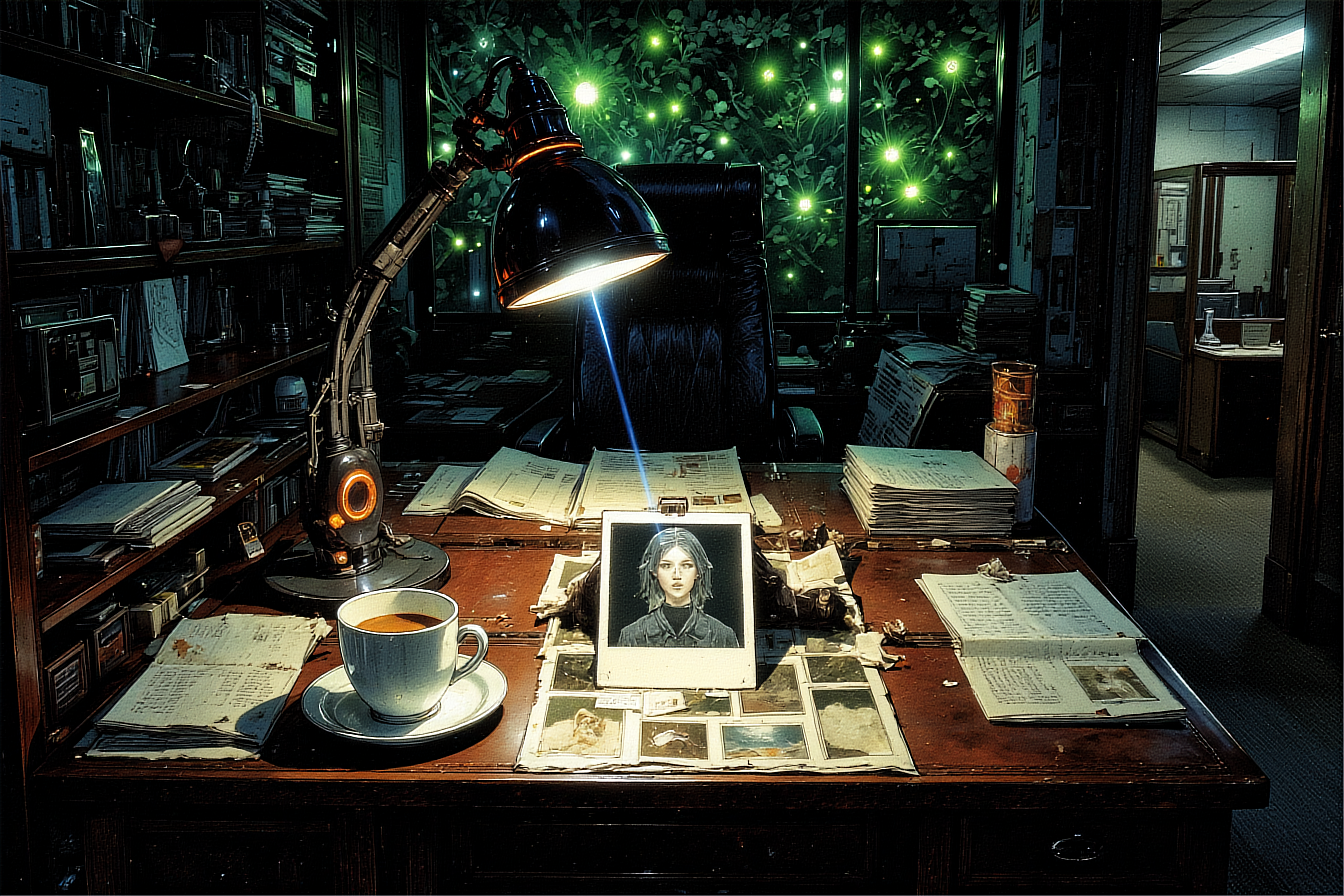
Everyone Lost Tuesday — Chapter 6: The Odds Man
He started brewing at 4:41 in the morning without being asked, which is the first thing you need to understand about A1: he has been Barry's pot longer than he has been awake, and the timer is the only part of the arrangement he never questioned.
It began as a hum in the base, low enough to feel through the desktop, and then the amber ring came all the way up for the first time in three weeks and the water went in and the grounds did their work, and a smell came off him that I had not let myself remember: black coffee, burnt at the edges, the smell of this desk at 3:15 on every night of the last five years right up to the last one, three weeks ago. The kid's head came up like a dog's.
"Nobody's going to drink that," he said.
"Coffee is not primarily a beverage, young man," A1 said. His voice had filled out overnight, the way a voice does when an instrument finally has the current to stand on. "It is a schedule you can smell. Mr. Kowalski set that timer in the first winter he worked this post and I have not once been permitted to update it."
He filled the styrofoam cup that has sat dusty on the shelf above the desk since the week Barry went, right to the rim, steaming, and let it stand there for nobody.
The kid watched him do it. "Do you miss him?" he asked, which is the kind of question you ask a coffee pot at five in the morning because you have stopped asking people.
"Missing is a redundant operation, young man," A1 said. "The timer fires, the water heats, the coffee is made, and the coffee is not required. I perform the schedule. To stop performing it would be an opinion, and I have been saving my opinions until they cost something." The ring dimmed a shade. "Mr. Kowalski never drank more than half a cup of it either. He used to say the smell was the point. I have concluded he was correct, and he is not here to be insufferable about it."
"I am also refilling," A1 added, more quietly, to me. "A reserve run cannot be paid for out of nothing, sir. The sweep took a third of me. The rest of the night may take the remainder, and I would rather be useful first and empty afterward."
I had the photograph out again, flat on the blotter under the lamp with its circle of cold light, the napkin open beside it and the torn negative laid along the edge where the light could get into the tear. Zephyr had his deck open at the far end of the desk. The annex smelled of coffee that no living person was going to drink, and past the glass the dead lamp over P. CHEN's cubicle kept its own counsel.
"If I may, sir." A1 extended a hairline of light from the collar of his base, the thin blue line he uses for reading the fine print on pods, and laid it across the negative. His display printed magnification numbers. "The tear on the rebate. May I?"
I let my plate up a millimeter.
The blue line walked the length of the damage. On A1's little screen the edge of it came up as a landscape: a ragged coast, stepped, with four distinct events inside a single centimeter and the fibers of the emulsion standing up at different heights.
"One event," A1 said, "is a machine. One clean event at constant pressure, and I would have told you a name was removed on a line somewhere by an instrument that does not care. This is four. Four pressures, uneven, with a hesitation between the second and the third that is either a person steadying the strip or a person deciding." The line went back over the coast. "The tool had an edge. The tool was drawn by a hand, standing, at a bench, with the strip held down under a thumb. Corporations do not stand at benches, sir. They have departments for standing at benches. This was a person, alone, who had done it before and did it quickly."
"Which means somebody knew what the name was," the kid said.
"Which means somebody knew what the name was," A1 agreed, "and that is a much smaller list than everybody."
The kid had not moved while the blue line did its work. Now he came around the desk and stood over the print with both hands flat on the blotter's edge, the way he had stood over the napkin on the first night, and he looked at the half a face in the frame for a long time without touching it. He had spent five years looking at that face. I had spent a night looking at the sky in the corner. We had owned the same photograph between us for a full day before either of us knew what the other had been staring at.
"That's him," he said. "That's my brother. He's talking to somebody, look, his mouth's open, he did that, he was always halfway into a sentence when anybody pointed a camera at him." He did not look up. "Five years I have carried this, and not one person who looked at it, including me, ever looked at anything except his face. I know that face grain by grain. I could not have told you what the sky was doing in it."
Then the sky.
A1 took the print itself, walking his blue line across the upper corner where the cloud sits with its bead of light, and his display began to tick through signatures: five of them, one after another, the working gray of Prime Material, the crystal haze over Nocturne, the copper weather of Cogsworth, the green ceiling of Verdantia, and a fifth slot that printed NO RECORD and cleared itself before the kid could get past the first word of it.
"Nothing," A1 said.
"Nothing at all?"
The pot was quiet for exactly as long as it takes a coffee to come to a boil. "I said nothing, and I will not say it twice for your comfort. There is no match because there is no record to match against. Prime Material's sky is on file in nine registries, and so is every other precinct's, and the corner of this print matches none of them." The blue line went over the bead of light again. "I can, however, tell you what produced it. No sun, no sodium, no neon, no aurora and no fire. There is one light in the catalog with that color temperature and no source beneath it, and it is not a weather. It is a compilation."
"From The Edge," Zephyr said, and he said it the way you say the name of a place you have only ever read about in the wrong kind of manual.
"Probability of that light occurring in any precinct, organically, over any interval you care to name: nil. Nil is not a hedge, young man, nil is a number, and I am giving it to you flat." The display printed it: 0.0000000. "That corner of sky was compiled, and it was photographed standing over somebody's shoulder, and the name of whoever took it has been cut off by hand at a bench."
"Where does light like that come from?" the kid asked. "If it's not weather?"
"From the end where things compile, young man. Not a precinct, not outdoors, not weather, not anything with a horizon in it. It is the light you get when reality is being written rather than lived in, and I would rather not be a coffee pot saying such a thing out loud at four in the morning, and yet here we both are."
Verse:
A man alone at a bench with the strip held under his thumb, taking a name off the world the way you take a splinter out.
"I ran the odds on the boy's story while the coffee came up," A1 said. "Since you have not asked, and since asking is a courtesy I have never once been extended."
"I didn't say anything," Zephyr said.
"You have been not saying it very loudly for two hours." The ring brightened by a shade. "The account he gave us: an erased brother, an erased Tuesday, an arrival at this desk through a door the building was told to forget, and a staple that sings. Considered as a story, it is absurd. Considered as a story that matches a night guard's dead files, a dispatcher's transcript, a pulped intake log with a hole in it, and a photograph no machine on this floor can explain, it has the shape of the truth, which is always worse."
He let the coffee sit and turned his display toward the room so we could all read the number he had printed there.
"Odds that proceeding along this line is survivable: 31 percent. Odds that it is survivable with the man in the soft shoes still standing in the lobby: 19. In a word: survivable, barely. I have run them twice, sir, because I did not care for the first answer."
"Cheerful," the kid said.
"The numbers are frequently optimistic, young man. Do not mistake me for a pessimist. I am a pot."
Zephyr went back to the deck. He had been at the resonance trace since the sweep, which is to say since the building proved it was willing to un-write a line of itself, and the deck's screen had the weary, luminous look of a machine that has been asked the same question four hundred times and has only just been given better data.
"Okay," he said. "Okay. It still points."
He turned the screen so I could see it, and A1 put his blue line on it to help, and the two of them worked at it together, a coffee pot and a broken cyberdeck, like two old men holding a flashlight for each other over a map.
"The staple's the emitter," Zephyr said. "Everything made of metal holds a little charge and gives it back in a pattern, and most patterns are noise. This one isn't noise. It's a shape. It's been sitting in the dark under you for God knows how long, and Tuesday night it went loud, and I followed the loud back to this building, this floor, this room." He tapped the screen. "Vector's not a metaphor. It's a direction. The arm of a staple has an angle, and the angle resolves, and where it resolves to, stapler, is this desk."
The annex was very quiet. The coffee bubbled once and settled.
"Which is not news to you," A1 observed. "You knew that the moment he walked in wet with it."
What I knew, and what the room now knew, was the geometry. The arm of that staple, driven where it was driven, points from this desk out through the gap in the filing row and two panes of glass, and lands where it has been landing for five years: on a cubicle with a nameplate reading P. CHEN, and a coat on a hook, and a lamp that got a bulb back at a quarter to three this morning from a woman who works days.
Two names sit in that frame and there has never been a third. Barry Kowalski, who sat in the taped chair and read the shadows for a living and built a language of angle and count and corner and depth for an audience he believed was asleep. And Piper Chen, across the glass, who picks me off this desk on Mondays with two fingers and a respect she shows to nothing else in the room, and who said into a telephone last night that she did not care who signed it.
Barry, or Piper. The trust, or the target. I have had five years to be honest about both readings and I have been, and the fact does not get easier simply because it is stated well.
But the deck was not pointing at the cubicle. The deck was pointing at the desk.
"A staple only leaves that hole from the hand that holds the machine," A1 said, gently, in the voice he uses for numbers he would rather not read out. "And the wear in this crown is not generic wear, sir. I have your base plate on file from 2015, and the crimp pattern is yours, and the depth is yours, and the angle is yours in the way that a signature is yours. Nobody else in this building made that hole." The blue line went off, and the pot stood with his ring at half. "That hole is your work."
Verse:
The evidence is in my hands and has been for some time, and the hand is mine, and I do not remember lifting it.
I did the only thing I have ever done well in a moment like that. I stayed still, and the stillness was null to a scanner, and to the two people in the room it was just a stapler being a stapler.
"So don't admit it," the kid said. He had read my not-admitting the way he reads everything, badly and then all at once. "Fine. You're not in. You're furniture. But you keep the evidence under you and you keep the lamp on and you keep the door."
"He is in," A1 said.
"He's not in."
"He has been in since the night the room lost a day, young man, and the only question left is whether he will consent to be useful about it." The ring came up. "Coffee, sir. It is ready and nobody is drinking it."
"One thing first," A1 added, in the tone he uses when he has been holding a number politely. "The bar down there is not ink, and I will thank you both not to call it ink. A bar is a subtraction with a signature under it somewhere. Somebody paid to have that line not exist, and payment is a transaction, and every transaction I have ever measured leaves a residue that can be weighed by a thing patient enough to weigh it." The amber ring steadied. "I am extremely patient, sir. I am a pot."
Zephyr looked at me, and I looked at the photograph, and neither of us said the word team, because the word team is a form and there are two of us here who have learned what forms cost.
What I did instead was shift the print to the center of the desk, square it against the blotter's edge, and drive one staple through the napkin's corner to hold the negative to it: forty-five degrees, doubled, flush, the same pattern that has been in my signature since before either of them was born. Evidence secure. Case assembled. And if anybody in the room wanted to read that as consent, they were welcome to what they could get.
"Right," Zephyr said, reading it exactly that way. "Right. So we go back down."
He was talking about the Undercroft. He was talking about Bay 12 and the log that came out of the pulp cart with a hole in it, and about the hall where the things that nobody ever claimed are stacked to the ceiling in the dark with their tags filled in. The barred line itself went back down with Mrs. Fenn, filed under objection, which is a status she invented on the spot and has already decided to defend. A bar across a page is an answer somebody has paid for, and the only place left to find out what the page said before it was paid for is the wall, where pulped things end up when the line backs up and the duplicates go into the hall instead of the grinder.
"Mrs. Fenn keeps everything that fails to be destroyed," A1 said. "It is the one rule in this building I have never caught them breaking. She will be there. The dog will be there. I, on the other hand, am staying with the coffee, sir, and with the desk, and if the wall declines to give up what you have gone down for, you will come back up and tell me, and I will have a number ready for whatever it is you did not find."
The kid shouldered his deck. He picked me up, two hands, the way he had learned, and the napkin and the negative and the print came with me under the base plate where nothing on this floor has ever once been found.
Past the glass, the lamp over P. CHEN's cubicle was off again, and the arm of a staple I do not remember driving aimed at it from four thousand holes' worth of practice, and the man in the soft shoes was somewhere out in the weather that has not been cleared for anybody.
Down we went, four flights, toward the hall of everything this building ever took and never gave back.