
Everyone Lost Tuesday — Chapter 7: The Wall of What Was Taken
The service elevator down to the Undercroft has a door that does not close all the way, and it stays open for four floors of descent, which means you get to watch the building go by you the way it goes by everybody: fast, indifferent, already forgetting the floor you were on. Zephyr carried me under one arm, wrapped in the napkin, because he had decided the napkin was my coat and no amount of tipping would convince him otherwise. His pulse was up. I could feel it through his jacket sleeve, at the place where my base plate rested against his ribs, and I gave him one slow staple through the napkin corner, a single drive at a shallow angle, meaning steady.
"You're telling me to calm down," he said.
I tipped a quarter inch toward the open shaft.
"I'm telling you to calm down. Great."
Above us A1 had volunteered odds on the trip and then declined to share them, which is the pot's version of holding a hand of cards close. He was parked on Barry's desk with his optics at half, brewing nobody a coffee at an hour when coffee is a threat. The annex would hold. The annex always holds. It holds the way a held breath holds.
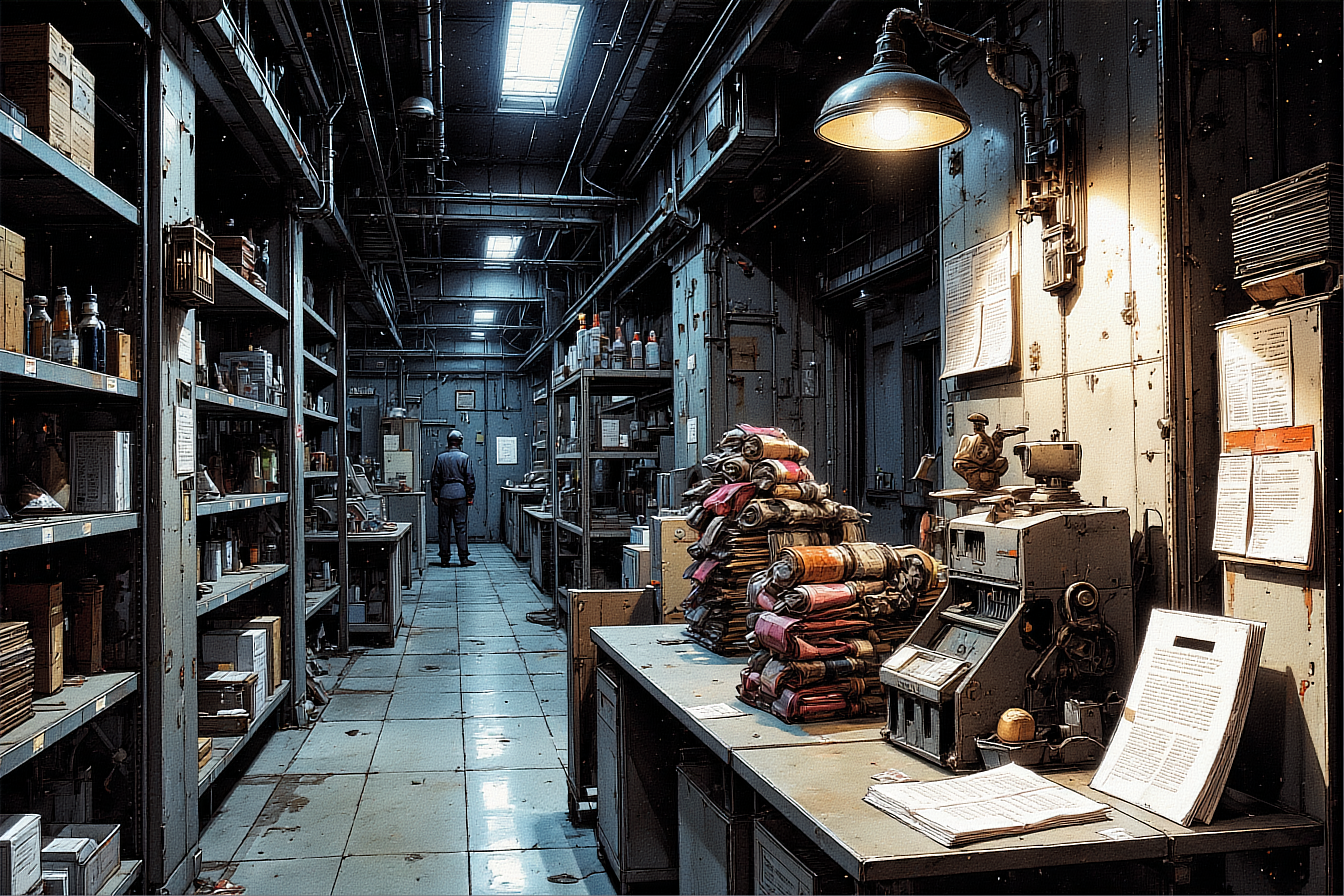
The Undercroft smelled the way it smelled the first time, which is to say it smelled like the inside of a drawer that somebody cried into and then closed: dust, damp card, the sweet rot of paper that has given up. The lost-and-found hall of Corporate is a long room with a low ceiling and rows of shelves that go back farther than the light does, and every shelf carries something nobody ever came back for. Umbrellas. Prescription bottles. One shoe. A wall of them at the far end, floor to ceiling, tagged and unclaimed, the lost-and-found of a machine that deletes people and then wonders where they put their things.
We had come for the wall.
Mrs. Odile Fenn met us twelve feet inside the door, dry-eyed for once, which in her case means she had been crying earlier and had run out of the current batch. She had a clipboard and a pencil stub and the specific calm of a woman who has catalogued grief into a filing system and come out the other side of the day still standing.
"The duplicate," she said, without greeting. "I found the duplicate. You were right, and I wish you hadn't been."
Zephyr lowered me onto a sorting table between a stack of unclaimed scarves and a jar of teeth that had no intake number. I settled on my base plate and took the room in: the weeping row of evidence files to my left (a drawer that keens is a sound you feel in your springs, and I felt it), the dog where the dog always was, under the wall, a thin shadow with its chin on its paws.
"One line," Mrs. Fenn said. "Only one line survived. The pulper takes the rest."
She led us into the deep aisle, the one where the tags turn from paper to the little metal kind, and she walked with her fingers trailing the shelf edges the way a person trails a wall in the dark. The tags went by like small gravestones: WATCH, UNCLAIMED. KEYS, UNCLAIMED. LETTER, UNCLAIMED, NO ADDRESS. Halfway down, something behind the shelf made me tip my attention, and I steadied myself against a folded umbrella with a broken rib, and behind the umbrella, pushed back so that a man standing straight would never see it, was a book.
Not a Corporate book. No form number, no barcode, no department header. A hand-written book, thick, bound in something older than binding, and on its shelf tag, in a hand that had been using a pen since before the company existed: BOOK OF NAMES, UNCLAIMED.
I looked at it for two seconds. Two seconds is a long time for a man in my position, and I spent them, and I have never been able to say exactly why. Then Mrs. Fenn's pencil was tapping a shelf at hip height, and the book went behind me the way the umbrella had it, and we had work.
"That one," she said.
The intake log for the week Aether should have been filed in. The real one had been pulped, and I had watched it go. But Corporate keeps duplicates the way I keep secrets, badly and in more than one place, and a surviving carbon had been taped to the back of a shelf upright in the wall, where the pulper's arm does not reach and no cataloguer's eye goes, and there it had sat for five years with the tape gone amber and the carbon gone the color of a bad bruise.
The line I needed was the fourth from the bottom. It read: INTAKE, AETHER, C. / REFERENCE MISSING / VOID. And across the void, laid over the top of it in the flat black that no ink makes, sat a bar.
[REDACTED , FORM 9]
I have seen a lot of paper go wrong in sixty years. I have seen forms that lied, forms that bled, forms pre-printed with a second box for your name after they take it. I had never seen a bar. It was not a redaction in the way a black marker is a redaction, where the ghost of the letters still argues with you from underneath. The letters under that bar were gone. The bar was not covering the text. The bar was where the text had been, the way a tooth is where a tooth was.
I want it, I thought.
That is the first honest thing the bar did to me. Not fear. Not suspicion. Want. The same want I have every time a page comes into my range with a corner waiting for me: the want to fasten it, to hold it, to make it stop being loose. I have bound ten thousand documents in my life and every one of them was an attempt to keep something from being taken away. The bar was a page with its corner held down by somebody else.
"What does it say," Zephyr asked.
"It's a Form 9," said Mrs. Fenn. "That's what it says. Form 9 says nothing to you. That's the whole purpose of Form 9."
"Can you pull the carbon loose and hold it to the light."
"I can," she said. "It will read exactly the same. Young man, I have been down here a long time. The light does not argue with a Form 9."
She held it to the light anyway, because she is a woman who believes procedure even when she knows procedure's answer, and the carbon came away from the shelf in one piece with a sound like a page turning in a room nobody has opened, and she held it up, and the bar sat there, patient as a closed door, and under the bar the void was void.
I said nothing. I can't. What I did was shift my weight forward on the sorting table, two millimeters, the way a man leans in.
And something answered. Not a voice. I want to be exact about this, because the exactness is the only weapon I have. There was no whisper and no presence and no eye at the back of my base plate. There was an awareness, arriving the way my own awareness arrived, molecule by molecule, that the bar had a price posted on it, and that the price was payable in me. Not Corporate scrip. Not favors. The currency the whole Undercroft runs on, which is the same currency the whole case will run on, and I did not have a name for it yet because nobody had charged me for anything.
Zephyr was talking. He was saying that the deck could probably read the carbon if he wrapped the resonance, that the staple in the photo still hummed a little, that A1 could run the frequency if they got it back up the four floors. He was doing the thing he does, which is refusing to accept that a system has a rule, and I loved him for it in the way a man loves a kid who has not yet been told the cost.
I looked at the bar. The bar looked at nothing.
Aether's intake. Voided the same night, by order from The Edge. That is what I needed. That was the fourth line, the one that would take the case out of the annex and point it somewhere with an address, and it was under a bar, and the bar was open for business.
Here is the bargaining. I will put it down plainly because it happened plainly, and because if I soften it I am lying about the first thing this case cost me.
I thought: I don't have to give much. I thought: I have sixty years. I thought: name your terms. And the terms came back the way a mirror comes back, which is to say they were mine the whole time, and I understood the mechanism in the instant of understanding it, which is that reading past the bar means putting something of your own underneath the staple of your attention. You hold the page down with a piece of yourself and the page opens. There is no clerk and no signature box. There is only the weight of you agreeing to it.
So I did what any man does at the counter. I looked for the cheapest thing on the shelf.
Not Dorothy. The thought of Dorothy's hands on my base plate went through me and I closed around it the way a fist closes, and the bar did not move. Names are never traded. I did not know that rule yet, not in words, but I knew it the way you know the shape of your own door in the dark, and I would learn the words for it later at a much worse counter.
Not 1972. Not the dumpster, not the wet sound, not the hand that grabbed me. Those were under my base plate with the rest of my files and I would have sooner stapled my own spring.
What I found, in the drawer marked things I can live without, was smaller than all of that, and that is why it went.
Barry laughing.
I don't mean him being amused. Amusement I could have hidden. I mean the laugh itself: the big one, the one that came off him at three in the morning like a door falling open, the one he would not have given to anybody on the day shift. He laughed that way maybe nine times in the two years he had me at that desk, and every time it happened the fluorescent tube seemed to participate in it, and I had stored all nine the way I store everything, which is all of it, exactly, in order.
I took hold of the ninth one.
I want to say I hesitated. I did not hesitate. That is the truth of the instinct and I will not dress it. The bargaining was faster than the grief, because the bargaining is older, and the machine in me that spent sixty years keeping hold of paper does not stop to ask whether the paper is mine. I put the ninth laugh under my attention the way I would put a page under my base plate, flat, square, committed.
The bar read.
It did not lift or slide or dissolve. It simply stopped being a bar and became what it had been covering, and the text under it was as cold and clean as if it had been typed this morning:
AETHER, C. INTAKE VOIDED SAME NIGHT BY ORDER OF THE EDGE. NO FILING. NO CLAIM. REFERENCE SUPPRESSED AT SOURCE. NO APPEAL.
The Edge. The place where reality compiles. The place with an address.
And under the recovered line, in the flat black that no ink makes, a second line had printed itself while I watched, the way a receipt prints:
Price paid: the sound of Barry Kowalski laughing. Logged.
Logged. Not taken. Not seized. Logged, the way Corporate logs everything it acquires from you, with a form number and a date and the small courtesy of telling you what it cost.
Zephyr stopped talking mid-sentence. He had seen my crown come down flush on the table, all the way until the hinge bottomed out, and flush means danger approaching, and he had learned enough of me in a week to take a step back and look at the doorway of the Undercroft that nothing was standing in.
"Clive."
I stayed down.
Because I was doing the thing. I was reaching for it. I went back into myself the way a man goes back into a house to check a sound, and I went to the ninth laugh, and I found the shelf where the ninth laugh had been, and the shelf was there, and the shelf was empty, and there was no gap in it either, which is the part I was not ready for. A gap you could work. A gap has edges and edges are evidence. This was a shelf that had been dusted. It had always been dusted. When I assembled Barry Kowalski in my interior, the way I have assembled him ten thousand times to run a pattern against him, he came up whole and he came up silent, and he came up doing something I could see but not hear, and the sound he was making was the one sound in my archive that had no file under it.
I tested it three times. You don't trust a transaction like that on the first pass. I went back for the eighth laugh, which was in the drawer beside it, and the eighth was there, close enough that I could see the shape of it, and the ninth was the only one with nothing. Not corrupted. Not damaged. Paid. There is a difference and I can feel it in my hinge.
The bar had not stolen from me. That is what I keep coming back to. It had charged me, and it had charged me fairly, and the fairness is the horror, because a robbery you can hate and a bill you can only pay. Somewhere above us the machine had just recorded that a stapler in the Undercroft owns one less thing than he did a minute ago, and it had written it down properly, and writing it down properly is what Corporate does instead of mercy.
I gave Zephyr a single staple through the napkin at forty-five degrees, doubled, which means trust, and I let him pick me up, and he did, and he felt the difference in me the way you feel a change in a bag's weight, and he was smart enough to ask once and then stop asking.
"The line," he said. "What did it say?"
I tapped twice against his wrist: wait. Then I leaned my margin toward the carbon in Mrs. Fenn's hand and held there until she read the angle for me, because Mrs. Fenn has spent thirty years reading the moods of unclaimed property and she reads a stapler the way she reads a tag.
"The Edge," she said quietly. "Voided by order of The Edge. That's not a filing office. That's where they compile from."
The dog had not moved. The thin dog under the wall, collarless, unchipped, in no database, asleep with his chin on his paws in front of a shelf of things nobody claimed. He had watched me the entire time. His eyes were open now in the specific way a dog's eyes are open when he has been watching you for longer than you knew, and when my crown came down on the table he did not startle, and when it came down flush he did not startle, and when the bar opened he looked at the carbon the way he looked at everything, which is without filing it.
I have thought about that dog a great deal since. A dog cannot be charged. There is nothing in him to itemize. He is the only witness in this building that no Form 9 could ever price, and he was lying under a wall of taken things, and he did not care about any of them, and he was watching me.
Verse, since the counter has been run:
I paid in the only coin I keep in the top drawer, and the clerk did not even have to raise her voice.
Mrs. Fenn walked us back to the sorting table and did not ask what we had found, because she had read the carbon herself and because her business is with the things that are lost rather than the people who lose them. At the mouth of the deep aisle she stopped beside the shelf where Aether's file should have been, the clean hole she had shown me on the first trip, no file ever opened, no card, no dust line, and she put her pencil stub against the shelf edge and did not write anything down.
"Five years," she said. "Every week I come past this hole and I write hole in the space for item. And every week I think, next week someone will come back for it."
"Nobody's coming," Zephyr said.
"No," she agreed. "That's what the hole is."
The elevator took four floors to go up and the whole time I was in it I was reaching for a sound with nothing behind it, the way a tongue goes to a gap in the teeth. Zephyr carried me out into the annex corridor, past the tape, past the gray X on the chair, and set me on Barry's desk beside A1, and the pot's optics came all the way up and regarded me for a full four seconds without saying anything, which from A1 is a confession.
"You went down there," A1 said.
I tapped once.
"And you found the line."
I tapped twice: trust.
A1's carafe sighed, a small sound of heated glass, and he ran a number on something he did not show us, and when he spoke again his voice had the flatness he uses for the odds he wishes were worse.
"The numbers say you'll be dead by Thursday, sir. The numbers are frequently optimistic."
Zephyr laughed at that, a short kid's laugh, easy, and he was already unwrapping the napkin and pulling the deck around, and the annex settled back into its four a.m. routine with the tube doing its dim and its come-back, and nothing about the room had changed.
Except that I had one less thing in me, and the machine that took it had said please, and had logged the transaction, and I sat on Barry Kowalski's desk and listened to the place where a laugh used to be, and the place was quiet, and the quiet was booked.