
Everyone Lost Tuesday — Chapter 8: Piper Chen
She asked for me by name, which is more than most people who use me do.
The request came through Zephyr, standing at the gap in the filing row with my weight in both hands, saying it in his flat voice so it would not sound like a summons: "She says she'll talk if we bring the stapler. She says she knows how he sits." And I gave Zephyr one staple through the napkin at a shallow angle before he finished the sentence, which meant caution, and then, because caution is a lonely thing to carry alone, a second drive right beside the first, which meant trust, and which meant go.
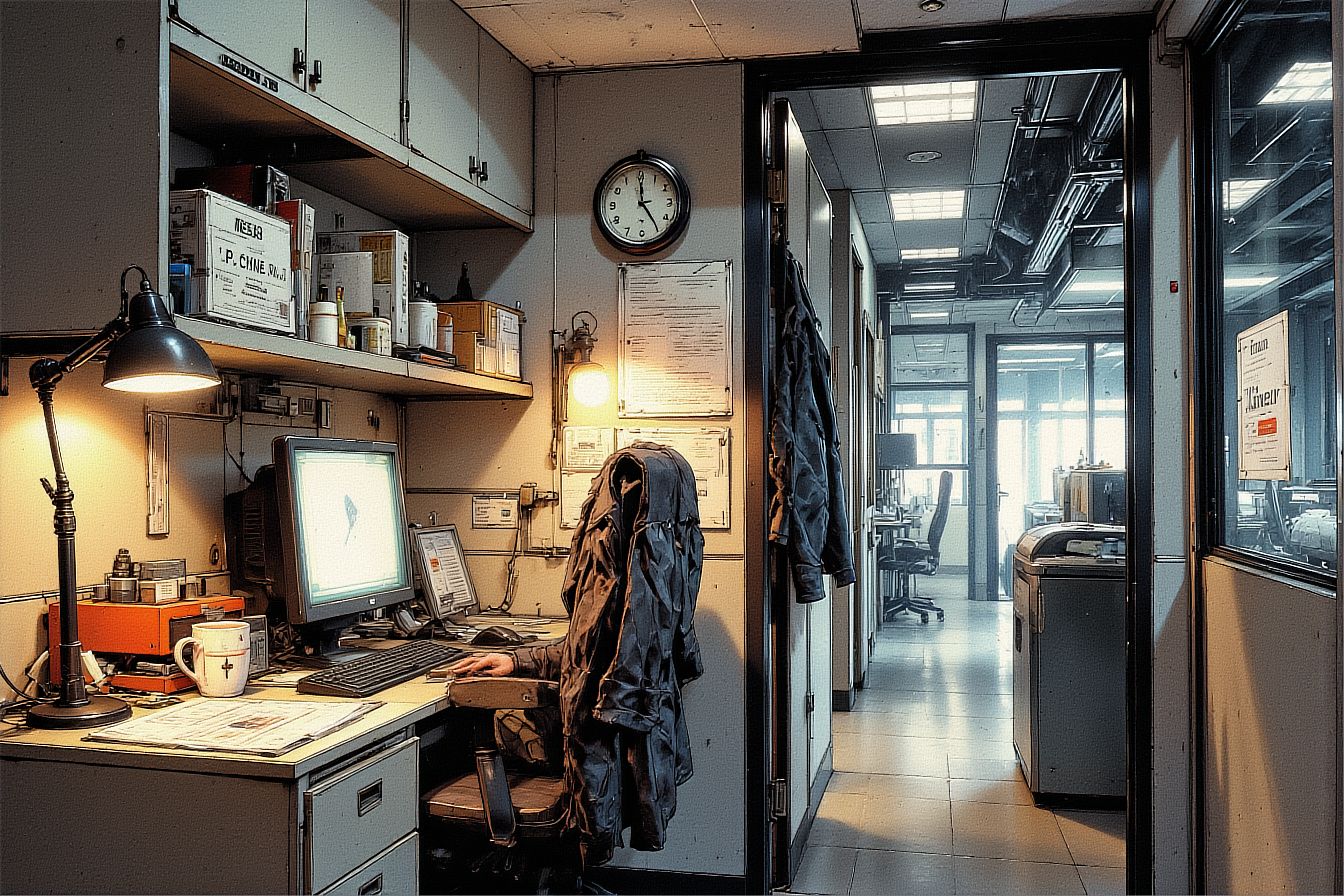
Piper Chen's cubicle is eleven steps from Barry's desk if you count the way a person counts and nineteen if you count the way I count, which is by the trouble in the route. You go past the taped chair, through the glass partition door that still has Barry's old access sticker going white on its frame, out onto the open floor where the dead task lamp hangs over P. CHEN's nameplate, and in. Her coat was on the hook. Her monitor was on. There was a mug on the desk with a tea bag string taped to the handle, because she had learned at some point that a tea bag string in an office the size of Corporate's is a structural failure waiting to happen, and I have always thought less of the company for that observation and more of her.
Zephyr set me down on the near corner of her desk, visitor side, the way a man leans in to sign something at somebody else's place. Barry's corner. Barry had stood at exactly this spot, five years ago, with a routing sheet.
Piper came around the desk and stood over me for a second with her hands empty and her arms down, which is how a person stands when they are deciding whether they are allowed to touch something.
"Hello, Clive," she said.
I did not move. Moving is a statement. Stillness is also a statement, and stillness is free.
She pulled her chair around the front of the desk and sat down with her elbows on the edge so her face was level with mine, and that is when I let her pick me up. Both hands. Under the base plate and around the spring housing, no fingers in the hinge, and she turned me a quarter inch to the light and looked at the orange the way you look at a color you have missed, and then she set me back down at the exact spot she had lifted me from, square to the desk edge, because she knows how I sit.
Five years of Mondays. She carries me back from Barry's post like a library book and has never once asked what is under my base plate, and I have never once let her see me staple.
"You've been down to the Undercroft," she said. "You've got Vault dust in your hinge."
Zephyr, in the doorway, started. I tapped once against the desk: let her talk.
"I worked with Barry long enough to know what a night that goes to the basement looks like," Piper said. "And you've got the kid with you, so I know what it's about." She folded her hands on her own desk, the way people do when they have decided to give a deposition and not a conversation. "Ask."
So I asked. I can't ask. What I did was this: I shifted my weight forward one millimeter toward her left hand, where it sat flat on the desk beside her keyboard, and then I rocked back, and then I did it again, the same direction, the same insistence, until she understood it, because Piper has always been quick with me, quicker than most, and because a woman who picks out an orange stapler from a supply closet because it is aggressively cheerful reads a pointed stapler faster than most.
"Barry's last week," she said. "All right."
She talked for eleven minutes. I know it was eleven because the wall clock over the dead lamp has a second hand with a stutter in it, and I counted the stutters, and she did not waste a single one of them.
The last week was audit week, and audit week meant crates. Not shipments the way Corporate moves shipments, with a manifest and a signature and a time stamp that agrees with the time. Crates that came up from the loading level at three in the morning with the routing sheet already filled in, four of them a night for six nights, no manifest numbers on the outside, and Barry logging them anyway in his own hand because a night guard who does not log things stops being a night guard.
"He brought me the log at the end of the second night," Piper said. "Walked it over here and stood where the kid is standing. Said, read this and tell me it's nothing." She looked at Zephyr without any particular heat. "I read it. I told him it was nothing. It was four crates moving between two rooms in the same building, and the routing sheet said the destination was a floor that doesn't have a destination on it, and I said the word misfiled to him, and he let me."
She stopped. She had given me that for free, and we both knew what she was doing with the pause, and I gave her the pause back, because a witness who is allowed to choose her next sentence tells you more than one who is hurried.
"He also asked me what a Form 9 was for."
There it was. I took it without a tip, without a shift, without anything she could read, and I put it under my base plate with the rest.
"I told him what I knew," she said. "Which is that a Form 9 is a suppression order and that I had never signed one and that the people who ask what a Form 9 is for are usually three weeks away from finding out." Her hands stayed folded. "He said that was a good answer. He said it the way he said things when he was going to write them down later."
The clock stuttered. Twenty-six times, and I was not counting for evidence.
"You asked him to staple something," I made Zephyr say, by leaning my margin toward the kid and holding it there until he read it.
Piper's eyes went to the angle and stayed on it, and something in her face did the small rearrangement that a face does when it is deciding between two true answers and which one is safer to give.
"I asked Barry to staple my copy of a routing sheet," she said. "Yes. It was late and I had one sheet and he had one sheet and my copy was coming apart at the corner, and I said staple this for me, and he did, and then he said a thing I have thought about every day since." She looked at my hinge. "He said, you want mine in yours. He said, that's how it starts."
Silence. The kind that has a shape.
"That's how what starts," Zephyr said.
"I don't know," Piper said. "That is the truest sentence I have said in a week and I would like it recorded."
I gave her a single staple into the desk pad, shallow, at an angle that reads caution to anyone who is looking, which she was, and I let her see me do it, and I watched her watch my crown go down, because Piper Chen has known me for ten years and has never once seen me work, and what happened on her face was not surprise. It was the particular stillness of a person whose suspicion has just been confirmed and who had been holding out for a better answer.
"You could have done that any Monday," she said.
I could have. I didn't. Both of those are true and neither clears me of anything, which is the condition I live in.
"Barry trusted me," she said. Then she said it again, differently, with her head a few degrees over where it had been, the music changed without the words changing: "Barry watched me."
The room agreed with both readings. The dead task lamp, the nameplate, the tea bag string taped to the handle, the coat on the hook. Trust this person. Danger approaching. The pointing staple had been aimed at this exact cubicle for five years and I had never once in five years been able to tell whether it was a trail or a target, and I had come here for a woman who knew Barry better than anybody left breathing to settle it, and she had handed me the same sentence twice and let me hold both.
I worked my margin toward Zephyr and held it on him until he caught it, and he read the angle off me the way he has learned to, slowly, mouthing the geometry.
"And the night he went," he said. "Somebody came to your desk that night."
Piper did not look at Zephyr. She looked at me, and she waited out the length of two stutters before she answered, and the answer when it came was dressed in the same coat as all her others and fit it perfectly.
"Two men in soft shoes," she said. "They came up at the end of the round, before the log was closed, and they asked me whether Barry had left anything with me. Papers, they said. Anything at all. And I said no, because he hadn't, and they looked at my desk the way you look at a desk when you are counting what is on it, and then they left, and the next morning my visitor log page for that night was blank where the entry had been." She smoothed a spot on her own desk with one finger, a small circular motion, polishing nothing. "That is what happened at my desk that night."
"That isn't what happened," Zephyr said.
"No," she agreed. "It's what happened at my desk."
I gave her a single staple into the desk pad, angled, caution, and left the caution sitting there for her to pick up or not, and she did not pick it up. She let it lie. Some witnesses argue with a code to get past it and some step over it, and the ones who step over it are the ones who have been read to before.
"That's the job," I made Zephyr say.
"Yes," Piper said. "It is." She unfolded her hands and put her right one flat on the desk, palm down, in the place where a person rests a hand when they want it to be near something without holding it. I could see the tendons at her wrist and the small ink stain on her second finger and the place where a ring had been and was not. "Ask the next one."
The next one was where she was the night he went.
I did not make Zephyr say that one. I had tipped my margin toward her left hand for the last question I had, and Piper looked down at the angle of me pointing at her own wrist, and she took her hand off the desk and put it in her lap, and the gesture cost her nothing and told me everything, which is that she had prepared for this question the way you prepare for a door you know is coming.
"Gently, Clive," she said. "I'm going to decline that one. Not because it's damning. Because it's mine."
Zephyr started to speak and I stopped him with a flush drive into the desk pad, all the way down, flush being danger approaching, and the flush was not aimed at her. I have used it that way in front of people before and I will again: danger is in the room, the danger is not the woman, say nothing. Piper saw the flush and did not flinch, and I understood something then that I have been turning over ever since: she has seen that pattern before. Not from me. From him.
"Did he show you that code," I made Zephyr ask.
"He showed me everything at three in the morning," she said, "and nothing at nine, and I have never been able to decide which one of those was the compliment."
The clock stuttered forty-one times. Then she stood and went to the small cabinet behind her monitor and came back with a thing wrapped in a paper towel, and she unwrapped it on the desk in front of me with both hands, careful, the way you set down the only copy of anything.
A routing sheet. Photocopy, second generation, going soft at the folds. The night's shipments logged in a hand I have been reading for two years, four crates, times between 02:10 and 02:52, and in the destination column a floor number that Corporate does not have, and in the corner, at forty-five degrees, doubled, driven flush, a staple, and the staple was mine.
I knew the hole before I saw it. I knew the crown wear the way a man knows the wear on his own key.
"I kept the one I asked him to do," Piper said. "My copy. The one that was coming apart at the corner." She did not touch it. She left it lying between us like a card that had been played. "And I have never asked you what you did with yours."
I looked at my own hole in her paper and the hole went back at me the way deep water does, and I thought about a night five years ago with my spring half-compressed and no witness in the room, and the thought had a gap in it that I have learned since to recognize as a price, except the price had not been paid yet, and the shape of the gap frightened me more than the bar had.
"You can have it," she said.
I gave her one staple into the desk pad, angled, caution, meaning no.
"Not yet," she read it. "All right." She wrapped the sheet back into its paper towel and put it in her drawer and did not lock the drawer, which was either trust or carelessness, and either one of them keeps a file open.
I had come for the shape of the pointing. I was leaving with a destination floor that does not exist, a Form 9 asked about by a dead man three weeks early, a routing sheet with my own signature in it that I do not remember driving, and a woman who had told me Barry trusted her and told me Barry watched her and declined, gently, to say where she was, and every answer she had given me was two-sided and she had known it while she gave it.
More than I came with. Less than I need. That is the trade every interview is, and a man who takes the trade anyway is either a detective or a fool, and the difference between them is whether the file stays open.
Zephyr picked me up. He waited until we were past the glass partition and the dead lamp before he spoke, because he is learning.
"She didn't answer the last one."
I tapped twice: trust.
"That means trust her?"
I tapped once, then twice, then once: caution, trust, caution. Both. Either. And the not-choosing was in my hinge again the way it had been for five years, and I rode the kid's shoulder back toward Barry's desk with the annex going gray around us and the tube doing its dim, and I thought about a woman who keeps things in paper towels and does not lock the drawer.
Verse, on the way back:
Two answers in one mouth, and she gave them both with her hands folded, and neither one closed the file.
The desk was empty when we got there, A1 at half optics and the napkin still under my base plate where I had left it, and the annex was quiet except the sound of the tube deciding, and I sat down on a desk where a man used to set his coffee and I held the two sentences she had given me up against each other the way you hold two photographs to a window, and they would not overlay, and they were never going to overlay, and Piper Chen had known that before I asked.