
Everyone Lost Tuesday — Chapter 9: The Year of the Letter Opener
There is a desk in me that I have never been able to get out of, and it is not Barry's desk, and it is not Piper's.
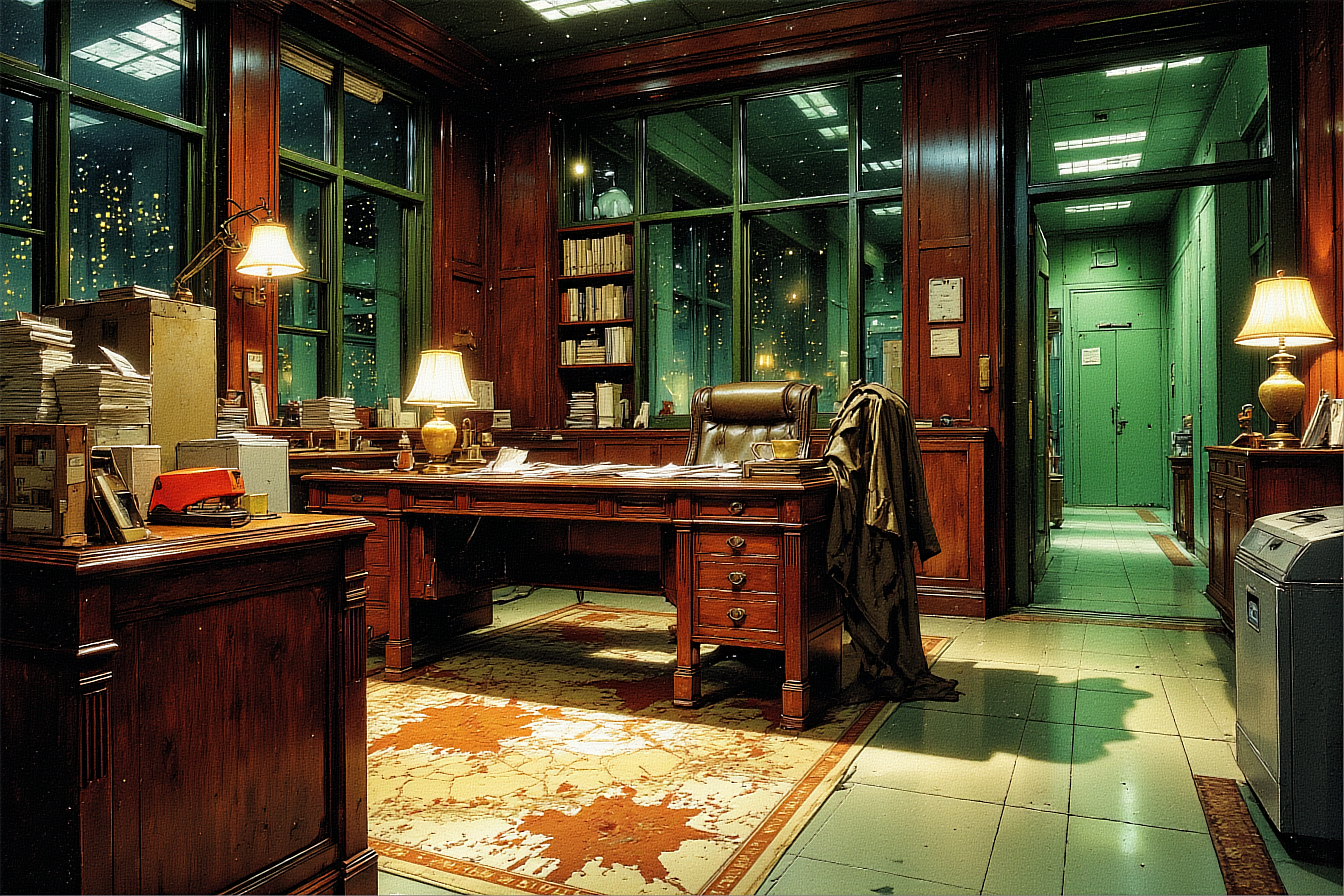
Madison & Associates occupied two rooms on the ninth floor of a building on Madison Avenue that has since been converted twice and is now, I am told, a place where people stand up at desks and yell about flooring. In 1967 those rooms were walnut and green glass and a rug with a map of the world on it, and the senior partner's desk faced the window, and on the corner of that desk sat me, new, orange, still carrying the warmth of the plant, with Dorothy's fingerprints under my base plate and the smell of the paint not yet dry.
Maxwell Madison worked late the way other men drink water. He was not a good man. I have had sixty years to decide whether that matters and I have concluded that it does not, because the point of a witness is that he testifies to what happened and not to what the victim deserved. He worked late on a Tuesday in September 1972 with his collar open and his reading glasses pushed up, and the light in the room was the desk lamp and the window, and the window was the city at ten-thirty at night, and the city was doing what it does, which is being indifferent at scale.
Dolores came in later. Dolores Vidal, twenty-six, the secretary, the kind of shorthand the word secretary was built for and has been apologized for ever since. She came in with two cups of coffee in the paper sleeves and she set one down at the corner of his desk where the second box on his stationery sat empty, and she said something about the morning, and he said something back, and the two of them existed in the room the way two people exist who have agreed on the shape of the evening and are not going to discuss it.
The wife's shadow came up the stairs at 10:51. I know it was her shadow because I never saw her face, and I want that on the record: I have spent my whole life collecting faces, and the face of the woman who walked up those stairs is the one I can describe least. What I saw was a shape in the frosted panel of the door and then a shape in the doorway and then a shape standing just inside the room with her hand still on the latch, and what I heard was Maxwell Madison say a name, and then the door shut, and then the room went back to being two people, except it wasn't, because the count had changed and everybody in the room knew it.
They argued in the register of a marriage that has long since stopped being an argument and become a procedure. I will not quote it. I have it, word for word, in the exactness I keep everything in, and I have never once in fifty-four years taken it out to look at it, because there are files under my base plate that exist for the record and not for me.
What came out of her coat, when it came, had been a Corporate gift since 1965. A brass letter opener, four inches, weight to it, the kind they engrave with a division name and hand out at a dinner and never see again. She did not bring it up from the stairs. It was already in her hand when she came in. That detail took me thirty years to be sure of and I am sure of it now: she came up the stairs holding it.
The wet sound.
I have heard a lot of paper go through me and a lot of men go through a lot of rooms, and I want to say precisely this about the sound and then never say it again: it was not loud. It was the sound a boot makes going into wet gravel, which is mostly the sound of the ground giving up. It lasted less than a second. Maxwell Madison made a noise with his mouth that had no word in it and he sat down into his own desk the way a man sits down when his legs have been sent a memo, and he stayed sitting, and the rug with the map of the world on it took what it took, and Dolores Vidal stood in the doorway with two cups of coffee in paper sleeves and did not scream.
That is the thing I have never been able to hand anybody. She did not scream. She stood there with her mouth open and the coffee going cold in her hands and she looked at the man at the desk and then she looked at the woman by the latch and neither of them looked back at her, and she set one cup down, on the corner of the desk, six inches from me, and the coffee spread under the saucer, and she put her hand out.
People grab what is nearest when the world goes wrong.
She grabbed me. Around the spring housing, two fingers in the hinge, the way you grab anything, badly, and she ran, and she was still running when the stairwell door banged, and I was looking back over her arm at the room behind us the whole way, which is the last time I saw Maxwell Madison alive, from the height of a woman's elbow, at speed, with the corridor lights going by in bars.
Three blocks. I know it was three because I counted the intersections with her heartbeat, which was against my base plate, and I have never in sixty years had a closer relationship with another living thing. She went down an alley behind a dry cleaner, and she put me in a dumpster on top of a broken crate and a stack of damp circulars, and she stood there with her hand on the rim of the dumpster for a while, and I could hear her breathing the way you hear a machine that has been run too hard, and then she took a handkerchief out of her sleeve and she wiped my base plate.
Prints. She wiped my base plate and then her own hands on the handkerchief and then she dropped the handkerchief in after me, on top of the circulars, and she went, and I never saw Dolores Vidal again, and she lived, as far as any record goes, and I have never once, in fifty-four years, been angry at her for it.
The police ruled it a botched robbery.
I have read the ruling. Somebody left the file where I could get at it eventually, because files go everywhere and a stapler is where files live, and it says: forced entry not evidenced, cash drawer undisturbed, one brass letter opener (1965 Corporate gift, senior partner's desk) reported missing from the scene. Botched robbery. The word botched is doing the work of a whole department in that sentence, and the missing letter opener is the alibi for the woman who took the stairs, and the file was closed on a Thursday, and I sat in a dumpster in the rain behind a dry cleaner on a Thursday with a truth in me that no procedure has a field for.
Nobody asked the furniture.
Verse, before the rest:
I have been the nearest thing to a witness in a room full of people and the report reads nothing of evidentiary value.
Here is what happens to a witness who cannot testify for forty-eight years. He goes.
The detective agency on West 44th kept me in a drawer with the rubber stamps, three months in 1983, and a man named Fennick ran it, and Fennick would come in at seven and work his fingers to the bone on other people's problems and at night he would take a form out of the drawer, a blank, and he would staple the corner of it over and over while he thought, and he never once noticed that he did it, and I learned more about the human animal in that drawer than in all the rooms before it. You can read a man's fear in where he drives a staple. High in the corner means he is protecting something. Ragged and repeated means he has decided twice and the second decision was the wrong one. Flush and square means he has accepted something he did not want. Fennick never once drove flush, and he died of a heart attack in 1986, and his last form is under my base plate, and it is high and ragged.
The suicide notes I bound in rooms I will not name, eleven of them I can count, and a love letter I estimate in the hundreds, and the difference between them went through my throat at exactly the same speed, which is the speed of a spring under load, and that speed is the only thing in my life that has never once varied. I have thought about that more than I have thought about the letter opener. A man pours his worst morning into a page and the page gets the same treatment as his grocery list, because paper does not care, and neither do I, and the not caring is not a moral position, it is a hinge.
2015. The bulk office supply exchange: a cardboard tray of us on a shelf in a supply closet, me among forty, all of us wondering in the way that furniture wonders, which is by not wondering and by holding on to everything anyway. And a hand came in, and the hand had an ink stain on the second finger, and it passed over three staplers that were newer than me and one that was shinier than me, and it took me out of the tray and turned me over and looked at the base plate for a long moment the way you look at the underside of a thing that has been somewhere.
"Aggressively cheerful," Piper Chen said, and carried me out of the closet, and I went home.
The grief thesis, if you want it, is not a thesis, it is a tally. I have been in the room for a murder, for a firing, for a bankruptcy, for a proposal, for eleven last days, and I have bound the paperwork of every one of them, and I have never once opened my mouth. Not because I am shy. Because there is no procedure for a stapler, and a fact with no procedure in front of it is not a fact, it is furniture, and I have been furniture with the truth in me since a Tuesday night in 1972, and the truth is heavy, and the heaviness has a shape, and the shape is a man sitting at a desk with his collar open.
Then, an hour ago, at the desk where a man used to set his coffee, a boy with a deck put a cutting in front of me and asked whether I had known him, and no one living has asked me that in fifty-four years, and the asking sent me back to the ninth floor.
Zephyr was there with the deck propped against the crate and the napkin photograph running through a resonance scan, and he asked me, without looking up, whether I had been in the 1972 end of things, because he had found the newspaper cutting under my base plate while lifting me to check the staple, and the cutting is small and folded eight times and has been folded eight times so long that the creases have gone soft as cloth.
"Madison Avenue," he said. "Senior partner. That's your first desk, right? Piper said you came from a firm."
I tapped once.
"Did you know him?"
I tapped once.
Zephyr turned the cutting over in his fingers the way you turn over something that belongs to somebody else and put it back on the desk, square with the edge, and he did not ask another word about it, because the kid has one gift above all his others and it is not the deck: he knows when a file has been answered. Then he slid the cutting an inch toward my base plate with two fingers, the exact gesture I have watched Barry make, the gesture of returning a thing to where it lives, and he said "It's still got a crease in the wrong place," and refolded it wrong again on purpose so that it would fit me the way it always had.
I have bound the paperwork of eleven last days. Not one of them asked the furniture anything.
Then Barry.
Barry talked to the furniture at three in the morning for a year before he said anything worth hearing, and I have gone over that year as many times as the hinge allows, looking for the moment he knew, and I have concluded that he knew much earlier than either of us would have admitted. He would come off his rounds and set his clipboard down and say goodnight to me out loud. He would leave the desk lamp on for me when he went to walk the floor, which is a ridiculous thing to do for a stapler, and he would say it as though it were for him, and it wasn't, and we both knew it wasn't, and neither of us had a form for what it was.
The night he said it was a Tuesday, because of course it was.
He had been reading the shipping log for an hour and he had stopped reading it and put both palms flat on the desk, which is the posture of a man who has decided to stop being careful.
"You understand me, don't you, orange," he said.
He did not phrase it as a question. He phrased it as a man setting down a weight he had been carrying up a staircase, and when it was out he exhaled, and he tilted his head two degrees left, and he waited, and the fluorescent tube above us did its four-hour dim, and I sat in front of him with my spring at rest and my hinge open and I gave him nothing, because giving him something at that moment would have been the wrong kind of gift, and because I was afraid, and because a man who has held a murder for forty years does not open his mouth on the first invitation.
So I waited one beat longer than was comfortable. And then I drove one staple into the log sheet's corner at forty-five degrees, doubled, flush, and I pushed it an inch toward his hand with my whole weight, and Barry Kowalski looked at the staple, and looked at me, and did not laugh and did not flinch, and said "All right," and went back to his rounds, and the partnership started there, and neither of us ever mentioned the sentence again.
The tube came back up. The annex made its four a.m. noise, and somewhere past the glass the floor settled into the hour where nothing happens, and I was back on the desk with the napkin under me and the Kowalski file open at the corner and Barry's routing sheet under my base plate, and the wet sound was back in its drawer, and the coffee Dolores set down was still spreading, after fifty-four years, under its saucer.
"Sir."
A1's voice comes up through the glass of his own carafe with the sound of water deciding whether to boil, and he does not use my name, because he has understood something about me that most people miss, which is that a name is a claim and I have never consented to be claimed.
"Sir, the kid is back in the building. And he is not alone. He has brought two people down from the lobby who have no visitor entry, no scanner signature, and no precinct in the registry. They are, according to every system I can reach, the police of a district that does not exist."
The napkin under me went loose. Zephyr's voice came through the partition, fast, young, doing the thing where he gets braver as he gets more scared, and behind it a second voice, unhurried, and the sound of shoes that were built for corridor floors.
I drove one staple flush into the blank sheet under my base plate, all the way to the crown, because danger approaches and the furniture remembers and the witness has been waiting fifty-four years to be asked something, and now somebody was walking in with a badge from a place that has no address.
A1's optics came all the way up.
"Sir," he said. "The numbers say you'll be dead by Thursday. The numbers are frequently optimistic."