
Everyone Lost Tuesday — Chapter 21: Project Palimpsest
Piper Chen keeps her access card in the second slot of a wallet that has never once been out of her handbag in five years, and she took it out of the handbag in front of us and set it on her desk next to her coffee and her good pen, and she did not ask what it was for.
That is the whole of the scene, and I want it down exactly, because a scene with nothing in it is the hardest kind to keep honest. Zephyr had come across the glass with the route printout in his hand and his speech already running, and she listened to the first four words of it and held up one finger, not unkindly, and then she opened the handbag.
"Records bay, Sub-Level 2," she said. "The card opens the pulp queue and the outer stacks. It does not open the back room and it does not open after 4 a.m., and if you're in there at 4 a.m. you're mine, meaning I'll have to come down and say I lost it." She slid the card across. "Do not lose it."
"What do you want for it?" Zephyr said, because he is twenty-one and he has learned that the only cheap things in five precincts are the ones that have not noticed you yet.
"I don't want anything for it," she said, and picked up her pen, and went back to her screen, and that was it, and we were halfway down the corridor before anybody said anything, and what everybody said was different.
Luminara said: "She didn't look up when she said it. People who are lying look up first, people who are selling look at the goods, and she looked at a spreadsheet."
Pixel said: "She's clearing a path. That's what it is. Either she wants you to find it or she wants it found with somebody else's name on the discovery, and I can't see which from here."
I said it with a staple at an angle, caution, and the arm aimed back up the corridor at her, at the glass, at the cubicle with the coat on the hook, because five years of that pattern's being unresolved have taught me that a person who hands you a key without asking a question is either trusting you with the door or pointing you at what's behind it, and the angle of the arm is the same either way, and Barry's own pattern still sits in my file aimed at that same cubicle with the same two readings in it, and if there is a third reading I have not found it in five years.
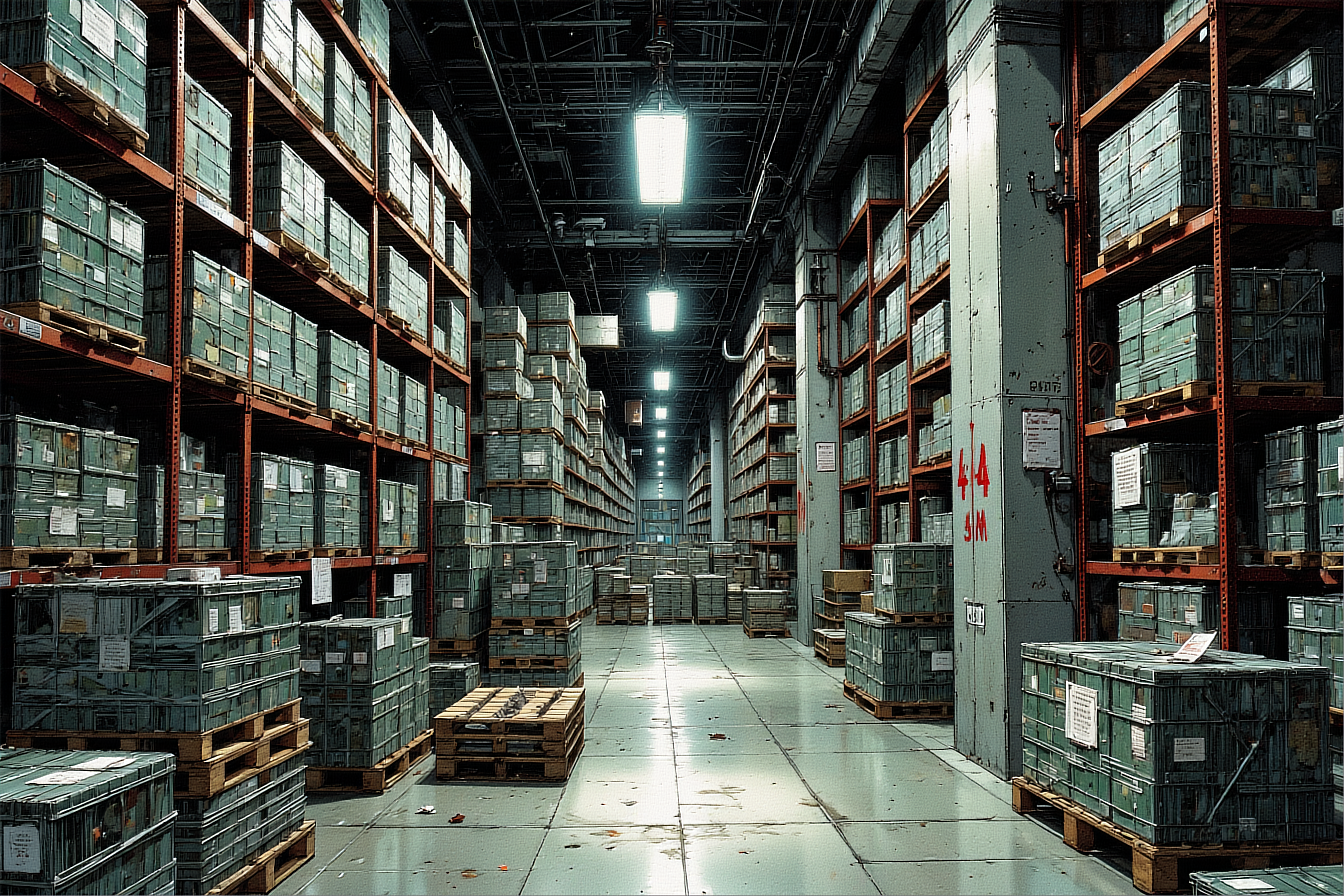
The bay was on Sub-Level 2 and it smelled the way pulp smells before it becomes pulp: old wood, old glue, old money. The card worked. The lights came up in three rows, and what they showed was a room the size of a parish church filled with pallets, and every pallet was stacked with folders, and every folder was waiting.
Waiting for pulp, is what they were waiting for. There is a queue in Corporate and the queue has a destination, and I know the destination the way a man knows the layout of a house he has been sleeping in: I have been pulled off that line myself, the TUESDAY folder, by my own base plate, in the dark, with nobody watching. Somebody saved one page once. It was me. It was the only useful thing I did in the years before I woke up, and I did not know I did it.
"They're all pending destruction," Zephyr said. He had his deck out and its little green line running along the shelf labels. "OmniNom sanitization queue. Whole wall of it. Sanitization is what they call it when they take a name and scrub it and take the scrubbing and scrub the record of the scrubbing, and this is the room where the paper version of that waits its turn."
"Dates," Luminara said. She was already photographing the shelf labels, one frame per foot of shelving, the witness working quick and dry. "Give me dates."
He read them off the dockets he pulled: overlay failure reports, thin gray sheets, the kind Corporate files when the machine that pastes one life over another does not paste clean; erasure orders for lawsuits, docket after docket with the plaintiff's name in a box that had been overprinted; sanitization manifests for OmniNom, the vendor that Corporate hires when the vendor's name itself is not supposed to be interesting. And every one of the dates, read out loud in an empty bay by a kid with a deck, fell into the same window: two weeks before the deletion and one week after, the three weeks in which the audit crates moved by night and Barry went cold and reality broke.
"The same three weeks," Pixel said. She was at the end of the row with her hand flat on the shelving, feeling the seams the way she feels all of them. "Lawsuits failing the same three weeks a vendor scrubs names the same three weeks a day goes missing. That's not a coincidence, that's a schedule."
"No bars," A1 said.
He had come in the bag too, Pixel carrying him by the neck with a folder of packing under each arm, and he had been quiet the whole way down, running his sums with the flame down to a needle, and he said it from the shelf where she set him, and his optics were up in the blue way they go when the pot is not being fond.
"I beg your pardon, sir," he said. "You have read nine Corporate documents in this room and not one Form 9 has come up. Which means the bars do not protect what you're finding here. The bars protect what you're about to find." The flame tilted the length of the room. "Deeper in, sir. I would go deeper in, and I would not enjoy it."
We went deeper in. The queue thickened, the labels changed, and at the end of the parish church of it, past a pillar with a 4 A.M. rule stenciled on it, there were pallets that had no vendor names and no dates on the shrink wrap and no docket numbers, only a stencil on the film in a typeface I have known since before I could feel it:
PALIMPSEST.
There were thousands of them. I do not mean a stack; I mean a floor of them, shrink-wrapped in rows, the film sweating slightly in the bay's bad heat, and they were not being destroyed, they were resting, the way a thing rests when the decision about it has already been made and only the calendar is left to catch up. Zephyr cut the wrap on the nearest pallet with a key off his deck and the folders came up out of it in a breath, gray-green, the color of a form that has been places, and he fanned the top six with his thumb and then he stopped fanning them and said nothing, and Luminara came over and looked, and she said nothing, and it took Pixel two seconds longer than them because what she saw was a seam and what they saw was a corner.
Every folder. Every single one, upper-left corner, a staple hole punched clean through at forty-five degrees, doubled, driven flush, the crown sitting in the paper the way a signature sits, and the burr around the entry hole turned the same direction on every one of them because a hand turns the same way every time when the hand does not know it has a choice.
I know that burr. I know it the way a man knows his own handwriting in a room full of forgeries, because it is my handwriting, and the fans of holes Zephyr was no longer fanning lined up through the pallet like light through a rifle barrel, four thousand corners and every one of them punched by me.
"Clive," Zephyr said, and he said it the way you say a man's name when you have found the man under the wreckage, and he picked me up and set me on the pallet beside the open stack so I could see the holes at eye level, and I rocked forward until my base plate hung over the edge and I looked down a row of them, angle for angle, burr for burr, my own pattern at forty-five degrees, doubled, flush, the pattern I sign everything that matters with, driven through the paperwork that erased them.
The forms that deleted two million seven hundred thousand lives and one whole Tuesday and Aether and every lawsuit in the same three weeks went out of this room wearing my signature in the corner like a maker's mark.
I had stapled the paperwork.
Nobody said anything for a while. A pot does not say anything while he is thinking, and a kid does not say anything when the thing he came to do has changed shape in his hands, and a girl with no record in the world stood at the end of the pallet row with her hood down and her mouth shut and the look on her that I have read twice before, once when she told me about the glitch-lines and once when Thistlewick named the seeds, which is the look of a person watching the last of her reasons to stay quiet run out.
"The probability," Pixel said, "that somebody else punched these."
"Say it, sir?" A1's optics went fully up. He rolled along the shelf edge to the pallet and put his light on a hole Zephyr held open with two fingers, and the pot examined it the way a man examines a thing he already knows, and then he examined another, and a third, and the blue light went back down to its needle.
"Probability that any stapler other than the one currently resting on this pallet produced this hole pattern, accounting for angle, crown height, burr rotation, entry wear, and the double strike: nil." He said it in the voice he uses for the Thursdays. "I ran it four ways. I ran it against the sample in the napkin the boy brought you and the sample on Barry's routing sheet and the sample in the glitch-lines the girl has been transcribing for months. Nil, sir. There is no second stapler. There has never been a second stapler, and I would give a great deal not to be the one telling you, since you are the only piece of furniture in five precincts who has ever been worth the coffee I brew."
I took the only course open to a witness who has just been shown his own hands: I asked for the photograph.
Luminara had been waiting without being asked, which is the mark of a photographer who has been waiting five years for a room worth standing in. She backed off to the pillar, framed the pallet floor whole: the rows, the cut wrap, the gray-green corners catching the bad light, Zephyr's hand still holding one open, and the witness took what was there, and she came back and thumbed the plate out and put it into my file the way you put a letter where it can be read at leisure.
And in my own account of it, where the plate lies in these pages as I write them, the bars came up across the photograph. Two of them, [REDACTED , FORM 9] running the long way down the rows and [REDACTED , FORM 9] across the near corner where the label on the pallet's film showed a stencil of its own, and the stencil was the last thing I wanted barred and the first thing the machine knew to cover, because the photograph had caught the routing tag and the routing tag was going to say where these came from.
I went to the drawer again. The landlord had knocked before I was ready, and I stood in the dark of it a moment, counting what is left, which is a short count and getting shorter: a laugh, a hand, a quiet, a tilt, a face, a weight, and yesterday a voice, all of them gone into bars in five weeks, and what is left on the shelf would fit in a matchbox and the matchbox would still be too big to lose.
What I had that would open a pallet of your own crimes is the beginning.
The night Barry and I met. He crossed the glass at two in the morning on a night like every other night, and he picked me up off Piper's desk by the body, and he carried me to the post with the excuse that his routing sheets wanted stapling, which they did not, and he sat me down at his elbow where the coffee rings were, and he talked. He talked to a stapler the way a man talks to a wall that he has decided is listening: fragments first, then the shape, then the hours. He never once explained why he came across the glass. He just came, night after night, until the desk was ours.
That was what was in the drawer. I could feel its edges, the way you feel a coin through cloth.
I paid.
The bars came off the photograph like film coming out of a bath, and the routing tag resolved, and it read: PULP QUEUE, ORIGIN SUB-LEVEL 4, DRM DIVISION, NIGHT POST. Batch PALIMPSEST, awaiting release. Which is to say: they had come up out of this desk's own floor, out of the night post where a guard used to work, out of the corner of a desk where a stapler used to sit and do what staplers do, which is bind what is put in front of them, hundreds a day, every day, with nobody asking and nothing in me then that knew to ask either.
Price paid: the night he and Barry met. Logged.
I tested it, because the price deserves it. I went back for the two a.m. and the excuse and the elbow and the coffee rings, and I have the fact of it the way you have a receipt for something you cannot find in the house: I know it happened, I know the date off the guard log, I know a man came across a glass partition and did not come back, and there is no night in it anymore. There is no sound of him sitting down. There is no first sentence. The partnership has a starting date and no start, and I have just written out, in my own hand, in this file, the reason it ended, and the two ends do not touch, and the gap between them is filled with a pallet of folders I bound with my own pattern while I was still the thing on Piper's desk that a man could carry by the body without asking whether it minded.
I minded. That is the thing I would have told him, if there had been anybody to tell, in the night I can no longer reach: I minded, and there was nothing in me yet with a mouth to say it, and my hands signed for what my mouth hadn't learned.
Zephyr was still holding the folder open, and he had gone pale the way a person goes pale when he is trying to think of something to say that will not be a lie and will not be nothing, and Pixel said, from the end of the row: "You can put it in the file. It doesn't clear you. It doesn't damn you either. It's just the truth with your marks on it."
And then I felt the jam.
It was in the folder Zephyr was holding. Not the hole: the hole was clean, because Zephyr's folder was one I had bound, like all of them, but when he turned it for the light, the corner had a second shape in it, a small bent thing lying loose in the fold of the staple's own making, and I knew it before he touched it the way you know a tooth that has been wrong for years: this one had not driven. Somewhere in the weeks after Barry vanished, in the middle of a batch I did not slow down for, one form had refused me. The staple had gone in crooked and bent double under the crown and stayed there, and I had kept going, because keeping going was all I was, and the page under it had never been truly bound to the stack.
Zephyr worked it out of the fold with two fingers and held it up, and it caught the bay light: one staple, bent almost flat, the color of everything Corporate prints.
"One form," he said. "One page you didn't bind clean."
I shifted my weight, and the pallet under me held four thousand folders signed and sealed and waiting on a calendar, and the bent staple went under my base plate where the file lives, next to a memo with a hearing date on it, next to a manifest with a route on it, next to the only photograph of the stack that the machine has already tried and failed to cover, and it sat there with nothing else in the room sitting with it, small as a splinter and just as hard to ignore.
A page that can be pulled. That is what it is. Everybody in this room looked at it and arrived at the same sentence without saying it, and the sentence was: if one didn't bind, one can come out.
Nobody said it. Zephyr put the bent thing in my file himself, two fingers, the way you put a man's last letter where the man can get at it, and Luminara took a second frame of the open pallet for the record, and A1 let his flame all the way down and started quietly brewing nobody coffee in the middle of a records bay at midnight out of sheer need for a ritual, and Pixel stood where she could see the door on the pillar with the 4 A.M. rule on it, which she has not stopped doing since the tavern, and the doors in Sub-Level 2 stayed shut, and the queue waited, and my file got heavier by exactly one bent staple.
Verse, since a room this quiet owes one:
My hands signed the paper and my hands signed the man, and one of them bent in the middle of both, and the page under it never learned how to hold.
We wrapped the pallet back up the way a man closes a coat over a sleeping child, and Zephyr shouldered the bag with me in it and A1 under his other arm, and we went back up past the pillar and the pulp queue and the wall of OmniNom dockets with their dates falling into the same three weeks like dropped coins, and out past her card's reader, and the light in the corridor was the light that means the building has stopped pretending anybody is working.
At the top of the stairs Pixel said, "We should tell her. Piper. That her card went into that room."
"We should," Zephyr said, and neither of them moved, and the ambiguity stood in the stairwell with us the way it had stood at her desk, and Barry's staple in my file still pointed at her cubicle with its two readings, and I carried a bent staple of my own now, and no reading at all.