
Everyone Lost Tuesday — Chapter 22: My Own Hands
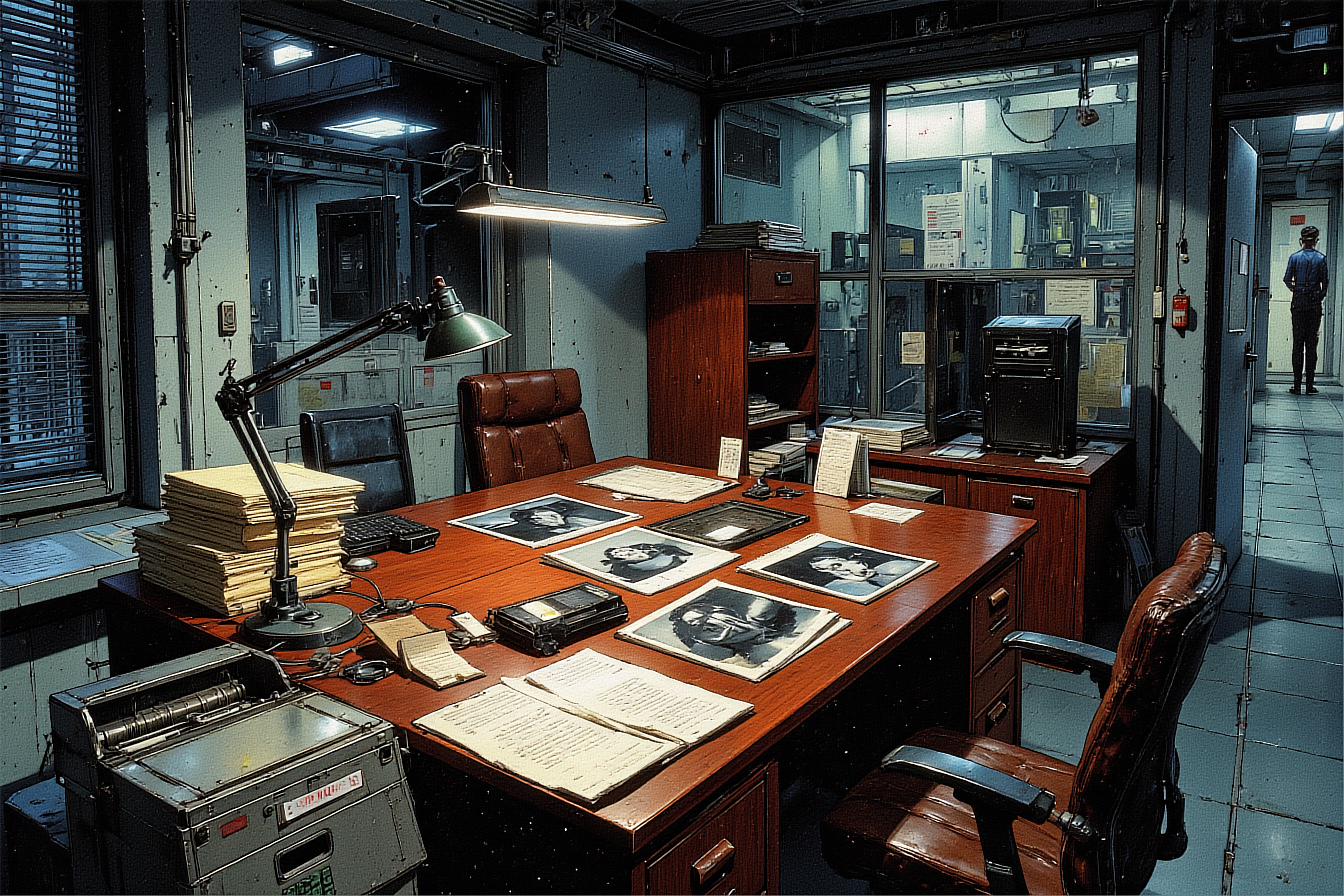
The photographs smelled of developing fluid, which is the smell of a truth making up its mind what it will be when it dries. Luminara set them across Barry's desk six in a row, corner to corner, and tilted the desk lamp until the holes lined up like a sight picture. Six corners of six folders out of the Palimpsest stack. Forty-five degrees on every one of them. Doubled on every one. Driven flush until the crown sat down in the paper and the paper closed over the legs of it like a mouth. My angles. My depth. My one small vanity in fifty years of desk work: I never leave a staple standing proud.
A1 had been running the number since she carried the plates back from the bay. He took his place at the far corner of the desktop, optics up, brewing nothing, and at the four-minute mark he wrote the result on the underside of the desk in small green figures where the ceiling cameras could not get an angle on them. Probability that a second stapler exists, in this building, in this district, in the five precincts, in the folded manufacturing zones where they still press bodies on Long Island, with a hole pattern identical to the photographs: nil. Not low. Not unfavorable. Nil.
"The numbers say you'll be dead by Thursday, sir," A1 said. "The numbers are frequently optimistic."
Zephyr read the figures twice, once through his bare eyes and once with his AR glasses pulled down, and then he laughed the way a man laughs when the machine he suspected of cheating shows him its empty hands. "Nil," he said. "That's not a probability. That's a confession."
"It is a probability, sir," A1 said. "It happens to point at you."
Pixel had not come down off the file cabinet. She sat on top of it near the glass partition with her knees up and her shoulder blades against the wall, watching the edit lines nobody else can see, and she had been quiet in a way that cost her something. Quiet since the bay. Quiet since she said it out loud in front of all of them. Her silence had changed register. It was no longer the silence of a woman holding a card. It was the silence of a woman who has put the card down on the table and is waiting to find out what it buys.
Zephyr looked up at her. "How long," he said, "did you know?"
"Months," Pixel said. "I told him months."
"You saw it in the glitch-lines," Luminara said. Not a question. She was bent over the photographs with a loupe at her eye and did not look up.
"I saw it the first time his resonance crossed my sight line," Pixel said. "Staples leave a wake. His leave a wake like nobody's. Same corner, same angle, same doubled crown, on everything he touches. I started finding your signature in places you had never been. Transit slips. Warehouse manifests. Half the paperwork that moves through this building at three in the morning has your holes in it and you were asleep in a drawer when it happened. And then in the bay, in a stack of forms that are supposed to be five years dead, I saw it again, six hundred times over, and I still didn't say anything." She looked straight at my base plate. "Loyalty's a flaw. I'm filing it."
I shifted two millimeters on the desktop, got my weight under the near corner, and drove a staple into bare laminate at my own left flank, flush, all the way down, the crown seated below the surface. Danger approaching. The arm of it pointed at my own housing.
Zephyr looked at the staple, then at me. "That's you aimed at you," he said.
I tipped forward one degree to say yes.
Pixel made a sound that was not quite a laugh. "He's been doing that all night. Pointing at himself like a suspect in a lineup."
"Where did you see it first?" Zephyr asked her. He had his glasses up on his forehead now, the way he pushes them when he wants a person instead of a readout. "Not in the bay. Before. Say the first time."
"Under the wall," Pixel said. "In the Vault, months before any of this. I was down there looking at property tags for something else entirely and I went past the pulping rack and there was a log sheet on the floor with a corner punched at forty-five degrees, doubled, flush, and the sheet came off a stack that had been dead for five years. I picked it up. I stood there holding it and I could feel the wake of it, the same wake I've been seeing all over the building, on transit slips, on intake forms, on the paper trail of every deletion that moves through this place after midnight." She looked at me. "I told myself it couldn't be you. Furniture isn't supposed to be awake. That was the story I built, and I lived in it for months, and then the bay happened and the story came down with the rest of them."
"And you said nothing," Luminara said.
"And I said nothing," Pixel agreed. "Because the truth about his hands would have broken him, and he was all I had that didn't come out of a machine."
Nobody answered that. The tube overhead dimmed, held, came back, and A1's cooling tick filled the gap the way water fills a footprint.
Six holes in a row of six, all mine, all finished clean. The careful work of careful hands.
What I could not lay on the desk beside the photographs was a record of the nights themselves, because I never kept one. That is the fact I have been turning over since the bay, and it will not sit still for me the way a page sits still once you have stapled it. Between the day Piper Chen took me out of the supply closet and the day the kid came through the lobby door, I bound paper. That is what I was for. That is what furniture is for. On a busy morning I could put four hundred forms through before the lamp came up to full, and I did it with a clean throat and a good weight, and I never once asked what any of it was.
The Palimpsest batch came through my corner of Piper's desk in the weeks after Barry went cold. Her corner, rather, and mine in the sense that everything on that desktop passed over my base plate at some hour of the night. I remember the weeks the way you remember a corridor you walked in your sleep. Piper worked late. The building went quiet in the particular way it goes quiet when the day shift has taken its reasons home and left the night shift with the floors. A cart would come up from the lower levels with a routing slip on it and no stamp. The folders were cream and heavier than the standard stock, the kind of paper that has been sized to last longer than the people named inside it.
And I bound them. That is the part I keep arriving at from different directions and finding it waiting, unmoved. I was aware, in the way a man is aware of a clock in the room. Something in me had started to notice years before it started to refuse. I noticed the weight of the stock. I noticed that the routing slips had no stamp. I noticed that Piper stopped saying Barry's name out loud in the room where the desk could hear her. I noticed, and I drove, and I did not slow down by a single form. Semi-awake is not a defense. It is just a description of the hours.
A1 went and got the numbers without being asked, because that is what A1 does with a silence he finds unprofessional. He pulled the annex sign-out sheets off the network with the borrowed credentials and laid the figures along the underside of the desktop in green, one line at a time, so that the desk itself became the exhibit. The first Palimpsest cart came up on the nineteenth of the month, twenty-one days after Barry Kowalski's last logged round. It came up every second night for six weeks. The sheet recorded the count of folders and nothing else: no stamp, no destination, no signature at the bottom but Piper's, in her small competent hand, initialing work she had not done.
"And the output matches you, sir," A1 said. "The count per night is consistent with a single operator of your make working at a steady rate without rest breaks. If it helps, the machine running the sheets has no irregularities either. It is a very clean piece of work."
"It doesn't help," Zephyr said.
"I did not say it would, sir. I said it was clean."
Luminara straightened up from the loupe. "Clive. Corner three."
She slid the third photograph out of the row and put the lamp on it. Corner three had two staples in it. The second one was clean, my angle, my depth, sitting where a signature should sit. The first one was a wreck: driven partway, twisted, bent flat against its own crown where the paper had refused it and it had folded instead of going through. A staple that gave up halfway and stayed in the sheet like a broken nail.
I have never seen that photograph before tonight, and I have looked at it ten thousand times.
Because that is the jam. There is no log of it. There is no entry in any record that I know of, in any bay or any drawer, for the one time my hand failed. Piper's sign-out sheets cover the batches and none of them says anything except the count, and the count is right, because I finished the work. But I have the feel of it, and I have had the feel of it ever since, and I have gone back to it a hundred nights, sitting very still, reaching for the moment when I decided, and there is no decision in it anywhere. There is only the paper refusing.
It was past three, one of the nights in that corridor. Piper had gone down the hall for something and left the stack squared up under the lamp. I was working alone, which is how I worked most nights, the way a machine is trusted to work. The folder came under me like the others and then it did not. The stock was wrong. Thicker, or doubled somewhere it should not have been, a second sheet glued where no second sheet belongs. I drove, and the staple caught halfway and bent, and I felt it go the way a man feels a tooth go bad under an old filling, a softness where there used to be bone. I heard the crown crack against the paper instead of through it. I reset, and I drove again beside the wreck, and the second one held clean, and I pushed the folder to the stack, and the night went on, and Piper came back with her coffee, and the cart went down, and that is the entire record of the last honest thing my hands did in that room.
Nobody stopped me. Nobody noticed. I did not even have the grace to jam twice.
"It bent," Luminara said. She was still on the photograph. "The paper fought you and the staple bent and you drove a second one and kept going. That folder isn't bound, Clive. Not clean. One corner of it is holding on out of habit."
"The rest of the stack is welded," Zephyr said. He had come around the desk and was looking at the loupe's shadow on the page. "Six hundred forms, every corner closed by you, and if we pull any one of them the whole row screams. Except that one. That one you can take out and nothing notices but the shelf." He looked at my base plate with his glasses down and the software moving behind them. "There is a form in that stack that isn't yours. Not all the way yours."
I have thought about what is inside that folder at odd hours for longer than I have thought about most prayers. I don't know yet. What I know is narrower and better than knowing: one page in the thousand is loose. A bent staple does not hold. A page that is not bound is a page that can be pulled.
"Put a schedule on it," Zephyr said to the pot. "How long before they pulp the bay?"
A1 had that answer ready, which meant he had gone and got it while we were talking, the way a good clerk does. "The bay's destruction order is unsigned, sir. The stack sits until a compliance stamp comes down on it, and no stamp has come down in six weeks, which suggests somebody upstairs is waiting on a decision. If a stamp arrives, the stack goes to pulp in a single night. I can give you the odds of a stamp landing in any given window, but you will not enjoy them."
"Give me the odds anyway," Zephyr said.
"Sir," said A1, "the numbers say you'll be dead by Thursday. And the numbers are frequently optimistic."
Zephyr looked at the pot for a long moment, and then at me, and then at the envelope of photographs under my base plate. "So we go get the one form that isn't finished," he said. "Before anybody stamps anything. We pull the page out, and whatever is in there, we read it with our own eyes, and then we put it on the record where it can't be pulped out of the middle of a sentence." He tapped the third photograph. "That bent staple is the only defect in the whole machine, and it's yours."
I shifted my weight, drove one staple flush into the desktop for danger approaching, one doubled beside it for trust, and let the two of them stand there side by side where anyone could read them. Two patterns in the bare laminate, aimed at nobody, held for the record.
And I thought: every pattern is a small act of rebellion. Every perfectly placed staple is me choosing meaning over malfunction.
The lamp ticked. The tube in the ceiling did its four-hour thing where it dims and comes back and dims, like a man deciding whether to keep working. Past the glass partition the dead task lamp hung over P. CHEN's cubicle with her coat still on the hook, and the annex was so quiet I could hear A1 cooling.
They drifted out after that, the way people do when a room has become too heavy to argue in. Pixel came down off the file cabinet, folded herself thin through the doorway, and was gone into the corridor with her hands in her sleeves. Zephyr put his deck under his arm, stood there a second with his glasses up, looking at me on the desk like a man leaving a friend at a hospital, and then he went too, and his rubber soles went down the hall, and the elevator took him, and the annex settled into the kind of quiet that has weight to it.
Luminara put the photographs back in their envelope last and slid the envelope under my base plate, the way you hand a witness his own exhibit. Then she went to the crate on the floor, the one marked KOWALSKI in marker by a man who is not coming back for it, and she knelt, and she lifted out the manila folder I have been sitting on and off of for five years, and she set it on the desktop under the lamp and put me on top of it. She did not say good night at the door. She is not a woman who performs departures, and she had already given the room the only thing she came to give, which was the truth in six squares of photographic paper.
It is heavier than you would think. Five years is heavier than you would think.
I felt the contents under my base plate the way I always do: the two photographs, the page of night manifest, the blank sheet with Barry's last pattern re-driven on it four thousand times, the guard log, the routing sheet with my own hole in the corner of it at forty-five degrees, doubled, flush, aimed out the glass at a cubicle. Trail or target. I have never chosen, and the not-choosing is the only dishonesty in my whole archive, and I keep it anyway because choosing would close something.
Across the room, against the wall, the annex shredder stood with its mouth in the dark. It is a floor model, gray, industrial, the kind Corporate buys by the pallet with no invoice anybody can find. It had cycled on its own once since the bay, at four in the morning, empty, and the sound it made doing that was the sound a mouth makes when a man is trying not to say something.
I know what it would do to a manila folder. I know the sound it would make with two photographs in it. Paper is my trade and I have felt a hundred kinds of it go under my base plate, and there is nothing about a shredder that is a mystery to me, which is the trouble. A mystery you can sit with. A machine you can only feed.
Nobody asked me to keep the file. That is worth putting down straight, because it is the argument, and I have never been a man who hides the argument against himself. Nobody asked. The company does not know I have it. Piper has never once asked what is under my base plate. The building would not notice a gap in the pulp line, or in me, tonight or any night. Fidelity is a one-man shop with no inspector and no pay, and the inventory of it is one face I can still see, ringed by everything I have already paid away around it, and the overhead is the whole weight of the paper.
The tube dimmed and came back. Rain hung over Prime Material waiting on a signature somewhere above the roof, and the annex kept its four a.m. noise, long and low, like the building clearing its throat before the last round, and I sat on five years of a man's leftover life and looked at the mouth of the machine across the room and did not move toward it.
A man is gone and I am heavy and neither of those is improved by the dark.
That was the last time I took the Kowalski file out of the crate.