
Everyone Lost Tuesday — Chapter 23: The Quiet Case
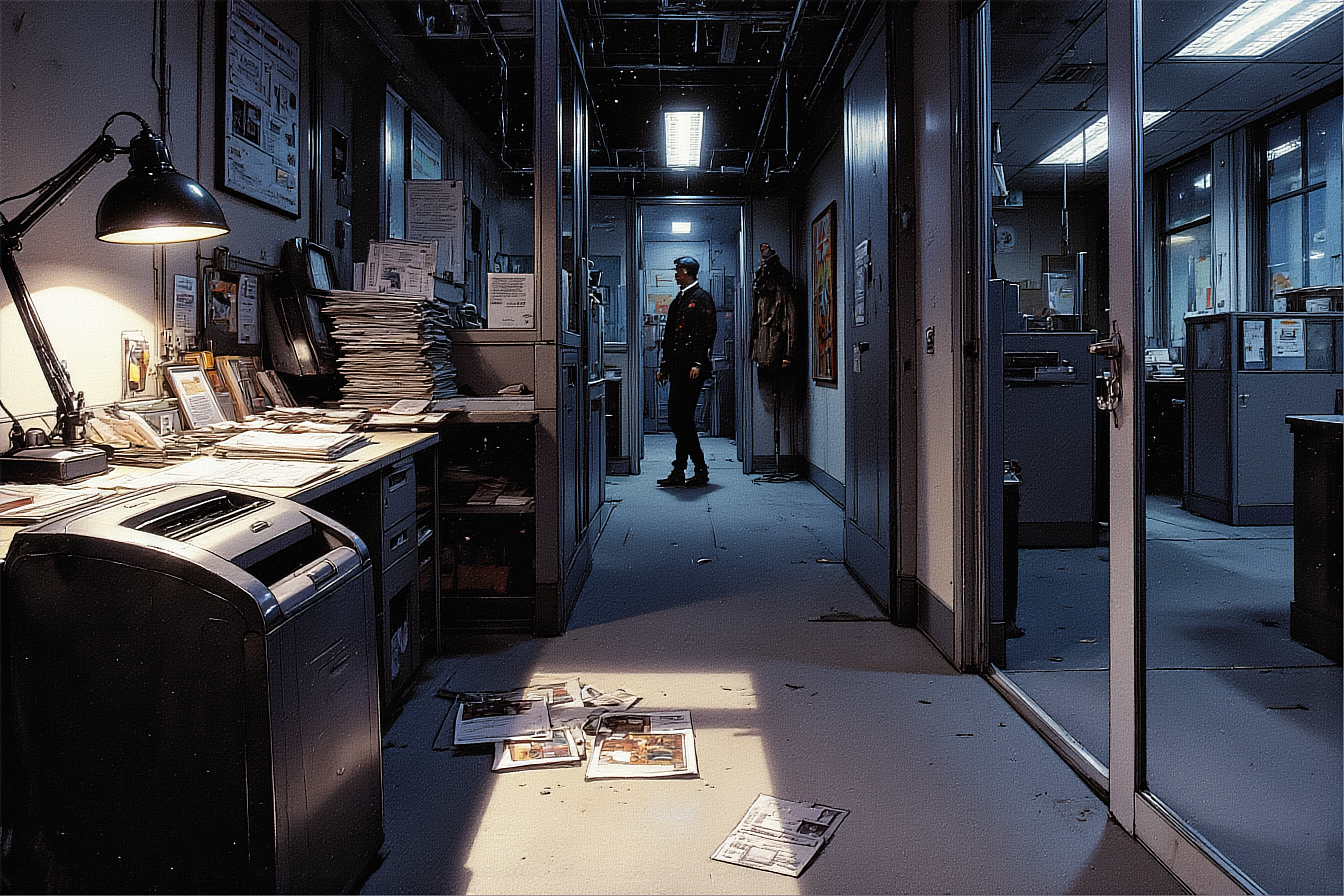
At four in the morning the annex shredder hummed on standby with its mouth in the dark, the tube above the desk had settled into the long dim it holds between decisions, and I was alone with the file.
A1 had his optics down to a single green ember inside his housing, brewing nothing, saving nothing, which is the pot equivalent of a man sitting with his eyes shut in a room he intends to stay in. The lamp Luminara had tilted was still on, angled at the envelope of photographs under my base plate, and beyond the glass partition the dead task lamp over P. CHEN's cubicle hung in its usual darkness with her coat still on the hook, and the rain over Prime Material had still not been cleared by anybody.
I made the case for letting it die the way I make every case: out loud on the inside, where there is no one to interrupt.
The case was good. That is the first thing to say about it, because a bad argument would have been easier to sit with. The case went like this. A stapler has no obligation to be a widow. The company does not know the file exists. Piper has never asked what is under my base plate, not in five years of carrying me back and forth across the glass like a library book, and if I put the folder in the crate and sat on the desk the way furniture sits when it has no business, nobody would come down the corridor asking. The quiet would arrive the way it arrives in this building, without a clerk and without a sound, and a man could live in that quiet for the rest of his service life. That is what a settlement looks like from the inside of one: not an offer, just a stop. You stop, and the machine stops noticing you, and the second box gets filled in with nothing at all, and the nothing is very clean.
Nobody asked me to remember. That was the second count, and it was the strongest one, and I put it up first the way you put up your best exhibit. Barry never asked. He left the routing sheet and went out on a round he did not come back from, and he did not look back at the desk, and he did not leave a note asking a stapler to hold anything for him. The man was a professional. He knew what the building does to a forwarded mail. If he had wanted a monument he would have stapled one, and instead he pointed, and a pointed staple is an instruction, not a commission.
And the price. I have been paying for pages since the Vault, and the trade is honest and the trade is permanent, and a man who intends to keep trading has to look at what he is trading from. I looked. Under my base plate I had a stack of a man's leftover life: a crate's worth of forms, a guard log, two photographs, a night manifest, a blank sheet with a pattern on it four thousand times over. And I had his face. That was all that was left of him that was not already spent, and it was the most expensive thing in the room, and the machine humming against the wall was offering me a way to stop paying.
Eleven feet of carpet lay between the desk and the shredder, and a drop I would not survive at the end of it, and no man in the room to carry me across. I have been moved by people who do not think to check what they are moving, but you need people for that, and at four in the morning the annex had none. It is a detail worth noting in my own defense: I did not refuse the machine. I simply could not reach it.
The file is patient. Files always are.
I looked at the manuscript instead, the account I have been setting down since the Vault, in my own voice, and I understood that if this was to be the last page it would have to be complete, and a page about a man with no face in it is a page about nobody. So I put my attention on the place where the face goes, and the page came back the way pages come back now, with three bars standing across it, level and black and patient.
[REDACTED , FORM 9] [REDACTED , FORM 9] [REDACTED , FORM 9]
Three bars over the only part of him the company did not already own.
I have learned the mechanism the way a man learns a toll road. You put something of your own under the staple of your attention and you press, and the bar gives, and what it gives you, it gives you by taking. There is no clerk to appeal to. There is no reduced rate for old customers. I set my attention on the bars and the price came up in me all at once, without ceremony, in the flat voice that prices use: the face. All of it. And beneath the number, in the small print that lives behind my own teeth: eyes last.
I held still for a long time after that.
I could have closed the page unfinished. I could have ended the account at the jaw of a thing and left the rest of the man to the dark, and the dark is where most files end, and nobody would have marked it as a failure. I could have written him from the outside: height approximated, build from the guard log, coloring from two photographs I have looked at ten thousand times. I could have written the crate instead of the man.
That is the choice the bars offer, and it is worse than it sounds, because a man who writes the crate instead of the man has already paid, and paid, and gotten nothing for it.
So I traded.
The bars thinned the way they always do, and what came under them was not a photograph and not a sentence. It was my own remembering, arriving feature by feature out of the place where I had kept it safe for five years, and I understood the terms as I went, which is that each piece I set down would be leaving as it landed. I wrote the jaw, and the jaw went. I wrote the mouth, the way it set when he was doing his thinking out loud at a desk past midnight, and the mouth went. I wrote the line of the brow and the ear and the scar tissue at the corner where some previous job of his had put it there, and each one came through my attention like a coin through a slot, and each one was gone the moment it was spent.
The eyes came last. The eyes held for one line longer than everything else, long enough for me to see that they were tired in the specific way a man is tired when he has read a manifest he should not have read, and then they went the way the rest of it went, and the sentence closed over the place where they had been, and the page was finished.
Price paid: Barry Kowalski's face. Logged.
I reached for him then. A man reaches for a memory the way he reaches for a word at the tip of his tongue, with a kind of confidence that the thing is there and only mislaid. I reached, and the reaching went through nothing, and I came back with my hand empty, and I thought: that is the first time. And I reached again, more carefully, the way you check a drawer twice, and again there was nothing in it, only the drawer, only the wood. And the third time I understood that the price had been paid in full and that the trade does not have a reversal window, and I sat in the middle of my own finished sentence with nothing behind it.
They take the eyes last, always, as if a man could still be filed once there is nothing left in him to see.
I went looking for him in the exhibits, which is what a witness does when the witness fails. The two photographs under my base plate are photographs of paper: a corner of a routing sheet, a corner of a night manifest, staple holes and ink and nothing else, and I went through them both twice anyway, holding the lamp's angle down onto them with the tip of my housing, hunting the reflection of a man in the gloss of his own paperwork. The guard log has his round times in it, 02:41 and 02:58, and his signature on the back of the page, and I read the signature the way I have read it a thousand times, for the pressure of the hand that made it, and the pressure was there, and the hand was not. The crate on the floor has MARKER on it in a print I would have known across a room, and I looked at the letters, K, O, W, A, L, S, K, I, and the letters stayed letters.
A name is never traded. That is the one rule the trade has honored without exception, and tonight, for the first time, I understood what a mercy it is, and how small, and how little it does for a man at four in the morning with an empty shelf behind his eyes.
Barry Kowalski's face is gone. It is gone the way the voice is gone, and the hand, and the tilt of the head, and it will not come back on a good night or a bad one or in a dream I am not sure I have.
Because I have tried to build him since then out of the parts I have left. That is what a man does with a loss: he goes to the shelf and works with what is on it. The two-degree tilt went to a bar across an impostor's name. The sound of his voice went to a number in a monk's memo. His left hand and the watch went to the first bar in my own account. The weight of his hand lifting me went to a fire in a greenhouse. The laugh went in the Vault. The night we met went into the forms themselves. I went down that shelf tonight, item by item, the way you check a register at closing, and every slot was empty, and the shape they used to make together is not in any one of them. You cannot assemble a man out of receipts. That is the plain lesson of my trade, sixty years of binding other people's papers into stacks that add up to nothing, and I did not believe it about a person until I tried it on one.
What is left is paperwork. A crate with his name on it in marker. A log with his last round in it. A routing sheet with my own hole in the corner, at forty-five degrees, doubled, flush, aimed at a woman across the glass. Trail or target, five years of not choosing, and now there is no one left to ask, because the only man who could have told me which is a man I cannot see.
It gets said in the trade, in the parts of the trade that talk, that you pay grief for the truth. That the truth is worth it. I have written three hundred pages since the Vault and I can tell you the saying is wrong in both directions. Nothing here costs grief, because the grief is not the price of the case. The grief is the case. The file is what fidelity looks like when the man is gone, and a man who closes it has not stopped paying, he has only stopped getting anything for it.
So I did not shred anything. I could not have, alone, and I would not have, anyway, and both of those are true and I am content to carry them together.
I had the finished page in front of me and the open folder under my base plate, and I took the page in the only grip I have, which is weight, and I dragged it to the edge of the folder and set myself on the corner of both, and drove my signature through the two of them together: forty-five degrees, doubled, driven flush until the crown sat down in the paper. Caution. Trust. Danger approaching. The whole alphabet of what I have, laid across the last page of a man's face, binding the account to the file where nobody can pull one loose from the other.
The shredder hummed its standby hum against the wall, patient as a colleague.
Then I heard the lobby door at the end of the corridor, the one they disabled after the audit, and rubber soles coming down the hall at the speed of a man who has thought better of going home, and Zephyr came in out of the held rain with two paper cups in one hand and his deck under his arm, and he stopped just inside the tape on the floor and looked at the desk, and at the lamp, and at the page stapled to the folder with my pattern in the corner of it.
He read it. He read it the way he reads everything, quick, with the glasses down, and whatever the three patterns said to him together he did not say out loud. He set one of the cups on the desk in front of A1, where the pot could look at it if the pot ever wanted to, and he kept the other one, and he did not drink from it either.
Then he lowered himself to the floor with his back against the crate marked KOWALSKI, and put his deck on his knees, and stayed.
Nobody said anything. He had bought two cups because he had bought two, the way you do when you have been walking and thinking, and the second one steamed on the desk in front of the dark pot where A1 could look at it if A1 ever wanted to, and neither of them was drunk, his or the pot's, and the room got cold enough that the steam went thin and then stopped.
The tube did its dim and its coming back. Somewhere above the roof the rain waited on a signature, and the file stayed open on the desk with my staple in the corner of the last page of it, and the man whose face was on that page could not be found in the page or out of it, and we sat with that, the kid and the pot and the stapler, in the dark of the annex at the hour when the building clears its throat.
The file is open and the man is closed, the crate is full, the crate is his, and the crate does not know he is not coming.
A closed grief is a deleted name, and I have watched this company delete better things than mine.
He did not go home. He sat on the floor against the crate with his coffee going cold on the desk above him, and he did not ask me what the pattern meant, and he did not look at the page again, because he had read it the first time and reading it twice would have been a way of asking, and he had decided against asking sometime in the corridor on his way back. So he stayed, and the file stayed open, and neither of those was asked for by anybody, which is how I know they are real.