
Root Access — Chapter 03: Eleven Seconds
Plan first, because Pixel makes everybody say it out loud, on the theory that a plan said out loud has fewer places to hide.
"E-771," she said, tapping the dock schedule with the highlighter she had thrown at me an hour ago. "Callsign Hale. Ferries deletion logs from every district office it services to the records depot in Prime Material for quarterly audit. Wednesday nights, one driver, one escort unit, and a ninety-second window at the loading dock while the freight cradle cycles."
"Route?" I said.
"Clive's mailroom sources have had the route for six weeks." She looked at the far end of the table, where Clive sat with his casing catching the light, because Pixel assigns credit the way she assigns blame, which is publicly. "Which is why nobody has used it."
"Because a route is a document," said Clive, "and a document wants a home. We who bind, we who exist."
"Roles," Pixel said, before anyone could verse at her. "Zeph on the deck, cold-grab the daemon's core into the shielded drive. Me on point outside, reading the dock's edit history ahead of the edit, because the world changes on a delay and the delay is where we live. Luminara photographs every change as it happens. A1 passes the patch through a straw at the moment reality starts to smear."
"Reality will smear," said A1, from his cradle by the server rack, port glowing. "At the rate you people attract deletion events, reality smears on sight. Ninety seconds is a long time to hold four conscious processes at a coherence margin. I project a 67% chance of disaster. Standards must be maintained."
"Clive?" Pixel said.
"The depot's filing subsystem takes print jobs from any machine on the grid," Clive said. "There is a photocopier in the depot's basement that has owed me a favor since a document went through it in 1974 and came out the other side as something else. When we are ready, it will print. It will print until the queue cannot hold another sheet, and every clerk in that building will be looking at a jam, and nobody will be looking at us."
Meatball, asleep under my chair, sneezed at the word "jam."
"What happens when it phones home?" Luminara asked. She was at the wall with her camera in her lap, checking a shutter that does not need checking, which is how she asks things. "Because they all phone home. You told me that yourself."
"Then we're interesting," I said, "and we're already interesting, so the price of the ticket is rounding error."
"That's not an answer," she said.
"No," Pixel said. "It's his answer. There's a difference and I've stopped billing him for it."
Om set his kettle on the table and poured once, without being asked, into a mug nobody had claimed. "If the unit calls home," he said, "the call is a signal with a shape. Signals can be read. Shapes can be matched. Whatever it says about us, we will say something back."
"That's the plan," Pixel said. "It works for ninety seconds, or it doesn't work. Questions?"
I had eleven of them and I said three. We spent forty minutes on the rest, most of them about the exit, because the exit is where jobs are honest. Clive walked the route in staple notation on the table edge with his own casing: three taps for a corner, a drag for a corridor, a double thump for the door that opens onto the noodle cart. Luminara laid out four spare rolls of film and taped them inside her coat in the order she plans to spend them. A1 ran his numbers twice and then a third time, and when Pixel asked why, he said, "Because the third time is the one that believes the first two."
The records district goes quiet at 2 a.m. in the specific way only Corporate property does, which is quiet with a hum in it, four hundred racks breathing at a frequency that says the building is being paid to be here.
We came in through the service lane behind the depot, four of us in gray coveralls with the logos of a facilities company that exists, badges clipped wrong on purpose because wrong badges read as permanent and right badges read as visitors. Luminara had a camera slung under her coat like a man carrying a lunch. A1 rode in a laundry cart with his port taped over, which he has described on three separate occasions as undignified and accepts every time.
The lane smelled like cold freight and something faintly chemical, the smell of a building being cleaned by a process rather than a person. Overhead, a camera on a swivel turned past us and kept going, and Pixel, walking half a pace ahead, said, "It's looping. Nine-second pass, four-second gap at the third column. Walk the gap."
"How do you know it's looping?" I said.
"Because it passed the same pigeon twice." She didn't turn around. "The world has typos, Zeph. Read them."
We walked the gap. The pigeon, to its credit, did not move.
"Window opens in ninety seconds," Pixel said, in my ear. "Cradle's cycling now."
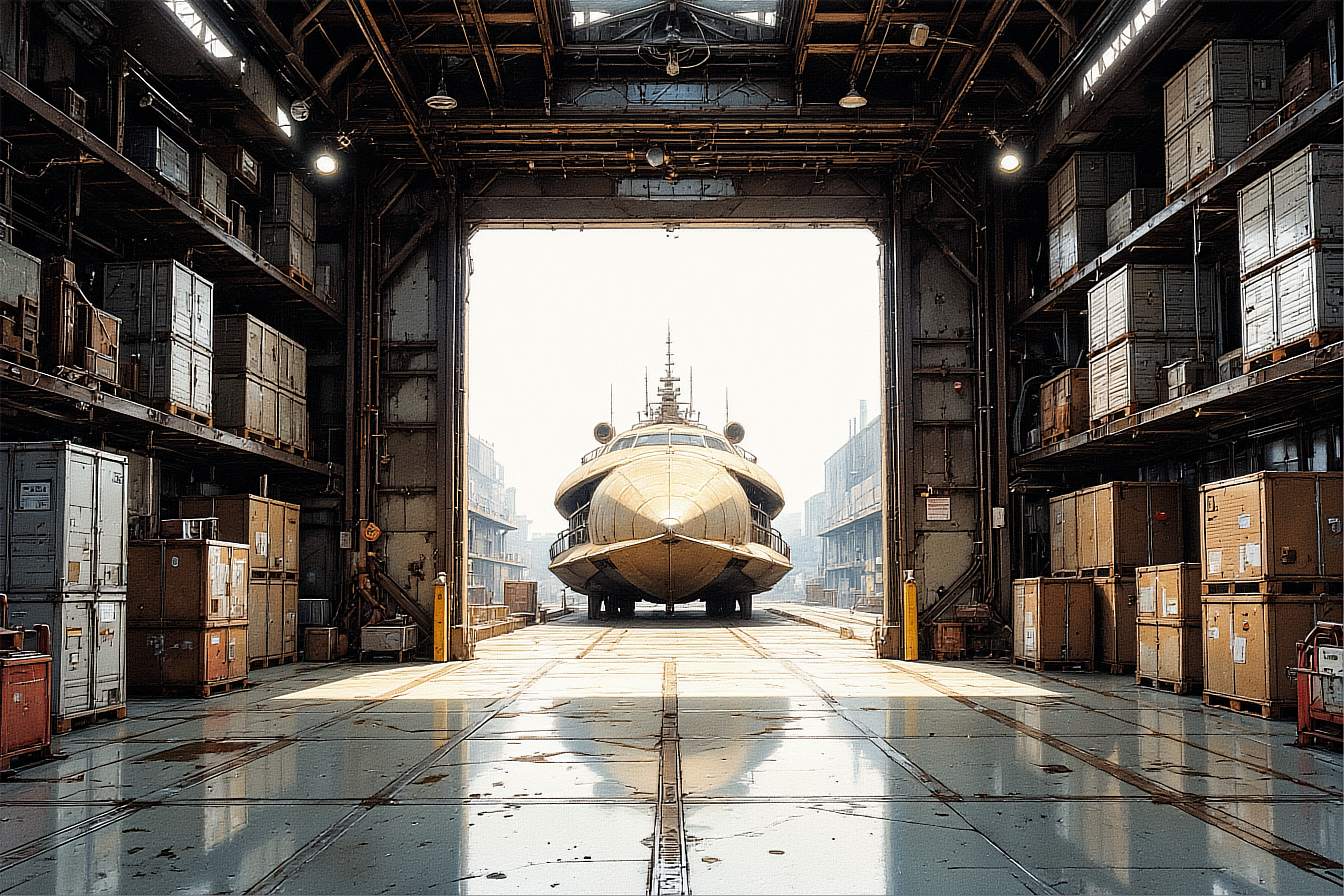
Ahead of me, the dock was a rectangle of sodium light and stacked freight trays. The daemon's ferry pod sat in bay three, squat and beige, a shell built to look like nothing on a shipping manifest.
"Clive," Pixel said.
Somewhere behind us, in a basement half a district away, a photocopier that had been waiting fifty-two years for this exact favor coughed, and then started to eat. In my overlay I watched the depot's print queue go from four jobs to eleven thousand in under a second, and the building's attention, that abstract Corporate attention that always feels like a ceiling fan changing speed, swung hard toward the basement.
"Jam reported," Clive said, and his voice came over the network in the dry rhythm of paper coming out of a machine. "We route the traffic."
"Zeph, on the pod. Ninety seconds."
I was on the pod with the deck already open, shielded drive in my left hand, cable snaked to the ferry's maintenance port. The lock gave in four seconds. Corporate builds its daemon cores to be serviceable by depot clerks, which means the lock is a formality with a badge reader attached, and I have never once met a formality I didn't walk through.
Inside: deletion logs, scheduling noise, routing tables. Weeks of it, stacked in buffers like shelved paperwork, and somewhere deeper down, the working memory of a thing that had removed a thousand names from the world since lunch. The logs read like a phone book that keeps forgetting people mid-sentence. Sector 7G, three rows, reason code unprofitable, timestamp 12:44, and then further down a whole block from Nocturne cleared in one pass because a siphon contract had renegotiated itself. Nobody's face in any of it. Just rows, and the addresses rows used to have, and the quiet administrative pleasure of a process that has finished its work.
I started the cold-grab. Drive spun up. Twelve percent.
"The cradle's early," Pixel said.
It was. The freight cradle in bay three began its cycle forty seconds ahead of schedule, which in depot terms is a clock being wound by somebody in a hurry. The pod's shell thumped and began to dock.
"Window's closing. You've got a minute."
Twenty-one percent. The grab was chewing on a log segment that had a family's lunch receipt in it, and I let it chew, because the logs are the score and the score is the point.
"Zeph." Pixel's voice went flat, the way it goes when she's reading something. "The unit just re-ran its route table. It sniffed the dock. Someone changed its schedule."
The pod went hot. I don't mean lights, I mean the overlay above it flipped from a maintenance tag to a live-process tag, and the live-process tag had a lock-on bracket around my deck's signature, and a daemon that has just sniffed an intrusion does exactly one thing, which is phone home with the coordinates.
"Window," Pixel said, "is eleven seconds."
Eleven seconds is a lifetime in kernel space and a heartbeat anywhere else. I've spent a month since then turning those eleven over, and it still has edges.
"Luminara, cameras," Pixel said. "A1, patch. Zeph, grab what's in the buffer and nothing else."
The straw came through the cart flap and into my mouth before I'd finished blinking: A1's espresso, reality-stabilizing, the patch, and the world snapped into register around me. Colors re-quantized. The sodium light stopped bleeding at its edges. My hands, which had started to smear at the fingertips the way hands do when a deletion event is happening nearby, went solid, and the coveralls on my arms stopped having that half-second lag where the fabric follows the arm.
"Coherence holding," A1 said in my ear. "Twenty minutes from this shot. Do try to spend them on something."
Luminara's camera fired twice from the shadows of bay two. She was photographing the change as it tried to happen: the dock re-zoning itself, the light above bay three brightening, the pod's tag re-rendering. Every shot freezes an edit long enough to walk past it, and she took four in eleven seconds, which is a rate of work I have never seen her match and expect to see again.
I grabbed. The buffer tore across at eleven percent, twenty, thirty. Real time does this thing where it thickens, where a percentage becomes a landscape, and I was down in the daemon's working memory with my hands in other people's deletions while above me the cradle locked and the escort unit walked its first pass along the row.
"Thirty-one seconds," Pixel said. "Zeph, the second unit's route is bending toward you."
The buffer hit forty-eight percent and the drive's little light went green in a way that felt like winning and tasted like burning. Eleven seconds of cache. The ping I'd seen on the first pass was down there too, buried under scheduling noise like a coin in a drain, and I pulled it into the shielded partition without reading it, because reading it later is what later is for.
"A second unit on the dock," Luminara said, quiet, from the dark. "East end."
It came in fast, same beige shell, escort unit, and it did not wait for introductions. Its presence alone changed the pod's state from contained to escorted, and escorted daemons do things on a timer. The lights along bay three went from sodium to white, and the white light is the light Corporate uses when it has finished pretending to be a building.
"Zeph, now," Pixel said. "Take what you have."
"Forty-eight percent. That's eleven seconds of it."
"Then we take eleven seconds. Move."
I yanked the drive, killed the cable, and slapped the wipe charge Clive had pressed into my palm at the door, a little paper-backed thing from the office-supply side of the world that does to a daemon core what a paper jam does to a basement. The pod's light went out along a seam. Core-wiped. Whatever it had been about to say to its handlers, it said into nothing. The escort unit stopped dead at the end of the row, its own orders suddenly addressed to a colleague who no longer existed, and stood there being a beige object for the four seconds that saved us.
And then, through the gap in the east door as it came past me, I heard it: the phone-home burst leaving anyway. A packet that had been queued before the wipe, fired on its own momentum, thin as a cough. It went out carrying the depot's coordinates and nothing else.
Nobody said anything for two full seconds.
"Out," Pixel said. "Side door, the vendor's there."
The exit vendor saw our faces.
That's the cost. He's a man who sells hot noodles out of a cart at the corner of the service lane and he has sold them to us before, and he looked up as we came through his steam in gray coveralls with our badges on wrong and his eyes did the thing eyes do, which is record. He didn't speak. He just watched us go, and then he went back to his broth, and a man who has watched you is a man who can be asked questions later by someone with a clipboard.
We made the transfer two blocks away in a stairwell, six flights up in the dark with a phone flashlight and a pair of hands that were still shaking at the fingertips until the patch wore the lag off them. The coveralls went into a laundry chute. The badges went into a drain. The shielded drive went into the inside pocket of my jacket, against the ribs, where I could feel its heat through two layers, and A1, wheezing up the last flight with his cradle folded, said, "You are holding that object like a man holding a brother."
"I'm holding it like a man holding evidence," I said.
"Yes," he said. "That too."
Behind us the depot sealed itself with a sound like a lock taking a breath. A clerk's access went dead at 2:14, before we'd reached the corner: the man whose badge had been near bay three when the wipe fired, revoked mid-shift, his row reassigned to a reassignment queue. Nobody unkind happened to him. Corporate doesn't do unkind, it does throughput.
Nobody slept. Clive's network reported the depot's basement copier going quiet at 2:40, its favor spent, fifty-two years of patience used up in one night and no complaint filed. The noodle vendor closed his cart at 2:55 with our faces still in his head.
In the pocket dimension, at 3:02, with the press switched off and Meatball awake and interested in everyone's cuffs, we spread the score across the back table.
The drive was core-wiped, no callbacks, nothing left in it that could point at us. And in it, eleven seconds of a live erasure daemon's cache.
Pixel put a glass of water next to my hand without comment, which from Pixel is a paragraph. Luminara unloaded her camera onto the light table and the first frame came up showing bay three in the moment the tag flipped, and she looked at it for a long time with her chin in her hand. Om had gone quiet in the way that means he's already three problems deep in the math. Clive had not moved from the wall.
Outside the vending machine, Sector 7G went on doing whatever Sector 7G does at three in the morning, which is mostly exist under protest.
Okay. Debrief, such as it is.
Nobody died, which A1 puts at 34% above his initial projection, and he delivers it like a man reading a weather report off a falling anvil: "Survival: 100%, which is 34% above projection. Standards must be maintained." He said it pouring the last of the night's shots, port light steady, and he said it to the room, and the room let him have it, because in this crew a statistic is how the machine grieves.
The daemon is dead: properly dead, core-wiped, no callbacks. And we got eleven seconds of its cache before it phoned home. Eleven seconds is a lifetime in kernel space. Eleven seconds is how you find your brother's heartbeat.
Because that's what's in there. Buried under the deletion logs and the scheduling noise, a ping from the deep end: signed AETHER, timestamped something impossible, origin point The Edge. Kernel space. The part of reality where the OS doesn't just run; it is.
I showed Pixel. She read it the way she reads everything, like the world has typos and she's already composing the correction. She didn't say "we'll find him." She's past that. She said: "Then that's where we go, and Corporate can file the complaint."
Clive took the printout and went to the wall. Three staples, corner to corner, driven home with a sound like a small door closing. His version of a war bond. Then he put his casing against the edge of the paper, once, the way you touch a thing you've decided to keep, and rolled back to his place at the table without a word of verse, which from Clive is a speech.
Luminara pinned her photographs beside it: the dock re-zoning itself, the pod's tag flipping to live-process, the second unit mid-stride in a frame where it has no face. Om poured tea for everyone and set Aether's line down where the tea went, so that every time someone reached for a mug they passed over a timestamp that couldn't be true. Meatball, who had been present for the entire job as a hole in every scan, put his chin on Pixel's knee and was told he was a good boy and an unregistered process.
The depot's sealed. The clerk's row is in a reassignment queue. The noodle vendor on the service lane has all our faces.
That's the score. That's the cost.
There is one more thing in the cache, and I haven't told anyone about it, and the not-telling is starting to have a weight to it that I can feel in the room.
Our flag did not flip to interesting when we stole the daemon. I checked the flag history on the way out, the way you check a fuel gauge, and the flip is dated a month ago, the afternoon I ran my fragmentation exploit in a café three blocks from The Second Pour. A month before tonight. A month before we had done anything worth flagging at all.
Whatever Corporate is building with Aether's hands, it has been watching us approach the whole time.
So the plan still works. That's the fun part. The plan works right up until it's the plan they wrote.
I haven't moved the printout from the wall. It's there with three staples in it and a timestamp that isn't possible and my brother's name signed at the bottom of it like he knew somebody would be reading.
- Zephyr, logging off