
Root Access — Chapter 04: The Patch and the Crystal
Morning in The Ephergent starts with the press and ends with a shot, and the order is not negotiable.
A1 had his port open and his tray warm by 8 a.m., which for a machine that spent last night folded in a laundry cart counts as a victory lap. He came rolling out of the alcove with the cradle squeaking on its left wheel, set himself beside the back table, and produced a cup the size of a thimble with the ceremony of a man presenting evidence.
"Coherence check," he said. "Fingertips first."
I held my hands up in front of my face and looked at them, which is a sentence that would get you committed in any century except this one. They were solid. All ten fingers, all present, no trailing, no second outline. When you desync, the lag starts at the extremities: fingertips arrive a half-beat late, and then a hand becomes a smear at the edges, and then, if you keep going without the patch, you arrive somewhere that isn't a person anymore.
"Frame repeat," A1 said, and waved a port light at my face. "Look at me. Blink."
I blinked. He watched me the way he watches a gauge.
"Your left eye held the same frame for four hundred milliseconds at 03:41 last night. A face re-using a frame is the first sign of a payload coming apart. The second sign is that other people start seeing it too, and the third sign is glitch-slop."
"Which is?"
"The state in which you are several places at once and none of them are the room you are standing in," he said. "I have cleaned glitch-slop off this floor twice. It comes up out of the boards. It has opinions." He pushed the thimble closer. "Drink."
The patch is espresso, and everybody in this business has a theory about why.
I've heard the theories. Coffee is a stimulant and stimulants sharpen attention, which is a real answer for a world with physics in it. A1's machine runs hot and passes heat to the cup, and heat is a thing the OS has to render. Om says the shot is a sigil, and that a drink prepared by a consistent hand at a consistent minute is a small act of continuity in a system that edits continuity for a living, and Om, annoyingly, is the one I believe. My theory is that it doesn't matter. What I know is what happens in the cup: A1 sources beans nobody will name, pulls them at a pressure he recalibrates by ear, and hands you a shot that tightens reality around you like a strap. Colors re-quantize. The lag at your fingertips stops. A crew running a job drinks mid-job or smears at the edges, and smearing on a job is how people end up documented as missing.
We had a runner, before my time in this room, who took a job in Nocturne without a patch because he said he only needed ninety seconds. He got his ninety seconds. He also got a version of himself that came out the far side reusing the same four expressions for a week, and every photo Luminara took of him in that week has a second jaw in it. He's fine now. He doesn't run jobs.
"You can't run a job without it," I said, because mornings are for arguments.
"You cannot run a job without it," A1 agreed, "in the same way you cannot run a car without fuel. The car will have strong feelings about the matter and the road will disagree." He was already wiping his tray. "What you mean to ask is whether I can keep supplying it."
"Can you?"
He did the thing where a machine does arithmetic it doesn't like. Port light, twice. "The last good beans come from Verdantia, and Verdantia is drying up. Terraces that used to run green are running brown at the margins, water table shifting under the pre-release changes for whatever Corporate is shipping next, and the growers are selling what they have to the sectors that pay." He paused. "I am down to eleven shots."
"Eleven."
"Eleven good ones. After that I have a reserve blend, and I want it on record that I will be apologizing for it in percentages."
Eleven shots for a crew that runs jobs. It's the kind of number you write on the back of your hand, so I did, in the corner of my overlay where Meatball's scan logs go, and A1 watched me file it and said nothing, which from him is an endorsement.
The power bill arrived at 9:15, the way it always does: the pocket dimension announcing that it would like to keep existing.
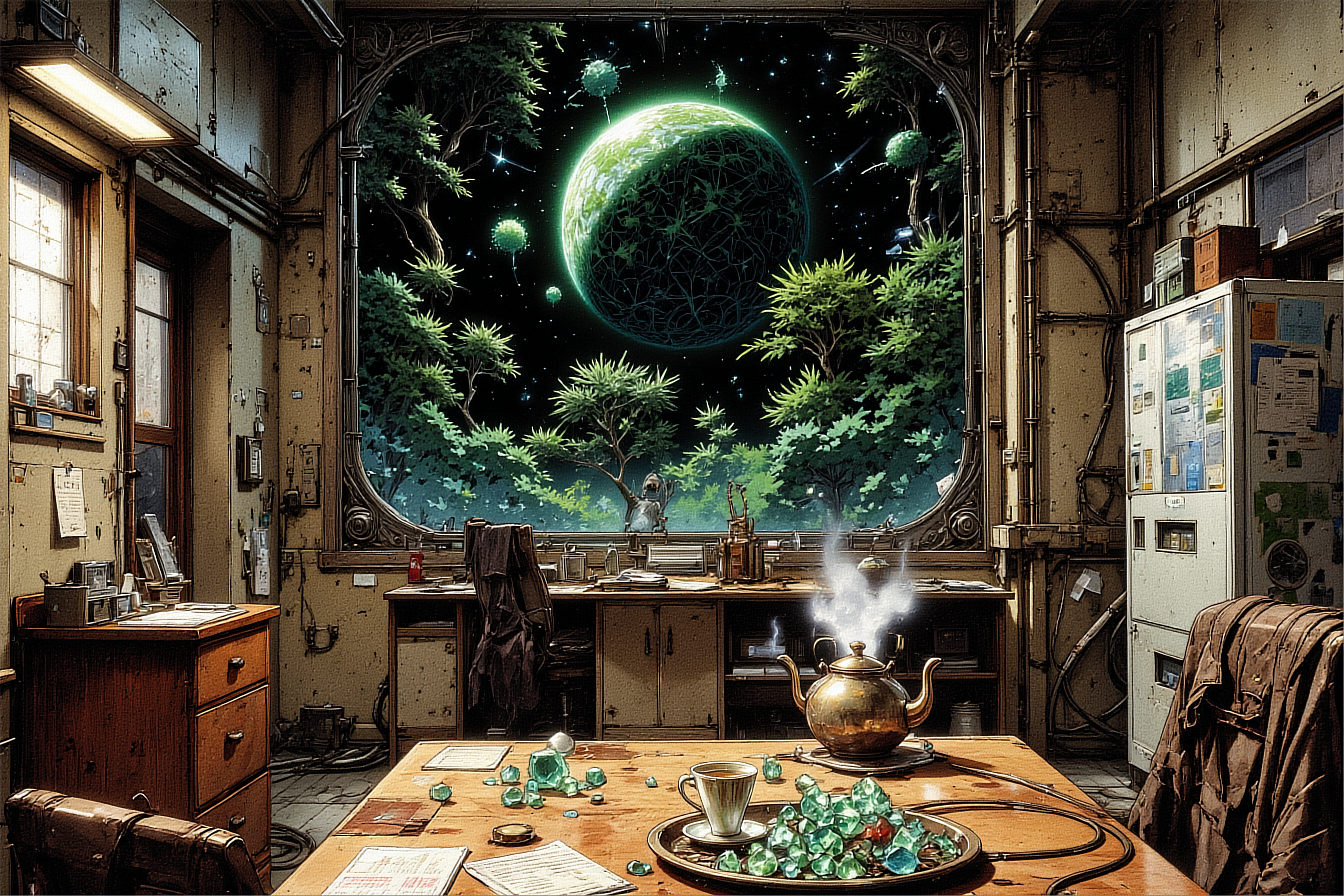
The machine outside the vending machine draws from the district grid the way a bar draws from a tab, and twice a month somebody has to settle it. Pixel settled it that morning with a bag, not a cred stick. She upended it on the back table and the crystals came out in a small avalanche, thumb-sized, cold, faintly luminous, each one the shape of a laugh somebody had mined out of a bad week and sold.
"That's the whole draw?" I said.
"That's the whole draw," she said, sorting them by eye. "Power, ink, and the machine's opinion of itself."
CLX. Crystallized Laughter. The one asset Corporate can't mint and can't fork, because you cannot print joy, you can only take it off somebody and hold it, and the OS has spent six hundred years trying to work out how to counterfeit it and failing in a way that suggests the problem is fundamental.
The mechanics of the failure are the interesting part, and Pixel explains them every time somebody new joins a distribution point, so I've heard the lecture in four accents. Corporate can copy a cred. Corporate can copy a name, a badge, a signature, a face on a security feed. It cannot copy the moment a laugh happens, because the moment a laugh happens is an event with an audience, and the audience has to be there. Fork it and you get a file that contains every property of laughter except the part that makes it worth anything. The miners call themselves lucky. Everyone else calls them haunted. That's the joke and the tragedy in four words, and there's no room in it for a punchline, so I don't add one.
I have met a miner whose laugh hasn't come back.
He worked a seam under the lower districts, six weeks down, and came up with a pocket of crystal that paid his rent for a year, and the laugh he mined out of himself never returned. He told me about it in a noodle shop, perfectly pleasant, eyes kind, and at the end of the meal something funny happened at the next table and he did the thing where a person tilts their head and waits for the laugh to arrive, and it didn't, and he finished his soup. That was three years ago. I think about him when Pixel counts the crystals out on the table, one by one, cold and bright.
"Stop looking at them like that," Pixel said.
"Like what?"
"Like they're somebody's ribs."
"I'm looking at them like they're somebody's ribs."
She bagged the rest and went to feed the machine, and the pocket dimension took the payment with a sound like a fridge approving of itself.
"Rate's up again," she said, coming back. "Everybody's rate is up. The grid's squeezing the lower districts before the next re-zone, which means our power gets expensive exactly as fast as our neighbors get deleted, and I want it noted that those two facts are on the same invoice."
"You want it noted where?"
"In your head, so that when you next suggest a ninety-second window you remember what ninety seconds costs in crystal." She dropped into her chair and stole a sip of Om's tea, which she does every morning and Om permits every morning, having apparently priced it in.
Om refilled the pot without looking up. "The crystal is honest," he said. "It was paid for once, by someone laughing, and it will be spent once, by someone who needs power. Systems that mint their own currency forget the paying."
"That's either very wise or very stoned," Pixel said.
"Yes," said Om.
Clive talks about the network the way other people talk about the sea.
It starts with a photocopier. Every machine on the grid is a node, and every node remembers who taught it what: the copy rooms, the fax lines in basements that still tick over, the filing cabinets with a catch that only sticks one way, the badge printers in HR that have printed ten thousand names and kept a copy of each. Since 1967, Clive has been laundering documents through all of it, and the network owes him the way a river owes a mill.
"We who bind, we who exist," he said, resting his casing on the table. "Paper routes around the OS, you understand. The OS reads packets. Paper it reads with its eyes shut."
"Case in point?" Pixel said, and she means it as a challenge, and Clive takes it as an invitation.
"Case in point. There's a machine in Accounting, twelve floors up, beige as sin, that still runs on my authority, and my authority only. It prints an expense form that nobody alive has signed, and every quarter the form comes out, and every quarter somebody pays it, because the machine has never once been wrong."
I've watched him work a route. A job order goes out as a whisper across the network: a badge printer in a lobby in Prime Material picks it up mid-cycle and prints a pass nobody collects, and the pass sits in the tray until a mailroom copier in Nocturne asks for it by serial, and the copier lifts the image, carries it three floors, spits it out into a binder that a filing cabinet opens for exactly as long as it takes. Four machines, three sectors, no packets. The OS sees a lobby printing passes and a janitor filing paper, which is the whole trick: to the network, our traffic looks like office work, because for sixty years office work has been the only crime nobody audits.
"And the cold file?" I said.
Clive's casing ticked. That's the tell, and he knows I know it. "Barry Kowalski," he said. "An old contract. Old enough that the man who signed it is a footnote in three other files and a line item in none." He said it the way you say a name at a graveside. "I keep meaning to publish it. The network has carried worse and survived."
"That's not an answer either," Luminara said, from the light table, without looking up.
"No," said Clive. "It's where an answer gets stored until one's needed."
Barry Kowalski is a cold file in the office-supply network, which in Clive's world means a document waiting patiently in a cabinet for a century to become relevant. That's the whole of him: a name on a folder, a contract that predates the OS's paperwork, color in a fence's lore. Clive will produce it one day the way he produces everything, in the dry rustle of a machine doing a favor.
Luminara developed the night's photographs while we argued, because Luminara develops while the argument is happening and then contributes a single print that ends it.
First came the depot. Bay three in sodium light, the pod mid-dock, and in the corner of the frame the exact moment the tag flipped from maintenance to live-process, a bloom of red that the eye misses and the film doesn't. Then the escort unit in the east doorway, faceless, mid-stride. Then the service lane with our backs in it and the noodle vendor's cart steaming at the edge of the exposure, and I looked at that one longer than the others, because it's the frame that costs us.
Then she pinned the last one and the table went quiet.
It was a block in the lower districts, taken from across the street at an angle she favors: the bakery, the laundromat, the booth-shaped absence between them. The kerb was doubled. The whole street had a watermark in it where the old version still showed through the new one, and floating over the block, in the gray that only she and I ever seem to catch, three bars where three people's rows used to render.
"The Vega block," she said. "Same edit as last night. Somebody re-ran it this morning."
"The family," I said. "The café."
"The whole block's on the audit list," she said, and tapped the print. "There's a diff on the bakery's card machine too. It was accepting names again for nine days, and somebody has just finished un-accepting them."
Nobody said anything about the man in the beige suit. We didn't need to. The print hung there on its pin, doubled kerb and all, and the room looked at it the way you look at a receipt you already paid.
"Nine days," Pixel said at last. "The bakery accepted names for nine days and then somebody audited it."
"Somebody didn't audit it," Luminara said. She was already capping the developer tray. "Look at the edge of the frame. The edit came from the north side, at 4 a.m., with the seam on the light. That's a scheduled job. Somebody put the bakery on a list months ago and waited for the date."
"Which means the list exists."
"The list has always existed," Luminara said. "We just found the corner of it." She hung the print crooked, noticed, and straightened it, and her hand stayed on the pin a second longer than the pin needed. "The family was in there on Tuesday. I photographed them by accident, you know. Three people in a café window, out of focus, in a frame I took for the kerb."
I looked at the print for a while. There were three shapes in the window of the booth, soft at the edges because they were three meters from where I'd been sitting and Luminara had focused on the street. They could have been anybody's family. They were.
Later, after the press started up and the others drifted to their stations, I took the file out.
This is the part of the night nobody gets, and the part I've been carrying since the day I cracked it. Layer one. Four layers of encryption wrapped around a voice, and the first one came apart on a Tuesday while the press was running and Meatball was asleep on my feet, and what came out of it was a line of code and a man's voice saying things I have played forty times.
RETURN connection perfection
And underneath it, Aether, older than the last time I heard him and younger than the day he vanished:
"Don't spend your life chasing my ghost. Find people worth fighting for."
Forty times. I have played it forty times and I could not tell you now which of those forty I played for information and which I played because it was the only place he still exists. The voice has a room in it. It has the kitchen, the refrigerator cycling, the deck he built me set between us on the floor.
I played it once more while the press was clacking, with the sound pinned low enough that nobody hears it over the ink. "Don't spend your life chasing my ghost." He said that like he'd read the sentence somewhere and liked the way it fit. The last time he says my name in the recording, he says it the way he said it when I was small and he was carrying me to bed, and the file is eleven seconds long and I have never once managed to hear it as a file.
Layer two is behind it, and layer two is real and shaped like a door. I get the algorithms to the seam and they stop, every time, not with an error, with something worse: a shrug. Whatever the second layer is made of, brute force doesn't touch it, and I have never once put in front of another human being the fact that I have a dead brother's second sentence sitting behind a wall I can't reach.
The overlay blinked. 11:20. Down the table, Pixel was arguing print runs with a volunteer, A1 was recalibrating by ear, Om was pouring.
I closed the file and put it away and went to help.
- Zephyr, logging off