
Root Access — Chapter 05: Callback Path
The question was simple enough to write on the back of a napkin, and I had written it on the back of a napkin, and Pixel had looked at it for a full ten seconds before answering.
"Where does a daemon call home?" she read. "You broke into a records depot for this."
"I broke into a records depot and it called something on the way out." I turned the napkin around so the crew could see it. Eleven seconds of cache sat on the drive in the middle of the table, and inside the cache was a packet that had left before Clive's wipe charge landed, gone out on its own momentum, thin as a cough. "Whatever it phoned, it phoned without asking. That's a route. Routes have an address."
"And addresses have an owner," Om said.
"And owners have habits," said A1, "and habits are the only thing in this universe I can still predict."
Clive's casing ticked twice against the table. "There is a place," he said, "where they keep them between deletions. Under the records district, below the depots, below the loading docks, below even the freight. My machines have printed the maintenance schedules for it since before you were an idea. It is called the docking bays, and every unit that works in Prime Material sleeps there."
"A cathedral of cradles," Luminara said. She said it flat, the way she says anything she's photographed in her head first.
"Then we go where the daemons sleep," Pixel said, "and we go quiet, and we go tonight, because the audit cycle gives us four more days before every unit on that floor gets its logs pulled."
The table went quiet in the way that means the decision has already been made and the room is only attending the ceremony.
Clive raised one objection, in his own way, by stapling a corner of the dock schedule to the table edge twice and leaving it there. Two staples means a question in staple grammar, and the question was the obvious one: after the depot, why would anything down there be unattended?
"Because it's guarded by boredom," I said. "Nobody raids a charging floor. The whole point of a cathedral of cradles is that it's where everything goes when it isn't being interesting."
"Everything goes where it isn't being interesting," Clive said, "until someone reads the schedule."
Luminara asked about cameras and I said the bays are below the camera layer, and she asked how I knew, and I said because Pixel had read the edit history of a corridor we hadn't entered yet and found no seams, which is the clearest signature in the world of a place nobody has bothered to rewrite. She wrote it in her notebook anyway, the date and the source, because evidence that lives only in someone's memory has a habit of being reclassified.
A1 posted the numbers without being asked: ninety minutes of coherence for two bodies moving slow, one shot, and a reserve of forty minutes if somebody panics. "If you are inside when I count to zero," he said, "you will not be inside anywhere in particular. The floor will have you. I say this as your physician and as a machine who has swept this floor before."
The maintenance signal is a heartbeat the building sends itself: a periodic packet, dumb as a metronome, that travels from the records district down to the bays to wake the cradles and tell them which units are due for charge. Everything on the grid has one, and everything on the grid assumes nobody rides them, because you'd have to be crazy or out of options to cram yourself into a keepalive.
We were both.
"We ride it down, we get ninety seconds inside the bay's own traffic before the next tick throws us out," I said, sketching the descent on my deck for the third time. "Pixel reads the bay while I read the route. Clive's network carries us."
"The machines have agreed to help," Clive corrected, "which is a different grammar."
His route for us was the best thing the office-supply network has ever produced. We wouldn't move as people down there; we'd move as office equipment. Two hand dryers in a service corridor, a badge printer on the mezzanine, and a photocopier with its lid up, and our audio would ride through their cycles the way paper rides through a tray: half a second at a time, hopscotching from machine to machine, anonymous in the most boring way the grid can imagine.
"A1 on the horn," Pixel said. "Coherence countdown the whole way."
"I will be counting," A1 said, "and you will be listening, because the last time a crew of yours ignored my count, I spent an evening scraping one of you off a doorframe. Ninety minutes of coherence from one shot. Twenty minutes from a sip through a straw. Do try to budget accordingly."
We went in at 4 a.m., through a service hatch behind a laundromat, down three flights that the city's maintenance log insists do not exist, and out the other side into the bays.
Getting in was Clive's choreography, and Clive choreographs the way old machines do anything, which is slowly, completely, and with a preference for corners. The laundromat's dryer two is a node. The corridor's hand dryer is a node. The badge printer on the mezzanine has been printing temporary passes for a contractor that dissolved in 1998 and will keep printing them until someone in facilities learns to read a cancellation notice, and every one of those cycles gives us half a second of cover for a packet to move.
"The machines are expecting us?" I asked him on the way down.
"The machines were told to expect a maintenance sweep," Clive said. "I am a maintenance sweep. I have been a maintenance sweep since 1967." His casing caught the stairwell light once. "We who bind, we who exist, and tonight we exist very quietly."
Om, who had come along to hold a channel open with a key he whispers rather than types, set his kettle on the third landing and poured two cups in the dark without spilling. Butter tea. He handed me one and said, "If the signal stutters, drink. The tea confuses anything that tracks by heat, and down here everything tracks by heat." It's a cryptography trick disguised as hospitality, and it works on drone tracking, and I have never once seen him explain which part of that sentence is the joke.
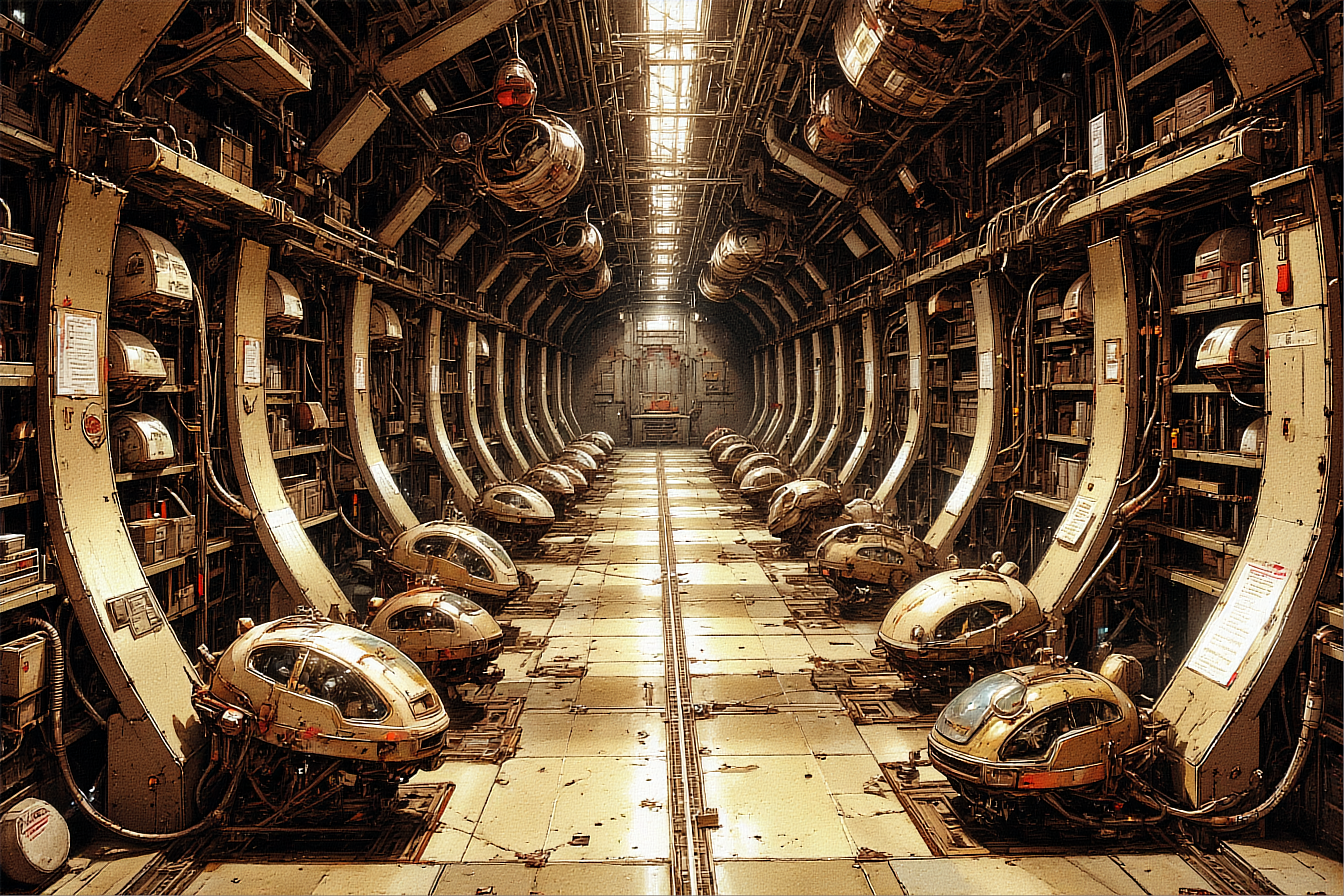
Imagine a cathedral built out of charging racks.
That's the docking bays: four hundred meters of them, row on row, low enough that you crouch, deep enough under the records district that the air has been in here since before the OS learned to paint. Each cradle is a curved slot the size of a delivery pod, cable spine, contact pins, a status lamp in Corporate beige. Most were occupied. Erasure daemons slept in them like commas, shells dented from the week's work, and the lamps pulsed on a slow shared rhythm that made the whole room breathe.
"Edits," Pixel murmured. She had her palm flat on the nearest cradle and her eyes half shut, reading the bay's history the way she reads a street, which is to say out loud and in fragments. "This one's been redone twice. This cradle has had three different serials and the floor still has the paint from the first." She moved down the row. "They come back from deletions with fresher paint than they left with. Every unit that goes out gets a repaint on return, and the repaint is always the same beige, and the beige is always three weeks newer than the shell underneath it."
"Why repaint a shell nobody sees?"
"Because somebody audits the paint," she said. "Somebody up there likes a world that looks tended."
I was already jacked in. The cradle network is a backplane, dumb and broad, and a deck in maintenance mode rides it the way a rumor rides an office. Traffic went past me in bursts: charge requests, unit status, a nightly roll call of who had gone out and who had come back, and under all of it the thing we'd come for, a thin outbound channel that every daemon on the grid uses to say the same four words to the same place.
DELETE COMPLETE // ACKNOWLEDGE
The channel was open. I rode it up.
Halfway there, the roll call hit our row.
It sweeps the bays one cradle at a time, a tick that goes down the floor like a librarian checking lamps, and when it reached the empty cradle beside my knee it stopped, because an empty cradle during a scheduled charge cycle is a contradiction, and contradictions make the grid itch. Pixel's hand closed on my sleeve. Somewhere above us a hand dryer roared for its one allotted second, and in that second Om whispered a key that made the tick read the cradle as occupied by a unit in transit, and the roll call moved on.
"Forty seconds of that," A1 said in my ear, "and I will start charging you for the adrenaline."
"A1?" Pixel said.
"Coherence 94% and steady," A1 came back, from a laundry cart three districts away, riding the horn like a man with a stopwatch. "You have a clean line. I would enjoy it while it lasts. Eighty minutes."
We moved down the row in the dark with four hundred sleeping deletions breathing around us. Luminara had stayed above, photographing the hatch, the stairs, the corridor that the maintenance log denies, because every route out has to exist in film before it exists in an emergency. She sent one frame down through the badge printer in the time it takes to print a pass nobody collects: the bays from the top of the stairs, cradle on cradle, lamps pulsing, and in the corner a beige shell mid-charge with a fresh coat of paint on it that the shell under it had not asked for.
Clive's machines carried our audio up and down the mezzanine like a relay race: hand dryer, badge printer, hand dryer, and under each hop the dryers roared for one second to cover the gap. Somewhere above us a badge printer was printing passes for people who would never collect them, and that is what freedom sounds like in this city.
The route resolved, and I stopped moving.
"Pixel."
"I see it."
The callback didn't go to security. That's the thing neither of us said for a long ten seconds, because when you pull a route expecting a security endpoint and find something else, the something else is heavier. Every unit on the grid reported to a channel that bypassed Corporate's security stack entirely, went up a layer past it, and terminated at an executive endpoint with a signature I didn't recognize. Security got a summary. Security got the quarterly digest. The live feed, the one with coordinates in it, went to an office somewhere in the apex that has no name on the door.
"Someone above security has a private line," Pixel said, "and the daemons have been using it the whole time."
"Does it have a name?"
"It has an approval ID. It stamps every packet." She read it off my overlay: a string of letters and numbers, and then she said, very quietly, "Zeph. This approval ID is on other things."
It was. It took me ninety seconds to check, riding the backplane from the bays up into archives I had no business in, and it was on three of our recent jobs' worth of luck. The delivery drone that had rerouted over our heads in Sector 7G and left a gap in the coverage. The window of unattended time in the records district that had let us walk a route we shouldn't have known. The photocopier in the depot basement being off the audit rotation for one quarter, exactly the quarter we needed. Three lucky breaks, same stamp, and a timestamp in the corner that made my stomach do something I will not describe.
The flag flip was in there too, filed under the same ID, dated a month before we stole the daemon.
Show everything to Pixel is a rule. The exception I took started a month ago and I have not been able to put it back.
"A1," I said. "How long?"
"Forty minutes, and I would prefer you spent them moving."
We were out on the return tick, through the hatch, up the stairs that don't exist, and into a dawn that had started without us.
The score sat in my deck like a stone in a shoe: the callback topology, an executive endpoint above security, an approval ID, and a timestamp I have not shown anyone. Daemons report to an office with no name. Lucky breaks come pre-approved. My flag didn't flip when we broke into the depot; it had been sitting there for a month, patient as hold music.
I didn't tell them about the approval ID. I told them about the endpoint, and the channel, and the private line, and Pixel wrote it on the wall between Luminara's photographs in marker, and the crew looked at it the way you look at a wire you've just realized is live.
Cost arrived two days later, in the form of a man.
He turned up at the distribution point on Ninth, where the zine goes out on Thursday nights to whoever will take a stack. Beige jacket, no name badge, a clipboard with a form on it that had more boxes than questions. He was polite in the way of a machine that has been coached on politeness: good morning, how many copies, may I note the address, thank you for your engagement with Corporate services. Luminara photographed him from across the street and told me his shoes cost more than the table.
"He asked about our print run," the volunteer said afterward, a nineteen-year-old with ink on her wrists. "He asked it like it was a health survey."
"Did he write down your name?"
"He asked if I had one first," she said.
The next Thursday he was back, and the Thursday after that, same clipboard, same courtesy, no badge. He never blocked a single copy. He stood at the edge of the distribution point with his form and his pen and he recorded who came, and everyone who came saw him, and the seeing is the point.
He asked me, the third week, whether the zine had "a reader metrics process." I said we counted stacks. He wrote that down, exactly that, and thanked me for engaging with Corporate services, and his pen moved the way pens move when the answer is already in the box.
"An auditor," Pixel said, reading Luminara's photographs off the light table. "Sent to be seen."
"They're telling us they can count us," I said.
"Yes," she said. "That's exactly what they're telling us."
We argued about him for an hour, which is what we do instead of panicking. Luminara wanted his shoes photographed at a focal length she named twice. Om said a watcher who wants to be seen is broadcasting, and broadcast is a channel, and channels carry both ways. Clive said the network had no record of him: no badge print, no clearance, no purchase order for the clipboard, and a man who exists in no machine's paperwork is either off-grid or above it. A1 ran the odds of an unbadged auditor being a coincidence and gave us a number with two decimal places and a small sad sound like a kettle finishing.
Nobody could make him leave. That's the part I keep turning over. You can't uninvite a man who never entered anything.
That night I put the approval ID on the wall where nobody was looking, under a corner of an old routing sheet, and stood back from it, and the room went on around me: press clacking, dog snoring, A1 counting shots into a glass like a man counting ammunition.
Someone opened these corridors for us. The bays were unlocked, the cameras looped, the route clear at four in the morning in a building that has never once been unattended, and a man with a clipboard is already waiting at the far end of the job we haven't run yet. Corridors get left open for two reasons: because a guard went home, or because somebody wants you through the door. I stood there with the taste of it in my mouth, close enough to say, and said nothing to anybody.
- Zephyr, logging off