
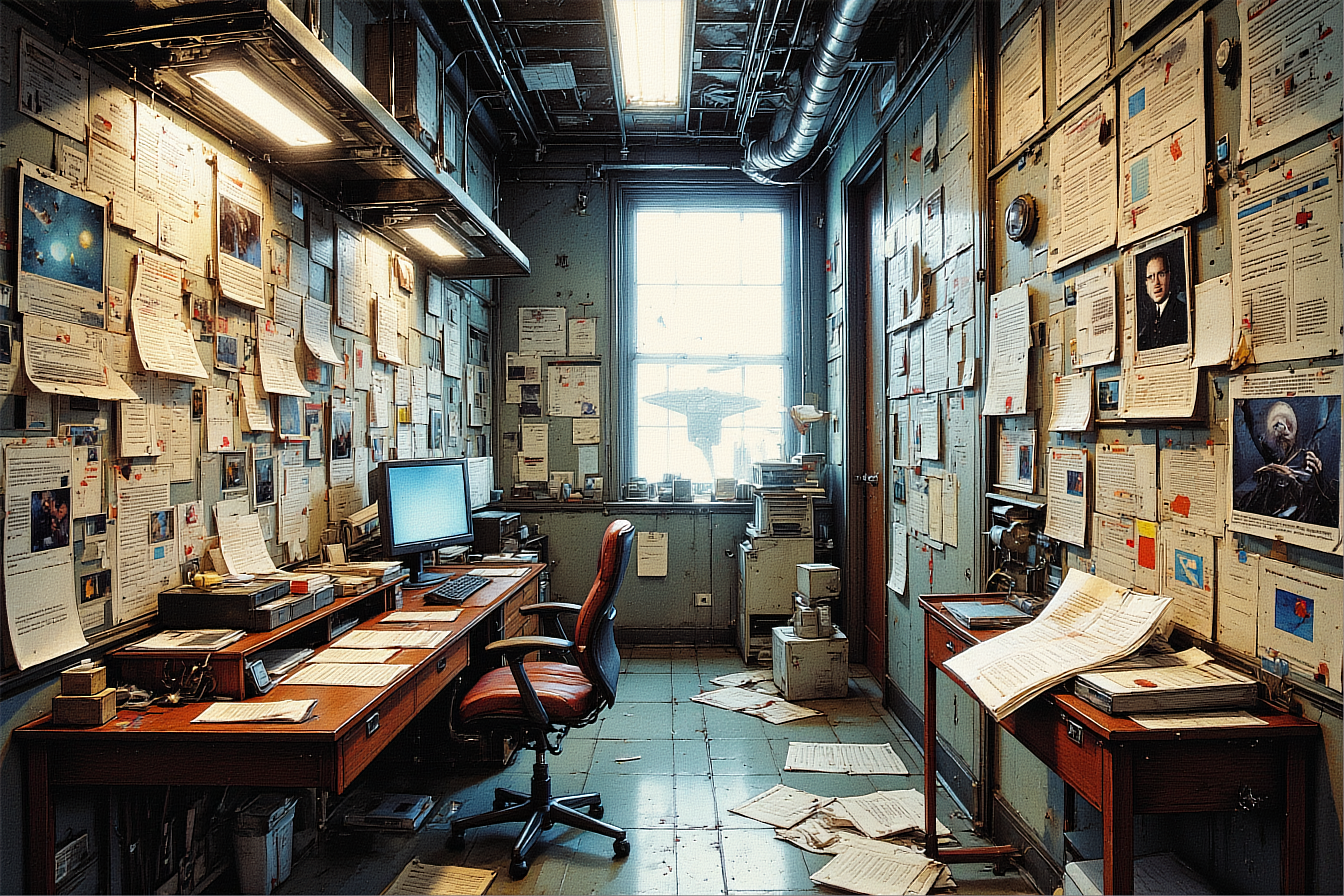
Root Access — Chapter 06: Corridors Left Open
I had been building a wall, and I had been doing it since the afternoon my flag flipped, and I hadn't noticed until Pixel took one down.
It started as a normal Thursday. The press was running the Vega block issue, A1 was counting shots he'd already counted, and Meatball had claimed Om's chair because Om had stood up, and the room had that shape a room gets when everyone is working and nobody is saying so. Pixel was at the wall of photographs, rotating a print by a degree, and she went past the routing sheet I'd papered over, and her hand stopped.
"Zeph."
"It's a working stack."
"It's a stack you've been hiding, and I read stacks for a living." She pulled the sheet. Underneath: printouts, timestamps, flag histories, the approval ID, a routing table from the depot, three pages of daemon cache with a highlighter line running through the same string in all three. "How long?"
"How long what?"
"How long have you had this and not put it on the wall where the wall can do its job?"
Nobody in the room moved. Clive's casing went very still, which for Clive is a shout.
"Since it happened," I said. "The flag history, since the afternoon it flipped. Everything from the depot on, since the night we ran the daemon."
She didn't shout. Pixel doesn't shout, and I sometimes wish she would, because the version of her that goes quiet and starts pulling prints off the wall one at a time is much worse.
She read the wall the way she reads anything: fast, sideways, out loud, correcting as she went. "The depot route was pre-cleared. Look. Here's the dock schedule, and here's the audit exception, filed six weeks before we touched it, granting an unscheduled delivery window at bay three on the exact night we ran. Somebody requested that exception in writing."
"Corporate does everything in writing," Luminara said.
"Corporate does everything in writing, and this request has no requester." Pixel pinned it beside the printout. "It has an approval ID. The same one."
She kept going. The docking bays: cameras on the lower level, all fourteen, looping a nine-second pass of the same empty corridor, and the loop's timestamp started three days before we went down. The clip Luminara had photographed of the corridor was proof of a thing that had been arranged for us, and Luminara, who photographs edits for a living, looked at her own frame for a long time and said nothing, which is what shame looks like on her.
"The clerk," I said.
"Go on."
"The clerk who saw our faces. His access was revoked at 2:14, before we cleared the corner. I checked the revocation order after, because revocation is supposed to come from depot security, and it didn't. It came from an HR queue three sectors away, filed by nobody, at 1:47. Forty minutes before we ever came through the service lane."
Pixel put that one on the wall with two pins, hard enough to tear the corner.
"Forty minutes," Luminara said. "So the man who could describe our faces was already gone when we arrived."
"The revocation is the easy part to parse," Pixel said. "The order of it is what I keep tripping on. He was already gone when we decided to come."
Clive, who had been silent through the whole of it, rolled to the wall and set his casing against the corner of the printout the way he does when a document is real. "In my trade," he said, "this is called a house that wants the goods. You walk in, the door is unlatched, the alarm has been disabled by the owner, and at the end of the corridor there is a buyer with a price already agreed. The only question left in such a house is which of you is the merchandise."
Nobody found a joke in that, so nobody looked for one.
"And the café," she said. "Say the rest of it."
I told her about the café that same night, and I left the flag out, because I hadn't checked the flag history yet and I hadn't wanted to. Three meters from a family in a booth: a man in a beige suit who ordered nothing, and beside theirs, the booth nobody sat in, reserved on the ledger since 11 a.m. by a cred account that resolves to a shell. I had watched that reservation all afternoon in my overlay and read it as protocol, because protocol is what you read things as when you don't want the alternative.
"The Vega family's booth was three meters from a booth Corporate had already reserved," I said. "I sat at the counter. The counter had no reservation and I didn't check whether it needed one."
"That's your part," Pixel said. "Here's mine: three days before the café, our pocket dimension's power was rerouted off the district loop and onto a line that doesn't appear on any grid map, which is why nothing has failed since. Here's Om's part: the butter tea recipe he's been using got modeled by something that never drinks. Here's Clive's part: the basement copier at the depot was off audit rotation for exactly one quarter, and Clive, ask him."
Clive's casing lifted an inch off the table and came down. "I assumed favor," he said. "Sixty years of favors, and I assumed this one was mine."
"Nobody guards a secret this badly," I said.
The room took that the way a room takes a dropped glass.
We put the map up properly then, all of it, side by side, and it took the whole wall and part of the ceiling.
Job 1's route, pre-cleared. The bays, pre-looped. The clerk, pre-revoked by someone else. The café's reserved booth. The power line. Om's modeled recipe. The three lucky breaks in Sector 7G stamped with an approval ID from an office with no name. Corridors left open, walls left thin, a schedule that bent around us for a month like water finding a person.
"Layer on layer," Om said at last. He had not sat down since the second pin. "Every obstacle removed before we reached it, every witness neutralized before it could become a witness."
"They didn't stop us at the depot," Pixel said. She was standing back from the wall with her arms folded, and her voice had gone through angry and come out somewhere colder. "They could have. Two daemons, twelve clerks, a lock with a badge reader on it. They had a second unit on the dock and it didn't fire once." She tapped the printout of the escort unit. "It walked the row, looked at us, and waited for the wipe."
"So we could take the cache," A1 said.
"So we could take the cache," Pixel agreed. "So we could take eleven seconds and bring them home and put them on this wall." She turned around then, and the anger, which had been aimed at Corporate and at the wall and at the schedule, came around and did the only thing it had left to do. "And you had a month of this and you put it under a routing sheet."
"I was going to bring it out when I had the whole thing."
"You've had this since the night we ran the daemon," she said, "and you put it under a routing sheet, and I want you to know I'm angry at you for exactly as long as it takes me to be angry at the people who wrote the routing sheet, which will be forever, so you'll have to stand there a while."
"I can stand there."
"You can," she said, and it was not forgiven, and it was also not the thing that mattered anymore, and she looked back at the wall the way you look at a door you've realized was held for you.
Nobody robbed us. We were walked, the way you walk a guest through a house you already own.
Om walked the wall twice with his hands behind him, the way you walk a garden you've decided to replant. At the power-line reroute he stopped. At the modeled butter tea he stopped again, longer, and I watched his hands, which shake on bad days, go perfectly still instead.
"Someone read my recipe," he said. "I have used the same eight minutes of preparation since I was a student, and a thing with no mouth read it and wrote it down." He let that sit. "What else have they read that belongs to us and has never been a document?"
Nobody had an answer, so the question stayed up on the wall with the rest of the map.
A1, who had run his numbers twice while we pinned, spoke from his alcove at last. "For the record, the coherence math still holds. Whatever is arranging our corridors has arranged a world in which you arrive upright. I find that reassuring and I distrust myself for finding it so."
"Comforting," Pixel said.
"Disturbingly comforting," A1 agreed, "which is the only kind I stock."
The endpoint called at 9:02.
It came in on the private channel above security, the one I'd pulled out of the daemon's callback route and hidden in my deck, and it lit up the room in a color nobody in this business ever wants to see: an open inbound from an executive layer, addressed to us, with our own crew handle in the header.
Pixel looked at me. I looked at the answer key.
"If we don't take it," I said, "she knows we found it."
"We know she knows we found it," Pixel said. "That's what an open inbound means."
She answered it.
The wall cleared itself and became a screen, and the room did what rooms do when authority arrives: the press wound down, A1's port light dimmed to a courteous glow, and Meatball, who has no opinions about authority, went on sleeping.
The woman on the screen was mid-fifties, beige done well, no jewelry, in an office with nothing in it that she needed to look at. She had a tablet on her knee and she did not look at it.
"Good evening," she said. "I'm Isolde Marrow, Chief Reality Officer. Thank you for taking the call. I appreciate that it arrived without warning, so I'll be brief, and I'll be quick to leave."
No raised voice. No daemon behind her. The courtesy was the loudest thing in the room.
"I've read the dataset you recovered from unit E-771," she said, "and I want to thank you properly for it. Eleven seconds is a generous donation of telemetry, and it has been useful. Your extraction was clean. The wipe charge was a nice touch, incidentally. The office-supply routing that carried it is older than our current Terms of Service and we have never managed to model it."
Pixel didn't speak. Neither did I.
"I'll tell you what you've worked out, so we can skip the part where you pretend," Marrow said, in the tone of someone reviewing a release. "Your route to the depot was pre-cleared under approval 7734-K, which you have on your wall. The lower level of the docking bays was placed in a camera hold on the ninth of this month. The revocation of the records clerk's access was executed from an HR queue to keep it out of your analysis, because a revocation originating from depot security would have given you the department, and the department would have given you me. You arrived at 4:07. You left at 4:31. You overpaid a noodle vendor on the service lane by a factor of four."
She let that sit for exactly as long as it takes to feel found.
"Your exit timing is fourteen percent better than your entry timing, which is a coaching problem, and I've taken the liberty of noting it in the margin. Your patch supply is eleven shots, from a supply line that fails in the spring. Your photographer's film is sourced from a vendor who files her orders under a name she stopped using in 2019. Your fence's network routes roughly forty percent of its traffic through a machine in Accounting that none of our teams can find, and we have looked, twice, and I've asked them to stop looking, because I prefer it where it is."
She paused, and something moved behind her face that had nothing to do with the metrics.
"Also: charred tomatillo, one raw white onion, a serrano with the seed vein pulled if the customer has had a week. I mention it only to be clear about the level of detail we're working at. You have been thorough and we have been thorough, and the difference between us is that I got to read your file before you read mine."
"That's enough," Pixel said.
"It is," Marrow agreed, and did not raise her voice by a single degree. "So let me tell you why I called, because I don't hunt. Hunting wastes good people on the wrong problems. What I do is measure, and measurement requires a live subject, and you are the most instructive subjects on the network. I signed the Terms of Service in a year none of you were born in, and I signed it because a world with deletion in it is a world where grief can be administered: filed, closed, and stopped accruing against people who need to work in the morning. You can call that monstrous. I'd rather you called it a design decision, because design decisions have acceptance criteria, and yours are coming."
The screen held her for a moment longer.
"This was a courtesy call. Nothing you did tonight was a mistake, and nothing you do next will be one either. You'll keep the cache, you'll keep the route, you'll keep going, and we'll keep watching, because I would rather watch you than be surprised by you. That's the whole offer. Good night."
The screen went dark. The press wound back up. Somewhere Meatball opened one eye, decided the world still had no opinion about him, and closed it again.
Nobody spoke for a long time, and then everybody did, badly, at once, which is the crew's way.
Luminara wanted to know how a woman with no camera had read a film vendor's invoices. Clive wanted to know which two teams had looked for his machine in Accounting and what they had said when they found nothing, and his voice had a quality in it I've only heard once, from a photocopier the day its building got condemned. Pixel stood with her back to the wall so she could see every face at once, and I recognized the posture, because it's the posture of a person running a room through an emergency she hasn't named yet. Om sat down, finally, and poured the tea he'd refused to pour, and set a mug in front of each of us in an order that meant something to him.
Then A1 rolled forward to the middle of the room, port light steady, and poured himself a diagnostic the way a doctor pours a drink, and we all looked at him, because A1 with numbers is our weather report and we've learned to read the sky.
"One year," he said. "The crew's one-year survival projection, updated as of this minute." He set the glass down. "I have run it four times."
"Read it," Pixel said.
A1 looked at the glass, and then at the wall with all our pinned luck on it, and then at the sleeping dog, and he closed his port light in a way I have never seen him do, which is his version of taking off a hat.
"No," he said.
"Meaning it's that bad."
"Meaning," said A1, "that standards must be maintained, and one of the standards is that a statistic delivered to a crew under this much load becomes the crew's next decision instead of its information. I will read it aloud when it helps. Tonight it would only decorate the panic." His port opened again, one blink. "I suggest we plan instead."
So we planned. That's what you do when a Chief Reality Officer has just read your wall back to you with notes in the margin: you plan, because planning is the only answer that doesn't sound like surrender, and because somewhere under the arithmetic there was still a job to be run, and a brother in a file, and a wall full of maps that somebody had bothered to leave open for us.
Telemetry has been watching since page one. I wrote that on the wall, in the corner, under the approval ID, in marker, where everyone has to see it every morning.
Nobody guards a secret this badly. They never were guarding one.