
Root Access — Chapter 07: Run Anyway
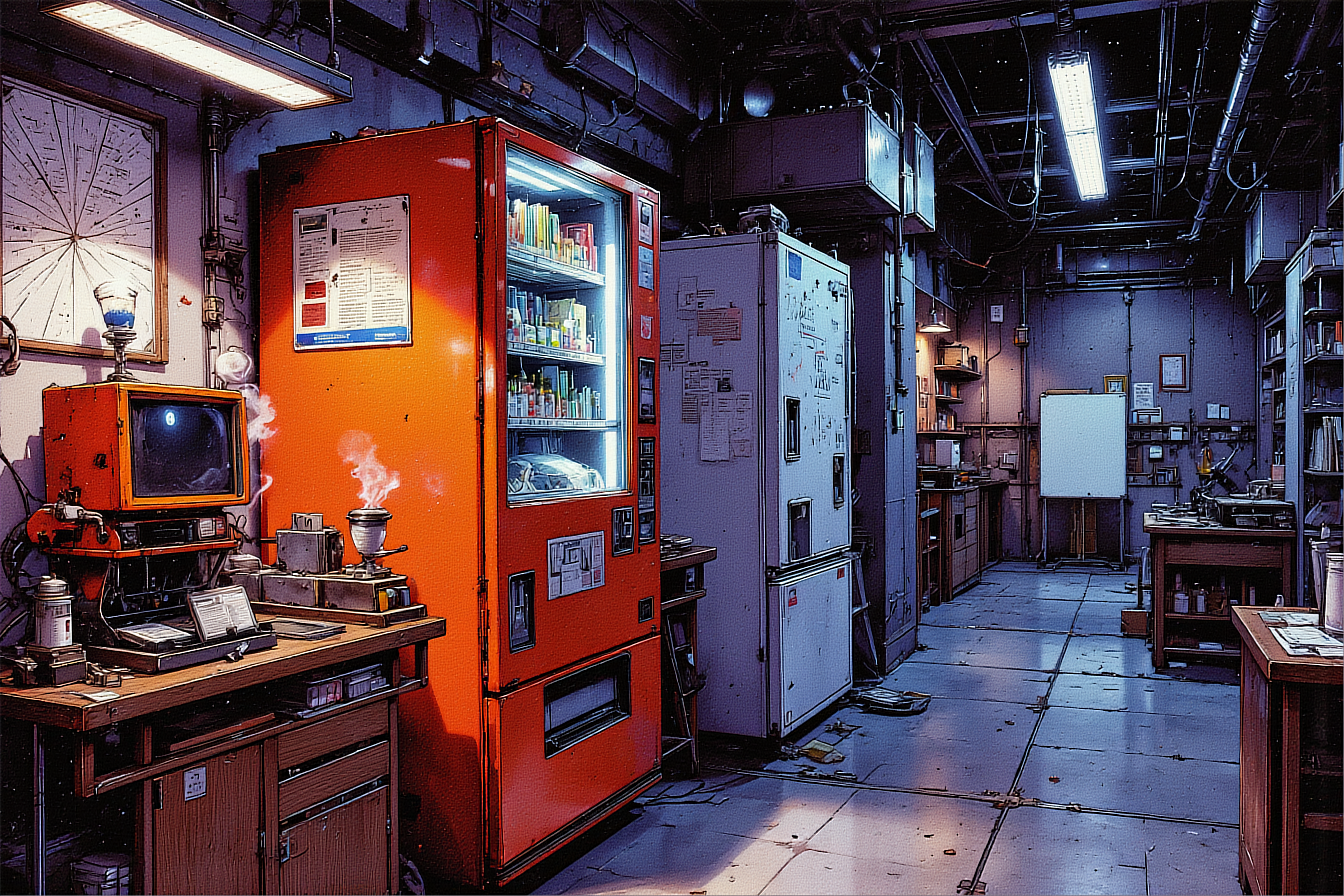
The endpoint stayed live for four seconds after Marrow hung up, the way executive lines do, long enough for the room to hear itself breathe. Then the call folded and the pocket dimension took back its usual noise: the zine press idling at the top of a cycle, the busted vending machine ticking through a cooling downgrade, Meatball's nails on the concrete as he re-evaluated whether the polite beeping had been a squirrel.
Nobody spoke. That's the part nobody warns you about. You get told the Chief Reality Officer has read your whole plan in telemetry since page one, and the immediate result is six people discovering they don't know where to put their hands.
A1 broke it, the way A1 breaks most things.
"One-year crew survival projection, revised downward," he said, steam venting off his group head in a thin, apologetic line. "The figure exists."
"Read it," Pixel said.
"I have elected not to read it aloud. Standards must be maintained, and one standard is that nobody makes decisions in this room on an empty stomach. I am making cortados. Arguments improve with sugar."
He rolled two meters to the steam wand and went to work with the grave focus of a man defusing a package addressed to himself. Nobody stopped him. Rule two of the crew: drink the patch before you desync, and an argument in this room counts as desync. Our walls go soft when we fight, the whole dimension printing itself like a photo left out in the rain. The Ephergent is held together by quantum tape, an orange Swingline stapler manufactured in 1967, and the fact that nobody has ever successfully metered a dog.
Meatball came over and put his chin on my knee, because my knee was doing nothing, which is his favorite activity for a knee.
Clive went first. In weather like this, the fence always goes first.
"We who scatter, we who survive," he said. His staple arm clicked twice against his own casing, an old habit, a man checking his seams. "I have stashes older than most governments. Paper in eleven basements and a filing cabinet in Sao Paulo that still believes it's 1974. We take the press, we take the dog, and we go quiet in the walls until the flag ages out."
"Flags don't age out," Pixel said. "They escalate."
"They do," A1 said, at the wand. "Median interval between escalation steps, on the little we've watched: forty-one days, with a long tail toward scheduled."
"Plain," Clive said.
"He means we'd die later," Luminara said, "and in a queue."
Luminara stood at the photo wall with her camera hanging off two fingers, touching nothing. "My turn. I can document this. I can photograph every corridor she claims she has walked and put all of it on the front page, and here is the part where I disappoint you: a photographed cage is still a cage. I carried nine years of proof that I existed, and the Registry still billed me as a legacy row. Evidence is a mirror, and the OS doesn't check its reflection."
"Mine's negotiation," Pixel said.
The room turned. She had her back to us, arms folded, watching the dead endpoint the way you watch a dog that bit once.
"Don't," she said, before anyone could. "I know. I hate it more than any of you. I'm the one who asked you all if you wanted to burn Corporate Corp to the ground, and now I'm standing here doing arithmetic on the cost of being seen doing it. She would offer terms. Terms are a thing you can read, and she reads everything, and at least we would know the shape of the room we're in."
"A managed asset is a room," A1 said, "and I have watched what quiet does to people who know things in rooms. They become quiet people. Quiet is a treatment plan, and it works beautifully, provided you never intend to use what you know again."
"Quiet," Clive said, "is a man with stashes in a basement, listening to his own heart."
"Which beats," Om said, "until it doesn't."
Om had not left the table. He had a cup of butter tea in front of him that he had not drunk, which for Om amounts to standing on a chair and shouting.
"So," he said. "Scattered, quiet, negotiated, photographed. Notice what the four have in common. She owns the truth. Every option on this table is a request to the writer of the records for a nicer entry. Scatter and quiet ask her to forget us. Negotiate asks her to price us. Photograph asks her to admit. None of it is ours to require, because she holds the pen."
He lifted the cup, drank exactly enough, and set it down on its own ring.
"An operating system that owns the truth cannot be out-stolen," Om said. "Only embarrassed."
The press clacked. In the wall, a photocopier we don't own coughed, carrying traffic on Clive's network through our house the way a dog walks a smell indoors.
I let the argument finish circling, because that's the job. You watch where it lands before you put your hand in.
A1 put a cortado in front of me. I picked it up and did not drink, which is how he knew I was thinking.
"Here is what she gave us," I said. "That she read the plan. That she had our exit timing down to the second. That she had my salsa recipe at level of detail. She thanked us for the eleven seconds of cache, then hung up polite, like closing a ticket that closed well."
"And the other thing," Pixel said.
"And the other thing she did not do. She did not seal anything. She did not come down here, did not offer a term, did not warn us off a next job, because as far as her instruments know there isn't one yet. She spent surprise on a courtesy call. A woman who thinks in release cycles does not spend surprise unless the spend returns something."
"Which is?" Luminara said.
"A live subject," I said. "Her words, last night. Measurement requires a live subject. Whatever she is building with my brother's hands, it needs us moving. Every option on this table is a way of going still, and going still is the one move that dries up her data."
"So we run," Pixel said.
"So we run, and we start lying."
The word went around the room and came back to me.
"Telemetry is a channel," I said. "Channels carry both directions, poison included. She sees what we do, so from here on we decide what she sees. We announce a job, loud, through every pipe Clive owns, and her dashboard lights up for a mark we never touch. We run the real one somewhere her instruments are not pointed."
My deck chimed before anyone could answer. Endpoint origin, no subject line. I read it out loud, because hiding things is how we got here.
Follow-up as courtesy. Channel remains open on your side; primary research beats modeled scenarios. Unrelated process note: grief is the one process I have never managed to unschedule. It ships. I.M.
"Channel carries both directions," A1 said.
"She is explaining herself," Pixel said. "That is worse than a threat, and she knows it is worse than a threat."
"Note it, don't debate it," I said. "Second half of the plan, and this is the half that matters. We cannot steal the truth from a system that writes the truth. Fine. She wins the nouns. But we can undo deletions faster than her daemons can re-run them, and every restore is a public crack in the Terms of Service. She soft-deletes a name and nobody checks the logs, that is a cleanup. She soft-deletes a name and we put it back before breakfast, that is a bug report with a million subscribers."
"The zine's readership," Pixel said.
"Is a million bug reporters," I said.
Om nodded once, the way he does when a proof finally has a shape.
"Feeding the observer is a recognized countermeasure," A1 said, "and it has a failure mode worth stating: if she prefers the data we hand her to the data she takes, she stops taking her own, and then we are writing her report."
"Then she is a worse engineer than she is a threat," I said, "and I don't believe that for a second."
"Neither do I," A1 said. "I maintain standards by stating the failure mode. For the record, sixty-eight percent of me likes this plan."
"You're sixty-eight percent espresso," Pixel said.
"Coincidence is the shell of statistics," A1 said, and rolled away with the portafilter.
Pixel was at the board before the steam finished clearing, marker out, which is the tell I have learned in two years: when Pixel is about to agree with you, she stops looking at whatever made her angry and starts drawing.
"Ladder," she said, and wrote it at the top and underlined it twice. "That is how we do this from now on. Rung by rung up the ladder of extraction, and every rung pays twice: what we lift, and what we learn. Job one paid us a ping signed AETHER from kernel space, plus a map of who watches us. Job two has to pay something we cannot get by asking politely."
"The mind-farm," Luminara said.
Nobody asked where she got it. It had been in the file since the week we started collecting Corporate's soft-delete side effects: a converted hospital in Nocturne Aeturnus where human processors dream in loops for the compile queue, paid in credits that clear late and then never clear at all.
"The farm's cache," I said. "What the dreams are being fed into. If the Simplification is a build, the build has a queue, and the queue has an address."
"Recon first," Pixel said. "Nothing runs until I have seen the room. I read the edit history, Luminara photographs the paperwork, Clive talks to the machines, and Zephyr keeps his deck in his pants until I say go."
"And the lie," I said.
"And the lie, which is my favorite part, because it costs us nothing and it buys her a whole dashboard of wrong." She drew a line from LADDER to NOCTURNE, then a second line branching off toward Cogsworth. "We announce the time-vault. Everybody knows the Cogsworth hoard is loaded, everybody knows we are cornered, and a cornered crew going after the clock farm is exactly the story her model already wrote for us. Leak it through the copiers. Let the rumor ride the office-supply chatter until it has fingerprints."
Clive's staple arm rose and clicked once against the table.
"The lie rides better folded into a form," he said. "We who mislead in the traffic's own voice, we who bind. There is a badge printer in Prime Material that owes me for a union contract, and a fax machine in Cleveland that believes it is 1981. By morning, four sectors will have heard that we are casing the time-vault, and every one of those machines will swear it read it off a job ticket."
"Make it a job ticket," Pixel said. "Numbers, a window, a wrong entry point. Her telemetry loves a number."
Clive clicked twice more and went to the wall port, and I watched the old stapler feed a rumor into the office-supply network with the tenderness of a man mailing a letter home.
A1 came back with the tray. Eleven shots lined up under the lamp, amber and small, each one a patch against the edges of reality smearing.
"Eleven," he said, "and Nocturne Aeturnus eats coherence faster than anywhere on the network. Raw emotion in the air, siphoned grief pooling in the gutters, and my espresso fighting it a molecule at a time. Half-life of a shot down there, twenty minutes, call it fifteen if the job goes loud."
"Then we don't go loud," Pixel said.
"They never go loud on purpose," A1 said, "and it is loud anyway. That is what loud means."
I picked up my cortado and drank it, and the room tightened by a quarter notch, colors re-quantizing, everyone's outline holding where it belonged. That is the patch doing its work. Twenty minutes later it would wear off and we would all be a little soft at the fingers again, and that was fine, because twenty minutes is a whole job if you plan like Pixel.
"Two days," Pixel said. "We go look at the hospital, we come back with a plan, and Corporate spends forty-eight hours studying a broken clock farm and feeling very informed."
She capped the marker. Then she looked at me, the way she does when the room has emptied and she wants the version of the answer I give with people still in it.
"Walk with me," she said.
The press stopped at 2:40 a.m., which is when a pocket dimension gets honest. The lie was already moving: Clive had fed it through the badge printer, two photocopiers, and the Cleveland fax, and the office-supply chatter net was carrying word of a time-vault job in the flat, official register that Corporate's scrapers trust on sight. Back on the wire he reported it in his own cadence: we who mislead, we who bind.
We stood behind the vending machine where the pocket dimension's mouth is, in the hallway of the lower districts, where the fluorescent tube does a fifty-nine-second loop and nobody has reported it in years.
"There's something I haven't told you," I said.
"How big," Pixel said.
"Big."
"Then it's the big one, because I've been watching you carry the small ones around in your face for a month."
That landed where she aimed it. She leaned against the dead machine, folded her arms, and waited, and the fluorescent tube completed its loop, and I understood that waiting is a thing she learned from me and hates using.
I opened the file on my deck. Layer one came up the way it always does: the box, the key, and the two things I got for free the night I finally broke it. I put RETURN connection perfection on my glasses so she could see it in the air between us, and then I played the voice.
"...don't spend your life chasing my ghost. Find people worth fighting for."
Forty times, and it still came out crooked. He recorded it in a hurry, or in a place where hurry was the weather. Underneath the words there is a hum, a compile hum, and I have spent a month telling myself it was compression.
"He left it when he went in," I said. "I cracked it before we ever stole the daemon. I have known for a month, and I sat in that room while we all planned around a thing I could have shown you on day one."
"Why," Pixel said. Not angry. Worse.
"Because as long as it stayed a file, I was still the guy chasing a ghost, and I knew exactly how to be that guy. The other version, where my brother hands me instructions and I have to do something with them, that guy has to start somewhere, and starting somewhere is the part I don't know how to do."
She held out her hand, so I gave her the deck. She did not look at the screen. She put her palm flat over the box, the way you would check a fever, and stood there with her hand on my brother's voice.
"Play it again," she said.
I played it again. The hum. The words built crooked. My throat did the thing it does, and I let it, because the hallway was empty and there was nobody to perform for, and Pixel did not look at me while it happened, which is the only kind of mercy she has ever been any good at.
Then she went inside and came back with two coffees and handed me one, and she stood there not drinking hers for a long time, long enough for the steam to stop, and the fluorescent tube ran its loop twice more.
"Then we bring him home from the top down," she said.
I did not tell her about the shape behind layer one: a dent in the encryption I can feel the way you feel a tooth coming in, patient, underneath everything. She had just gotten the big one. That was the deal. The rest of it would have to earn its turn.
"Ladder first," she said. "Nocturne in two days, and you say the big ones out loud in the room from now on."
"Deal," I said.
On the overlay behind my eyes the status bar had not changed in a month: Corporate Corp OS, uptime in centuries, ToS accepted by everyone, accepted by nobody, and in the corner our little flag reading INTERESTED in Corporate's own typeface. I looked at it until it went boring.
Then we went back inside to plan a job she would never see coming.