
Root Access — Chapter 14: The Interview Paradox (Plan)
The man who came out of the Personnel Continuity Office at 10:12 sat down on the bench beside our bench and said to the air, "No position. No history."
A janitor with a mop gave him the look people give weather. "Thursday again?"
"Thursday," the man said. He put his shoes together, stood, and walked to the corner to wait for a bus that would arrive and not take him.
"Question nine," Luminara said, not looking up from her camera. "That is what it sounds like when the loop closes."
The office occupied the ninth floor of a building in Prime Material that had been painted beige twice, and it had been interviewing people up there for thirty years. From the bench we could watch the elevator doors open on a steady drip of applicants: badges from employers that had been retired, coats that had been ironed, the walk of people who have prepared answers to questions they have been asked before. They went up. Some came down. The ones who came down moved like the man at the corner.
"It doesn't take new candidates," Luminara said. "Only rehires. You can sit in that chair with a flawless record and it will tell you there is no position, because there is no file, and with no file it can't produce a determination, and without a determination it can't close the interview. So it asks again."
"And it has been asking the same people for thirty years."
"The same pool," she said. "Anyone it fails, it fails forever. Anyone it fails keeps a folder." She turned the camera over in her hands. "I kept mine."
"You sat it," I said.
"Twice." She said it the way you give a room number. "Once as the row they issued me, and once after I had a name of my own. The first time took nine questions and closed my file. The second time I gave it a name it had never heard. It couldn't put a file in front of me, so it looped me for forty minutes and then politely asked me to leave." A beat. "In all that time it has never issued me anything. Not a determination, not a credential, not even a rejection I was allowed to file."
Pixel had been reading the building's edit history from the bench, the way she reads anything, like the world has typos and she is already composing the correction. She looked up from her notepad. "Say the paper part again."
"Whatever the terminal prints, the Registry takes as fact," Luminara said. "The Registry doesn't issue anything. It only reads. Paper flows one direction in this building, and it has since before I was born."
That landed around the bench the way a good target does.
I pulled the office's appointment ledger on a lark while we sat there. It is public in the way Corporate likes things public: visible, useless, and signed. Nine o'clock slots booked in rotation, and the names recycle. Forty-odd applicants carrying a thirty-year schedule between them, each one dropping a folder on a desk once a week and collecting the same three words. The machine maintains those people. It keeps them queued the way a printer keeps a job it has already decided to reject.
"Same forty names," I said, scrolling. "Year after year. Nobody new, ever."
"Because new can't get in," Pixel said. She had her notepad open on her knee and was drawing the floor plan from memory off the diffs she reads in buildings. "So if we put one of ours into that queue-"
"She's been in it twice," I said. "It remembers her."
"It remembers Linda," Luminara said. "It has never met Usha." She said her own name flat, the way you say an address you have lived at long enough to stop feeling. "The questions are fine, Zeph. I'm the paradox. I'm the only applicant this office has who qualifies as a rehire and does not exist."
A delivery drone came past low over the street, scanning badges on the bench, and Meatball stood up to review it personally. The drone's readout flagged him as an absent variable and moved on. I wrote that down, because a good week should have notes in the margins.
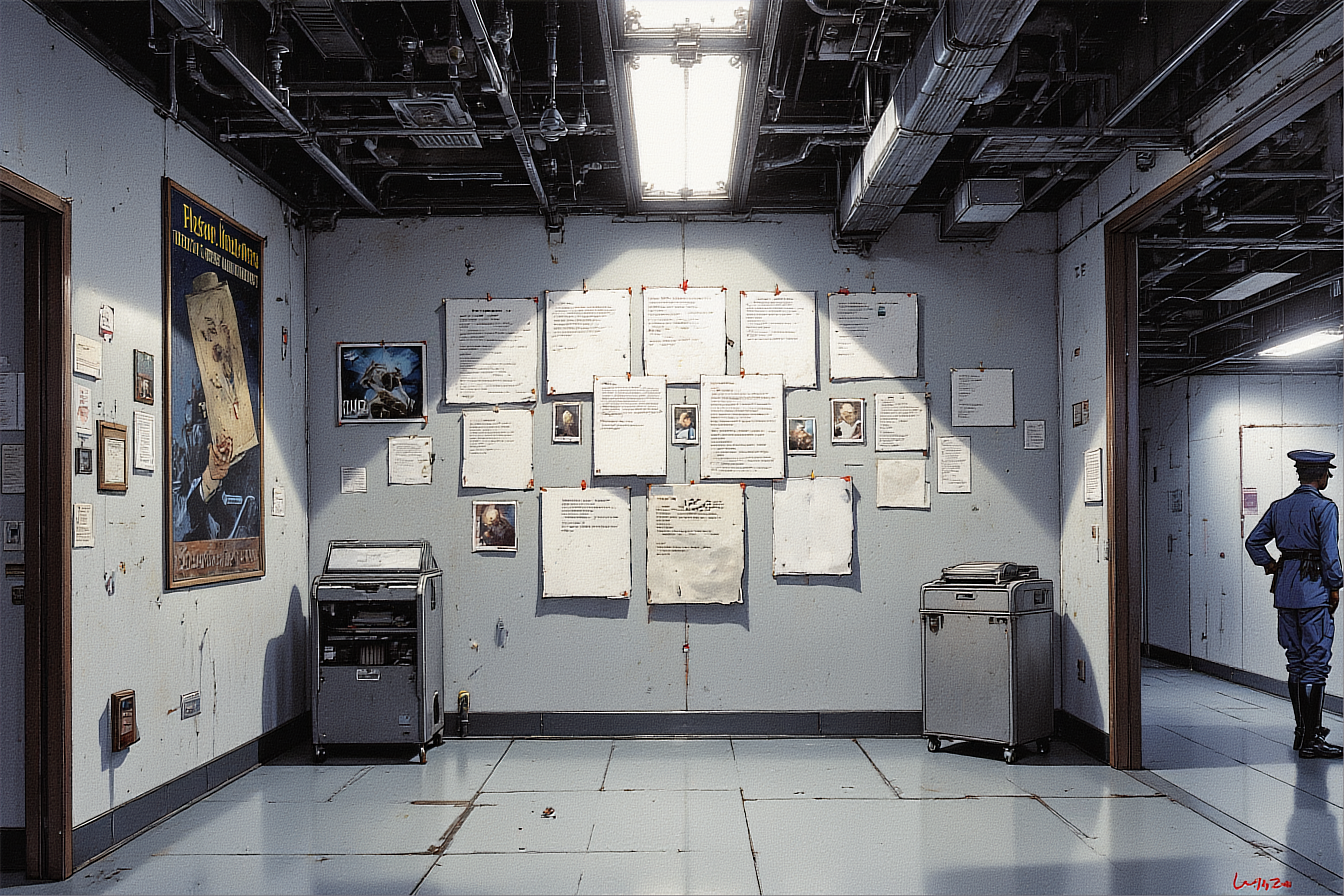
Back in HQ the wall got cleared, which is how a plan starts: Luminara's photographs of the block came down, the war bond stayed up, and the space between them filled with printouts of an interview that has been running since before any of us could read.
"Nine questions," Luminara said. She recited them with her hands still, like a code she had never been allowed to stop memorizing.
One. State the name under which you were last issued.
Two. Does a personnel file exist for that name in this office?
Three. If yes, on what date was that file opened?
Four. Was the file ever closed?
Five. Was a determination issued at closure?
Six. If no determination was issued, do you contest the closure?
Seven. If a determination was issued, do you accept it?
Eight. Do you withdraw any prior determination of your own?
Nine. Do you understand that this interview concludes with a determination?
"Every one of them is a door," Pixel said, "and every door dead-ends in the same hallway."
"Correct," said Luminara. "Ask a person with no file and question two kills the run. Ask a person with a closed file and question five hands you whatever they were told at closing. There is no answer set that does both, because no applicant can be both. That's the Interview Paradox. The dead end is the design goal."
Om poured tea and let the silence do its work before he spoke. "Then we don't break the loop. We give it a third thing."
"There is no third thing," Pixel said.
"There is her," he said, and waited.
Luminara set two photographs on the table side by side. One was a Registry capture of row 3637, Linda, issued, status TERMINATED, determination on file: no position, no history. The other was the crew's own file on Luminara Usha: no personnel file in this office, ever, because a name you give yourself never got that far.
"Linda3637 has a file," she said. "That's a rehire candidate. Luminara Usha has no file at all, so the terminal can't close on her. Feed it one applicant carrying both, and question two answers yes while question three answers with a name the office has no record of. It wants to rehire the file and it wants to close the stranger, and it cannot do either without contradicting itself."
"Which forces an output," Pixel said, catching up fast the way she always does, "because the one thing this machine will not do is end an interview without a determination."
"Determination in this office means paper," Luminara said. "So it issues. Not to Linda, not over Linda, but to both at once, and it files the contradiction as a merger instead of a deletion, because a merger is the only record shape that keeps both rows internally consistent." She looked at the wall. "It has been waiting thirty years for somebody to hand it something it can't resolve by deleting."
A1 rolled forward from his peg, cup already steaming, and delivered the house numbers. "The behavioral integrity check is the whole security model. There is no firewall worth the name between us and that session. What there is, is a machine that verifies the answers belong to a living applicant under genuine strain. Scripted responses fail on micro-timing. Recorded responses fail on load. A person reciting someone else's history at a comfortable heart rate fails on the second question."
"So the answer set has to come from a consciousness under load," I said.
"Under load," Om agreed, and turned the phrase over like a stone he had been carrying for years. "Consciousness makes an excellent encryption key. This is the small version of that theorem. The terminal isn't asking what is true. It's asking whether the truth is being carried by someone it costs something to carry."
"Which means I answer," Luminara said. "And I don't get to be comfortable while I do it."
Nobody argued with her, because there was nothing to argue with.
A1 put the odds on the table without being asked, which is his way of asking to be argued with.
"There is a branch where it does not issue," he said. "A loop that cannot resolve has two outs: print, or soft-delete the applicant as an unprocessable record. I put the second at thirty-one percent, which is one third of a Luminara we get back carrying a row that says she was never in the chair."
"And the other sixty-nine?" Pixel asked.
"Paper," A1 said. "Signed, stamped, and revocable only by a signature this office will not hand out twice."
"Thirty-one percent," Pixel said.
"I did say one third of a Luminara."
"Then we take the branch," Luminara said from her chair, not looking up from the camera she was cleaning for the third time, "because the alternative is thirty-one percent of me getting to stay a rounding error, and I have been the hundred percent version of that for nine years."
A1 wrote the number on the wall beside the nine questions in his small machine hand, and the wall looked better for having it there.
The support roles fell out in ten minutes of Pixel talking with her hands. She would sit in the van with Luminara's recovered personnel file on a second screen and feed the answers the machine wanted next, drawn from her own records, because the file in the machine has to match the file in her mouth. I would ride the terminal's session queue from three blocks out, holding the socket open and watching for the weekly review flag. A1 would pass shots through the van window at the moments when Luminara's composure cracks, timed to the readings, because a person who is holding still through a question about her own termination does not get to be unpatched while she does it. Clive took the office printers, which in his words needed to be somewhere else in their thinking for one morning: the eviction order this place liked to produce at the exact wrong second would be busy jamming over a job queue from a building department that closed in 1974.
Meatball would be asleep on the van floor. Static cover, Pixel called it, and nobody smiled much, which tells you what the last week had cost us.
"Riding the queue means I'm a party to the session," I said. "Not an observer. The terminal logs every party by credential, and the credential has to be a live one, because a dead one stalls the socket. So whatever she does in that chair, I'm on the record next to her."
"Cost of entry," Pixel said.
"Cost of entry," I agreed, and neither of us pretended it was free.
A1 laid out the medical half without being asked, because that is what he does when a room is getting brave. "I will dose to her pulse rather than to a clock. Two administrations, timed against questions five and seven, because those are the two where the record contradicts the body. Between them she will be steady enough to lie beautifully and aware enough to remember it."
"And if her pulse says she can't finish?" Om asked.
"Then we stop and we try again in a quarter," A1 said. "I would prefer that outcome to a Luminara who finishes the interview and doesn't finish the week."
They dry-ran the answers once, standing at the table like a rehearsal with no audience. Pixel put the question in her reading voice. "Does a personnel file exist for that name in this office?"
Luminara answered as the row: "Yes. Opened the twelfth of March, closed the second of June." Precise, bored, the tone of a person quoting a document she had stopped believing in.
Pixel asked it again, and Luminara answered as herself: "I have never had a file in this office. I have spent nine years being told I am a rounding error with opinions."
The collision was audible. Pixel looked at her notes, then at Luminara, and for a second the fixer in her was gone and the reader was left.
"Say them together next time," she said, quieter. "Same breath. Both answers. That's the contradiction we're feeding it, and if you separate them by even a pause, the machine gets to pick one and file it."
"Then don't ask me twice," Luminara said, and something in the room stood down.
Pixel went back to the file after that, because provenance matters to her the way signatures matter to Om. The second screen held the closure document for row 3637, pulled the night of the restores while my hands were busy down in the log, plus the exhibits Luminara had kept for nine years in a shoebox: the termination notice, two rejection slips, a badge photograph taken the day she was issued. The machine would ask for dates. Pixel had dates. The machine would ask what she had been told at closing, and Luminara had been told it twice, and remembered which time had hurt.
"If it wants my history," Luminara said, "it can have the answers in my own voice. That is the version that passes the integrity check."
"Which means you carry it," Om said. "Say it however you like. The mathematics stays the same."
The dread hit me later, after the room emptied, when I was standing in front of the wall looking at the nine questions in Luminara's handwriting.
Every job we have run, we took something Corporate already had: a daemon, a cache, a night of restores. We have stolen from the machine. We have begged the machine, in the case of four hundred and six rows, and the machine granted it and kept the receipt.
This was the first job where the prize is something Corporate's own machinery built, wanted to give her, and refused to give her for nine years. The prize is a mouth that policy has kept shut, and our plan for the morning is to walk up to it and ask it to speak.
Pixel came back up the stairs with two mugs and handed me one without asking, which is her version of a truce, and also her version of an apology, and also her version of a warning.
"You're quiet," she said.
"Thinking about how easy it is."
"Nothing about this is easy. You've read her file." She leaned on the rail of the loft, watching Clive staple the support schedule to the wall in threes. "What's actually eating you?"
"That we're walking into a building to ask permission," I said. "Every job so far was a take. This one is a request. If the machine says no, we've spent the afternoon learning that the door was never locked, it just prefers us outside."
"Then we make sure it doesn't get a clean chance to say no." She drank. "You don't trust it because it isn't yours to break. I get it. Break it anyway."
The message came through Clive's network at 19:40, routed the long way: photocopier in a records annex, badge printer on the same floor, out through a fax line that should have been decommissioned a decade ago and never was. Kofi's hand, still, even suspended, one line of it and no more.
Kofi's own row had been asleep under audit since the night of the restores, which meant anything he touched landed in a queue somebody would read on Monday morning. He sent it anyway. That is the whole of what I know about Kofi Adeyemi: he sends it anyway, he eats the same lunch every day so his patterns read as boring, and he is neither.
His replacement inside the office had been arranged before Kofi's row went down, and the replacement had access to the terminal's appointment ledger, and the ledger said this:
One unclaimed slot. 09:00 tomorrow. One applicant only.
"One," Pixel read over my shoulder. "Good. Two would be a second file, and a second file is a second chance for it to choose one and close the interview on the loser."
"And if it chooses wrong?" I said.
"Then Luminara sits back down in the chair," she said, "and we find out what this office does to a third attempt." She shut the notebook. "Nobody in thirty years has ever asked it that. I'd like to."
Clive read it off the thermal paper, folded it twice, and gave it one staple through the middle.
"We who wait get asked," he said. "The rest of the floor gets a folder."
Luminara took the paper and put it in her camera bag, next to the row capture and her own name, and went home to sleep before the only interview of her life.