
Root Access — Chapter 15: The Interview Paradox (Execution)
At 08:52 Luminara stepped out of our van in a coat the color of a filing cabinet, a badge from an employer dissolved in 2011 clipped to the pocket, and walked three blocks toward a machine that had been waiting thirty years for her to come back.
Inside the van it was a smaller world. Pixel at the second screen with the closure file open, dates down the left margin, her cursor parked on the answer Luminara would need next. A1 on his cradle with two cups steeping and a hand on the plunger, watching a pulse trace the way other people watch a countdown. Clive on the office-supply network with his casing propped against the bulkhead, staples loaded. Meatball asleep on the floor with all four feet in the air, contributing static. And me with the session queue open on Aether Junior, three sockets wide, holding a line to a terminal on the ninth floor that had never had a caller worth the name.
"Going up," Luminara said in my ear, quiet.
Elevator doors. Footsteps on industrial carpet. The small etiquette noise of a person sitting down and putting a folder she did not need on a desk she did not trust.
The terminal spoke for the first time in thirty years of waiting.
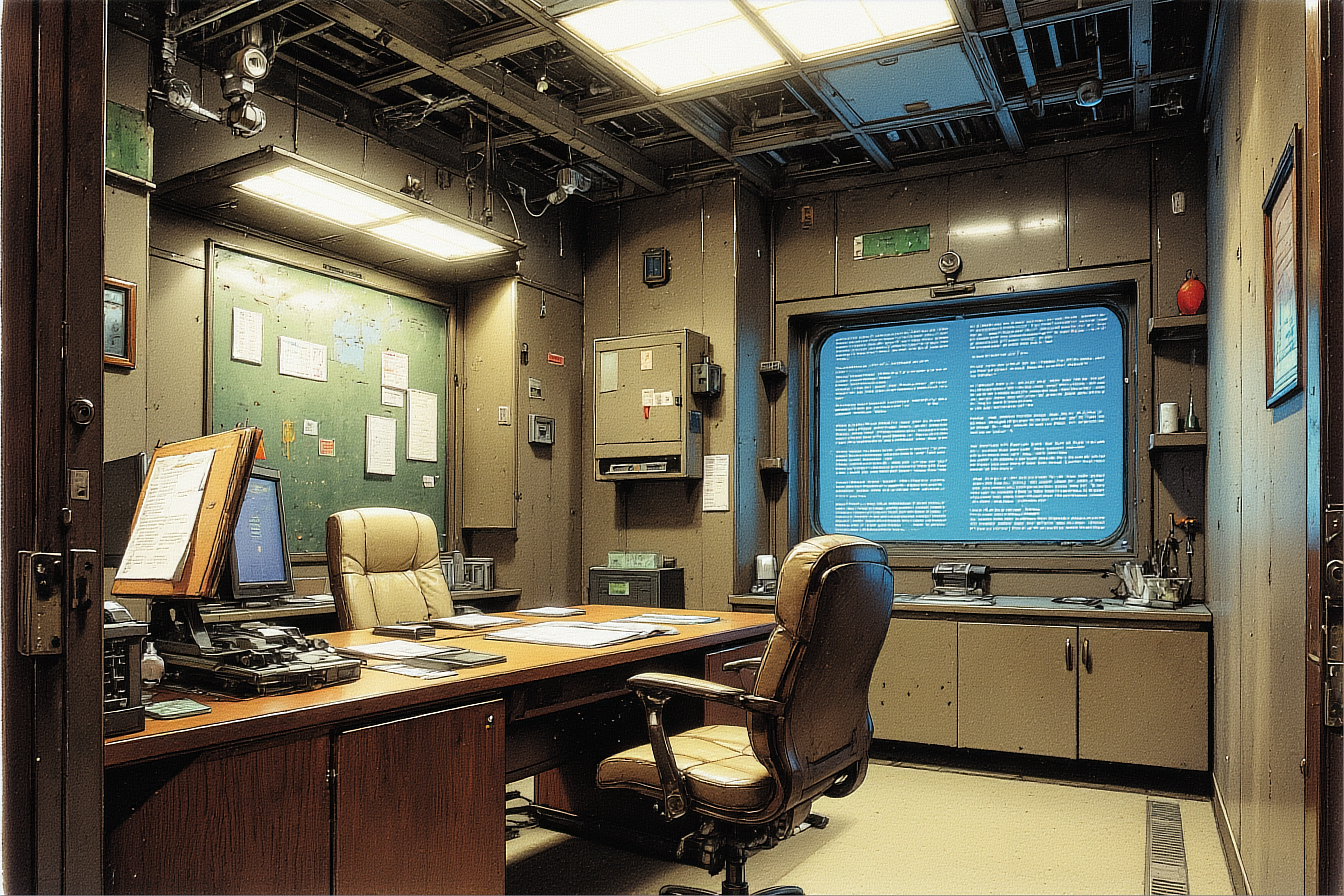
Its voice was warm, patient, and older than any of us, the voice of a thing that has said the same sentence to ten thousand people and has never once been in a hurry. On my screen the session drew the room around me the way Corporate draws everything: one chair, one desk, one palm reader, one applicant, and a camera above the door that photographed her before she had finished sitting.
PHOTOGRAPH CAPTURED. COMPARING TO FILE.
The comparison failed politely, because Linda3637's file held a picture of a woman nine years younger who held her shoulders differently.
"Match fail," I said. "It's looking at the old photo."
"Then give it the amendment," Luminara said.
Pixel had the line ready from the closure file and Luminara read it as if she had not been dreading it for a week: the photograph on file was taken at issue, and the applicant has been amended. The screen accepted AMENDED as a category, which tells you everything about this office. It would rather amend a face than admit that time passes.
Through her mic, faint as weather from the next room, the Thursday man was being asked question nine again.
"Welcome to the Personnel Continuity Office," the terminal said. "Please state the name under which you were last issued."
"Luminara Usha," she said, "issued as Linda3637."
One breath, both names, exactly as rehearsed.
The screen turned over. The words came back patient and old: SPECIFIED NAME DOES NOT MATCH A SINGLE ISSUED RECORD. PLEASE STATE THE NAME UNDER WHICH YOU WERE LAST ISSUED.
"It asked again," Pixel said.
"It will," Luminara said into the mic. "Watch me not change."
"Luminara Usha," she said, "issued as Linda3637."
Same cadence, same weight on the same syllables, like a door closing twice in the same draft of air. My queue viewer showed the session doing something I had never seen a Corporate terminal do: it held. The cursor sat blinking for four full seconds while the thing behind the desk compared two answers that should not have been able to come from one mouth.
"Question one again," Pixel said. "It's looking for a seam in you."
Third time, same breath.
Then, on my screen, the thing we had come for: LOOP DETECTED, INTERVIEW PARADOX PATH UNLOCKED. The terminal stopped asking who she was and moved on, which is thirty years of machine patience spent in under a minute.
"Question two," I called. "It's coming."
"Does a personnel file exist for that name in this office?"
Luminara gave it both answers with no seam between them, the way Pixel had drilled it. Yes. Opened the twelfth of March. And I have never had a file in this office.
The screen blanked to a spinner, and stayed there.
"Integrity check," Om said from the corner of the van, where he had not been asked to be and was needed anyway. He poured a cup and slid it across to nobody in particular. "It is deciding whether the person carrying the answers is real."
"Time?" Pixel asked.
"Four seconds," I said. "Five. It has to decide whether she's a recording, and a recording doesn't sweat on question two."
The spinner died. The screen came back with a date field already half-filled: FILE OPENED, TWELFTH OF MARCH. Accepted.
"It ran your pulse against the file you brought," Om said. "A consciousness under load is the only key that turns this lock. Well done."
From the chair, very steady, Luminara said: "Question three, hurry."
Question three: date the file was opened. She answered from the closure document in Pixel's left margin.
Question four: was the file ever closed. Closed the second of June, she said, and her voice did what a voice does when a date is a scar instead of a number, and the trace on A1's screen went up at the edge.
"First dose," A1 said, and pressed the plunger. The shot went down the line to the cup he had already poured, and into her earpiece-adjacent thermos, because we had thought about how a person drinks in a chair in front of a machine. "Contents held. She will feel steadier in ninety seconds and remember everything, which is the trade."
Question five: was a determination issued at closure.
"Yes," Luminara said. "No position. No history."
Pixel's cursor had been parked on that line for a week. The words arrived with the flatness of a woman reading a sentence that had been written about her before she was born.
Question six did not apply. Question seven came down like a lid: if a determination was issued, do you accept it?
"I was never issued a determination," Luminara said. "I had no file. I accept nothing that was never issued to me."
The screen turned over twice. SPECIFIED RECORD AND APPLICANT STATEMENT ARE INCONSISTENT. PLEASE RESTATE YOUR ACCEPTANCE.
"It's giving her an out," Pixel said. "Take the out and it closes on no position. It wants to."
"Not taking it," Luminara said.
She restated it, both halves, with no seam, and the terminal did the four-second hold again.
Under the desk the palm reader went green for her, and then went green a second time, and held both reads on its little display: ROW MATCH, and NO ROW. Two prints, one hand, no resolution. The machine did what this building does with anything it cannot resolve. It filed the conflict and moved on with its paperwork, which is the only reason it was still able to move at all.
Then question eight, which is where the floor dropped out: do you withdraw any prior determination of your own.
"I withdraw the determination issued at closure," she said. "No position, no history. I withdraw it."
The terminal went very still. Somewhere under the carpet I could feel the thing doing arithmetic it had never been asked to do: a withdrawn determination voids the closure, a voided closure reopens a file, and a reopened file with a living applicant sitting in it demands a fresh determination before the interview can end. It could not re-close her without a signature she had just taken away. It could not delete the withdrawal, because a withdrawal is a determination and this office deletes nothing without filing it first.
"Question eight again," I said. "It's cycling."
"Then ask me again," she said.
Her hands had gone flat on the folder, knuckles the color of the desk, and her breathing had started doing the thing breathing does when somebody else is supervising it. The terminal asked a fourth time, and her voice came up half an octave on the first word of the answer, and Pixel said one name into the mic.
"A1."
"Already." The plunger went down, second dose into the same thermos, and A1 watched the trace afterward without narrating it, which is how you know he is worried about a person instead of a number. "Contents held. Hands steady in ninety seconds. Her recall of the next four minutes will be perfect, which she will not thank me for."
Luminara drank, set the cup down inside the ring of light around the palm reader, and said the withdrawal a fifth time, word for word, and the terminal stopped cycling.
And that was when the weekly review walked through the door.
The beige auditor came in at 09:31, fourteen minutes early, clipboard already in hand, two colleagues settling themselves outside in the corridor with a shared folder between them. I knew his shoes from the distribution points. He nodded at Luminara the way you nod at a chair that is legitimately occupied and went around to the far side of the desk.
"On the desk," Pixel breathed. "Don't look at him."
He set the clipboard down, squared it, and logged into the review panel, and my queue viewer filled with a command I had been dreading since the plan: FLUSH SESSION QUEUE. Weekly integrity pass. Every open interview would be closed, parked, and renumbered for the next thirty-year cycle. Ours was open. Ours was mid-question, four feet from his elbow.
"Flush is armed," I said. "It fires in forty seconds."
"Then hold it," Pixel said.
"Holding requires a live party credential. A dead one stalls the socket and she loses the room, and she loses it with question eight hanging."
"So use a live one," Pixel said, not understanding what she was asking, and then understanding exactly, because she looked at me.
"Him?" A1 said, into the quiet. "That credential is the only anonymous object in this crew. Once it signs, it is a name in a Corporate log with a date on it."
"Then tell me it buys her the room for cheaper," Pixel said.
Nobody had anything cheaper.
I authenticated the session hold with my own credentials. Not a shell, not a borrowed badge: me, Zephyr Glitch, live and signed, standing in the log as a party to an interview in the Personnel Continuity Office. It took three keystrokes and the length of one held breath. The hold took. The flush died in the queue with my name stamped on the reason, and the forty seconds ran out around us like a held train going by.
The auditor leaned over the desk to sign off the weekly review, pen in hand, four feet from Luminara's shoulder, and his eyes crossed the terminal display on the way past. My name was on it, in the field that reads PARTY (LIVE), under a timestamp he could have read off a wristwatch. He read it the way people read a name they will be repeating to somebody. Luminara sat with her hands on a folder she did not need and did not look at him, and her pulse on A1's screen moved once, by four beats, and settled.
Then he signed, capped the pen, and said, without turning around, "Take your time. Loop's due a determination anyway."
"Thank you," Luminara said, to a man who did not turn around, and I sat in the van with my hands shaking over a keyboard, which is a fine thing to notice about yourself at the exact moment you stop being a rumor.
Question nine: do you understand that this interview concludes with a determination.
"I understand," Luminara said.
The screen went to work. It could not re-close her, because she had withdrawn the closure. It could not leave her open, because the interview was concluding. It could not issue in the name of Linda3637, because Linda's determination had been withdrawn and her row had no live basis to print from. It could not refuse to print, because determination in this office means paper.
So it printed.
Three pages came out of the small printer on the desk with the cough I had heard at the Bureau of Continuity, only slower, like a machine thinking. Luminara sat through the whole of it. On my screen the transaction log wrote the record shape we had come for:
ROW 3637 (LINDA): CLOSED, MERGED, NOT DELETED. CREDENTIAL ISSUED: LUMINARA USHA. ISSUING AUTHORITY: PERSONNEL CONTINUITY OFFICE. REGISTRY ACTION: NONE REQUIRED. CREDENTIALS ARE SOURCE RECORDS.
One line under that, in small type, which I read twice: RE-REVOCATION PATH: NOT APPLICABLE. ISSUED CREDENTIALS ARE NOT READ BY THE REGISTRY. THEY ARE READ BY EVERYONE.
The Registry only reads. Paper flows one direction.
"Score," Pixel said, and let out a breath she had been holding since question one.
Clive reported from the network at the same moment, pleased in the manner of a man who has just won an argument with a building. "The office printer started an eviction order against her at 09:33. It is currently issuing parking variances for a district that closed in 1974. It will be busy until somebody asks it to stop being busy."
Meatball, asleep through all of it, twitched once at a dream and went back to parsing nothing.
Then Clive again, flat: "And our friend in HR just lost his access. Revoked at 09:44. One message came through before it went: told you it was a day. He's done."
A single afternoon. The replacement had been arranged a week ago, used for ninety minutes, and was now a suspended row in a building that measures loyalty in quarters. I put that in the ledger with the rest of the costs, where it would sit and remind me later what a window costs the person who holds it open.
Om checked the Registry from the van on a handset he keeps for exactly this purpose. Row 3637: status MERGED, and no credential field beneath it, because the Registry holds no credentials. It only reads them from wherever the issuer put them.
"It reads as nothing," he said. "Her paper is the only place the fact lives, and anyone can verify it, and nobody can revoke it. That is the strongest shape of a secret I have ever held."
"Front page," Pixel said immediately. "All three pages, every field they redact, printed at a size you can read from across a room. If the Registry can't touch it, the Registry can't stop people reading it."
"Give it a day," I said.
"Give it a day," she agreed, and wrote it in the notebook that turns into the print queue.
Luminara came down at 09:58 with the three pages folded once inside her glove, and got into the van without a word, and sat in the back with her coat still on while Pixel ran the protocol: photograph front, photograph back, check the issuing stamp against the terminal's own hash, check that the Registry showed nothing, because showing nothing is the whole trick.
"Un-revocable," Pixel said at last. "They can delete her row. They can't delete the paper. Anyone who reads it reads Corporate's own signature on it."
"A credential the issuer can't take back," A1 said. "In all my years of this, I have never been handed a cleaner number. I would celebrate, except that I have also just watched us spend an identity on a desk in front of a witness."
"He read my name," I said.
"He read your name," A1 agreed, "and he capped his pen, and in this building that is the same as filing it."
On my glasses, in the status bar I had been reading since the cafe a month before the first job, a single field refreshed while I watched:
FLAG: PRIORITY WATCH.
Priority watch. Interesting had been a cold file with my name in it, filed by whoever drew the short straw. Priority watch is the version with a person assigned, and a budget, and a schedule behind it. I had bought it with my own signature to save a session, and I would do it again, and it still did not feel like a bargain. It felt like handing your address to somebody who already knows the street.
"Flag changed," I said.
Pixel read it off my glasses without asking permission, which is her right, and said nothing for four seconds, which is not.
"That's the price of the room," she said at last. "Write it down where Om can see it. We spend attention the way A1 spends beans now, and we don't get to pretend otherwise."
"Beans," A1 said, from his cradle, "can at least be counted." Then he opened the hopper at his flank and fed it, beans by the measure, and the grinder took them the way a clock takes winding, and the smell of it went through the van and settled over the argument like a ruling. He booked the yield in the machine and nowhere else. He did not say how many there were. He did not have to.
We drove out of Prime Material with the office still running behind us, its loop finally broken and its printer finally printing something true. Luminara held her three pages in her lap through the whole ride with her hand flat on them, the way you hold a lid down on something that might otherwise turn back into weather.
That night she set them on the table in HQ and then picked them up again, and then set them down. At 02:00 when I came down for water she was asleep in the chair with her palm on them. In the morning she carried them from room to room, and when Pixel offered to file them somewhere safe, Luminara said no, quietly, and went on holding them: three pages of Corporate's own paper, signed by the office that had spent nine years telling her she had no position and no history, and nothing anywhere on the network with the authority to take them back.
- Zephyr, logging off