
Root Access — Chapter 16: The Wave
The press ran the credentials at a font size you could read from across a room, which was Pixel's instruction, given twice, because a proof you have to lean into is a proof you can be told you imagined.
By 05:00 the first copies were warm enough to fog a thumb. By 06:00 there was a line at the distribution point on the corner of 9th and Canal that had not been there yesterday, and by 07:00 the line had stopped being a line and become a crowd with a purpose. People came to hold a printed copy of their own row: name, number, the stamp of the office that issued it, and under everything, in small type, the sentence Corporate had never once printed for a person: this record is valid.
A man in a delivery vest held his against his chest like a menu he had finally been served.
"I existed before this," he said to nobody. "Nobody could prove it."
"Now you can prove it to them," the volunteer at the table said, "and you can't prove it to anybody else, because it's yours."
"That's the trick, isn't it."
"That's the whole trick."
I stood at the back of that line with Meatball on a lead and my glasses up, counting heads the way Pixel counts diffs, and the number I kept coming back to was the number of people holding their own paper up against ours. Every person in that line had been carrying a document for years that the network refused to read: a birth registry slip, a work permit from a folded employer, a laminated card from a school that got re-zoned out of existence. They brought it because being told your own document is decoration does something to a person, and being handed the same information on Corporate's own stock undoes it.
A crate of names arrived at 08:00, consigned to the help desk with no return address: slips torn from notebooks, phone bills, church registers, a kid's report card with a parent's row number written in the margin. Each one had a name at the top and the same sentence underneath. CAN YOU MAKE THIS ONE REAL.
A volunteer asked me what to do with it.
"Number it, photograph it, queue it behind the ones we already have," I said. "And answer this part: the queue is real, and the queue moves."
Because that is what a person writing that sentence wants. The yes or the no comes later, and for most of them the answer will be no for years yet. What they can have today is a place in a line that somebody else is standing guard over.
By 09:00 our subscription count had passed every issue we had ever printed, combined, and Pixel said the word out loud in the middle of the room, twice, because she does not believe numbers until she hears them with her own ears.
The argument in HQ started before the ink dried, and it was the best fight we had ever had.
"If the Registry can be beaten from inside," Pixel said, pacing with a copy in each hand, "then every unregistered name can be issued. That's a different verb from restored, and it's the verb we want."
"Restores are writes," Om said. "Writes get overwritten."
"Exactly. But issuance isn't a write to the Registry. It's a document the Registry has to read. We spent one night and four hundred rows begging for their ledger to let people back in. This" she held up the credential, "is walking into their office and asking for paper they have to sign."
"The machine only rehires," Luminara said from her chair, where she had been since 04:00 with her own three pages in front of her. "It won't do it for everyone."
"It did it for you."
"It did it for a paradox," she said. "A person who was both a closed file and no file at all. Most unregistered people are only the second half." She turned a page. "So we find the ones who are both. Anyone who was ever issued and then unissued has a row it can rehire. There are a lot of those."
The room went quiet in the way rooms go quiet when the map just got bigger.
"Clive?" Pixel said.
From his wall, where he had been following the argument by the sound of it, the stapler gave his read of the traffic. "Paper knows its people. The machines file a name and forget it. People print a name and carry it. We who bind, we who exist, and now we who print, for whatever printing is worth."
"Printing is worth exactly one thing," A1 said, rolling forward with cup in tray. "It is worth a proportional increase in the number of people sent to observe us, and the hiring notices have already posted at eleven hundred roles. I will add that I consider this the most predictable result in the history of this crew." He set the cup down. "Subscriptions doubled overnight and are still climbing. Distribution velocity up four hundred percent. My projections indicate we have taught several million people a word they had stopped using: tomorrow. I also project that this level of attention has a half-life, and that the other side of it has a payroll."
"They already have the payroll," Pixel said. "We've met them. Three clipboards."
"Then meet the rest of them," A1 said, "because hiring notices went up at 06:00."
He was right. The notices were everywhere by breakfast: internal postings, agency contracts, beige tiles on every job board in Prime Material. THOUSANDS OF AUDITOR POSITIONS OPEN, the banners said, and under them a program name that had been chosen by somebody in a room with very good lighting: the Unperson Initiative.
"Audit everything they've touched," Pixel read, flat, standing in front of the wall where the postings had joined the war bond and the commendation memo. "The Registry restores, the mind-farm story, the beach, the distribution points, the credentials. Re-audit all of it."
"And the credential itself," Luminara said. "Filed as a precedent pending review."
"Filing it as a precedent is the polite version of a threat," Pixel said. "It says: we know what we printed, and we're deciding whether to keep knowing."
"It also says they can't just void it," Om said. "You don't review a forgery. You review a document that works."
Marrow's own team filed the paperwork, courteous as everything she did: a review window, an acceptance criterion, a comment field left open for our feedback. Her press line called the credentials "an issuance event under evaluation." Nobody came to the door. Nobody needed to. By noon the initiative had posted eleven hundred auditor roles, and by evening the first of the new ones were standing at our distribution points beside the original three, sharing folders, politely measuring.
I read the filing itself on my deck at 16:00, because Corporate loves a comment field. PRECEDENT REVIEW: ISSUANCE-001. Source document: credential, Luminara Usha, Personnel Continuity Office. Question on review: whether issuance under existing terminal loops creates obligations the Registry must carry. Comment field: open to involved parties, seven days.
At the bottom, in the signature block of the reviewing officer, her name.
I. MARROW, CHIEF REALITY OFFICER.
She had put herself on the review of the document that proves her own machine can be argued into telling the truth, and she had left us a form to fill in. I read it three times looking for the threat and found none of it anywhere. What I found was a comment field, patiently open, the way a lab leaves a lid cracked.
Two of the new auditors came to our table on 9th at 17:00 with a laminated sheet asking every person in line to register their copy for review. The volunteer on shift, a seventeen-year-old from the block named Ferreira who had been with us since the crate, handed each of them a copy instead and told them the register was full.
"Registers don't fill," the older one said.
"This one did. Nine thousand entries, all names, closes at midnight." Ferreira had Om's handwriting on the laminated sheet behind him, and the auditors read it, and one of them took a copy anyway, and they stood there measuring us for eleven minutes without finding a single thing to write down.
The zine's answer was a room.
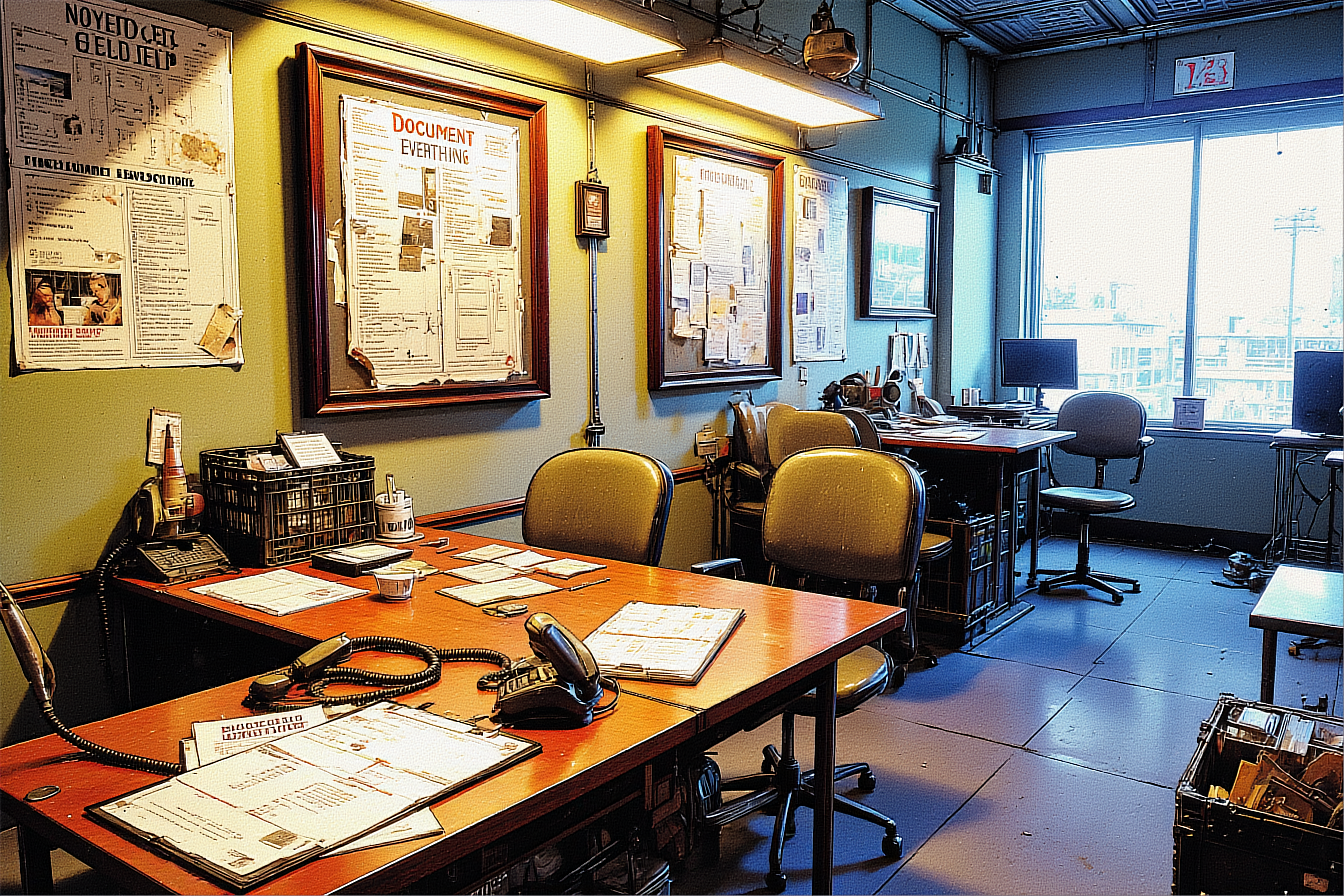
The help desk started as a folding table in the corner of HQ at 11:00, one handset, Pixel's notebook. By 14:00 it was two tables and four volunteers, people from the Vega block who had heard we were the address you write to. By 18:00 there was a phone tree: three handsets, a call roster, and a laminated sheet of rules Om wrote in his small exact hand, the first of which was NOBODY GETS DELETED WHILE THEY ARE ON HOLD.
The second rule was: document everything.
Volunteers came through the door in a stream all day, and the stream needed supervision, and supervision needed a person the room would listen to, and that person turned out to be Luminara, who had wanted a camera and got a counter instead.
"No, the credential does not replace your row. Yes, you still need the row. Yes, we will try. No, we cannot promise, and anyone who promises is selling." She said it forty times an hour, precise as a metronome, and people calmed down in front of her the way people do in front of someone who has clearly been through the thing they are afraid of.
Someone started calling her the office. She did not like it. She also did not stop it, which told me something about the nine years.
The call at 16:20 was a woman named Ada Prewitt in a kitchen in Sector 4, holding a landline handset the color of a tooth, asking whether a row deleted in 1998 could be issued rather than restored. Pixel looked up from her notebook. Luminara took the handset.
"Was there ever a file?" she asked.
"They told me it never existed."
"Somebody filed the telling," Luminara said. "That's how being told works. Give me the office name, the year, and the clerk if you remember the clerk."
"I remember the clerk."
"Then we have a door," Luminara said, and wrote it on the roster in her small even hand, and Ada Prewitt on the landline made a sound at the other end of the line that nobody in the room knew how to bill, and the phone tree rang twice more before she had put the handset down.
"That's the shift," Pixel said to me at 21:00, watching the room work. "We used to be a crew with a zine. Look at it now." The press was running in the next room, the handsets were going, a teenager from the block was stapling rows into envelopes with a rhythm Clive approved of from his wall. "We're a zine with a crew. The crew is the part that goes out at night."
"And Luminara's the face."
"Luminara's the face," she agreed. "Whether she likes it or not, which is the price of being the only person in the room whose paperwork is beyond argument."
The costs arrived on schedule, because costs in this business arrive on schedule.
Nobody slept. That is the simple version and it is true: the help desk ran past midnight, the phone tree rang in three rooms at once, and by the second day the crew had divided itself into shifts without anyone proposing shifts, which is what happens when a room becomes an institution. Om sat with the roster and moved names around and said nothing about the hours, and if you asked him how he was, he handed you tea. Clive took the night sheet because, in his words, the machines do not sleep either and neither should their shepherd.
I took the 04:00 shift three nights running, which is how I know the exact sound a handset makes when it rings in a room where somebody has fallen asleep holding it: one ring, a scramble, then a voice doing a convincing impression of a person who is completely rested.
"The Ephergent, this is the office," Pixel would say at 04:15 from the floorboards, where she had been answering calls until the floor happened to her. She ran the whole operation loudly and on purpose, the way she runs everything, and by the third day the volunteers had stopped asking her permission to do obvious things, which I suspect was the actual goal.
A1 re-counted the patch supply at breakfast, which he does daily, and announced the number the way he announces weather coming off a falling anvil.
"Nine shots."
"Nine," Pixel repeated.
"Nine. I recount daily and it comes up nine daily, which I find restful in the way that a fixed number of anything is restful before you have to spend it. Two jobs remain on the ladder, as I understand the plan. Two jobs, nine shots, and a city that now expects us to answer a telephone."
Om, at the far end of the table, set down his kettle and said the other cost.
"Someone is modeling my butter tea."
The room didn't stop, but it slowed, the way rooms do when a floor turns into a lid.
"Modeling it how?" I asked.
"Pattern," he said. "The recipe has been requested through four separate help-desk channels in two days, each from a different address, each phrased as an admirer. My butter tea destabilizes drone tracking. Whoever is asking wants to know what destabilizes drone tracking, and they are asking politely, and they do not drink." He poured a cup anyway. "Something that never drinks has taken an interest in a beverage that exists to make following us difficult. I have noted it. The recipe stays with me."
"Document it," Pixel said.
"Already written down," Om said, "which is the problem. Anything I write down is also somewhere they can read."
He picked up the roster and moved two more names, and the night shift went on, and nobody slept, and the telephones rang in a room where people were learning, for the first time in their lives, that ringing phone meant somebody was trying to exist on schedule.
At 03:00, when the last handset had gone quiet and the volunteers had taken the couch, I found Luminara in the back room with her three pages under the lamp.
She had them out on the table in order, weighted at the corners with a lens cap and a cup, and she was looking at them the way other people look at photographs of people they have lost. Her camera was beside her, unused, which in that room was a kind of silence.
"You've been carrying those for two days," I said.
"I know where they are at all times now," she said. "That's new."
I sat down across from her. The press thumped away in the next room. Somewhere out front a handset rang once, thought better of it, and stopped.
"I need you to understand something about me," she said, "because the room out there has started calling me the office, and the office is the thing I ran from." She lined the pages up against the edge of the table. "Nine years. I was issued row by row, designation first, name never, and every door I walked into after that had already read the row and closed. I spent nine years being told I was a data-entry error: an error the way a line of code is an error, something to be corrected by somebody with authority."
Her hand came to rest flat on the top page.
"And then this prints." She looked up. "Do you know what the strangest part is? It's the same machine that told me I had no position and no history. Same office, same nine questions, same voice. It showed no softening and no apology. It reached the only output it was capable of producing and produced it." She pressed down slightly on the paper, the way you check a thing is solid. "Paper is heavier than it looks, Zeph. You spend your whole life being told you're imaginary, and then somebody official prints that you aren't, and it weighs more than any photograph I have ever carried."
I did not say anything for a while, because there was nothing to say that would not make it smaller.
Outside, the telephones were quiet for the first time in two days, and the press in the next room finished a run and stopped, and in the silence you could hear the city out there doing what it had started doing that morning: believing it exists.