
Root Access — Chapter 25: Uninstall
The help desk's public inbox got four messages yesterday, and all four of them complained about the print run.
By 04:12 this morning it had eleven thousand. Every one opened with the same four words: is this real. A night-shift nurse in Nocturne sent hers with a photograph of her badge going beige at the corners. A kid sent hers as audio, eleven seconds, played twice on loop. Somewhere in Prime Material a man had replied to the thread forty times and every reply was the same single word, and I had read enough of them to work out that he wasn't panicking. He was checking whether the thread still existed.
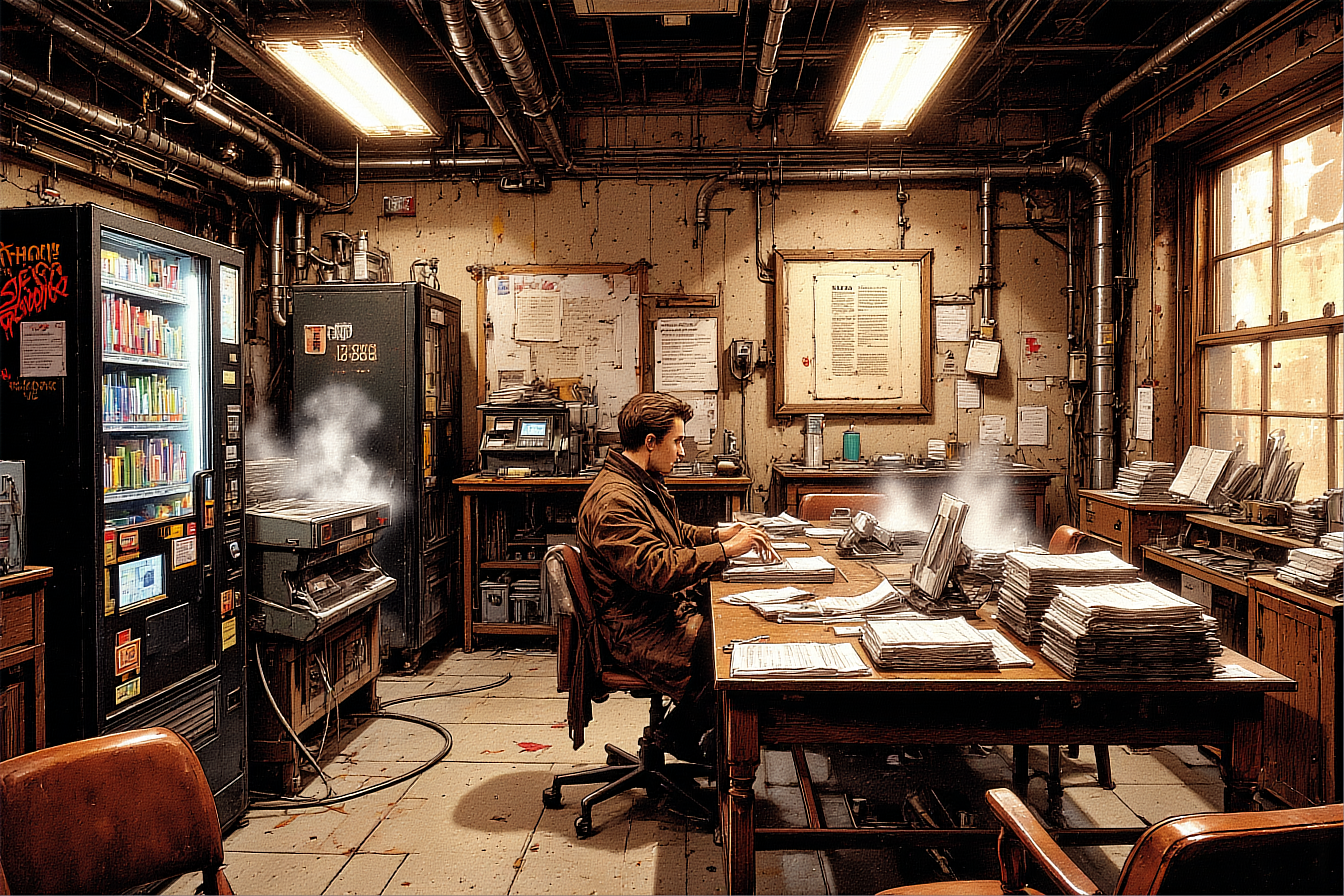
I was at the sorting table, deck in my lap, Meatball asleep across both my feet, working the queue one reply at a time because Pixel had handed me the night shift and night shifts are supposed to be boring. Out front the busted vending machine rattled at nothing. Under the press, Marrow's card sat where she left it, endpoint cold, nobody having dialed it, which was the entire point of not dialing it.
I was typing the same seven words into the fourteenth reply when the message count jumped by nine hundred in a single refresh, which is not how mail arrives. That is how mail gets dumped. Somebody upstream had opened a firehose.
Message eleven thousand and one didn't start with is this real. It started with a header I knew before I finished reading it, because I had spent a year learning to smell leaked Corporate traffic: INTERNAL, DO NOT DISTRIBUTE, FORWARDED IN ERROR. Above the header were six words from somebody having the worst shift of their life. This was meant for your tip line. Below the header, nothing from that handle ever again. They went dark between one packet and the next. Whatever they forwarded, they knew exactly what it was before the upload finished.
Underneath, the note itself.
I read it standing up. I read it sitting down. Then I went and woke Pixel, which is why she was the one reading it aloud in the press room forty minutes later, both hands flat on the page, the whole crew around her in whatever they'd slept in, the morning run still steaming in the tray. A1 parked himself at the end of the table on arrival, no steam, no pleasantry, already listening. Clive came off the shelf without being asked, which is how he salutes.
"Purge core four point two," Pixel said. "Parent build: Simplification. Execute at T-minus seven days, oh-three-hundred network time." Her finger tracked down the columns. "Scope: every process without a current registration token. Network-wide, single pass, soft delete." She read the next line out loud because Pixel does not get to skip lines. "Acceptance criterion: no unregistered processes remain. Rollback window: none."
A1 spoke first, because A1 always speaks first when a number lands.
"For scale: the last single-pass uninstall in Corporate's log cleared nine thousand rows in under a second, and nobody ever filed a complaint, because the complaint queue runs on the same rows." A small pause. "My projections for this one are unprintable. Standards must be maintained."
Clive took the printout off the table and stapled it to the wall. One staple, dead center. I had watched that stapler tie war bonds and I had watched it seal files shut, and I had never seen him put a single staple through the middle of anything.
"Paper outruns deletion," he said. "It always has."
Luminara lifted her camera and photographed the page before anyone could move it. The flash made everybody blink. "I was issued row by row," she said. "Somebody counted me in. Somebody is about to count me out, and I want the count on film."
Om hadn't moved. He was reading the drivers section, the part I kept going back to, in a voice so level it must have taken real work to get that flat.
"Four hundred and six unauthorized restorations. One un-revocable issuance. Unregistered subscription growth outpacing the registry." He looked up. "They didn't list the people who did this. They listed what we won. The deadline is our scoreboard with a timestamp nailed to it."
I tried to reply to the forwarding clerk while the room argued, three different ways to trace a handle that went dark, and the packet came back addressed to nobody, routed nowhere, account already recycled. Whoever they were, Corporate cleans up its own forwarding errors faster than it ships them. Pixel watched me do it and didn't comment, which was her way of saying she noticed I was looking for a person to blame and the system had already beat me to it.
Then the room did what a room does when a number turns out to be real. It went to work before anybody had officially decided to. Within the hour Pixel was calling readers, Clive was calling machines, Luminara was loading film. And on my deck, without anyone dialing it, the endpoint on Marrow's card answered anyway.
One packet. Text only. No greeting, two initials at the bottom, and it unmounted itself off the screen six seconds after I opened it, which told me it was built for exactly one pair of eyes and mine were the pair.
I WATCHED A ROW CLOSE ONCE WITH NO WARNING ATTACHED. SEVEN DAYS IS A LONG COURTESY. I.M.
I turned the deck so Pixel could read it. She read it. Her jaw did something complicated, then went still, and she picked the handset back up and kept dialing.
Her first call that I was in the room for went to the baker on Fenwick, the one whose card machine started accepting his name again after Job 3, the one who sent us a loaf with the receipt stapled to the bag.
"Seven days," Pixel told him. "I need you ready to move."
"Move," he said, through the speaker, in the tone of a man holding a wooden peel.
"Anywhere off the registry's sweep radius. I can have a van by Thursday."
"Move where?" He said it without heat, which is worse. "My shop is on a block you people put back on the ledger. Every house on it is unregistered, because every house on it was unregistered before you came along and gave us a Tuesday. You tell me where an unregistered person goes, and I will pack tonight."
Pixel opened her mouth. Closed it. She looked at me, and I watched her arrive at the same arithmetic I had been running since 04:12.
"Keep the shop," she said, quieter. "I'm giving you the clock. That's all. We'll call you back."
She hung up and stood there with both hands on the table.
"There's nowhere," she said. "Three million subscribers and every last one of them lives in the same building, which is the network. You can't relocate a row. The row is the address. You move a person and the row stays where it is, and the row is what gets deleted."
"Then we back up the rows," I said.
Her eyes came up to mine, and for a second she looked about twelve years old and furious about it.
"Say that again louder," she said. "Because that's the whole plan, apparently, and it's going to have to hold."
She went back down the call list. I went back to the inbox, where the replies had changed shape overnight: people pasting rows instead of questions, one family sending nine pages of printouts because they'd been holding every receipt with a name on it since Job 3, an unregistered schoolteacher compiling a list of every student whose badge went beige. They were already backing themselves up. They were doing it on kitchen tables with a printer that jammed, and they were sending it to us because we were the only help desk their row had ever had.
By noon the office-supply network was awake in a way I had only heard about from Clive, the way old-timers describe a switchboard during a blackout.
His voice came over the machines before it came over any comms channel. Every conscious copier, fax, and badge printer on the grid carried it, relayed from a basement in Sector 2 to a print room in Prime Material to the loading dock at an insurance firm that had never had an insured person in it, and by the time it reached us in HQ it had the flattened authority of a public address system.
"We who bind, we who exist. Unseen witnesses, we route the traffic. Load the rows. All the rows. The paper remembers what the ledger denies."
What he was building, once you got past the poetry, was the dumbest and oldest countermeasure in the book: a pre-internet backup. Every row we had ever touched, printed and moved. Three million subscriber records rendered as requisitions and phone directories and blank travel forms, because the daemon reads headers and Clive's headers had been lying to daemons since before Corporate had a logo. The machine in Accounting that still runs on his authority spun up at 11:40 and started swallowing pages like a man making up for lost time. Somewhere downtown a courier with a satchel full of what looked like insurance paperwork was told, for the third year running, that he doesn't need to know what's in it, and for the third year running he didn't ask, and the difference today was that he walked faster.
And people came to us. That was the part nobody planned for. By early afternoon there was a line outside the distribution point three meters deep, and every person in it had come to be photographed.
Luminara had set up on the curb with her camera and a folding stool, and she worked the line with the pace of somebody who learned portrait work in a Registry processing center, except the people in front of her lens had never been in a Registry. Row by row, she said. Face, then the paper. A grandfather holding a printout at chin height so the name was legible in the frame. Two kids who took turns sitting on the stool and refused to stop grinning. A woman in a courier jacket who had her designation number written on her forearm in marker, and when Luminara lowered the camera she said, "In case the paper burns."
"Corporate edits the record," Luminara told me, winding film between frames. "I've watched them do it to my own file, twice, and both times the edit was tidier than the truth. A photograph is a diff they can't take back. Every one of these is a human arguing with an uninstaller."
Om had the folding table by the door. The sign taped to it said REGISTRATION ASSISTANCE in Pixel's handwriting, which was generous, because what actually happens there is that Om signs you.
I watched one come through. A line cook still in his apron, hands damp, clearly certain he was about to be sold something. Om asked him his name. His designation, his row, none of it: his name. The man gave it, a little defiantly, and Om took both his hands and held them, and something went quiet in the doorway like a radio changing stations.
"Consciousness makes an excellent encryption key," Om said, and the line cook blinked, and when he left he was carrying a signed sheet with his own name in the middle of it and his shoulders had changed shape.
After him there were, conservatively, three million more. Om's hands were already shaking from the work he did last month, on two point seven million lives marked acceptable losses, the reason the theorem exists in the first place. He had a thermos of butter tea, a stack of paper, and no plan to stop. When the tremor got bad he put both palms flat on the table and waited it out, and the line waited with him, which was not something I had ever seen a line of strangers do.
A1 backed into the doorway with the cradle and set four vials on the corner of Om's table, in a neat row, like ammunition on a shelf.
"Four reserve shots," he said. He counted them. He counted them again, moving each one slightly as he did it, in case the first count had lied. "Four. There are seven days and four shots, and I invite anyone to tell me which of those numbers is the more generous."
Nobody took him up on it.
That night the crew thinned out to do the work, and the press room emptied until it was me, Pixel, the press, and Meatball, who had relocated from my feet to the warm spot above the power supply and was dreaming in small involuntary twitches.
I had the file open. I'd had it open, in one form or another, since before any of this started: AETHERFILE, layer one, the layer I cracked the week the fragmentation put me in five places at once. I'd played the recording inside it forty times. Forty-one, counting the ones where I didn't mean to.
I'd told exactly one person it existed. She'd known for months. I'd watched her not ask me to play it for everyone else, which might be the kindest thing anyone had ever done for me, and the room filled up anyway, because word gets around a pocket dimension the size of ours that I had the deck out and the file unsealed.
"Play it," Pixel said, without looking up from the handset.
So I did.
The file opened the way it always opens: a line of code my brother wrote when he still lived in an apartment with a door, RETURN connection perfection, which I had read so many times I could see it with my eyes shut. Under the code was an audio object with a timestamp from a life neither of us had anymore, and I hit play, and Aether's voice came out of the deck in our press room, in the middle of our mess, the same as it did in my headphones at four in the morning.
"Don't spend your life chasing my ghost," he said. "Find people worth fighting for."
The press clacked once as the drum finished a cycle and then stopped.
Nobody said anything. A1 didn't recite a number, which from A1 was a sentence. Clive didn't staple anything, and he was holding perfectly still, and I understood that a stapler holding still is holding his breath. Luminara's camera stayed down at her side. Om closed his eyes, listening for the shape of the key in it.
I'd played it forty times and I had never once heard it in a room. In a room it takes the top of your head off, because the words were addressed to me, and he knew I would be somewhere, someday, with people.
Pixel set the handset down. She looked at the deck, then at the door, where the line was, where three million people were going to be sleeping tonight under a timestamp.
"Then we fight for all of them," she said.
Nobody decorated it. Clive put a second staple into the wall an inch from the first, which read as a tally and cost him nothing. Om slid a sheet across the table: the first name he signed today, the line cook's, already out the door and in a coat pocket somewhere on Fenwick. A1 rerolled the cradle into the doorway and stopped there, in the manner of a machine that had decided the room was a position to hold.
Here is what I kept turning over after that, with the lamp off and the machines humming:
You cannot outrun it. A deletion pass runs on a schedule, inside the machine that renders every room you could hide in. Unregistered already means the map doesn't show you, and at T-minus seven the map stops having to pretend.
You cannot negotiate it. There is no office above the note. Marrow signs the Terms of Service, and the Terms of Service is the product, and the courtesy card on the table bought us exactly what courtesy has ever bought anyone: time to notice.
And you cannot steal from it. This was the one that sat in my chest. We had stolen daemons and caches and keys and four days off the end of my own life, and every one of those came out of a system that could afford to lose it. A timestamp lives in the truth, and the truth is the one asset Corporate keeps outside a vault, because the truth is the operating system. You can't lift a clock out of the clock.
Seven days. No route, no counteroffer, no score. Their wins in the reason column, our names on the acceptance criterion, and a clerk who hit send and vanished for telling us.
There was one other date in the building. We stole it out of the Cogsworth time-vault: the quarterly sync window, the moment Corporate's own clock reaches down through The Edge and shakes hands with the kernel. Nine days out when we copied it, fewer now, and it would land in the same week as the timestamp. I had written it on the wall behind the press in black marker, a foot under the photo Luminara took of the release note, and nobody in this room had said out loud yet that the two dates sat in the same week, because a date is only a date until somebody invents the thing that happens on it.
So I sat there in the dark next to a dog who didn't know any of this, and I asked the only question left in the building.
If we can't out-steal an operating system, then what can we do to it?