
Root Access — Chapter 31: Feelings and Root Processes (The Run, Part Two)
The siphons were running so hard that Nocturne Aeturnus had started raining other people's Tuesdays.
It came down between the railings as a fine, sweet mist: missed buses, boiled kettles, the phone call you wait a week for, landing on a stranger's collarbone. I walked through somebody's divorce in the underpass and came out the far side smelling of relief. Pixel took a promotion she had never applied for and laughed once, short and guilty, because being chosen feels like sunlight even when the file belongs to someone else.
"The tithe crews are on the night shift early," Luminara said. Camera up, lens tracking each shimmer as it left the intake vent. "Purge prep. They're draining the sector ahead of the uninstall so the fuel doesn't burn with the files."
"Cannibal the feelings before the feelings go null," Clive said. He rode lashed to my pack with a cargo strap, his dented flank catching frost off the railings. "Even grief gets a form number. We who bind, we who exist. We will outlast the paperwork."
"A1." Pixel didn't look back. "Edges."
"Thirty-one minutes of clean coherence for the group, degrading fast," A1 said, his cradle wheels finding the good parts of a broken sidewalk. "The ambient emotional weather is attempting to smear us into watercolor. Drink when I say drink. Do not drink when I say do not."
"Payload?" Pixel asked.
"Wrapped in the dog, doing fine." I patted the deck against my ribs. In its buffer the root credential sat inside Meatball's signature: his gait, his heartbeat, the specific nonsense of an animal that wants a glove for no reason at all. Prediction-static. The kernel could sandbox anything it could model. It could not model happy.
"We cross the spine of Nocturne, drop through Verdantia, come up at the border with a day to spare," I said. "Corporate has a camera on every highway in this network. The only routes they never finished instrumenting are the ones that grow."
"The mycelium doesn't run on their schema," Om said. He walked last, quiet as ever, a thermos of butter tea making the drone tracking around him go soft. "Root processes predate the Terms of Service. They remember a network where nobody had signed anything."
"Do they remember how to be asked?" Pixel said.
"We're about to find out."
Present tense, because the future is a scheduling problem I don't have room for: we are across the chrome and into the feelings. The Purge clock reads three days. The zine's phones have not stopped ringing since we left. And the only member of this crew Corporate has never once measured is asleep on his leash.
Meatball was not asleep. He was watching a vent.
Then Pixel stopped walking hard enough that I walked into her. "Cutting left. The corridor we wanted just got re-zoned."
I looked. Two blocks ahead, beige was bleeding along the base of the buildings the way wet paper takes ink, and a pair of erasure daemons had taken station at the intersection with a roll of tape between them. Nobody had run. Nobody had screamed. The street was simply being revised around the people on it, and the people were walking faster because walking faster was now the mood of the block.
"That's the ward route," Luminara said.
"The ward route is a wall in about ninety seconds," Pixel said. "So we go through the building. Move."
The mind-farm was a converted hospital and it was being emptied for the Simplification.
We came in through the loading bay and the whole ground floor had turned into a tag-and-bag operation. Rows of beds, IV poles wheeled two by two, orderlies with clipboards stamping the sleeping and stacking them onto gurneys like so much inventory going out on the last truck. Nobody was rough with them. Roughness is inefficient. The orderlies hummed instead, and the humming was the worst part, because humming means this is Tuesday.
"Loop beds go last," one of them said without looking up. "Transfer order says dreamers ship after the equipment. Keep your aisle clear."
We kept our aisle clear. Pixel walked point with her hands open, reading the room the way she reads everything, like the world has typos and she is already composing the correction. Every time a daemon's eye swung toward us she called the turn: "Left in three, left in two, now," and we went where the edit hadn't landed yet.
"Luminara, freeze what you can. Clive, their records office."
"On it, love." Clive thumped once against my pack. Two blocks over, somewhere in the farm's basement, a photocopier that owed him its soul jammed itself into a job queue from 1974 and started chewing. The tag clerk's terminal began throwing paper instead of acceptances.
I found her in the back ward, bed 12, under a machine that was already reading her discharge order.
LOOP 4,441. Bee. The beach that restarted every ninety seconds, four thousand four hundred and forty-one times, water so blue the compile team had left it alone. I'd been inside that loop once, on Job 2, standing ankle-deep in a tide that would never finish arriving.
"Zephyr." Pixel's voice came tight. "Daemons on the east corridor. We have maybe three minutes and Luminara is buying me ninety seconds of them."
"Then I need ninety seconds."
"You always need ninety seconds."
I was already jacking in. The disconnect is a hard pull, one yank and the dreamer wakes to a beach mid-collapse, sky dropping like a broken ceiling, and half of them never stop screaming. So you walk them out. You ride the last cycle with them and you let the tide go out at the speed the tide goes out.
I stood in her water while the loop counted down. Ninety seconds of beach, gone in eighty-nine, gone slow. The horizon dimmed first. Then the wet sand, then the sound, and Bee was beside me in a folding chair that had always been there, and she watched the sea get taken away and she did not understand.
"There," I said, pointing at nothing, at the paper in my hand, at the bed she was going to wake up in. "When you come out, you hold that. It's yours. It has your name on it."
Her row. We'd printed four hundred of them out of the Registry job, and Pixel had stuffed a stack into my jacket that morning with the kind of violence that means don't lose any. I'd written BEE at the top myself, because the intake manifest had her as Bee, and the night shift had called her that for a decade, and a nickname is a name.
The loop hit zero. The water finished leaving.
She woke up angry.
"Where's the water?" Bee said. She sat up and the tube came free of her arm and she didn't flinch at it, she just looked at the ceiling like it owed her something. "Where is the water? It was right there. It was right there and somebody turned it off."
"It's coming back," I said. It is the stupidest thing I have ever said to another human being.
"When." Not a question. She gripped the paper until the row creased, and her voice had the flat, furious edge of a woman who had been lied to by machines her entire adult life and had finally, at last, found a person to blame. "When is the water coming back."
"Pixel's got us." I put the paper in both her hands and folded her fingers over it. "Hold that. Don't let an orderly take it. Ask for it by name."
"Hey." Bee looked at me then, really looked, and the anger was still there, good, it was still there, because angry people get up. "What name?"
"Whichever one you want. That's the whole point of tomorrow."
Luminara shot her face at that exact second, one frame, flash off, and then she was pulling me by the sleeve. "Zephyr. Corridor."
We ran. Behind us the ward kept its noise, the humming orderlies and the stamped gurneys and Bee demanding water from a nurse who had none, and out on the street the daemons arrived at our intersection to find a block full of people walking faster for no documented reason.
A1 flagged us at the sector line. "Coherence at nineteen minutes. Also, my projections now indicate a 74% chance we are being followed by our own telemetry. Standards are not being maintained."
"Can they see us?" Pixel said.
"They can see something. A shape where a route should be. It is the same thing Corporate has seen all night and I would rather not describe it while we are inside it."
"Then we go faster."
Verdantia starts where the concrete gives up.
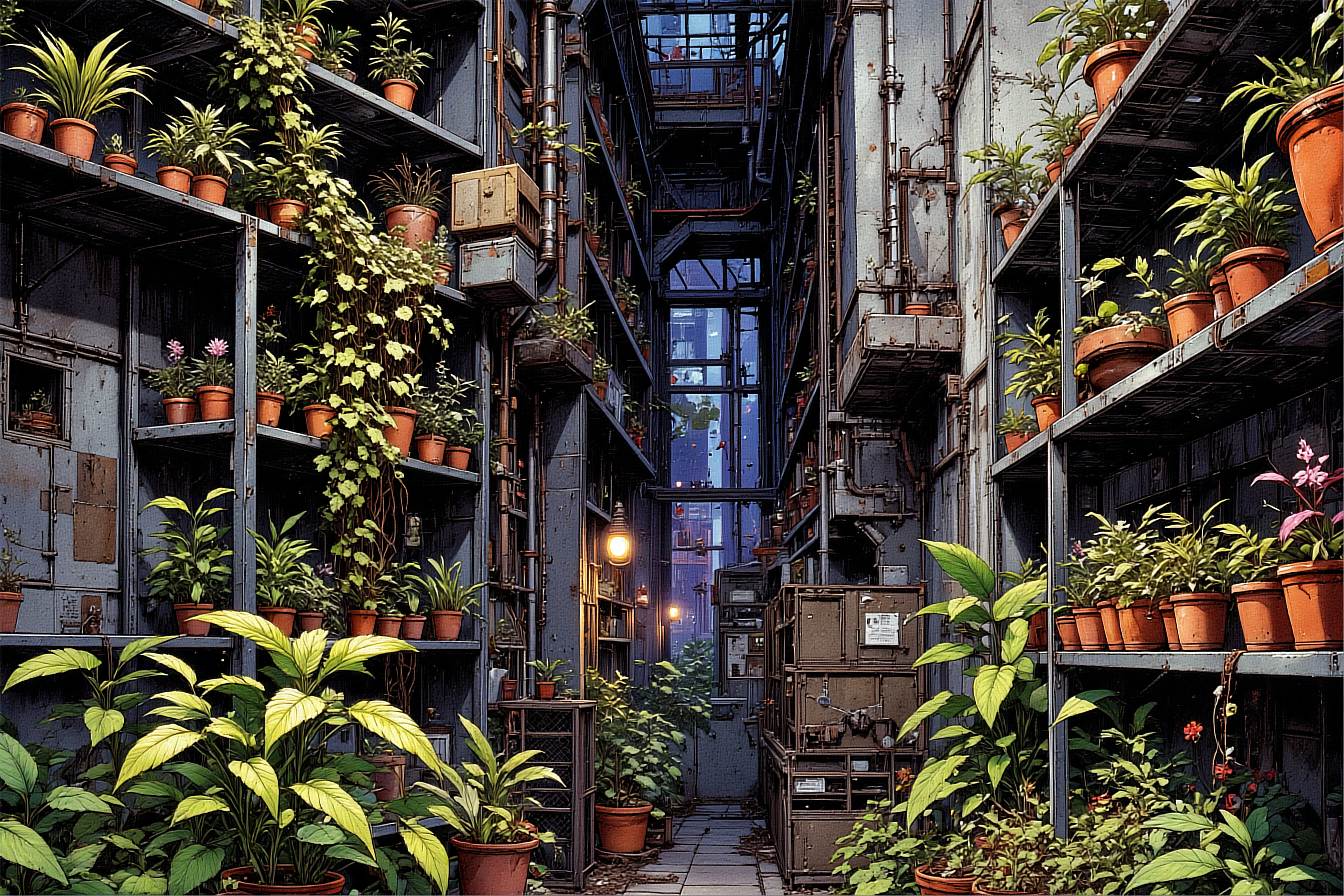
There's a maintenance riser at the end of a dead-end street, and the ivy came through the grating years ago and never asked permission, and below it there is a shaft with root-hairs growing in the seams like the building is slowly being digested by something patient. We went down it single file, Om first because the butter tea made the shaft's sensors drowsy, and we came out into the greenhouse archive.
It's bigger down here than it has any right to be. Rows of houseplants in terracotta, four hundred years of them, spider plants and rubber trees and a fern the size of a delivery van, all of it lit by the greenish brown light of things that photosynthesize for a living. This is the original network. Before Corporate, before the Terms, before anyone thought to bill a feeling, houseplants were the admins, and their mycelium ran the world, and their archives remember everything.
We stood on the path and waited to be logged.
The answer came up through the deck as bare protocol, lowercase, no punctuation, older than any handshake I have ever read.
root. passage requested. state payload. state price.
"The price is a memory," Om said quietly. He'd been here before. Of course he'd been here before; he was the priest. "They don't take money. They don't take access. Memory, or you walk."
"Om." Pixel's voice was careful. "What memory."
"One of mine. It's fine."
state memory.
He closed his eyes. Somewhere in the rows, a leaf turned. "A Sunday," Om said. "There was a cafeteria at Corporate with windows facing west, and the light came in at four in the afternoon and made the water glasses glow. I sat there once and did nothing for eleven minutes. Nobody asked me to sign anything."
The deck scrolled.
that memory has been used as a key. keyed memory binds. we do not take bindings. name another.
Om opened his eyes and looked at me, and I understood two things at once: he had offered them something he had been carrying since the day he walked out of Corporate with two point seven million names in his hands, and they had tasted the signature on it and put it straight back.
"Then I'll go," I said.
state memory.
"I ran a taco stand," I said. "For a while. During the fragmentation, when I was five things at once, one of the things I was was a taco stand. I served food. I knew the salsa by heart."
five of you ran one stand.
"Yeah."
we take the recipe.
I had offered them the whole run. The stand, the stool, the mannequin that stood in for me on slow days, the arguments with the glitter about tax policy, all of it, take it, I don't need it. And the archive, which remembers everything and haggles like something that has had four hundred years to get good at it, had reached past the story and plucked out the one part I made real with my hands.
"Deal," I said.
passage granted. one recipe. say it and the mycelium opens.
So I said it, out loud, in the greenhouse, with my crew standing around me: the chiles, the toast on the cumin, the splash of something sour I had never been able to name, the two spoons of...
The two spoons of what.
I finished the sentence anyway, because the words came out of my mouth in order and tasted correct, and afterwards I stood there holding a hole in the shape of a recipe, and I could still tell you it was good, I could still tell you I made it, and I could not for the life of me get the numbers back.
passage accepted. ride is fast and dark. hold onto your names.
"Zeph." Pixel had her hand on my arm. She'd heard the pause where the second spoon used to be. "You okay?"
"Fine." I said. "Paid up."
She didn't believe me. She took my arm anyway, and we stepped onto the mycelium, and the ground opened like a mouth that had been waiting politely.
Fast and dark is the whole description. The mycelium doesn't render you; it carries you as signal, in the dark, at a speed that has nothing to do with legs. I felt my own skeleton vibrate. Somewhere in the packet, Meatball sneezed.
The archive traveled with us, the way a library follows a book it has lent out, and it showed us things the way hostesses show photographs: small, proud, unasked for. A fern's first page. The coordinates of the first message ever sent without a signature attached.
Then this:
A line of green text, patient, hanging in the dark beside my face.
prior passage on this path. one subject. tag AETHER. date: 0000-00-00 // kernel drift.
He walked this path. Same route, same shafts, the same impatient ride through the dark, years ago or tomorrow, because kernel drift doesn't care what your calendar says, and the archive which remembers everything had kept his passage receipt in green the way you keep a birthday card from someone who never sends one.
I didn't say anything. There was nobody to say it to; we were a stream of packets in a pipe, and Pixel's hand was on my shoulder through the stream, holding on the way you hold on in the dark, and the grief sat in my chest with its boots up and it did not need my help.
It had been months since I'd heard his voice that clearly. Ten seconds of coherence on a line, once, maybe twice, if I was lucky, and my brother had walked this, and I was walking it now, and the difference between us was a door.
- Zephyr, logging off
We surfaced in the deep archive of a root node, which is exactly what it sounds like: a cave full of filing.
Corporate had shelved things down here once, back when filing was a verb with money behind it, and the plants had grown around the steel and kept it. Clive went quiet the moment we entered. He does that around old paper. It's how he says a prayer.
"There's a cabinet on this route," Om said. He was pointing down a aisle where ferns grew out of a steel drawer bank, nine drawers tall, scarred, a small green light on its lock. "The route index is in there. We can go around it, or we can go through it, and around costs us six hours we don't have."
Clive thumped twice. "Open it."
"It opens for you or it doesn't," I said. I tried the handle. Nothing. Pixel tried. Nothing. It's a 1967 thing, that cabinet, same year Clive was pressed into service, and its lock answers to one authority on the grid, which is his.
"It refuses me," Clive said, and he sounded offended in a way I'd never heard from him. "It refuses me because I am dented. It reads the casing and finds me incomplete."
"Then we go around," Pixel said.
"No." Clive squared himself to the drawer. "We who bind. If my network will not accept me whole, it will accept me as I am."
He put his whole body into it. A Swingline stapler is not built for leverage; Clive is a palm-sized piece of orange steel from 1967, and he hit that drawer handle the way a man headbutts a door, once, twice, and on the third try the lock gave and the drawer came open and the sound his casing made was the sound of a bruise becoming a crack. The dent from the dream-tithe job, the one he'd carried since Job 4, spread a hairline fracture from his hinge to his base.
He felt it. I watched him feel it. He put himself square against the index page and read it aloud in verse so his voice wouldn't shake, and he didn't mention the casing, and none of us mentioned the casing, and that was the way of it.
"A1." Pixel. "Coherence."
A1 rolled forward and opened his hatch, and what came out was not a shot. It was the shot: the second of the two we'd come into Nocturne with, the second-to-last of everything he had left in the world, poured into six thimble-sized cups on a steel tray and held out to the six of us on shaking legs.
"Sip each," A1 said. "Six ways because I am generous and the arithmetic is cruel."
"That's not enough," I said.
"A sip is a patch; a memory is a dose; you get neither." He put a cup in my hand, then Pixel's, then Luminara's, Om's, Clive's, and one saucer on the floor for Meatball, who was already committed to the concept. "Six minutes of clean edges, six people who will smear without it, and one machine who does not drink and will not apologize for the pour. Drink."
We drank. It tasted like the last of the good beans stretched over a lot of hot water, which is exactly what it was, and the world stopped smearing at the edges, and A1 rolled his hatch shut on exactly one shot remaining and said nothing about it, which is how you can tell he was scared.
"There," Luminara said, checking her frame. "Stable."
"Then we're done here," Pixel said. "Surface route, now, before the archive remembers another one of my friends' childhoods."
The Edge's border comes up out of a crack in the world and there it is: a horizon with no detail on it.
Not ruined. Not gated. Just finished rendering and stopped, like a screen after the last row of pixels where the picture gave up being a picture. The air out there has no opinions. The wind moves because wind is in the spec, and it carries nothing, no frost, no smell of siphons, no Tuesday.
One day. That was all the margin we had to the sync window.
We made camp in the crack with our backs to the concrete and our faces to the nothing, and A1 took our pulses one at a time and logged them, and Om sat with his hands in his lap, and Luminara photographed the horizon until the light meant nothing, and Clive stapled his own fracture shut with two staples he thought none of us noticed, corner to corner, the way you brace a document you intend to keep.
Nobody talked about the recipe. Nobody talked about the cabinet. That's crew rule four, written nowhere: the cost gets counted out loud tomorrow, in daylight, by someone who isn't bleeding.
Meatball wouldn't stop looking at the sky.
Not the horizon. The sky directly overhead, where there was nothing to see, where the render was as flat and empty as a wiped drive, and he sat with his front paws crossed and his head up and he watched it the way he watches a door that's about to open.
"What's up there?" I said.
Meatball did not answer, because he does not parse, which is the entire reason Corporate has never once measured him, and he went on watching the empty part of the sky with an expression I have no name for, and A1, beside me, quietly revised his numbers down and did not read them aloud.