
Root Access — Chapter 32: The Soul-Harvest Line (Approach to the Edge)
At dawn the soul-harvest line was whistling.
Not the pipes. The pipes hissed, the way all refinery pipes hiss when they are moving something that used to be a person's best year. The whistling came from inside the workers' shed, six or seven of them on the rendering line, and they whistled because whistling is not a feeling the meters tax.
We watched them from behind a stack of empty cryo-tanks with Luminara's long lens. The facility straddled the border itself, half in Nocturne and half in the nothing, and its job was simple and old: the Unfeeling Archive ships its surplus down here, trays of last decade's frozen joy and grief that nobody claimed, and the line renders it into fuel and pumps the fuel toward the kernel. Cold storage becomes octane. Whatever you didn't feel becomes something that powers the feeling you're having now.
"The tanks say nineteen-ninety-eight," Luminara said. She shot the gauges through the shed's open door, one frame each. "That's a whole year of surplus. Somebody's entire spring."
"Somebody's entire spring is about to be a truck," Pixel said.
A worker came out for a smoke, saw us, and did not call anyone. He was maybe forty, apron stained, and he stood there whistling a tune with no name and looking at the horizon the way people look at weather they've decided not to argue with.
"You'll want to be past the fence by the shift change," he said.
"That a warning?" Pixel said.
"It's a schedule." He took a drag. "Whistling isn't measured. Neither is talking to strays. I've got eleven months till retirement and I'm not spending them on a conscience. Move along."
"We could pay you," I said.
"In what?" He looked at my deck, at the crate with Clive in it, at the dog. "You're already paid for. Everybody past that fence is." He went back inside, and the whistling picked up where he'd left it, and I filed the tune away under things I would remember for no useful reason.
Through the shed door we could watch the line itself. Trays of cryo-tips slid out of the cold store on a belt, each one labeled with a year and a sector code, and the renderer took them and did what renderers do: warmed them until they stopped being memories and started being joules. A gauge on the far wall read SURPLUS PROCESSED: 12,400,000 HRS, and under it, in smaller type, an efficiency figure that had improved four points this quarter. Nobody had improved. Only the machine.
Clive, who had been silent through the whole thing, spoke from my pack in the voice he uses for ledgers. "Every scrap through that belt came from a filing system. Someone kept the rows, someone indexed them, someone signed the drawer shut. And then they were rendered for fuel and the drawer was left open." A pause. "We route the traffic. I would like it on the record that we do not render it."
"Filed," Luminara said, and shot the gauge, the belt, and the open door, three frames, no flash.
The whistle from inside changed key, and against my better judgment I found that I was whistling too.
A1 rolled up beside me with a cup of something that was almost coffee. "One shot," he said, to me, quietly, so the others wouldn't hear it twice. "The one in the hatch is the last. After that I am a machine that heats water, and this crew is a group of people who smear. Statistically, the next twelve hours are the whole war."
"Can you make it a good statistic?"
"I can make it an accurate one, which is the only kindness I have left."
The fence line is where the render stops.
Past it, reality gets thin. The air out here has no opinions: it doesn't smell of anything, doesn't carry the siphon-frost from behind us, doesn't even settle into a temperature so much as decline to commit. I walked into it and my glasses tried to auto-expose three times and gave up, and the world came back the way a photograph comes back when you scan it at too low a resolution.
"Callsign for this is the Quiet," Om said. He'd walked ahead of us, thermos out, and he poured a little butter tea onto the dirt at the border and watched it soak in like an offering. "Nobody comes past the line without a payload and a priest. It isn't a rule. It's a fact about the physics. Out here the kernel doesn't render you, so you have to arrive already signed, or you don't arrive at all."
"And you're the priest," I said.
"I'm the one who remembers how to ask." He looked at the payload drive in my hand, then at Meatball, who was sniffing the butter tea with deep professional interest. "Carry the dog's signature wrapped tight. Anything unmodelled out here reads as a hole, and holes in the render get filled."
"By what?"
"By whatever is compiling."
So Om signed us. That's the priest part, and he did it fast, standing in that dead air with his thumb on each of our wrists in turn: a whisper, a date, a phrase of key-work that made the hair on my arm stand up. Consciousness makes an excellent encryption key, and out here it's the only passport the render recognizes, because a signature from a living mind reads as intended to the compile, and everything else reads as debris.
"Took you long enough," Pixel said, watching her own wrist afterward. She'd been quiet since the fence, and I knew why without asking: Pixel reads the diff. She reads edits the way a proofreader reads typos, the turn of a street a half second before it happens, the world correcting itself in front of her. Out in the Quiet there were no edits. Nothing was being revised, nothing was being re-zoned, and she was walking blind through a place that had stopped arguing with itself.
"Sorry," Om said.
"Don't be. I hate it here." She said it lightly, which meant she meant it in the other way.
The daemons out here did not patrol. That was the part that took my nerve down a notch. Back in Prime Material they walk beats, they check corners, they have that awful patient paperwork energy. Out here they simply existed: three of them at the shoulder of the old service road, standing the way furniture stands, resident, unhurried, with no interest in us at all and no guarantee that this would hold. They weren't guarding The Edge. Nothing guards the source. They just lived near it, the way moths live near a light they'll never touch.
"Do they see us?" Pixel asked.
"They see a request," Om said. "We haven't sent it yet."
We sent it at the relay.
The sync relay is a squat concrete block a kilometer in, all blast doors and old brass, and it is Corporate to the bolts: every handle plated, every plate stamped, a facilities notice from a decade ago still legible on the wall about proper badge etiquette. The vault's keys opened it in four seconds flat.
"That," Pixel said, watching the door retract, "is the most beautiful thing Corporate's paperwork has ever done to us."
That's the whole trick of this approach and I want it on the record: we didn't defeat the relay's security, we satisfied it. Cogsworth's sync keys, lifted out of the time-vault with four days of my life as change, unlock the relay's own door because the relay is a thing that audits itself and the audit is internally consistent. The door had been waiting for somebody whose forms were in order. We walked in with ours.
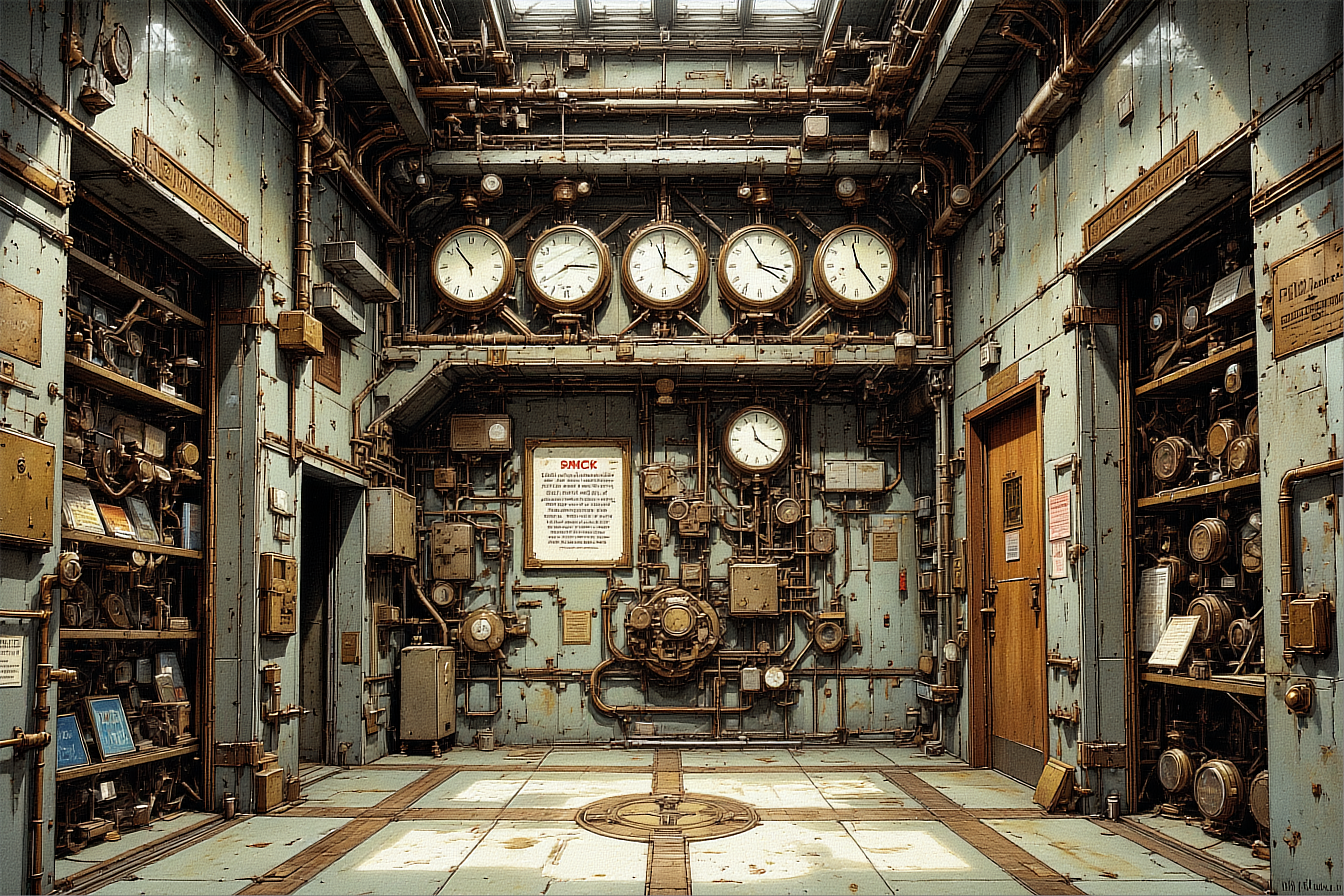
Inside: racks of buffer, a clock wall showing four prices for the same second, and the sync window, written on a maintenance slate in the handwriting of a man who has never made a mistake on purpose.
KERNEL SYNC // 04:00:00 // WINDOW: 04:00
Four minutes. In four minutes the vault's master clock and the kernel's clock shake hands, and for the length of that handshake every door in reality is slightly less certain about which side it's on.
The clock wall deserves better than I gave it. Every face showed the same second at a different price, because Cogsworth bills by the moment, and hanging over them, framed like a mission statement, was the tariff for one second of kernel time. I did that arithmetic once and then stopped doing it. Four minutes at that rate is a number with a title.
"Clive, what does the network say from out there?"
"Queues full, doors open, and a fax machine in Accounting that still runs on my authority has volunteered itself as the relay's fallback printer." A soft clack from my pack. "We are as ready as paper gets."
Luminara photographed the brass: the plates, the seal lock, the maintenance slate with its four minutes written out in a careful hand. "Proof we were here with permission," she said. "Permission is the story Corporate tells about itself afterward."
A1 hung at my elbow with his hatch shut and his one eye bright. "Coherence reserves: the six-minute sip is down to two and change, and that is if nobody runs. The shot in the hatch remains the shot in the hatch. I would appreciate it if the next several decisions were made calmly."
"Port location?" I said.
"Where the keys say it should be." Om had the sync schematic open, and he was cross-indexing it against the field diagram like a man reading two halves of the same hymn. "Relay bay three. Behind Corporate's own seal, which will open for the keys again, and behind that..."
He stopped.
"Behind that what?"
"Behind that, something else."
Under fire is the wrong phrase for what happened next, because nothing shot. But while we worked, the Quiet started paying attention. The resident daemons at the road turned to face the relay. A drone came over the fence line without a sound and settled on the roof and waited. And my deck, my stupid taped-together Aether Junior, began picking up a telemetry handoff that I recognized because I had spent a year learning to recognize it: someone was threading our position into a queue. Since Nocturne. Since the shape A1 wouldn't describe.
"Company's watching," I said. "They know the building."
"Then we work like we're late," Pixel said. "Port. Now."
I threw three things at it inside of a minute: a seam-splice, a lock-order reversal, and a very old trick involving a borrowed timestamp. The plate absorbed all three and handed each one back with my own telemetry wrapped around it, the way a mirror hands back your face. The inner pressure didn't rise. It didn't need to. You can't pick a door that has spent years deciding that doors are for staying shut.
We got it open in ninety seconds and stood in front of the real problem.
The port exists. It's exactly where the sync keys promised, a seam in the relay's floor plating sized for a man, ringed with Corporate's seal lock, and it is closed. Corporate closes it, which we expected. What we didn't expect was that it also refuses to be opened from our side, because something on the inside is holding it shut with the same grip that's holding it shut against Corporate.
"It's locked from both ends," I said, flat against the plate, deck cables running into the seam. "Seal says CRO's office, standard executive lockout. But the inner side isn't Corporate. The inner side is just... pressure. Someone in there has been leaning on this door for a long time."
"Can you pick it?"
"It's not a lock, Pixel. A lock wants to be opened by the right key. This thing wants to stay shut by everyone. From out here I could hack it until the Simplification ships and all I'd do is push it harder."
Om knelt and put his palm flat on the seam. He held it there for a long moment, and his hands, which had been shaking since the Registry, went perfectly still, which is worse.
"There is a person on the other side of this," he said. "A person who is also a hinge. He has been holding it against a compaction job longer than either of you has been alive in this body."
"How do you know?" Pixel said.
"Because I know what it feels like when a consciousness holds a thing shut. It has a heartbeat."
I opened my mouth to say something and my deck said it for me, because my deck had been waiting a month to say it: the seam lit up green, and the port spoke.
"Zeph."
Ten seconds. I have had ten seconds of my brother's coherence at a time before, in bursts smaller than this one, but this was a voice, live, arriving out of a seam in a floor with nothing behind it, and it sounded the way a room sounds when somebody's been in it a long time.
"You brought a dog to the end of the world," Aether said. "Of course you did. You always did have a thing for strays."
"Aether." I was on my knees on the plate with both hands on the seam. "Hold on. We're here to open it. We've got the payload and the sync window and the keys from the vault. Tell me how and I'll do it inside four minutes. Tell me what to pull, I'll pull anything."
"It opens inward," he said. "Always did. Corporate sealed it from your side because they can't stand a door that swings the wrong way. You don't pick it. You get somebody inside to let it go."
"I know, that's you, and I'm coming in to get you."
"No." His voice did something I'd forgotten it could do, which is get quiet without getting smaller. "You don't come in to get me out. I've been holding this against compaction for years, Zeph. Years, in here, in bursts, holding a door that Corporate has been trying to close since before you grew that haircut. If you pull on me for even one cycle, we both go. The payload goes."
"Then what do I do?"
"The payload gets carried by somebody who can be in two places at once. You. Not your hands. You." A burst edge crept into his voice, the old static, the module flickering. "You were built for this by the worst R&D team in history. Be in the compile and be at the relay, both, because the moment that credential fires, somebody has to be holding the seam while it happens, and that somebody cannot be me and also the reason it works."
Ten seconds had run out eight seconds ago. He was gone. The seam went gray, and the pressure on the other side went back to its long, patient work, and I was kneeling on a floor in a relay in the Quiet with my palms on nothing.
I got my legs under me and told them everything, flat and fast: the port opens inward, we don't pick it, the person inside has to let it go, and the payload has to be carried by somebody who can be in the compile and at the relay in the same second.
"Two places at once," Pixel said.
"That's what he said."
She looked at the seam for a long moment. "Corporate built him to hold a door and built you to walk through it. Same R&D team."
"The worst R&D team in history," I said. The words came out of his mouth so cleanly that the relay felt smaller than it was, and nobody laughed, and nobody was going to.
Then A1 said, from the doorway: "That burst was a ping. Outbound, kernel to flagged device, signed with a key the size of a building. The watching party did not miss it."
"How long do we have?" Pixel said.
"Ahead of us? Unknown. Behind us? They already know the sector, the building, and the door." A1 paused. "The Chief Reality Officer now knows exactly where we are."
Nobody said Marrow's name. It doesn't need saying out there; the Quiet has no room for it.
Pixel looked at the port, then at me, then at the drive in my hand with the dog wrapped around it. She ran the whole board in her face, every option, every cost, and whatever she found there she put straight down.
"Sync window's at four," she said. "Assume they arrive at three. We load the queue, we sign the entry, and somebody goes in ahead of the payload to hold the seam."
"I go in first," I said.
She didn't argue.
That's the part I'll keep. Not the plan, not the keys, not the four minutes. Pixel Paradox, who argues with sectors, who argued with me about a route in an underpass two days ago, who has argued with me every day since the day she asked me if I wanted to burn Corporate Corp to the ground, looked at me with her jaw set and her hands perfectly still and did not say one word.
"Okay," she said finally, which was worse than an argument, and much worse than a no. "Then you be careful in there, and you be fast out."
- Zephyr, logging off