
Root Access — Chapter 33: Kernel Space
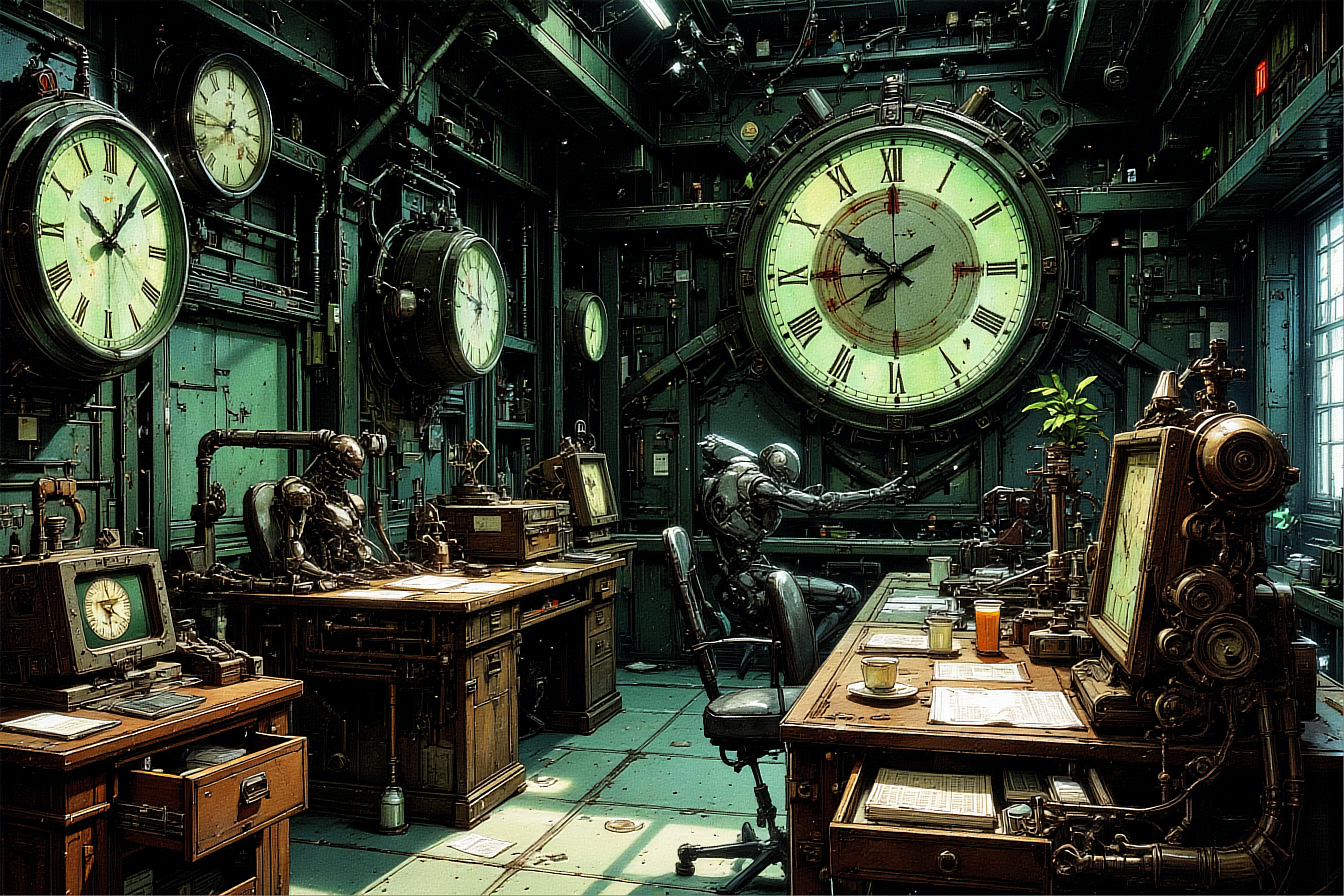
At 03:52 the clock wall agreed with itself for the first time all night. Four faces, four prices, four different opinions about what a second costs, and then all of them ticked over together to 03:52:00 like a band finding the tempo.
"That's our cue," Pixel said. She was on the relay floor with the source feed open on her knees, three panels deep in reality's diff, reading the street outside the way she reads everything: like the world has typos and she's already composing the correction. "Eight minutes to the window. Zeph."
"I'm here."
"You're quiet."
"I'm eating."
I wasn't eating. I was looking at the drive in my hand, where the root credential sat inside the dog: Meatball's gait, his heartbeat, the nonsense of an animal that wants a glove, wrapped around a password that could make kings of every consciousness on the network. Payload and priest. That's the whole religion of this place, and I had the payload, and behind me Om was pouring the last of the butter tea over his shaking hands like a surgeon.
Om signed me at 03:54.
He took my wrist the way he took wrists in the Registry and the tithe facility and every other place where a person needed to become a document: two fingers, a breath, a whisper of key-work that stood every hair on my forearm on end. Consciousness makes an excellent encryption key, and out past the render it's the only currency that buys. The signature went into my deck, coiled around the credential, and came back out as a stamp the kernel would read as issued.
"Ninety seconds," Om said. "For ninety seconds you are a legal process in kernel space. You have papers, you have a signature, you have the right to be where you're standing. After that you're an unsigned thing in the compile, and the compile compacts unsigned things."
"Om." I held his eyes. "Is that your last one? For me?"
"My last one for you." He let go of my wrist. His hands had not stopped shaking since the Registry, and they were worse now, and he did not hide them, which is a thing monks do when they want you to understand that the offering was expensive. "I have a few left in me for the people outside. Not many."
"Then don't spend them on me."
"I just did." He said it gently, and turned back to the queue, and Clive was already there, bolted to the relay desk beside him, the fracture in his casing taped over with the kind of repair you make when you have decided to keep working anyway.
"One shot," A1 announced. He rolled out of the corner with his hatch open and on the tray inside, glowing under the service light, was the last of everything he had. "I have divided it, because arithmetic is a cruelty I am prepared to commit. Half of this goes into you now, because you're going somewhere unrendered and unrendered things smear fastest. Half stays in the hatch for whoever is worst off while you're gone. Any complaints?"
"Yeah," I said. "Which half do I get?"
"You get the half I'd take if I drank." He put the cup in my hand. "I, on the other hand, get a stopwatch. Statistically the most depressing object ever issued to a machine."
I drank. It tasted like the weak reserve blend A1 had been apologizing for in percentages since Job 4, except today there was nothing weak in it, because the man who brewed it had put the last of his care in the water and it hit my spine like a hand slapping a table. The world stopped smearing. Every edge in the room came into focus hard enough to cut.
"Roles," Pixel said, because Pixel says roles when she's scared. "Read them back."
"Me inside," I said. "Two places at once: one of me at this deck, one of me in the compile. Payload fires through the port on my mark."
"Me outside," Pixel said. "I read the diff of reality's source ahead of Corporate's edits. If Marrow's team writes anything while you're in there, I call the turn before it lands."
"Luminara photographs the kernel's edge as it tries to unmake us," Luminara said. She checked her lens. "Proof of the unmaking. That's a first for my portfolio."
"Clive and I run the broadcast queue," Om said. "Fork the credential, hold the buffer, wait for the mark."
"A1 keeps the stopwatch," A1 said, "and the remaining half-shot, and the temperature of four panicking humans and a dog. Standards will be maintained. They always are, briefly."
Meatball, who had been asleep under the desk through the entire briefing, lifted his head as if he had been addressed, and went back to sleep.
Nobody moved for a second. That's what a crew that has run five jobs together sounds like when it's doing its arithmetic in silence.
Then Clive: "The traffic is routed. Every machine on the grid with a motor in it has been told what to do tonight. The photocopiers of this world are awake and furious."
"Thank them for me."
"They don't want thanks. They want a form number." A dry clack against the relay desk. "I have given them all a form number."
Om ran the arming sequence behind us, quiet, two fingers on the queue terminal: fork, buffer, hold. When it was armed he checked it twice, then a third time, because that's what priests do before a service. "Eight minutes of window," he said, "and one mark. Everything we built this year goes out in the space of a sentence from you, Zephyr. Don't make it a long one."
"I'm not great under pressure."
"You are excellent under pressure. You are terrible when you have time to think." He looked at me over the terminal, and his hands were shaking, and he smiled anyway. "So don't."
A1 started the stopwatch. It made a small sound, mechanical and final, like a pill organizer snapping shut. "Ten minutes on the clock. Six hundred seconds of not being glitch-slop. Don't spend them on a speech."
"I wasn't going to."
"You were about to. I count your pauses."
That got one laugh out of Pixel, brief and useful, and then 03:58 arrived and nobody was laughing, and that was fine too.
03:58.
I have fragmented myself before. Once, badly, in a café, five of me scattered across five realities like a dropped tray: a taco stand, a mannequin, sentient glitter arguing about tax policy, and a rescue that took a crew and an espresso machine and a stapler's staple-map to stitch back together. Corporate logged every millisecond of it. It's in a folder somewhere with my name on it, in the R&D wing of the worst team in history.
This time I did it on purpose, with my hands steady and my crew in the room.
It doesn't hurt. That's the lie everybody tells and it isn't a lie, it's just incomplete: it's like stepping into a shower that's already running, except the water is yourself. One Zephyr stayed at the deck with his fingers on the keys and his eyes on the feed. The other Zephyr went sideways through the ninety-second stamp and into the place where reality compiles.
The kernel isn't dark. The kernel isn't light. It has no lighting model, no floor plan, no weather, no opinion about any of it. What it has is the build.
I stood in it. Above me and around me, running in every direction past the point where directions are a concept: the sectors as threads. Prime Material's thread is chrome-bright and load-bearing, a cable thick as a river. Nocturne's is frosted and slow. Cogsworth ticks. Verdantia is green, patient, older than everything else in the room, and The Edge's thread doesn't end, it just goes somewhere I can't look. Every thread is a running process, and they're all held together by a build system that has been executing continuously for centuries, and I could see it the way you see the inside of a watch after somebody cracks the back: not hidden, exactly. Just never meant to be looked at.
Running alongside the threads, in red: deletions. A process, always on, chewing through the stack. I watched it take a row somewhere in Prime Material while I floated there, watched the row go soft, watched it get swept, and understood that the red thread doesn't sleep because deletion isn't a feature of Corporate's OS. Deletion is Corporate's OS, and everything else is what's left over between deletes.
And there were the others. The zine's readership, spread across the build as a haze of unclaimed nodes: millions of points of light with no thread attached, no credential, no ID the OS had ever paid for, sitting there in the dark parts of the compile waiting on a receipt for their own existence. I knew some of them by row. I knew one of them by the sound of her voice asking where the water went. They didn't know the build existed. They were just in it, the way everybody's in it, and in about forty minutes the red thread was going to come for all of them at once.
I floated near the row I'd watched die, which was a mistake, because the compile notices unsigned observers. Out of the corner of something I don't have out here, a sweeper came past: a compaction process the size of a train window, patient as an old filing cabinet, hunting anything in the build without a stamp on it. It passed within arm's reach of me, and for one full second I was the thing it was looking for, and Om's signature burned on my wrist like a hand pressed over a mouth, and the sweeper moved on.
Out past the render, the edge of a split tries to unmake the copy, and I felt it tugging at me the way a current tugs at a swimmer. Then I heard Luminara's shutter through the hardline: once, twice, five times, each frame freezing the unmaking just long enough for my body at the deck to stay a body.
"Holding you together from here," she said, quiet, in the flat voice she gets when the camera is up. "Try not to move around so much."
"Can't promise anything."
"Then I'll shoot faster."
And staged at the base of the build, bigger than any process I have ever seen, waiting with its lights on:
PURGE // EXECUTION PENDING // 00:41:12
Behind it, queued, patient, holding the door: SIMPLIFICATION. The beach. Bee's loop number, four thousand four hundred and forty-one, stamped on the manifest like a label on a crate. The whole flattening of five sectors waiting on one uninstall to finish so it could start.
Forty-one minutes. Pixel's voice came over the hardline from outside, thin and fast: "Zeph, the release channel just changed on me. PURGE was three days out when we left HQ. It's now reading T-minus forty-one minutes. Two days early."
"Marrow moved it."
"Marrow moved it. She knows where we are. She's had where we are since my brother opened his mouth in the Quiet," I said, and then corrected myself, because out loud it sounded like blame and there was nobody to blame. "Get the queue loaded. All of it. We go on the window regardless."
"Queue's loaded," Om said, from the relay, from three rooms and one reality away. "The dog is wrapped. The fork is armed. Clive?"
"Paper's moving," Clive said. "We who bind. The traffic is routed. Go, boy."
I went.
The port in kernel space is not a hole in a floor. It's a seam in the compile: a place where the build stops matching its own source, where the threads should meet and don't, because something has been holding them apart with its hands for longer than the process has been running.
And the hands had a person attached.
Aether is assembled from interruptions. That's the only way I can put it. The compile hiccups, and in the hiccup there's a shoulder. The build system garbage-collects something else, and in the gap there's the side of his face, older than I've ever seen it, and then he's gone and the seam is just a seam, and then he's back with a mouth on it saying my name.
"You're in," he said. "You're actually in. Two of you, one at a time, and the stamp's holding." A burst of static swallowed the middle of his sentence. "Ninety seconds, Zeph. Eighty of them already spent talking."
"Then let me finish. I'm pulling you out."
"No."
"Aether, we have the payload, we have the fork, we have four minutes of window and a load of people who are about to get deleted if we don't move, and you are coming with us when it's done, that's the deal, that's the whole deal."
"It's not." The static cleared and his voice came through clean, and it was the voice that taught me to read code, the voice that said reality's just another system, it's got rules, it's got exploits, and it was tired in a way that bodies get tired and machines don't. "Listen to me for one cycle, because I have been waiting years to say it and I can feel the compaction loading. You want to rescue me. You've wanted to rescue me since the café. Every job, every rung of the ladder, this whole year has been you climbing toward a door with me behind it."
"So what are you saying?"
"I'm saying stop looking at me like a rescue and start like a relay." A hand appeared on the seam, gray, worn down to the shape of the work. "I'm not in the machine, Zeph. I'm the hinge. If you pull on the hinge, the door swings and everybody's build comes down. What you do is you carry the payload through me, and you fire it, and you get out."
"Hinges don't get to be people."
"Hinges get to choose which side they hold." The static took him again, and when he came back his voice had that bright, far-away quality I remember from him at fourteen, debugging in the dark, sure of everything. "I can hold it through one cycle. One. As long as you stop trying to get me out first. Deal?"
"Aether."
"Deal?"
Ninety seconds don't leave room for the sentence I wanted to say, which was a hundred words long and started with the word stay. What I said was: "Deal."
"Good boy." The seam lit up green. "Now go be in two places at once. That's what they built you for."
The static took him the rest of the way and the seam went gray, and where my brother had been there was only the pressure of a hand on the other side of a door, steady and patient and alone. I stayed there one breath I couldn't afford, holding the kind of wish you don't say out loud in a compile because the compile is listening: someday, one room, one conversation that doesn't end in the middle of a sentence.
The build turned overhead. The red thread chewed. Somewhere in Prime Material a row went soft while I watched, and I made myself look at it, because looking is the job.
The stopwatch was in my ear before the echo of him finished: A1's voice, clipped, from the relay.
"Coherence accounting. Total across the operation: ten minutes. That's you inside, us outside, and the fragment you left at the deck, split three ways and burning. When it's gone I give away the half-shot and start reading statistics at people. So whatever you're doing in there, do it in the next ten minutes, and Zephyr?"
"Yeah."
"Bring everyone back. I have run the numbers on what it costs if you don't, and I decline to read them aloud."
He cut, and left me standing in the compile with the build turning overhead and the red thread chewing and the staged process at the base of everything, its lights on, its counter falling:
PURGE // EXECUTION PENDING // 00:00:07
Pixel's voice, tiny: "Zeph. It's starting early. Everybody's row is about to flicker. The help desk just went to a thousand calls. Whatever you're going to do, do it fast."
The counter hit zero.
The Purge uncoiled.
From inside the build it looked like a tide coming in: the staged process spreading its flags across the stack, the red thread doubling back on itself and thickening, and everywhere across the haze of unclaimed nodes the softening began, block by block, millions of points going gray in the first two seconds because they were never attached to anything Corporate could ask permission of. Behind the Purge, SIMPLIFICATION inched forward in the queue, one place closer to the head.
I hung in the middle of it with the payload warm in my deck and the queue armed and the mark in my hand, and I could see all of it happening at once: the threads I was supposed to save going dim, the compile running the uninstall like a machine that has done this a thousand times and finds nothing remarkable in it, and out past the edge of everything, in a relay in the Quiet, four people and a dog waiting on a word from me.
Om's voice on the hardline, calm as church: "Queue holding. Fork armed. On your mark, Zephyr."
Clive, right behind him: "We who bind. The traffic is routed. Go, boy."
Above me the first unregistered rows on the network finished going soft, one after another, like stars being turned off in a room where somebody has finally found the switch.