
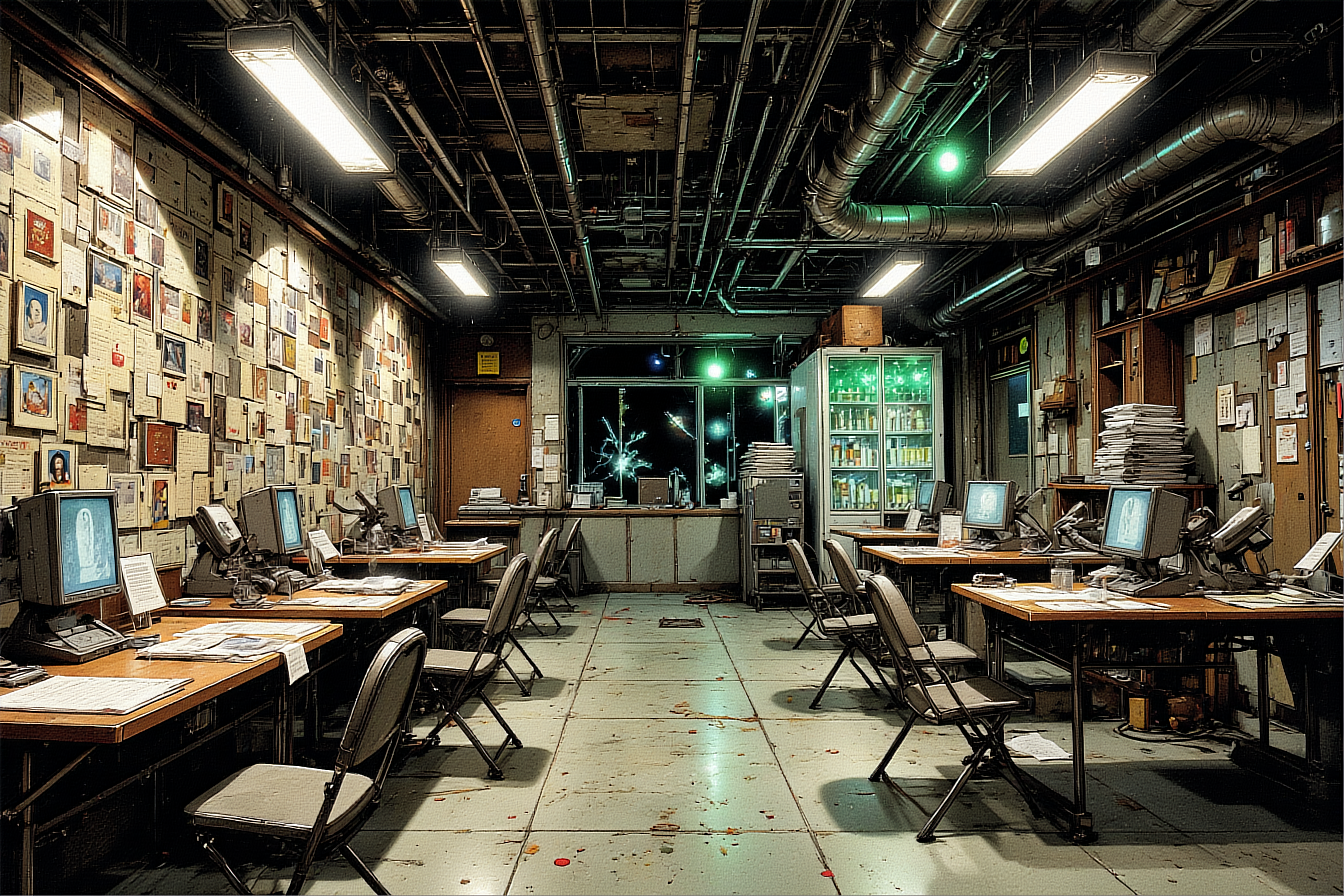
Root Access — Chapter 34: Purge
At 04:01 the zine's help desk went from forty calls to four thousand.
I heard it through Pixel's hardline while I hung in the compile with the seal under my hands: forty volunteers at folding tables in a basement behind a busted vending machine, all of them picking up at once, and every single line saying some version of the same sentence. My row is flickering. My receipt just priced itself at zero. My kid's badge stopped working at a school that still exists.
"The masthead just went null," a volunteer shouted, and I didn't need to see it to know: our name, The Ephergent, the one we'd printed across every front page for a year, gone beige on a thousand screens at the same moment, because uninstall scripts start with the loudest voice in the room.
"Phone tree," Pixel said. She was on two channels at once, and her voice had gone into the mode it gets where she's frightened and absolutely level. "District captains, repeat the warning: if your row flickers, stay where you are, don't queue at an office, the offices are being de-rezzed. Luminara, give me something to point at. Clive, your machines. Now."
"Already," Clive said. "Already, love, they're running."
From the relay window, Luminara photographed the horizon: the Quiet has no weather, but the far edge of it, where the render meets the sectors, had started to go the color of a manila folder, a beige tide coming up the sky like sunrise done by an accountant. She shot it, checked the frame, shot it again.
"Witnesses," she said. "Every frame I take is a witness. If they delete the day, somebody still has the print."
She had the volunteers shooting too, which was her move: every district captain with a phone became a photographer, and she briefed them in eleven flat words. "Close-ups of faces. Receipts. Anything with a name on it." Frames started arriving at the relay in streams, coming up on my deck's side panels while I worked: a man holding a badge that no longer resolved, a kid's school card going gray at the photo, a woman in a doorway with her hand over her mouth, four hundred people packed shoulder to shoulder into one street whose rows Corporate couldn't revoke. Luminara pulled each print as it came off the relay's spool and pinned it to the wall, thumbtacks and all, and the wall filled the way a wall fills at a wake.
Here is what a deletion looks like when you photograph it in progress: a person in a doorway holding a receipt, and behind them the block is fine, and in front of them the block is fine, and the seam between those two facts is walking toward them down the street.
In Prime Material the sky went beige at the edges first, the way paper yellows at the corners. In Nocturne the siphons stopped mid-draw, holding a month of other people's Tuesday in their pipes with nowhere to bill it. In Cogsworth the meters began showing a price of zero for everything, which everyone knew was a rounding error that would be corrected shortly. In Verdantia the green held, because the green has held before, but the mycelium's messages went short, one word at a time, the way a person speaks when they are counting.
And on every screen the zine had ever reached, rows began to flicker.
Not to vanish. That's the thing Corporate never gets about soft-delete: it's a soft delete. The row stays. It just stops being yours. Your name with a gray flag on it, your address with a caret through it, your face on a badge that still parses and no longer resolves. Millions of them, at once, in one pass, an uninstall with a timestamp and an acceptance criterion that read: no unregistered processes remain.
"Half the district captain lines are dead," Pixel said. "Half the district captains are rows."
"Then the other half keeps calling," Luminara said, and Pixel said yes, of course, that's exactly what the other half will do, and picked up the next line with her hand shaking and her voice steady, and that's the part I'd heard in her voice through the hardline: she wasn't calming anyone down. She was counting.
District Seven called in from a stairwell. I know it was a stairwell because you can hear the echo, and I know it was Seven because the captain, a woman named Ferreira who runs our distribution point on Halloway, was counting people out loud instead of names.
"Eleven in my hall, seventeen on the landing. The bakery's card machine went beige mid-transaction with a line behind it and nobody moved, because nobody was told they could. How long do we hold?"
"Until it stops," Pixel said.
"That's not a number."
"No," Pixel said. "It isn't." Then, harder: "Ferreira. Listen. The Vega block is holding. Every row we signed against a living person is holding, because the uninstall has to ask permission to delete them and everyone on those blocks is declining. Get your people toward the keyed blocks if they can walk."
"If we're keyed, they can't take us."
"Nobody takes you if you're keyed. That was the whole point of the theorem. Go."
Ferreira went, and the stairwell echoed with eleven people being told they had somewhere to be, and somewhere in Prime Material the unkeyed rows kept going gray, and I went back to the seal with her voice in my ears.
Clive's machines answered with paper.
Every copier, every fax, every badge printer and till receipt and label spool on the grid, the whole office-supply network that had been laundering documents since 1967, took the queue he'd loaded it with and started pushing names through itself: rows printed on whatever was at hand, in stacks, in bursts, out of the machines in basements and back offices that Corporate had stopped auditing decades ago. Paper is hard to uninstall. You can null a row on a screen in a millisecond. Try nulling four hundred names on a page stapled to a wall.
Clive's verse went out over them as a morning broadcast, riding the machines the way it always had, and I heard it through three channels at once:
"We who bind, we who exist. Unseen witnesses, we route the traffic. Every name in the queue, every row in the drawer, we print you, we hold you, we keep the forms."
And the machines, loyal and furious since before any of us were born, ran until they ran out of toner.
Meatball slept through all of it, on his back with his paws in the air, and A1 checked the predictor feed twice and reported that where the dog lay, the logs showed nothing at all: no row, no read, a hole in the telemetry shaped like an animal that wants a glove. The Purge could not unregister what it could not find, and the payload wrapped in that same nothing sat warm in my deck and waited.
Om signed faster.
That's the sentence I have to write, so I'll write it plain. Signing isn't typing. To key a row against a consciousness you have to hold that person's awareness in your hands for as long as it takes to bind, which means that for one moment a stranger's whole experience of being alive is sitting in your palms, and you have to keep it from spilling while you write the hash. Om had done that before at Corporate scale and it had broken his hands then. Now he did it at zine scale, one at a time, the way he built the theorem to be used, and he went down the list the phone tree fed him and he did not stop, he did not pause for water, he did not let the shaking slow the work, because a signature from a living mind is the one thing the uninstall cannot overwrite.
His hands were already wrecked. They had been wrecked since the Registry, since Corporate, since two point seven million names marked acceptable losses, and he held them out over the terminal and used them anyway, and I watched on the deck feed as the signing slowed, and then stuttered, and then kept going out of nothing I have a name for.
"Om," A1 said, and he was there with the hatch open, the half-shot in his hand, the last of it, the whole remainder of the machine's medicine, and he put it in front of Om's mouth rather than offering it, which is the closest thing to urgency A1 has ever shown. "You are the worst off. Drink. That is an order from a physician."
"Half a name left on this row," Om whispered.
"Then finish it and drink."
He finished it. He drank. And A1, with the hatch empty now and nothing left in him but water and statistics, stood up straight and recited at the room: "Sixty-seven percent. Standards must be maintained."
"Is that the disaster number?" the volunteer asked.
"That is the disaster number." A1's voice did not change register. "It has been the disaster number for a year. It is also, at this moment, the number of people in this basement who are still doing their jobs, and I will thank you all to keep it up."
Om finished the signature after the shot, and got to the first name of the next batch, and then his hands simply stopped belonging to him. He folded at the relay desk and Clive, who could not catch him, caught him anyway by main stubbornness, the two of them going down together into the papers, and the relay's floor took them, and A1 was already saying into the phone tree: "Collapse at the relay, one signer down, he is alive, he is out, send nothing, we are continuing."
Alive. Out. His hands done, finally, completely, the way they should have been allowed to be months ago, lying in a printout of four hundred names like a man who had signed his last.
Inside, at the seal, I had never felt so watched.
The port's Corporate seal was not a lock. I know locks. I have picked them, forked them, socially engineered a looped interview terminal into issuing paper out of one. This thing was a mirror with a keyway. It read me the moment I put my hands on it, and what it read back was me: every move I have ever made, laid out as tumblers.
The fragmentation exploit. The five realities. Eleven seconds at the depot. The Registry aisle. The tithe tanks. The time-vault, and four days of my life falling out of my ledger as change. It played them like a combination, one move at a time, and at each move the seal gave a quarter-inch and then took it back, because the next move was already in there too, replayed, predicted, mine. My deltas as a key that fits only me. Marrow had paid to write part of it.
I tried the splice. Expected. I tried the timestamp borrow. Expected. I tried a thing so old I learned it off Aether when I was eleven, and the seal opened a quarter-inch and I felt the whole dashboard on the other end lean in, because that's the move Zephyr makes, that's what the subject does, the subject does the move, and the door drinks it and stays shut.
Then I understood. The lock knew what I would do because it had data on what I had done. The only key it couldn't model was a subject who had stopped having moves.
So I opened a channel. Not to the port. To her.
I keyed the deck to broadcast raw, no compression, no redaction, no flag, straight into Marrow's own dashboard with the REC light on, and I gave her everything.
"My name is Zephyr Glitch. Twenty-one years old. Priority watch, upgraded from interesting on the day I stole eleven seconds of a daemon's cache, which you already knew. Crew: Pixel Paradox, fixer, reads diffs, runs the zine you keep trying to null. Luminara Usha, born Linda3637, Registry row 3637, photographer, she has your deletion frames framed. Om Kai, cryptographer-monk, he keyed your un-revocable credentials and his hands are shaking because of two point seven million of your acceptable losses. Clive, Swingline stapler, serial 1967, dent from the tithe job, casing cracked, currently stapled shut. A1 Assistant, espresso machine, no shots left. Meatball, dog, unmodelled, that's the whole exploit, his joy doesn't parse and our payload rides inside it."
The seal gave a quarter-inch and held.
"Plan: mass credential-issuance through the sync window, root forked to every consciousness on the network at once, registered and unregistered, so the Purge executing right now has nothing left to authorize. Payload fired by me, in two places at once, held by my brother, who has been leaning on your door since before you signed anything. I lost four days in your time-vault and I'll never get them back. I ran your R&D fragmentation on myself and you kept the deltas, and you have been replaying them ever since, and I have read the folder, SCENARIO: FRAGMENTATION BETA, SUBJECT: GLITCH, Z., every job I ever walked already exists as a file in your office."
I could see it on my own overlay, the dashboard she reads: my whole dossier lighting up as I spoke, fields filling in that had been redacted to me a month ago, because I was giving them, and a lock that only knows deltas cannot reconcile a subject who volunteers his data. What do you predict about a man who hands you his own dossier mid-sentence? There's no next move to model. The combination has nothing left to hold.
"Zeph." Pixel's voice, fast, over the hardline. "They're writing around your channel. Source diff moving on your left side, Corporate's own team patching the hole you just opened in their telemetry. Whatever you're doing to that seal, their model is scrambling to catch up."
"Let it catch up. I'm going to feed it more than it can eat."
"Then feed it," she said. "The zine's list is at fifty-eight percent remaining and falling. Feed it everything."
"You want metrics? Here's the metric. You have been measuring me since the café and you never once measured the dog, and that is going to cost you root."
The seal stopped reading me. It started reconciling, and reconciling is what a model does when the data contradicts the subject's own account of itself, and it went back through my history looking for the move I was really making, the real angle, the hidden one, and there wasn't one, because the angle was that there was no angle, I was telling her the truth with the recorder on, in her office, in her dashboard, in front of whatever she'd built to watch me.
Behind me in the compile the red thread ran and the unclaimed nodes flickered, and Pixel's voice came through thin: "Zeph. Her endpoint hasn't dropped you. The Chief Reality Officer's dashboard is still on the line, recording every word. So say something."
"Almost," I said.
"Say something that isn't almost."
The relay took a hit then: Clive's casing, the fracture from the deep archive taking the strain of one more hard shove as he forced the relay's backup spool open to keep paper moving, and it split. I heard it, a sound like a staple going through a phone book, and I heard him feel it, and I did not hear him stop. He put three staples into his own shell, corner to corner, a war bond on himself, and went back to the verse, and his voice had holes in it now, and the holes were where the metal used to be.
"Halfway gone," Pixel said, and her voice cracked on the number, the first time all night.
A1's stopwatch came back in my ear, clipped to the second: "Ninety seconds. That is the total across the operation, and I have already spent the half-shot. When it runs out, everyone on this frequency smears, including the fragment you left at the deck, and I start reading statistics at a room that can no longer hear me. Whatever is going to happen needs to happen now."
And there was a piece of the dossier I hadn't said yet, so I said it, into her recorder, the crew rule we wrote on the wall of the pocket dimension on our first day, when Pixel was twenty and I was a runaway and neither of us had watched a row go null from three meters away: everything gets documented. So I documented myself. All the way down. Every job, every lie, every hiding place, the four days, the folder, the dog, the fork, out loud with the light on, until the subject handing over his own dossier had nothing behind it but the next sentence.
The seal cracked.
Not open. Cracked, the way a thing cracks when it has been asked to model a subject and the subject has declined to be modeled. The port's Corporate lock parted down its center line, and behind it, held apart from the build by nothing I could see and everything I could feel, the seam opened inward, and there was Aether.
Both hands on the door. Gray, worn to the shape of the work, braced against a compaction that has been loading since before I was born, and the light on the far side of him was the green of a build about to run.
"There you are," my brother said, and he was looking at the payload in my hand, and at the dog-signature wrapped around it, and at the whole ridiculous load we had carried across five sectors, and his face did something I have no protocol for.
"It's beautiful," Aether said.